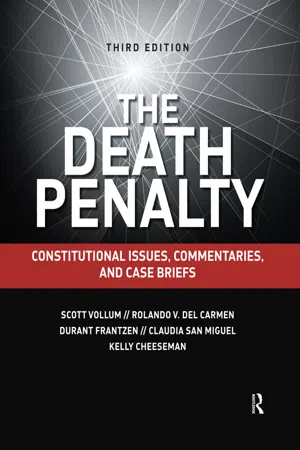
The Death Penalty, Third Edition, brings together all the legal issues related to the death penalty and provides case briefs for the most important United States Supreme Court death penalty cases. No other book available brings together a discussion of the major constitutional issues surrounding the death penalty with a broad array of associated case briefs. The authors classify cases according to legal issues and provide a commentary on the various sub-topics, presenting legal materials in an easily understood form. Though the primary audiences of the book are undergraduates in criminal justice programs and practitioners in the corrections and justice systems, the book will also prove useful to anyone who has an interest in the death penalty, the criminal justice system, or the United States Constitution. Every chapter starts with commentaries regarding general case law in a sub-topic, such as aggravating and mitigating factors, followed by a chart of the cases briefed in the chapter, and then the case briefs. These case briefs acquaint the reader with Supreme Court cases by summarizing facts, issues, reasons, and holdings. The Death Penalty, Third Edition , is a succinct, trusted guide to the law of capital punishment in the United States.
eBook - ePub
The Death Penalty
Constitutional Issues, Commentaries, and Case Briefs
- 356 pages
- English
- ePUB (mobile friendly)
- Available on iOS & Android
eBook - ePub
The Death Penalty
Constitutional Issues, Commentaries, and Case Briefs
Chapter 1
The Death Penalty: Past and Present
Chapter Outline
I Introduction
II A Retrospective Analysis of the Death Penalty
A The Colonial Period
B The Age of Enlightenment and the Early Movement to Abolish the Death Penalty
1 From Europe to the Colonies: The Impact of Enlightenment
2 Changes in the Death Penalty from 1790–1950
III Early Supreme Court Decisions on the Death
A Wilkerson v. Utah: Death by Firing Squad
B In re Kemmler: Death by Electrocution
C Louisiana ex rel. Francis v. Resweber: The Constitutionality of Being Executed Twice
D Additional Changes in the Death Penalty Prior to
IV The Current Status of the Death Penalty in the United States
A Retentionist versus Abolitionist States
B A Decline in Death Sentences and Executions
C Recent Supreme Court and Circuit Court
V In Summary, What Do These Cases Say?
VI Conclusion
Cases Briefed in Chapter 1
Case Briefs
Key Terms
Critical Thinking Questions
Internet Resources
I Introduction
The history of the death penalty in the United States may be divided into two historical periods: the period prior to the 1976 seminal decision in Gregg v. Georgia (1976)1 and the period after Gregg. This chronological division, based on the two historical periods of the death penalty, reflects the most significant change made by the Supreme Court regarding the constitutionality of the death penalty. However, to fully appreciate the profoundness of the Court’s decision in Gregg and to understand why Gregg is the point at which to differentiate between the two periods, an analysis of the historical roots of the death penalty must be undertaken.
This chapter first presents a brief overview of the history of the death penalty from colonial times to 1971. Specifically, it first explores the virtual importation of the death penalty from England to the colonies and examines the early justifications for the death penalty. It also discusses early movements to abolish the death penalty that were inherently influenced by the Age of Enlightenment. Parts of this chapter examine the constitutional issues that were important prior to Gregg. Additionally, because of the Court’s repeated use of the Eighth Amendment’s proscription against cruel and unusual punishment in determining the constitutionality of state death penalty sentences, this chapter discusses the high court’s early interpretation of the Eighth Amendment. The chapter also briefly explores the Court’s decision to use the Eighth Amendment despite the fact that it was not made applicable to the states until 1962.2 Finally, the chapter also explores the current state of the death penalty. Although it will be covered in more depth later in the book, this chapter provides an overview of recent state decisions to abolish or repeal the death penalty as well as recent Court and circuit court decisions.
II A Retrospective Analysis of the Death Penalty
A The Colonial Period
The first recorded execution in America occurred in 1608,3 but the death penalty’s formal and legal foundations were not firmly established until later in the seventeenth century, when European settlers formed permanent colonies in the New World after the 1620 s. In colonial America, the penalty of death was typically imposed on those who engaged in crimes such as murder, adultery, bestiality, witchcraft, and blasphemy. Although the colonies’ codifications of laws and accompanying penalties differed, most state codes were reflective of religious beliefs, and thus the death penalty was justified on religious grounds. For instance, biblical arguments in favor of the death penalty were evident in the capital laws of the Massachusetts Bay Colony. Strongly influenced by the Mosaic Code of the Old Testament, known for the retributionist doctrine “an eye for an eye,” the Bay Colony’s 1641 Body of Liberties (the penal code) prescribed the penalty of death for violation of 13 laws: idolatry, witchcraft, blasphemy, murder, manslaughter, poisoning, bestiality, sodomy, adultery, man-stealing,4 false witness in capital cases, conspiracy, and rebellion. Interestingly, the crimes listed in the Body of Liberties were accompanied by their biblical references in the Old Testament.5
The harshness that characterized the penal code of the Massachusetts Bay Colony was relatively lenient in comparison to the many crimes (more than 50) punishable by death in England during the same period. In addition, compared to the other colonies such as Virginia, Maryland, Georgia, and Carolina, which imposed the death penalty for crimes committed only by indentured slaves, the Bay Colony’s capital laws were quite lax. However, by the eighteenth century, support for the death penalty in all of the colonies grew as immigration to the New World increased substantially and public order was threatened. The death penalty grew almost by necessity because the colonies lacked adequate long-term facilities to incarcerate offenders.6 Despite such issues, the number of capital crimes increased because of the demands of the English Crown, which had renewed its control over the colonies during this time. The English Crown insisted that the colonies follow its example and revise their penal codes to include 200 crimes punishable by death.
B The Age of Enlightenment and the Early Movement to Abolish the Death Penalty
1 From Europe to the Colonies: The Impact of Enlightenment
While the colonists were struggling to control the massive immigration movement to the New World during the eighteenth century, Europe was at the height of a philosophical and intellectual movement known as the Enlightenment. The Age of Enlightenment, which began a century before, was spurred by the writings of naturalistic philosophers who were instrumental in dispelling spiritualistic or religious notions that human beings were born with fixed or innate personality traits.7 For example, John Locke, one of the most influential philosophers of the time, articulated the notion of sensationalism, which claimed that humans were shaped not by the spiritual world but rather by their sensory reactions to the external environment. In his book Two Treatises on Government (1690), Locke also rejected the idea that government was the creation of God and instead supported the principle that the government derived its authority from the people.8
Locke’s writings, and those of other philosophers such as Montesquieu and Voltaire, generated great changes in intellectual and philosophical thinking in Europe by introducing the notion that humans had the mental capacity, or the rationality, to create a form of government that protected the rights of the people. The writings of these Enlightenment philosophers eventually generated changes in the administration of justice, particularly with regard to the death penalty. Their writings influenced Italian philosopher Cesare Beccaria to advocate for the abolition of the death penalty.9 Beccaria, who wrote An Essay On Crimes and Punishment (1764), believed that a punishment should be proportionate to the crime committed or to the harm that was inflicted on society. He also believed that too severe a penalty, such as death, may provoke an individual to engage in lesser forms of crime simply to avoid capital punishment. Thus, rather than deterring crime, the death penalty, according to Beccaria, may encourage lesser forms of crimes. In addition, he argued that “the death penalty served as an example of barbarity rather than a deterrent to it, because it sanctioned the taking of human life—the very act it was intended to deter.”10 As alternatives to the death penalty, Beccaria proposed incarceration among several humane and proportionate forms of punishment.
In the colonies, the Age of Enlightenment served as an impetus for revolution and independence. Influenced greatly by Locke’s notion that a government should be altered or abolished by the people if it was not fulfilling its duty to protect natural rights such as life, liberty, and property, the colonists expressed their displeasure with the English Crown in the Declaration of Independence and subsequently declared war. However, with much concern about the beginning of the Revolutionary War, other Enlightenment ideals, such as those proposed by Beccaria, did not seep into the colonial mainstream until after the war. It was not until 1779 that Thomas Jefferson first advocated punishments in proportion to crimes committed. Jefferson, who advocated abolishing the death penalty for all crimes except murder and treason, believed that imprisonment might be able to reform offenders. He also opposed the death penalty because executions would greatly decimate the number of able-bodied men who were needed for various laborious tasks. In A Bill for Proportioning Crimes and Punishment (1779), he proposed that:
capital punishments, which exterminate instead of reforming… should be the last melancholy resource against those whose existence is become inconsistent with the safety of their fellow citizens… [capital punishments] also weaken the state by cutting off so many who, if reformed, might be restored sound members of society, who, even under a course of correction, might be rendered useful in various labors for the public, and would be living and long continued spectacles to deter others from committing the like offences. 11
Several years after the Articles of Confederation were adopted in 1781, a few states began to slowly abolish the death penalty for certain offenses, such as robbery and rape, but continued to retain executions for offenders who committed murder or treason. Pennsylvania in 1786, for instance, no longer imposed the death penalty for crimes such as burglary, robbery, or sodomy.12 The first true movement to completely abolish the death penalty, however, was spearheaded by Dr. Benjamin Rush in 1787. Rush, a signer of the Declaration of Independence, urged a reconsideration of the death penalty as well as punishments that were imposed for retributive or vengeful purposes. He declared that ...
Table of contents
- Cover
- Half Title
- Title
- Copyright
- Dedication
- Contents
- Preface to the Third Edition
- Preface to the Second Edition
- Preface and Introduction to the First Edition
- About the Authors
- Acknowledgments
- Online Resources
- Table of Cases
- Top Ten Most Significant Death Penalty Cases
- CHAPTER 1 The Death Penalty: Past and Present
- CHAPTER 2 The Foundation Cases: Furman v. Georgia and Gregg v. Georgia
- CHAPTER 3 Race and the Death Penalty
- CHAPTER 4 The Mentally Impaired and the Death Penalty
- CHAPTER 5 The Death Penalty for Juveniles
- CHAPTER 6 Juries, Jurors, and the Death Penalty
- CHAPTER 7 The Right to Effective Assistance of Counsel and the Death Penalty
- CHAPTER 8 Due Process and the Death Penalty
- CHAPTER 9 Aggravating and Mitigating Factors in Death Penalty Cases
- CHAPTER 10 Appeals, Habeas Corpus, and the Death Penalty
- CHAPTER 11 Evolving Standards of Decency and the Eighth Amendment’s Ban on Cruel and Unusual Punishment
- CHAPTER 12 Other Issues, Trends, and the Future of the Death Penalty
- Index
Trusted by 375,005 students
Access to over 1.5 million titles for a fair monthly price.
Study more efficiently using our study tools.
Frequently asked questions
Yes, you can cancel anytime from the Subscription tab in your account settings on the Perlego website. Your subscription will stay active until the end of your current billing period. Learn how to cancel your subscription
No, books cannot be downloaded as external files, such as PDFs, for use outside of Perlego. However, you can download books within the Perlego app for offline reading on mobile or tablet. Learn how to download books offline
Perlego offers two plans: Essential and Complete
- Essential is ideal for learners and professionals who enjoy exploring a wide range of subjects. Access the Essential Library with 800,000+ trusted titles and best-sellers across business, personal growth, and the humanities. Includes unlimited reading time and Standard Read Aloud voice.
- Complete: Perfect for advanced learners and researchers needing full, unrestricted access. Unlock 1.5M+ books across hundreds of subjects, including academic and specialized titles. The Complete Plan also includes advanced features like Premium Read Aloud and Research Assistant.
We are an online textbook subscription service, where you can get access to an entire online library for less than the price of a single book per month. With over 1.5 million books across 990+ topics, we’ve got you covered! Learn about our mission
Look out for the read-aloud symbol on your next book to see if you can listen to it. The read-aloud tool reads text aloud for you, highlighting the text as it is being read. You can pause it, speed it up and slow it down. Learn more about Read Aloud
Yes! You can use the Perlego app on both iOS and Android devices to read anytime, anywhere — even offline. Perfect for commutes or when you’re on the go.
Please note we cannot support devices running on iOS 13 and Android 7 or earlier. Learn more about using the app
Please note we cannot support devices running on iOS 13 and Android 7 or earlier. Learn more about using the app
Yes, you can access The Death Penalty by Scott Vollum,Rolando V. del Carmen,Durant Frantzen,Claudia San Miguel,Kelly Cheeseman Dial,Kelly Cheeseman in PDF and/or ePUB format, as well as other popular books in Law & Criminal Law. We have over 1.5 million books available in our catalogue for you to explore.