- 528 pages
- English
- ePUB (mobile friendly)
- Available on iOS & Android
eBook - ePub
About this book
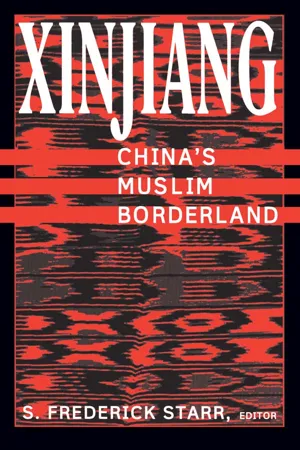
Eastern Turkestan, now known as Xinjiang or the New Territory, makes up a sixth of China's land mass. Absorbed by the Qing in the 1880s and reconquered by Mao in 1949, this Turkic-Muslim region of China's remote northwest borders on formerly Soviet Central Asia, Afghanistan, Kashmir, Mongolia, and Tibet, Will Xinjiang participate in twenty-first century ascendancy, or will nascent Islamic radicalism in Xinjiang expand the orbit of instability in a dangerous part of the world? This comprehensive survey of contemporary Xinjiang is the result of a major collaborative research project begun in 1998. The authors have combined their fieldwork experience, linguistic skills, and disciplinary expertise to assemble the first multifaceted introduction to Xinjiang. The volume surveys the region's geography; its history of military and political subjugation to China; economic, social, and commercial conditions; demography, public health, and ecology; and patterns of adaption, resistance, opposition, and evolving identities.
1
Introduction
S. Frederick Starr
If Xinjiang’s only claim to fame were that it is China’s largest province and a sixth of its land area, if it only had the highest per capita gross domestic product (GDP) of any province outside the booming coast, or if it could only boast of being home to China’s nuclear test facilities and of having the country’s largest oil reserves, this book would never have been written.
But Xinjiang is also the one province of China with a substantial population that is both Turkic and Muslim. In recent years, it has witnessed a vigorous Muslim revival and has been the scene of a protracted struggle for greater autonomy and even independence. Beijing officials and Western observers concur that some of the province’s Turkic inhabitants have mounted thousands of shows of resistance and committed a smaller but still significant number of violent and even terrorist acts. They speak with either pride or dismay of equally confrontational countermeasures by the Chinese authorities. All this takes place in a territory that borders eight other countries, three of them nuclear powers and five of them largely Muslim. It is these aspects of Xinjiang today that evoke the world’s concern and that gave rise to this book.
Xinjiang is remote from most major world centers. Its western and southern borders are closer to Baghdad or New Delhi than to Beijing. Trains from Xinjiang’s capital of Urumchi take several days to reach the capital of its northern neighbor, Russia, while its southern neighbors, Afghanistan, Pakistan, and India, are as yet unreachable from Urumchi by direct rail. Its remoteness has surrounded Xinjiang with an aura of exoticism. The nineteenth-century Russian explorer Nikolay Przhevalsky, the hero of Finnish independence C. G. Mannerheim, and the great American newsman Harrison Salisbury were but three out of scores of visitors from both the West and the East who made their way there precisely because of its remoteness and difference from all their usual points of reference.1
More recently, Xinjiang has entered the consciousness of the West because of the stunning Buddhist paintings that survive in cave sanctuaries near several of the ancient oasis centers along the southern rim of the Taklimakan Desert. These 1,500-year-old masterpieces attest to the region’s character as a cultural transmitter, receiving, processing, and sending out once more the most diverse cultural and religious impulses. Embodying as they do one of Buddhism’s most creative moments, and in a land whose people today are overwhelmingly Muslim, they also remind us of the historical discontinuities to which so open a territory gives rise. Xinjiang’s remoteness and discontinuities, along with the clear evidence of high cultural attainment in the countless towns that have flourished and decayed in its territory, leave visitors from Europe, Japan, the United States, and South Korea pondering vague questions that they can scarcely frame, let alone answer.
And yet, it is this seemingly remote land that Owen Lattimore, writing in 1950, characterizes as “[t]he Pivot of Asia” and “a new center of gravity … in the world.”2 Even if this claim may strike some as exaggerated, four developments occurring in the late twentieth century combine to give Lattimore’s assertion a new plausibility today.
First, the onset of Deng Xiaoping’s reforms in the late 1970s released Xinjiang from the quasi-military rule that had existed since the Communist takeover in 1949 and, to a considerable degree, over the century and a half before that as well. As a result, its capital at Urumchi has emerged as one of China’s boom towns, exuding that special kind of glittering prosperity that sudden wealth from oil and gas creates everywhere. Calla Wiemer provides evidence in chapter 6 that Xinjiang’s economy remains among the most state-centered of all China’s provinces, but the reforms have nonetheless emboldened leaders in Beijing and Xinjiang itself to dream dreams and undertake grand schemes that would have been unthinkable earlier.
Second, the opening after 1987 of China’s western border ended Xinjiang’s forty-year isolation from its neighbors and allowed the renewal of trade and contact with the rest of Central Asia that were as old as the fabled Silk Road. Sean R. Roberts in chapter 8 documents some of the dynamics of this new interaction and indicates both the possibilities it opens to Turkic peoples in Xinjiang and the government’s efforts to direct these into acceptable channels. He also reminds us that more open borders have unleashed new economic and social forces in Xinjiang that fit uneasily with the neat template of development that Beijing has imposed on the territory.
Third, the collapse of the Soviet Union and the establishment of independent states by Turkic and Iranian (e.g., Tajik) neighbors created a model of political sovereignty and cultural autonomy that entices and inspires many Turkic Uyghurs in Xinjiang. Why is it, they ask, that peoples that are poorer than us, and whose histories are far shorter than ours, enjoy self-rule while we do not? Even those who stop short of calling for independence take inspiration from the new sovereign states immediately to their west.
And fourth, the defeat of the Soviet Union’s Red Army by Muslim arms in Afghanistan, the renewal of Islam in post-Communist Central Asia, and the emergence of well-funded radical Islamic movements in both of these regions have inspired many of Xinjiang’s Muslims to redefine their aspirations in religious terms. A few returned to deeper forms of piety. Far more embraced Islam precisely because it is what sets them apart from their Han Chinese rulers. Shifting between policies of encouragement to minority peoples and cultures and outright repression, Beijing appears at a loss over how to handle this powerful and unpredictable force.
In the autumn of 2001, the war against terrorism exploded into this rapidly changing environment. Officials and observers in Beijing and many other world capitals urgently asked whether Xinjiang would now become a new locus of terrorist activity and of the Muslim extremism that many terrorists espoused. Immediately, sharp disagreements emerged. Some, notably the Chinese government in Beijing, claimed that this had already occurred and that the pathology had to be routed out with whatever force was necessary to accomplish the job. Others, including émigré Uyghur activists in many countries and many foreign observers, vehemently denied it. Still others insisted that the very term “terrorism” masked the real issue, which was whether Xinjiang’s non–Han Chinese peoples had any right to self-rule.
Unfortunately, nearly all these overheated exchanges demonstrated with appalling clarity that the internal life of Xinjiang today remains largely a terra incognita to outsiders. Acknowledging this, foreign embassies in Beijing rushed to send out staffers to gauge the situation on the ground. Leading news media dispatched reporters and film crews to Urumchi, Kashgar, or Ili with orders to “get the story.” But the mass of reports that flowed back from these efforts only deepened the confusion. Is this due to the fact that available data on Xinjiang are incomplete or inaccurate? Or is it that the evidence is available but is contradictory or inconclusive? Or, finally, do the conflicting analyses arise from the fact that conscious or unconscious biases distort the vision of even the most conscientious observers?
The authors of this book launched their collaborative effort in 1998, well before the current explosion of interest in Xinjiang. Many of them had already been studying and writing about Xinjiang for decades. They set as their task to draw a three-dimensional portrait of Xinjiang, with no concern over whether the resulting picture would support or cast doubt on existing views on the subject. They were acutely aware of the paucity of data on many key points, and equally conscious of the perverse way in which authoritative bodies of evidence can contradict each other. Looming over both of these difficulties, however, was their appreciation, which deepened as the work progressed, of the manner in which the same events or information can support strikingly different conclusions, depending on the vantage point of the observer. Bluntly, there is hardly any “fact” concerning Xinjiang that is so solid, no source of information that is so independent, and no analysis based on such overwhelming evidence that someone does not hotly contest its validity or meaning.
This contentiousness begins with the very name of the region. When Manchu rulers of Beijing declared this land to the west a part of their Qing empire, they began referring to it by what they obviously considered a fitting name: “Xinjiang,” meaning “new territory” or “new frontier.” While some Uyghur writers have claimed this name came into use only in the 1880s, James A. Millward finds references to it before 1800, when it supplanted the ancient Han dynasty term “western regions.” But whenever it arose, no one at the time contested the accuracy or appropriateness of this name. But since 1949, China’s Communist government has vehemently denied that Xinjiang was new to China in the 1760s and, as Gardner Bovingdon recounts in chapter 14, has assembled (or, depending on one’s perspective, concocted) a history of Chinese rule there dating back two millennia. Many local Turkic people, however, are equally adamant in their view that the region was their ancestral homeland and the continuous seat of their culture from deep antiquity down to the most recent times, when China usurped it.
In a 1955 effort to win over Turkic speakers in the territory, Mao Zedong’s government affixed to Xinjiang the sonorous title of the “Xinjiang Uyghur Autonomous Region.” In practice, the administration there was neither Uyghur nor truly autonomous. But as Dru C. Gladney argues in chapter 4, the official use of this resonant title strengthened, or even created, a sense of regionwide Uyghur identity and solidarity, as well as the expectation among many Uyghurs that Xinjiang should be really autonomous and not in name only. No one in Beijing is prepared to counter this current of opinion by giving Xinjiang a new name that proclaims what the Chinese Communist Party holds to be its ancient identity as part of China. But such expectations arouse deep concern in Beijing, which responds by banning all public references to “Eastern Turkistan,” the official name of two independent states established there briefly in the 1930s and 1940s, as well as the name “Uyghuristan” that some ethnic separatists favor today.
Conflicting vantage points may sharpen the controversies that swirl around Xinjiang, but their origins go far deeper than current polemics. In spite of its seeming remoteness, Xinjiang, like the rest of Central Asia, is arguably one of the most complex zones of cultural interaction on earth. Situated astride the great trade routes connecting China, the Middle East, Europe, and the Indian subcontinent, it has been a kind of cultural blotter for influences from each of these great civilizations. The fields of archaeology, linguistics, religion, technology, art, politics, and economics all confirm this truth. For millennia before 1877, when the German traveler and scholar Ferdinand von Richthoven coined the term “Silk Road,”3 Xinjiang was defined by its unique position along multiple cultural fault lines. This makes the territory the pivot of more than Asia and imparts to it, and to the rest of Central Asia as well, a centrality that neither remoteness nor isolation can gainsay.
International Ties and Centrifugal Forces
Over the millennia, these foreign contacts have set a bewildering array of attractive models before the peoples of Xinjiang for their own development. While it is an exaggeration to say that external influences have defined Xinjiang, it is hard to find another region on which such diverse external cultural forces have been so consistently exerted. Together, these act like external gravitational fields, pulling Xinjiang in different directions and away from whatever inward cultural moorings it may have. The physical analogy is not exact, since the force is coming from outside rather than from within, yet the result is to create something akin to powerful centrifugal tendencies within Xinjiang.
Asia alone has pulled Xinjiang in three quite different directions. For most of their history, the settled oases of the Tarim basin have felt the impact of nomadic peoples to their north. Coming in a seemingly endless succession, these mounted and well-armed groups have invariably arrived as floating bands of marauders and booty-seekers. The successful ones eventually settled in the region, often creating significant cultures. Once settled, they had to face the business of rule, which invariably opened opportunities to the oasis dwellers. The newcomers’ need for basic provisions also gave rise to reciprocal trade relations and to cultural interaction with the indigenous peoples.
A second and far more organized form of influence has come from the historic territory of China. To be sure, several of the dynasties that exerted the most powerful influence on Xinjiang, notably the Mongols and Manchus, had themselves emerged as leaders of settled states only after they conquered Beijing. But beginning as early as the Han and Tang times, China proper has exerted a powerful gravitational force on Xinjiang. Persisting over two millennia, this reached a crescendo during the period of Qing rule in the eighteenth and early nineteenth centuries and again under Communist rule after 1949. The new course that China adopted as a result of Deng’s reforms in the 1970s has brought in its wake unprecedented pressures on Xinjiang to merge its fate with the evolving Chinese model of market development. As described by Gladney, Wiemer, and Linda Benson (chapter 7), the range and depth of China’s impact since Deng have been enormous by any measure, rivaling or surpassing the Maoist changes, the Great Leap Forward, and the Cultural Revolution.
By comparison with China’s steady impact through the centuries, the gravitational pull of the Indian subcontinent has been more focused chronologically. This third form of Asian influence peaked during the first millennium, during which time Buddhism became a decisive presence in nearly all the major urban centers in Xinjiang. Even after the rise of Islam, trade with Kashmir, Rajasthan, and beyond remained important for Xinjiang. More recently, Xinjiang, like the neighboring province of Tibet, has felt the impact of Sino-Indian tensions. Beijing’s perception of a threat from India also gave rise to China’s, and hence Xinjiang’s, enduring strategic link with Pakistan. The fact that China has recently undertaken to construct a major port for Pakistan at Gwadar on the Arabian Sea that will serve the entire Indus basin, Central Asia, and Xinjiang suggests that a new age of intensive interaction with the India-Pakistan region is dawning in Xinjiang. How deeply this will affect the territory remains to be seen. One thing is certain, however: Such ties with the south will bring new influences, as has already happened as Pakistani traders attempted in the 1990s to disseminate their understanding of Islam and of an Islamic state.
Trade also provided a moving conveyer belt for Xinjiang’s interaction with the Middle East and the heartland of Central Asia. Until quite recently, however, far more contact has been with the larger Persian world (including the great oasis centers of the Ferghana region and Bactria) than with the more remote Arabs farther west. Such trade brought the Persians’ dualistic religions, Zoroastrianism and then Manichaeanism, and also the Syrian-Persian branch of Christian...
Table of contents
- Cover Page
- Half Title page
- Series Page
- Title Page
- Copyright Page
- Contents
- Figures
- List of Acronyms
- Note on Transliteration
- Frontmatter Page
- Frontmatter Page 01
- Frontmatter Page 02
- Frontmatter Page 03
- 1 Introduction
- Part I Historical Background
- Part II Chinese Policy Today
- Part III Xinjiang from Within
- Part IV Costs of Control and Development
- Part V The Indigenous Response
- Bibliographic Guide to Xinjiang
- List of Contributors
- Index
Trusted by 375,005 students
Access to over 1.5 million titles for a fair monthly price.
Study more efficiently using our study tools.
Frequently asked questions
Yes, you can cancel anytime from the Subscription tab in your account settings on the Perlego website. Your subscription will stay active until the end of your current billing period. Learn how to cancel your subscription
No, books cannot be downloaded as external files, such as PDFs, for use outside of Perlego. However, you can download books within the Perlego app for offline reading on mobile or tablet. Learn how to download books offline
Perlego offers two plans: Essential and Complete
- Essential is ideal for learners and professionals who enjoy exploring a wide range of subjects. Access the Essential Library with 800,000+ trusted titles and best-sellers across business, personal growth, and the humanities. Includes unlimited reading time and Standard Read Aloud voice.
- Complete: Perfect for advanced learners and researchers needing full, unrestricted access. Unlock 1.5M+ books across hundreds of subjects, including academic and specialized titles. The Complete Plan also includes advanced features like Premium Read Aloud and Research Assistant.
We are an online textbook subscription service, where you can get access to an entire online library for less than the price of a single book per month. With over 1.5 million books across 990+ topics, we’ve got you covered! Learn about our mission
Look out for the read-aloud symbol on your next book to see if you can listen to it. The read-aloud tool reads text aloud for you, highlighting the text as it is being read. You can pause it, speed it up and slow it down. Learn more about Read Aloud
Yes! You can use the Perlego app on both iOS and Android devices to read anytime, anywhere — even offline. Perfect for commutes or when you’re on the go.
Please note we cannot support devices running on iOS 13 and Android 7 or earlier. Learn more about using the app
Please note we cannot support devices running on iOS 13 and Android 7 or earlier. Learn more about using the app
Yes, you can access Xinjiang by S. Frederick Starr in PDF and/or ePUB format, as well as other popular books in Business & Business General. We have over 1.5 million books available in our catalogue for you to explore.