- 414 pages
- English
- ePUB (mobile friendly)
- Available on iOS & Android
eBook - ePub
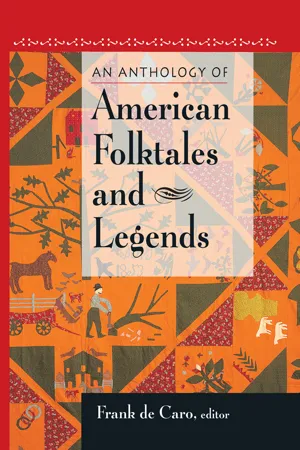
An Anthology of American Folktales and Legends
About this book
For folklorists, students, as well as general readers, this is the most comprehensive survey of American folktales and legends currently available. It offers an amazing variety of American legend and lore - everything from Appalachian Jack tales, African American folklore, riddles, trickster tales, tall tales, tales of the supernatural, legends of crime and criminals, tales of women, and even urban legends.The anthology is divided into three main sections - Native American and Hawaiian Narratives, Folktales, and Legends - and within each section the individual stories explore the myriad narrative traditions and genres from various geographic regions of the United States. Each section and tale genre is introduced and placed in its narrative context by noted folklorist Frank de Caro. Tale type and motif indexes complete the work.
Information

Folktales from a Number of Traditions
Animal Tales
Stith Thompson, the great American authority on folktales, suggests that because, for our ancestors, the world of animals and the world of human beings were seen as close together and overlapping, we have many stories in which animal characters behave as human. Whatever the reasons for the worldwide popularity of such stories (which make up a sizeable portion of the Aarne-Thompson international index of folktales), they certainly have found a role in American tradition. “The Donkey, the Dog, the Cat and the Rooster” is a version of the tale well known in the Grimm collection as “The Bremen Town Musicians.” “Lion, Fox and Cowboy,” from African American tradition, includes a human as well as animal characters and, indeed, deals with what happens when animals encounter the more powerful beast, Man. And in “Mr. Snake and the Farmer,” beast and human interact; here the narrator’s pressing a moral for his story connects it to the animal fables familiar from the works of Jean de La Fontaine and the legendary Aesop as well as oral sources. Of course, animals appear in other tales in this volume; a number of animal trickster stories, popular particularly in African American tradition, are included in the “Tricks and Tricksters” section.
18. The Donkey, the Dog, the Cat and the Rooster
Folklorists refer to this story generically as “The Animals in Night Quarters,” although it is well known from the Grimm collection, where it is called “The Bremen Town Musicians.” It makes a point about how humans sometimes treat domestic animals. This version was written down by students at historically black Hampton Institute, where they were members of a folklore-collecting club. AT 130.
Once upon a time there was a man who owned a donkey, a dog, a cat and a rooster. They became discontented for some reason. The man was a cruel master, he worked the donkey very hard from before sunrise until long after sunset. The donkey got mad and very discontented and said that if this continued, he would leave. It was continued, and so one morning when the man got up the donkey had gone. This made the man mad and he kicked the dog and he ran away into the woods. The next morning the cat was sitting in front of the fire and the man told it to get out of his way, so the cat ran off and did not come back.
The man used to get up very early but the next morning he got up a little later than usual which made him mad and he said the rooster was to blame because he didn’t crow at the right time, so he flogged the rooster and the rooster got mad and ran away.
After a while as the donkey was wandering about in the wood looking for something to eat he met the dog. “Hello, what are you doing here,” he said.
“Oh I ran away,” answered the dog. “Master kicked me, so I couldn’t stand it.”
“Well, let us go together,” said the donkey.
After a while they met the cat. “What are you doing here?” said they to her.
“What are you both doing here?” she replied.
“Oh the old man flogged us and we left.”
“Well, we will all three go together and get our living.”
As they were searching about for something to eat they ran across the rooster. “Well! What are you doing here?” they exclaimed. The rooster told his story, and then they decided to live together. If they were going to live together they must first have a house. The rooster said he knew of an old deserted house he had seen as he was coming down the road. “Now we will go there and take possession of it.”
When they got there they found the door fastened and a little smoke was coming out the chimney and they could smell something good to eat. There was no roof on the house. The rooster said “We must see what is inside. Now let the donkey stand close to the wall, the dog on his back, the cat on the dog’s back and then I’ll get on the cat’s back and look over and tell you what I see.”
When the rooster looked over he saw some gamblers sitting about the fire cooking their supper. This frightened the rooster and he fell in and scared the men so that they all ran off.
Then the donkey, the dog and the cat came inside. They said, “These men ran off but they will come back again, what shall we do?”
The rooster, who seemed to be wiser than the others, said “I’ll tell you what to do. Let the donkey go down by the gate, the dog lie at the door, the cat at the hearth and I will go as usual to the roof. If the spy comes back he will come to the fire to make a light, then let the cat touch him; when he goes to the door the dog can touch him and as he leaves the gate the donkey can strike him and I will give the alarm.”
By and by the spy did come, but soon ran back to his companions crying that the house was haunted! For he said, “When I went to take a light something slapped me on the face; then I ran out of the door and something cut me on the leg and when I got to the gate something gave me an awful blow on the back with a stick and then the ghost cried—’Hand him up here to touch! Hand him up here to touch!’”
19. Lion, Fox, and Cowboy
Narrated in 1952 by Walter Winfrey, originally from Arkansas, in Inkster, Michigan, to folklore collector Richard M. Dorson, this story posits humans as being the most dangerous animals. AT 157.
This fox was beat up by a lion. And he wanted to get even with the lion. He lay down side of the road, and he saw a cowboy riding a horse. He had a 45 on his right side, he had a 45 on the left side, and he had a 45 Winchester across his saddle. And the fox crawled off and met this lion. So he asked him had he ever seen a man. So the lion told him no. If he did see one he would roll his hair over his head and jump to him and tear him to pieces.
So the fox told him, “You come and go with me in the morning and I’ll show you a man.” So he placed this lion in the middle of the road, and he laid beside the bushes. The cowboy rode up the road and the lion saw the cowboy. He rolled his hair up over his head and made for the cowboy. So he takes his 45 from the left side and shot the lion in the left side. The lion grabbed a handful of leaves and stuck it in his left side. The cowboy drawed the gun from the right side, and hit the lion in the right side. That turned the lion—he wheeled and run. There was a hill he had to go up and over, and as he was going over the top, the cowboy shot him with the 45 Winchester.
He made it to his den. The fox went by his den, and he was laying grunting and aching with pain. The fox asked him, what was the matter. Did he see the man? He said, “Yes, he pulled out something and th’owed and bit me in the left side. And I grabbed some leaves and stuck it on my left side, and made it towards him. He th’owed something with his right hand and hit me on the right side.” And he said, “I wheeled and run.” And he says, “You know that little hill I have to go over? Just as I went over that hill he th’owed up something and it said Sshow! And my tail flew up (going over the hill) and he cut me a brand new ass.”
20. Mr. Snake and the Farmer
This story was told by J. D. Suggs, a prolific narrator whose talents were made known to folklorists by Richard M. Dorson. It was recorded in Calvin, Michigan, c. 1952, by Dorson. Mississippi-born Suggs is discussed in the introduction, and Dorson’s questions and comments are included here in the text. AT 155.
Richard M. Dorson: Maybe you’ll tell me a story or two, that you were telling me the other night. How about the one concerning the farmer and the snake?
[Laughing] I tell you, that’s a good one. It goes something like this. Well, you know, a snake, in the wintertime, he goes in the ground and he don’t never wake up. When the cold weather gets bad, he never wakes up till the weather warms up.
So the farmer goes out, he’s going to break his ground up at the end of February. So he plows up Mr. Snake. “Ain’t that something? Here’s Mr. Snake.”
And Mr. Snake says, “Why I’m just so cold, I don’t know what I’ll do. I just practically froze this winter.” He was so stiff, he couldn’t move. Said, “Will you put me in your bosom, Mr. Farmer, and let me warm … up?”
The farmer says [laughing nervously], “No. Mr. Snake, you’ll bite me.” Said, “I know it.”
“No, I wouldn’t bite.” Said, “Let me tell you, Mr. Farmer, I’m just cold. Don’t you know I wouldn’t bite you after you warmed me up?” …
Said, “No…. But you a snake.”
Said, “Mr. Farmer, I won’t bite you. Just warm me up, please….”
Farmer take him up and unbutton his shirt, put him in his bosom. Oh, he’s a great big snake. I think he must have been a rattlesnake… And so he plowed along until about nine o’clock. He stopped his mules and unbuttons his bosom, and he pulled it out, like this, you know, and he looks down in there, says, “How you feel, Mr. Snake?”
He says [in a feeble, high-pitched voice], “Well, I feel a little better. I’m kind of warming up.”
He says [in a feeble, high-pitched voice], “Well, I feel a little better. I’m kind of warming up.”
“Good, good.” Says, “Gitty-up!” So he goes around and he plows till about ten thirty. Then, “Whoa!” Mules stop. He opens his bosom, and he looked down (just like I’m looking in my bosom now), and he says, “How you feel, Mr. Snake?”
He says [slightly stronger voice], “Well, I’m feeling pretty good. I’m warming up good.”
He says, “Good, good. Gitty-up!” Mules started on up, and he plowed and he plowed till about eleven thirty. And so he could feel the snake kind of twisting, you know, and he just stopped, you know. Pulled his … shirt out and looks in his bosom again.
“How you feel, Mr. Snake?”
Says [strong voice], “Oh, I’m feeling a whole lot better. I’m warming up. You feel me moving?”
Said, “Yeah! I thought you was doing better.”
“Yes, I’m feeling a whole lot better.”
“Well,” farmer says, “Well, I’ll be out plowing awhile longer, and I’ll quit and go to dinner, then I’m going to get my dinner and put him out at the end.”
So he plowed till about fifteen minutes till twelve. He pulled out his shirt and he looked down there again. He said, “Well how are you, Mr. Snake?”
Says, “Oh, I’m warm. I’m just feeling good.”
He says, “Good.” Says, “Well, I’ll go a round or two, and then when I get ready to go to dinner, I’ll put you out at the end.” So he plowed around, and when he got near about back, Snake didn’t wait for him to open his shirt. He done stuck his head out, twitching away out between the shirt buttons, and looking at him in his face and licking out his tongue. Well, a snake’s angry. Every time he see you and go to licking out his tongue, he’s mad. And the farmer knew he’s going to bite then.
He said, “Now, Mr. Snake.” Said, “Now you told me you wouldn’t bite me after I warmed you.”
“Yeah. But you knowed that I’s a snake.”
He said, “Yeah. [Laughing] But … don’t do that, don’t bite me. Please.”
“You see, I’m a snake. I’m supposed to bite you.”
He said, “Yeah. But you told me you wasn’t going to bite me.”
“Yeah, but you know I’s a snake before. I’m supposed to bite you, and you know that.” So he all went on [and bit] the farmer, right in the mouth. His face begin to swell, so he goes to the house, running. He didn’t take time to take his mules out of there. Went in.
Wife says, “Well, what the matter?”
He said, “Well, Mr. Snake. I seen him out there in the field. I plowed him up, and he said he was so cold he was stiff. And if I would warm him up, he would not bite me.” And said, “After I got him warm, he bit me in the face.” And said, “Let me tell you one lesson. Don’t care when you see a snake, don’t never warm him, put him in your bosom, put him up, cause when he gets warm, he’s sure going to bite you.”
Then he laid down and died.
Then he laid down and died.
And that’s why he left word with his wife, “Don’t never fool with a snake.”
Richard M. Dorson: There’s a real lesson in that story, isn’t there?
Real lesson there. That’s correct. Well, you know we have people that way. Long as you got something he wants, he just gets right in your bosom, and soon as he get what he wants, then he’s going to do you harm.
Richard M. Dorson: I see.
When you know that a fellow is a crook or a thief, a robber, don’t care how he tell you how he done quit it, don’t never put him in your bosom, for when he gets warm, first chance, he going to trip you.
Richard M. Dorson: So there’s something really to be understood in that story.
Yes. Never put a snake in your bosom.
Jack and His Fellows: Classic Hero Tales
The classic fairytale hero is the young man who sets out into the world and manages to triumph over adversity and over adversaries (both human and supernatural) and who winds up a great success in his undertakings. By the eighteenth century in England, this hero was commonly named Jack, and that name carried over with English-language tales that came to America (thoug...
Table of contents
- Cover
- Half Title
- Title Page
- Copyright Page
- Table of Contents
- Preface
- American Tales and Legends: An Introduction
- I. Native American and Native Hawaiian Narratives
- II. Folktales from a Number of Traditions
- III. Legends from a Number of Traditions
- Story Credits
- Index of Tale Types and Motifs
Trusted by 375,005 students
Access to over 1.5 million titles for a fair monthly price.
Study more efficiently using our study tools.
Frequently asked questions
Yes, you can cancel anytime from the Subscription tab in your account settings on the Perlego website. Your subscription will stay active until the end of your current billing period. Learn how to cancel your subscription
No, books cannot be downloaded as external files, such as PDFs, for use outside of Perlego. However, you can download books within the Perlego app for offline reading on mobile or tablet. Learn how to download books offline
We are an online textbook subscription service, where you can get access to an entire online library for less than the price of a single book per month. With over 1.5 million books across 990+ topics, we’ve got you covered! Learn about our mission
Look out for the read-aloud symbol on your next book to see if you can listen to it. The read-aloud tool reads text aloud for you, highlighting the text as it is being read. You can pause it, speed it up and slow it down. Learn more about Read Aloud
Yes! You can use the Perlego app on both iOS and Android devices to read anytime, anywhere — even offline. Perfect for commutes or when you’re on the go.
Please note we cannot support devices running on iOS 13 and Android 7 or earlier. Learn more about using the app
Please note we cannot support devices running on iOS 13 and Android 7 or earlier. Learn more about using the app
Yes, you can access An Anthology of American Folktales and Legends by Frank de Caro in PDF and/or ePUB format, as well as other popular books in Social Sciences & Labour Economics. We have over 1.5 million books available in our catalogue for you to explore.