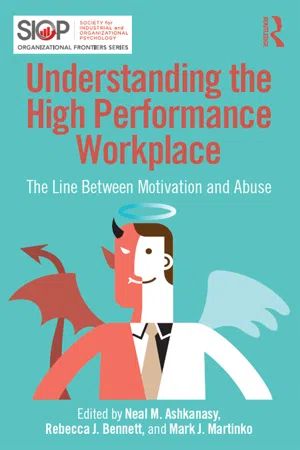
eBook - ePub
Understanding the High Performance Workplace
The Line Between Motivation and Abuse
- 318 pages
- English
- ePUB (mobile friendly)
- Available on iOS & Android
eBook - ePub
Understanding the High Performance Workplace
The Line Between Motivation and Abuse
About this book
This book asks the crucial question: When does high performance supervision become abusive supervision? As more organizations push to adopt high performance work practices (HPWP), the onus increasingly falls on supervisors to do whatever it takes to maximize the productivity of their work teams. In this rigorous, research-based volume, international contributors offer insight into how and when seemingly-beneficial workplace practices cross the line from motivation to abuse. By reviewing critical issues in both high performance work practices and abusive supervision, it illuminates the crossover between these two modes of work, and forges a path for future scholarship.
1
UNDERSTANDING THE HIGH PERFORMANCE WORKPLACE
Introduction
In recent years, high performance work practices (HPWPs) have come to be recognized as essential for achieving high levels of employee productivity, especially if such high performance is not to be to the detriment of employee well-being (Van De Voorde & Beijer, 2015; Van De Vorde, Paauwe, & van Veldhoven, 2012). At the same time, however, there still seems to be much we don’t know about HPWPs and, in particular, their long-term effects. The chapters in this volume present cutting-edge ideas on the HPWP concept and offer a wealth of ideas for future research (see Chapter 15).
Today’s accelerated impetus for HPWPs in industrialized economies came to the fore following the global financial crisis of 2009. In the Australian context, for example, employers in both the private and public sectors have been under pressure to cut costs, and staff reductions have traditionally been the strategy of first resort to achieve such aims (Parker, Chmiel, & Wall, 1997). For example, after coming to power in the 2012 Queensland (Australia) State Election, incoming state premier Campbell Newman ordered deep cuts to public service staffing levels (McKenna, 2012), claiming that “Labor (the previous government) have employed… 20,000 more public servants than the people of Queensland can currently afford.” Similar large-scale staff cuts have taken place since 2009 in the Australian private sector (e.g., see Holden, Scuffham, Hilton, Vecchio, & Whiteford, 2010). Following these cuts, “survivors” are placed under increasing pressure to “do more with less” (e.g., see Unikel, 2013), often involving working longer hours (Holden et al., 2010). In the Queensland Public Service, for example, morale slumped as public employees struggled to complete additional work as a result of the incoming government’s staff cuts (Wiltshire, 2012).
In this volume, authors focus on the role played by workgroup supervisors and the reactions of employees to their use of HPWPs. Today’s supervisors are coming under increased pressure to maintain productivity at or above previous levels (Carter et al., 2011). This increased pressure to perform can result in supervisors engaging in overzealous supervisor practices that can be seen by employees as abusive. Moreover, this effect is not all that new. For example, Robert A. Caro (1981), in his award-winning biography of President Lyndon B. Johnson, gives a graphic description of a young Johnson’s abusive supervision of his staff while he was Texas director of the New Deal program called the National Youth Administration (NYA). Caro describes how Johnson would curse his staff, constantly belittle them, play demeaning practical jokes on them, and drive them to work extreme hours. NYA staff members who were unable to take this behavior were quickly fired (albeit not by Johnson—he always asked his assistants to do the firing). Paradoxically, however, Johnson elicited lifetime loyalty from those employees who could deal with his abuse. Caro (1981) notes, “The Chief [Johnson] made his boys feel part of a team, almost like part of a family.” So the question arises: What’s going on here? This is the question the authors in this volume seek to answer.
Underpinning the chapters in this volume is the idea that “frontline supervisors play an important role in organizational performance and effectiveness and that supervisory management is an important determinant of high performance” (Brewer, 2005, p. 505). Of course, supervisors can adopt different means to motivate their subordinates to work harder, including offering rewards for goal attainment and/or making the consequences of failure to meet goals clear (Poister, 2003). Unfortunately, and as our earlier examples attest, attempts to motivate employees to work harder all too often result in supervisor behaviors that are perceived as abusive, including angry outbursts, public ridiculing, (non-contingent) punishment, social isolation, and denigration of the target’s work. Researchers have used several different labels to refer to these kinds of behaviors, including abusive supervision (Tepper, 2000), petty tyranny (Ashforth, 1997), supervisor aggression (Schat, Frone, & Kelloway, 2006), supervisor undermining (Duffy, Ganster, & Pagon, 2002), bullying (Hoel, Raynor, & Cooper, 1999), and incivility (Pearson & Porath, 2004).
Previous research provides clear evidence of the harmful consequences of abusive supervision on employees. Tyrannical supervisor behavior has been linked to employees’ psychological distress (Schat et al., 2006; Tepper, 2000), problem drinking (Bamberger & Bacharach, 2006), and somatic health complaints (Duffy et al., 2002). Besides the psychological, emotional, and physical repercussions for the abuse recipient, supervisors’ aggressive behaviors can ricochet and cause harm to the organization or others within it (Duffy et al., 2002; Mitchell & Ambrose, 2007; Schaubhut, Adams, & Jex, 2004). The effects can then flow through to the abuse recipient’s family members (Hoobler & Brass, 2006) and can even boomerang directly back to the supervisor via supervisor-directed aggression (Dasborough, Ashkanasy, Tee, & Tse, 2009; Dupre, Inness, Connelly, Barling, & Hoption, 2006; Inness, Barling, & Turner, 2005; Mitchell & Ambrose, 2007). Clearly, abusive supervision is something organizations want to discourage among their managers.
To answer the question as to when high pressure supervision can be perceived as abusive, most of the authors in this volume adopt an employee’s point of view. In other words, abusive supervision is a phenomenon that is “in the eye of the beholder” (Tepper, 2000, 2007), where employees perceive that their supervisors are engaging in abusive supervisory practices irrespective of whether the supervisors are actually engaging in such behavior (or even are seen by others to be doing so). As a result of this perception, the employee can be expected to experience stress, resulting in low performance (Harlos & Axelrod, 2005) and/or “choking under pressure” (Baumeister, 1984, p. 610; see also Markman, Maddox, & Worthy, 2006, for a review). Moreover, the perception of abusive supervision can also lead employees to engage in nonproductive “deviant behavior” (Lian, Ferris, & Brown, 2012).
On the other hand, subordinates could also view their supervisors to be engaging in appropriately motivated HPWPs rather than in abusive supervision. In this instance, trusting relationships (Cho & Lee, 2012) and the development of a supportive performance-orientated climate (Dysvik & Kuvaas, 2012) become critical ingredients in influencing perceptions of high pressure supervision. For example, in the NYA example cited earlier, many of Johnson’s subordinates did not see his (what some would call outrageous) behavior as abusive, but simply as representative of his strenuous attempts to achieve positive outcomes under difficult circumstances. Consequently, Johnson’s team produced positive outcomes despite experiencing what some might have viewed as abusive supervision.
Clearly, the issues are complex, interactive, and dynamic. In this regard, there is an imperative to understand the antecedents and consequences of HPWPs in modern work organizations. As such, the time is ripe for a volume that brings together some of the leading authors in this field in a single volume. To address these issues, we have structured this volume in three sections. In Section I, authors focus specifically on the nature of HPWPs, including definition of the term and discussion of antecedents and consequences. These authors also touch on a potential “dark side” to HPWPs. Our Section II authors discuss in more detail how HPWP can morph into abusive supervisory practices and how such practices can serve to negate any positive effects of HPWPs. The authors of chapters in Section III of this volume delve more deeply into the causes and effects of poorly managed HPWPs and the resulting supervisory practices (perceived to be abusive). In the concluding chapter to the volume, we distill the major threads that have emerged from the chapters and make recommendation for research needed to help us understand the nature of HPWPs and their effects on organizations and their employees.
Supervision and High Performance Work Practices
In the opening section of this volume, authors address the nature of high performance work practices and HPWP’s role as a determining factor in work supervision practice. The clear conclusion reached by all authors in this section is that HPWP is a double-edged sword. While such practices offer potential benefits in terms of productivity and equity, this is only if they are well managed. Poorly managed HPWPs, on the other hand, can have detrimental effects, especially to employee well-being. The four chapters in this section address these issues from varying perspectives.
In the first chapter of this section, Chapter 2, authors Flores, Posthuma, and Campion discuss the pros and cons of HPWPs. Benefits include greater job satisfaction, higher productivity, and lower employee turnover (Combs Liu, Hall, & Ketchen, 2006); disadvantages include stress resulting from overly harsh performance appraisal practices or performance-dominated remuneration practices, often resulting in job-to-home spillover (White, Hill, McGovern, Mills, & Smeaton, 2003). Flores and her colleagues go on to argue that the negative side-effects of HPWPs can be countered though adoption of positive management practices, including avoidance of stress-inducing negative HPWPs that result in harm to employees.
In Chapter 3, authors Ogbonnaya, Daniels, Connolly, van Veldhoven, and Nielsen define HPWPs as “a system of ‘innovative’ HRM practices that optimize employees’ knowledge, skills and abilities to promote organizational performance” (Beltrán-Martín, Roca-Puig, Escrig-Tena, & Bou-Llusar, 2008). As such, they have the potential to promote organizational productivity and should result in employee benefits including increased job satisfaction and decreased turnover. The authors note, however, that HPWPs can also come to be seen as a “beguiling management model for eliciting greater effort from employees” that returns few real benefits in terms of employee well-being, especially through work intensification resulting in anxiety-inducing pressure and stress. Ogbonnaya and his co-authors argue in particular that these practices can even come to be representative of the “dark side” of transformational leadership, whereby such leaders set unrealistic expectations on employees.
In Chapter 4, authors Jensen and Van De Voorde provide additional analysis of the potential deleterious effects of HPWP. They argue in particular that HPWPs can be viewed as devices intended to elicit management control rather than employee commitment (Arthur, 1994; Guest, 1999; Lepak & Shaw, 2008). The authors review the empirical evidence arising from research that has focused on individual-level outcomes such as job performance, health-related well-being, and job attitudes such as turnover intentions. They also introduce the idea of a potential “tipping point” at which HPWPs transition from a positive set of practices designed to benefit both the organization and the individual to an exploitative approach designed to meet organizational ends at the expense of individual employees. Jensen and Van De Voorde examine in particular managerial implementations of HPWPs and the effects of employee characteristics and job design. Finally, they identify conservation of resource theory (Hobfoll, 1988) as a potential means to understand and manage the tipping point effect they identify.
In the final chapter in this section (Chapter 5), Boxall and Macky examine two pathways that deal specifically with the potential downsides of HPWPs: (1) high involvement versus (2) job intensification. The authors argue in particular that high employee involvement can enhance both productivity and employee well-being (Lawler, 1986; Vandenberg, Richardson, & Eastman, 1999). Boxall and Macky deal in particular with the difficult choices facing managers who are under increasing pressure to deliver results, while at the same time finding themselves responsible for the health and well-being of their employees. The solution the authors offer is for managers to understand better the dynamic nature of the pressure their employees are likely to experience and to adjust their management style accordingly.
What is clear from the chapters in this section is that there are potential problems with HPWPs that require astute management if employees are both to reach their performance potential and to enjoy good health and well-being. Particularly intriguing is the idea Jensen and Van De Voorde put forward in Chapter 4: that there is likely be a “tipping point” where HPWPs transition from beneficial to detrimental. This is an issue that authors explore in more depth in the following sections.
HPWP and Abusive Supervision: Crossing the Line
In this section, the focus moves to the perceptual processes of subordinates; authors seek to identify when subordinates determine that management’s requests for performance, which the managers see as legitimate, cross the line and are perceived as abusive. In viewing this body of work as a whole, the first impression is that each of the authors has a quite different answer.
The section opens with Kidwell and Lunde (Chapter 6), who view the issue as a moral and ethical problem and attempt to establish when subordinates see their supervisors, coworkers, and organizations as crossing ethical and moral boundaries. From this perspective, when subordinates see demands for high performance as unethical and immoral, they believe they are being abused. On the other hand, Russell, Ferris, and Sikora (Chapter 7) approach the problem from an attributional perspective and focus on attributions of intentionality. Essentially these authors’ position is that when subordinates perceive that management’s demands are well-intended and balance needs for employee well-being with demands for productivity, the employees are likely to react positively to calls for high performance. On the other hand, subordinates are likely to perceive that management’s demands cross the line when they believe their managers’ intentions are self-serving and disregard employees’ well-being. Thus two apparently different perspectives are offered by Kidwell and Lunde in Chapter 6 versus Russell, Ferris, and Sikora in Chapter 7: one stresses breaches of ethical and moral standards while the other focuses on supervisory intentions.
A third and seemingly further divergent perspective introduced by Spector (Chapter 8) focuses on perceived stress. According to this perspective, supervisors engaging in HPWPs feel increased pressure to increase work demands, which, in turn, results in the supervisors making demands on employees for task performance that the subordinates perceive as exceeding their job scope. Together, these dynamics are viewed as precipitating stressful organizational climates. Spector suggests that supervisors can buffer the effects of this climate by ensuring there are rewards for performance and social support. Thus within the context that Spector describes, demands for high performance work systems (HPWSs) cross the line when they...
Table of contents
- Cover
- Half Title
- Title Page
- Copyright Page
- Table of Contents
- List of Contributors
- Series Editor’s Foreword
- Preface by Bennett J. Tepper
- 1 Understanding the High Performance Workplace: Introduction
- SECTION I Supervision and High Performance Work Practices
- SECTION II HPWP and Abusive Supervision: Crossing the Line
- SECTION III When HPWPs Become Abusive: Causes and Effects
- Index
Trusted by 375,005 students
Access to over 1.5 million titles for a fair monthly price.
Study more efficiently using our study tools.
Frequently asked questions
Yes, you can cancel anytime from the Subscription tab in your account settings on the Perlego website. Your subscription will stay active until the end of your current billing period. Learn how to cancel your subscription
No, books cannot be downloaded as external files, such as PDFs, for use outside of Perlego. However, you can download books within the Perlego app for offline reading on mobile or tablet. Learn how to download books offline
Perlego offers two plans: Essential and Complete
- Essential is ideal for learners and professionals who enjoy exploring a wide range of subjects. Access the Essential Library with 800,000+ trusted titles and best-sellers across business, personal growth, and the humanities. Includes unlimited reading time and Standard Read Aloud voice.
- Complete: Perfect for advanced learners and researchers needing full, unrestricted access. Unlock 1.5M+ books across hundreds of subjects, including academic and specialized titles. The Complete Plan also includes advanced features like Premium Read Aloud and Research Assistant.
We are an online textbook subscription service, where you can get access to an entire online library for less than the price of a single book per month. With over 1.5 million books across 990+ topics, we’ve got you covered! Learn about our mission
Look out for the read-aloud symbol on your next book to see if you can listen to it. The read-aloud tool reads text aloud for you, highlighting the text as it is being read. You can pause it, speed it up and slow it down. Learn more about Read Aloud
Yes! You can use the Perlego app on both iOS and Android devices to read anytime, anywhere — even offline. Perfect for commutes or when you’re on the go.
Please note we cannot support devices running on iOS 13 and Android 7 or earlier. Learn more about using the app
Please note we cannot support devices running on iOS 13 and Android 7 or earlier. Learn more about using the app
Yes, you can access Understanding the High Performance Workplace by Neal M. Ashkanasy, Rebecca J. Bennett, Mark J. Martinko, Neal M. Ashkanasy,Rebecca J. Bennett,Mark J. Martinko in PDF and/or ePUB format, as well as other popular books in Business & Human Resource Management. We have over 1.5 million books available in our catalogue for you to explore.