- 192 pages
- English
- ePUB (mobile friendly)
- Available on iOS & Android
eBook - ePub
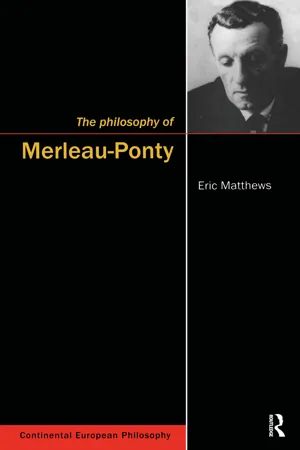
The Philosophy of Merleau-Ponty
About this book
In this introduction to the life and thought of one of the most important French thinkers of the twentieth-century Eric Matthews shows how Merleau-Ponty has contributed to current debates in philosophy, such as the nature of consciousness, the relation between biology and personality, the historical understanding of human thought and society, and many others. Surveying the whole range of Merleau-Ponty's thinking, the author examines his views about the nature of phenomenology and the primacy of perception; his account of human embodiment, being-in-the-world, and his understanding of human behaviour; his conception of the self and its relation to other selves; and, his views on society, politics, and the arts. A final chapter considers his later thought, published posthumously. The ideas of Merleau-Ponty are shown to be of immense importance to the development of French philosophy and the author evaluates his distinctive contributions and relates his thought to that of his predecessors, contemporaries and successors, both in France and elsewhere. This unrivalled introduction will be welcomed by philosophers and cognitive scientists as well as students taking courses in contemporary continental philosophy.
Information
CHAPTER ONE
Merleau-Ponty in Context
I
Why should we still read Merleau-Ponty? He died, after all, in 1961, at a time when the social and cultural situation and the preoccupations of philosophers were very different from those of the end of the twentieth century and the beginning of a new millennium. Is he not simply a representative of a now outmoded “humanism”, a philosophy of the “subject” and of the phenomenology of consciousness? That he was a humanist in some sense of that rather vague word is undeniable; he was certainly concerned to affirm human values and believed that there are such values to affirm. But he was not, as I shall try to show in the course of the book, a “humanist” in the sense in which that term is often used pejoratively by some of his “posthumanist” successors, such as Foucault and Althusser. That is, although he stressed the importance of the subject, he was not a defender of the Enlightenment conception of a human subjectivity that is independent of the physical, social and historical situation of the human being concerned. “Humanism” in this sense is sometimes associated by its critics with phenomenology and, clearly, Merleau-Ponty was a phenomenologist. But his “existential” interpretation of what that means, as again I shall try to show, was far from identifying it with a philosophy of the transcendental subject and a description of that subject’s inner consciousness.
Merleau-Ponty certainly learned from other philosophers, from Hegel, from Bergson, from Marcel, from Heidegger, from Sartre and, above all, from Husserl. But he combined elements from different thinkers (in ways that went beyond mere eclecticism) and added new elements, such as his study of Gestalt psychology, contemporary neurophysiology and Freudian psychoanalysis and ideas derived from his political commitment to a humanistic Marxism, to make from this material something that was entirely his own. The result was something that often seems to belong more to our time than to the time when he was writing. His discussion of the relation between the neurophysiology of the brain and human mental life, for example, despite the necessarily out-of-date science on which it is based, has a clear relevance to recent debates between thinkers in the analytic tradition, such as Searle, Putnam, Dennett and the Churchlands; at appropriate places in this book I shall try to demonstrate how it is relevant. In a different direction, I shall suggest that his questioning of the sharp distinction between “subject” and “object” of experience points forwards to the “decentring of the subject” in more recent French philosophy.
In short, this book is an attempt to present Merleau-Ponty not as a mere figure from the history of philosophy, but as a participant in continuing debates about what it means to be human, about the relations between individual human beings and between individuals and society, about language, art and expression, about the relation between science, common experience and philosophy, about the nature of time and history, and about the possibilities for human progress. Any discussion of his thought can therefore succeed only if it takes him as such a participant. It is not sufficient (although it is necessary) to explain what he says in terms of his influences; he must also be subjected to the kind of critical analysis that he would have to face if he were literally here among us, engaging in the contemporary arguments. Before we begin this analysis, however, it will be useful to place him in his own historical context and to exhibit the general interconnections between his ideas; this outline will then make it easier to follow the more detailed discussions of the succeeding chapters.
II
Maurice Merleau-Ponty was born in 1908, in Rochefort sur Mer, in the département of Charente-Maritime, in the far west of France. He was one of three children of an artillery officer who died in 1913; thus he, together with his brother and sister, was brought up by his widowed mother alone. Nevertheless, as Jean-Paul Sartre relates in his memoir “Merleau-Ponty vivant”, in 1947 Merleau-Ponty described his childhood as “incom-parable”, and said indeed that “he had never recovered from” it.1 He went to school in Paris, at the Lycée Janson-de-Sailly and the Lycée Louis-le-Grand, and entered the École Normale Supérieure to study philosophy in 1926. It was at the École Normale that he first met Sartre and Simone de Beauvoir; Sartre says of their relationship at that time, “we knew each other without being friends”.2 (Later, during the Occupation, they were to become much closer to each other, with significant effects on Merleau-Ponty’s life and thought.) During that time, too, he attended Georges Gurvitch’s lectures on the phenomenology of Husserl, Scheler and Heidegger, and the lectures that Husserl himself gave in Paris in 1929.
After graduating with the agrégation en philosophie (the qualification desirable to teach philosophy in French schools) in 1930, and completing his year of compulsory military service, Merleau-Ponty taught philosophy in lycées (secondary schools) for the next few years, apart from taking a year out to do research in perception. In 1935, he returned to the École Normale as a tutor and remained there until the outbreak of the Second World War. Until this time he seems to have been a Left-wing Catholic (Simone de Beauvoir remembers that he still attended Mass while a student at the École Normale), but he left the Church in the late 1930s in disgust at the attitudes of many in the Catholic hierarchy to Left-wing activity. Thereafter, he was always positioned somewhere to the left of centre politically, although he could never bring himself to the point of joining the French Communist Party, as some other leftist French intellectuals did at the time. He did, however, develop an increasing interest in Marxism, marked, for example, by his attendance at the lectures on Hegel given by Alexandre Kojève in Paris in the late 1930s, in which Kojève presented what was effectively a Hegelianized or humanistic Marxism. This was to have a profound effect on Merleau-Ponty’s own thinking, not only about political theory, but also about the wider questions of the historicity of human existence.
But the most important intellectual development at that time was Merleau-Ponty’s discovery of the later thought of Husserl. He had already heard from Husserl’s own lips, as well as from Gurvitch’s lectures, about the earlier version of phenomenology. Having read about Husserl’s later development in a journal article, Merleau-Ponty went to the Husserl Archive in Louvain in Belgium to read and study the later works of Husserl, which were then unpublished; much of this work was published after Husserl’s death, most notably as the second part of the work often referred to as the “Crisis-volume”, the Crisis of European Sciences and Transcendental Phenomenology.3 This reading convinced Merleau-Ponty that, in his later doctrine of the “life-world”, Husserl’s conception of philosophy had taken a decisive new turn; it was this later version that was to shape Merleau-Ponty’s own conception of phenomenology, as we shall see in Chapter 2.
Hegel, filtered through the young Marx (or, what amounts to the same, a younger Marx seen through Hegelian spectacles), and a certain reading of the later Husserl were two of the most important influences on Merleau-Ponty’s own thinking. What other influences helped to shape him intellectually? One, inevitably, was the French Cartesian tradition, with which Husserl had sought to connect his own phenomenology in the Paris lectures (which were published under the title Cartesian Meditations), but Merleau-Ponty was influenced by this only in the negative sense that he reacted against it. Another was the prevailing Kantianism of his teachers at the École Normale (and of others in the contemporary French philosophical establishment); his principal teacher there was the idealist Léon Brunschvicg, whose own thought was strongly influenced by Kant. Here again, however, the relevance of this tradition to Merleau-Ponty’s thinking was largely negative, as we shall see in Chapter 3.
Another philosopher who influenced him, Henri Bergson, was still alive and publishing when Merleau-Ponty was a young tutor in the 1930s. Merleau-Ponty was later to be elected, as Bergson had been, to a chair at the Collège de France, and makes appropriately respectful comments on his philosophy in his inaugural lecture there (published in book form as In Praise of Philosophy4). For all this, all that Merleau-Ponty seems to have taken from Bergson (important though it is) is the insistence on starting from immediate experience rather than from theoretical explanations of it, which reinforced the lessons derived from his reading of Husserl’s phenomenology. (In his inaugural lecture, Merleau-Ponty speaks approvingly of Bergson’s view that philosophy “cannot be a judgment given from on high on life, the world, history…”.5) Merleau-Ponty rejected the Bergsonian idea of a deep “inner self” which is the “real me”, and criticized rather unfairly Bergson’s views on “duration”, the temporality of inner experience. Another French philosopher who was more of a contemporary was Gabriel Marcel; indeed, one of Merleau-Ponty’s first published works was a review of Marcel’s Being and Having in the Catholic journal La Vie intellectuelle. It was in Marcel that Merleau-Ponty found what was to be one of his own key ideas — that our subjectivity is essentially embodied or incarnate. He also shared Marcel’s Bergsonian conception of philosophy as “concrete”. But Marcel’s presentation of these ideas, as of his philosophy generally, was much more literary and discursive than Merleau-Ponty’s, and correspondingly much less analytic and related to contemporary science.
Heidegger had featured in Gurvitch’s lectures on recent German philosophy, and in this sense must have entered Merleau-Ponty’s philosophical consciousness. But there are not many explicit references to him, at any rate in Merleau-Ponty’s earlier writings; we can infer an influence mainly from circumstantial evidence, such as the use of the central Heideggerian term “being-in-the-world” as a similarly central concept in Merleau-Ponty’s thought, and the discussions of Being and recognition of the need for an ontology as well as a phenomenology in the posthumously published late works such as The Visible and the Invisible. (Similarities to and differences from a Heideggerian treatment of these themes will be considered below in the relevant chapters.)
And then there was the mass of scientific literature, in physiology, psychology and psychiatry, which Merleau-Ponty had worked through in his researches on perception, for instance, and to whose findings he gave his own interpretation based on his philosophical perspective. All this work features prominently in Merleau-Ponty’s first book, The Structure of Behaviour, which was in effect his doctoral thesis, completed in 1938 but published in book form only in 1942. The purpose of this book, as he declares in the Introduction, is “to understand the relations of consciousness and nature: organic, psychological or even social”.6 By nature, as Merleau-Ponty goes on to explain, he means “a multiplicity of events external to each other and bound together by relations of causality”. The work is essentially a critique, not of scientific psychology as such, but of a certain misguided philosophical conception of what a “scientific” psychology has to be like. The philosophy of psychology that Merleau-Ponty opposes is a dualistic conception that opposes “the mental” and “the physiological” as two orders of reality that are external to each other and so can be only causally related.
Given that conception, there seem to be only three possible ways to make psychology scientific. One is to follow the way of classical materialism: to make the “mind” another kind of object in the world, in effect identified with the brain, and thus to treat psychology as identical with the study of brain processes and the causal relations between them and between what happens in the brain and what happens in the rest of the body. Another, which Merleau-Ponty describes as “critical thought”, is to distinguish between “analytic psychology”, the study of the conscious judgements that we make, and the study of bodily mechanisms. The third is the way of Watsonian behaviourism or Pavlovian reflex theory, the identification of “the mental”, at least as an object of scientific study, with the external behaviour that manifests our thoughts and feelings, and the interpretation of that behaviour as simply equivalent to physiological movements, so that it could be studied and understood in purely causal terms. The last-mentioned approach is explicitly non-dualist, since it does not appear to recognize “the mental” as a separate objective domain from “the physiological”. Nevertheless, it shares the dualist assumption that the term “mind” can have an independent reference only if it denotes an entity separate from anything physiological, where an entity is something that can stand in causal relations to other entities. Since behaviourists can identify no such separate entity, they identify the mental with physiological movements.
The assumption that is common to all three approaches is what Merleau-Ponty calls “realistic analysis and causal thinking”: the belief that consciousness, or the mental, can be taken seriously as a reality only if it can be considered an object in the world, separate from other objects, such as the body, and standing in causal relations to them. This is the assumption that his critique seeks to challenge. His method is to analyse the fundamental notion of “behaviour” itself, to show that it cannot be equated with purely physiological movements that might be explained in a straightforwardly causal fashion. The very facts cited by psychologists themselves, he argues, require for their explanation notions of “form”, “structure” and “intention”, which do not fit with such a mechanistic conception of behaviour. These established findings of psychology are described in abundance and analysed in intricate detail. His reliance in this early work is on the concepts of Gestalt psychology, which emphasizes such notions of form or structure. The word “phenomenology” hardly appears at all, but there are hints of the phenomenological approach of the later works, for instance, in starting from our actual experience of our own behaviour, which seems to require for its description and understanding notions of intention and meaning.
III
By the time The Structure of Behaviour finally appeared in print, the Second World War had broken out, Merleau-Ponty had been mobilized as an infantry officer and France had fallen and had been partially occupied by the German forces; Merleau-Ponty had thereupon been demobilized and had returned to teaching philosophy in the Lycée Carnot in Paris. Later in the war, in 1944, he moved to the Lycée Condorcet, where he succeeded Sartre. He had renewed his acquaintance with Sartre in 1941, when Merleau-Ponty had joined a small Resistance group called Socialisme et Liberté (Socialism and Liberty), to which Sartre already belonged. It was, as Sartre admitted, a group of petit bourgeois intellectuals, enthusiastic but not terribly effective, which “caught a fever and died a year later, of not knowing what to do”.7 But it did have the effect, as Sartre also says, of bringing the two men closer together than they had been before, and from then on they had a close, if sometimes stormy, relationship, both philosophical and political. Philosophically, Sartre says,
The key words were spoken: phenomenology, existence. We discovered our real concern. Too individualist to ever pool our research, we became reciprocal while remaining separate. Alone, each of us was too easily persuaded of having understood the idea of phenomenology. Together, we were, for each other, the incarnation of its ambiguity.8
This wryly humorous and affectionate characterization of their philosophical relationship, and of the similarities and differences between them in their interpretations of existential phenomenology, is also accurate.
Merleau-Ponty’s developing interest in Husserlian phenomenology, and in particular the thought of Husserl’s late period, which had really begun in the late 1930s, continued throughout this wartime period, and was no doubt stimulated further by his discussions and disagreements with Sartre. He applied it, above all, to thinking about perception — work that was embodied in his principal doctoral thesis, entitled Phenomenology of Perception, published in book form in 1945 and generally agreed to be his masterpiece. In later chapters we shal...
Table of contents
- Cover Page
- Half Title page
- Title Page
- Dedication
- Copyright Page
- Table of Contents
- Acknowledgements
- 1 Merleau–Ponty in Context
- 2 Phenomenology
- 3 Being–in–the–world
- 4 Embodiment and Human Action
- 5 Self and Others
- 6 Politics in Theory and Practice
- 7 The Arts
- 8 The Later Thought
- Notes
- Bibliography
- Index
Trusted by 375,005 students
Access to over 1.5 million titles for a fair monthly price.
Study more efficiently using our study tools.
Frequently asked questions
Yes, you can cancel anytime from the Subscription tab in your account settings on the Perlego website. Your subscription will stay active until the end of your current billing period. Learn how to cancel your subscription
No, books cannot be downloaded as external files, such as PDFs, for use outside of Perlego. However, you can download books within the Perlego app for offline reading on mobile or tablet. Learn how to download books offline
Perlego offers two plans: Essential and Complete
- Essential is ideal for learners and professionals who enjoy exploring a wide range of subjects. Access the Essential Library with 800,000+ trusted titles and best-sellers across business, personal growth, and the humanities. Includes unlimited reading time and Standard Read Aloud voice.
- Complete: Perfect for advanced learners and researchers needing full, unrestricted access. Unlock 1.5M+ books across hundreds of subjects, including academic and specialized titles. The Complete Plan also includes advanced features like Premium Read Aloud and Research Assistant.
We are an online textbook subscription service, where you can get access to an entire online library for less than the price of a single book per month. With over 1.5 million books across 990+ topics, we’ve got you covered! Learn about our mission
Look out for the read-aloud symbol on your next book to see if you can listen to it. The read-aloud tool reads text aloud for you, highlighting the text as it is being read. You can pause it, speed it up and slow it down. Learn more about Read Aloud
Yes! You can use the Perlego app on both iOS and Android devices to read anytime, anywhere — even offline. Perfect for commutes or when you’re on the go.
Please note we cannot support devices running on iOS 13 and Android 7 or earlier. Learn more about using the app
Please note we cannot support devices running on iOS 13 and Android 7 or earlier. Learn more about using the app
Yes, you can access The Philosophy of Merleau-Ponty by Eric Matthews in PDF and/or ePUB format, as well as other popular books in Philosophy & Mind & Body in Philosophy. We have over 1.5 million books available in our catalogue for you to explore.