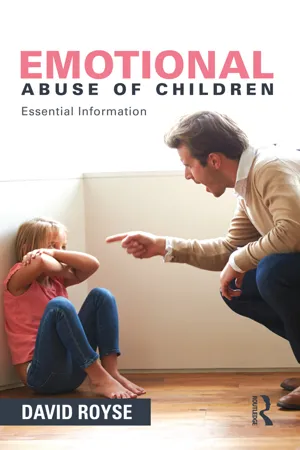
Children and Emotional Abuse is a research-informed learning resource for students in social work about the dynamics and consequences of psychological abuse—especially as it occurs in dysfunctional families and affects children and adolescents. Emotional abuse is still not widely understood or recognized. Helping professionals need to recognize emotional abuse, understand the damage it does, the theories that account for it, and be prepared to help children and families where the abuse often occurs along with physical and sexual abuse. This text will draw upon current peer-reviewed literature and evidence-based studies and summarize essential information to prepare students for careers in helping professions. Each chapter will also contain brief vignettes to illustrate some of the key points. This book is for courses in child welfare and child abuse/neglect, as well as other social work courses that focus on children.
- 218 pages
- English
- ePUB (mobile friendly)
- Available on iOS & Android
eBook - ePub
About this book
Information
1
RECOGNITION AND BASIC INFORMATION
Our children’s future and the future of the world are one.
—Dr. C. Henry Kempe
Overview: This chapter will answer several important questions: What is emotional abuse? How does it differ from neglect and other forms of child maltreatment? Nationally, how many children are estimated to be affected by abuse and neglect? Are children who are emotional abused likely to be mistreated in other ways as well?
Introduction
Although it is easy to assume that police and other authorities have been responding to child abuse ever since humankind became “civilized,” that would be an erroneous assumption. In fact, in the United States public awareness and professional response weren’t really kicked into high gear until the publication of the article “The battered-child syndrome” by physicians Kempe, Silverman, Steele, Droegemueller, and Silver in 1962. That study was the first major medical investigation of child maltreatment and was one that advanced the assessment and diagnosis of abuse by physical examination and radiographic (X-ray) findings (Leventhal & Krugman, 2012). A popular book that followed, the Battered Child, authored by Kempe and Helfer in 1968, did much to educate the public and nonmedical professionals.
Most of us could probably recognize the results of physical abuse on a child. Indeed, we would be suspicious of injuries that looked like cigarette burns on a child, unusual bruises or lacerations, or a toddler’s broken arm. But what about emotional abuse? Is it as easy to identify as physical abuse? What forms might it take? Let’s start our discussion of emotional abuse by looking at four different examples that show how emotional abuse can take varied forms in different contexts and settings.
Case Example 1
Ronnie, an overweight 12-year-old, was eating an after-school snack and watching television when his stepfather came into the room, plopped down on the couch beside him and said, “Well, Fatty, what did you do at school today? Play dolls with the girls?”
They have a history: The stepfather played football in high school. He has long resented that Ronnie has shown no interest in sports. On multiple occasions Ronnie has refused to pass the football with him and makes excuses—like needing to practice the piano. Ronnie avoids his stepfather whenever possible and spends Sunday afternoons in his room doing his homework instead of watching football games on the couch with his stepfather. But then he pays the price. After coming to the table for Sunday dinner, his stepfather refers to him as the “Bookworm” or the “Wimp.” Ronnie’s mother doesn’t say anything to defend him but passes the mashed potatoes to Ronnie and changes the subject. Lately, Ronnie has been praying that something bad would happen to the stepfather on the construction site where he works.
Case Example 2
Sheila, a petite redhead starting the ninth grade, is sensitive about the size of her nose. She feels that it is too large and that it makes her unattractive. Her older brother, a junior in high school, has been calling her “Beagle nose” to tease her. Recently she has been growing her hair long so that some of it falls across her face. Her brother, Rob, has responded by calling her “Sheep dog.” He bought some plastic fake dog poop from the Internet and secretly placed it in her backpack so that she would be embarrassed when she found it at school. Whenever he is around his friends and sees her, he goes “Woof! Woof!” until she hears and runs away in tears. Sheila feels that her parents like Rob better than her. Even though she’s complained many times about Rob’s hurtful words and actions, they have never given Rob any consequences. She’s started stealing some of the prescription drugs from the medicine cabinet to help her deal with the situation.
Case Example 3
Chanita lives with a grandmother who has struggled with drugs and depression most of her life. Twice in the last year, her grandmother has overdosed on prescriptions and Chanita has had to call 911. Now, at age 11, Chanita has to get herself up each morning, prepare her own breakfast and get to school. She dreads going home after school. If her grandmother is awake, she makes Chanita scrub the tub or the kitchen floor on her hands and knees. When it meets her grandmother’s approval, then Chanita must go to the grocery, buy food, and then make supper for the two of them. Afterwards, she has to wash the dishes not once but twice, to make sure they are clean. Earlier this year when Chanita refused to do the second washing, her grandmother turned on the gas oven and told Chanita that she was going to kill both of them. Luckily, the grandmother passed out soon afterwards and Chanita could turn the gas off.
Case Example 4
Juan Pablo’s dog, Greta, just had three pups. His father, however, never liked Greta and said that he was going to get rid of her. “No, please no,” said Juan Pablo. “Please let me keep her.”
“Well, OK,” said the father, “but you have to give the pups away.”
“I’ll take care of them,” Juan Pablo said. “You’ll see. I’ll get jobs in the neighborhood to buy their food.”
He kept his word and mowed grass and raked leaves and used his money to buy food for the pups and their mother. One day in October when the pups were about 10 weeks old, Juan Pablo came home from school and couldn’t find them. The same thing had happened last year when the cat had kittens. One day they were in their box and then the next day they were gone.
That night, after his factory shift was over, his father denied knowing anything about them but Juan Pablo didn’t believe him. His Aunt Rosie told Juan Pablo not to ask any more questions—that it would just make his father mad. His father offered 13-year-old Juan Pablo a beer and told him to “Be a man.”
Two days later while looking for his baseball, Juan Pablo found a cloth bag with bloodstains on it in the back of the old truck his father drove to work. Juan knew then his father was a liar and the pups would never be seen again.
Despite being different, in all four scenarios Ronnie, Sheila, Chanita, and Juan Pablo were made to feel unwanted, unloved, worthless, disrespected, or endangered by their close family members. They don’t trust these individuals and fear what else they may do. Worse yet, there appears to be little that they can do to improve their situation. They often dread tomorrow, knowing that things won’t be any different. Often they feel that their situation is hopeless and that no one can help them.
What is Emotional Abuse?
There is no standardized definition of emotional abuse that applies across all settings, cultures, or families. The lack of a strong societal agreement makes it difficult to clearly define emotional abuse and contributes to the problem of differentiating emotional maltreatment of a child from something that might be viewed as less harmful than physical or sexual abuse—something that might be called “suboptimal parenting” (Hibbard, Barlow, MacMillan, Committee on Child Abuse and Neglect, & American Academy of Child and Adolescent Psychiatry, Child Maltreatment and Violence Committee, 2012). Poor parenting skills may not always result in emotional abuse, but possibly could. A parent who forgets to latch the door before napping and creates an opportunity for a toddler to get out of the house and walk alongside a busy highway will very likely be charged by the police and be investigated by a child protection worker. That is different, however, from severe and usually escalating behaviors that reject, frighten, insult, and demean a child enough to be described as chronic and which could increase the likelihood of psychological harm or developmental disruptions—that is the essence of emotional abuse. (We’ll discuss the problem of distinguishing poor parenting from emotional abuse more in Chapter 4.)
As can be seen in Table 1.1, emotional abuse is often known by different terms. A recent tabulation of these terms in the Web of Science’s article database found the following number of terms in the titles of published articles between 1900 and October 1, 2014:
Table 1.1 Frequency of Terms Describing Emotional Abuse in Web of Science Database
| Term | Number of articles |
| | |
| Emotional abuse | 168 |
| Psychological abuse | 97 |
| Psychological maltreatment | 59 |
| Emotional maltreatment | 38 |
| Mental cruelty | 3 |
| Psychological battering | 1 |
Because emotional abuse is used more commonly than other terms describing the same hurtful behavior or treatment, it will be the term used most often in this book. Further support for the use of this term is found in a heavily cited journal article by Glaser (2002) entitled “Emotional abuse and neglect (psychological maltreatment): A conceptual framework.” Glaser noted that while others (e.g., O’Hagan, 1995) have attempted to distinguish between emotional and psychological abuse, that distinction is not useful. O’Hagan’s thinking was that psychological abuse would involve inappropriate behavior that damages the child’s developmental potential for healthy mental processes and mental faculties while he defined emotional abuse as inappropriate emotional responses to a child. However, any child emotionally abused would very likely be psychologically abused as well. Thus, spending a lot of time debating the distinction between the two may not be worthwhile.
A letter published in the British Medical Journal in November 1979 by W.R. Guirguis (“Physical indicators of emotional abuse in children”) shows up as the earliest title on emotional abuse in the Web of Science. Remarkably, the description found in that letter, though written over three decades ago, remains an accurate depiction:
It is not a single condition, but a whole range of maltreatment. … It describes an abusive environment rather than an abused child. That is why there is no one recognizable or constantly identifiable clinical picture which is diagnostic of emotional abuse.
(p. 1290)
All of the terms found in Table 1.1 share a common basis in that recipients of emotionally abusive behavior feel wounded—usually by someone they love. Because it is vitally important that we have a solid foundation for understanding emotional abuse, we will next examine more in-depth some of the various ways this form of mistreatment has been defined.
In 1995 the American Professional Society on the Abuse of Children (APSAC) created a set of practice guidelines and defined emotional abuse this way: “Psychological maltreatment means a repeated pattern of caregiver behavior or extreme incident(s) that convey to children that they are worthless, flawed, unloved, unwanted, endangered, or only of value in meeting another’s needs” (APSAC, 1995, p. 2).
The definitions of the American Academy of Pediatrics Committee on Child Abuse and Neglect of psychological maltreatment in the two quotations below are informative:
a repeated pattern of damaging interactions between parent(s) and child that becomes typical of the relationship. In some situations the pattern occurs only when triggered by alcohol or other potentiating factors. Occasionally, a very painful singular incident, such as an unusually contentious divorce, can initiate psychological maltreatment.
(www.pediatrics.org/cgi/content/full/109/4/e68)
Psychological maltreatment of children occurs when a person conveys to a child that he or she is worthless, flawed, unloved, unwanted, endangered, or only of value in meeting another’s needs. The perpetrator may spurn, terrorize, isolate, or ignore or impair the child’s socialization.
(Kairys, Johnson, and the Committee on Child Abuse and Neglect, 2002, p. 1)
Note that the exact, legal definition applying to acts of abuse or neglect will differ state-by-state. Federal legislation lays the groundwork for state laws on child maltreatment by identifying a set of acts or behaviors that define child abuse and neglect. The Federal Child Abuse Prevention and Treatment Act (CAPTA) (42 U.S.C.A. §5106g), as amended and reauthorized by the CAPTA Reauthorization Act of 2010, defines child abuse and neglect as, at minimum:
Any recent act or failure to act on the part of a parent or caretaker which results in death, serious physical or emotional harm, sexual abuse or exploitation; or an act or failure to act which presents an imminent risk of serious harm.
Most federal and state child protection laws primarily refer to cases of harm to a child caused by parents or other caregivers; they generally do not include harm caused by other people, such as acquaintances or strangers. Some state laws also include a child’s witnessing of domestic violence as a form of abuse or neglect. (www.childwelfare.gov/pubs/factsheets/whatiscan.pdf).
Almost all states and the District of Columbia include emotional maltreatment as part of their definitions of abuse or neglect. Approximately 32 states and the District of Columbia have specific definitions of emotional abuse or mental injury to a child. Typical language used in these definitions is “injury to the psychological capacity or emotional stability of the child as evidenced by an observable or substantial change in behavior, emotional response, or cognition” and injury as evidenced by “anxiety, depression, withdrawal, or aggressive behavior” (www.childwelfare.gov/systemwide/laws_policies/statutes/define.pdf). The vast majority of the legal definitions of psychological maltreatment focus not on the parent or caregiver’s acts but on the impact on the child (Baker, 2009).
Within the minimum standards set by CAPTA, each state is responsible for providing its own definitions of child abuse and neglect. Most states recognize the four major types of maltreatment: physical abuse, neglect, sexual abuse, and emotional abuse. (Indications of each type of maltreatment are discussed later.) Additionally, many states identify abandonment and parental substance abuse as abuse or neglect. While these types of maltreatment may be found separately, they often occur in combination. For state-specific laws pertaining to child abuse and neglect, see the Child Welfare Information Gateway’s State Statutes search page (www.childwelfare.gov/systemwide/laws_policies/state/).
One of the keys to understanding emotional abuse is the notion that it is not a one-time, single, or isolated event. The behavior may not be perceived as or considered as abusive if it occurs occasionally or infrequently and as long as the parent or other significant person is experienced generally as a loving and caring individual. It almost goes without saying that parents do get angry; they can lose their tempers and say things they don’t really mean and regret later. However, emotional abuse generally refers to a sustained or repeated pattern of behavior that, more than making the child unhappy, has the potential for affecting the child’s self-esteem, development, view of the world, and sense of belonging. The child feels unloved or unimportant at a deep level. This is different, for example, than an occasion when a small child is told to “Shut the hell up!” after being verbally reprimanded by an exasperated parent for something (e.g., throwing Daddy’s cell phone onto the concrete sidewalk) and perhaps an hour later has forgotten all about the incident.
The American Academy of Pediatrics Committee on Child Abuse and Neglect in 2002 (see Kairys et al., 2002) identified nine types of psycho...
Table of contents
- Cover
- Title
- Copyright
- Dedication
- Contents
- Preface
- Acknowledgments
- 1 Recognition and Basic Information
- 2 The Underlying Causes of Emotional Abuse
- 3 The Effects of Emotional Abuse
- 4 Assessment of Emotional Abuse
- 5 Intervening and Treating Emotional Abuse
- Appendix A: Additional Instruments for Assessing Abuse/Neglect
- Appendix B: Resources
- Appendix C: Biopsychosocial and Trauma-Informed Clinical Assessment of children
- Bibliography
- Index
Trusted by 375,005 students
Access to over 1.5 million titles for a fair monthly price.
Study more efficiently using our study tools.
Frequently asked questions
Yes, you can cancel anytime from the Subscription tab in your account settings on the Perlego website. Your subscription will stay active until the end of your current billing period. Learn how to cancel your subscription
No, books cannot be downloaded as external files, such as PDFs, for use outside of Perlego. However, you can download books within the Perlego app for offline reading on mobile or tablet. Learn how to download books offline
Perlego offers two plans: Essential and Complete
- Essential is ideal for learners and professionals who enjoy exploring a wide range of subjects. Access the Essential Library with 800,000+ trusted titles and best-sellers across business, personal growth, and the humanities. Includes unlimited reading time and Standard Read Aloud voice.
- Complete: Perfect for advanced learners and researchers needing full, unrestricted access. Unlock 1.5M+ books across hundreds of subjects, including academic and specialized titles. The Complete Plan also includes advanced features like Premium Read Aloud and Research Assistant.
We are an online textbook subscription service, where you can get access to an entire online library for less than the price of a single book per month. With over 1.5 million books across 990+ topics, we’ve got you covered! Learn about our mission
Look out for the read-aloud symbol on your next book to see if you can listen to it. The read-aloud tool reads text aloud for you, highlighting the text as it is being read. You can pause it, speed it up and slow it down. Learn more about Read Aloud
Yes! You can use the Perlego app on both iOS and Android devices to read anytime, anywhere — even offline. Perfect for commutes or when you’re on the go.
Please note we cannot support devices running on iOS 13 and Android 7 or earlier. Learn more about using the app
Please note we cannot support devices running on iOS 13 and Android 7 or earlier. Learn more about using the app
Yes, you can access Emotional Abuse of Children by David Royse in PDF and/or ePUB format, as well as other popular books in Social Sciences & Social Work. We have over 1.5 million books available in our catalogue for you to explore.