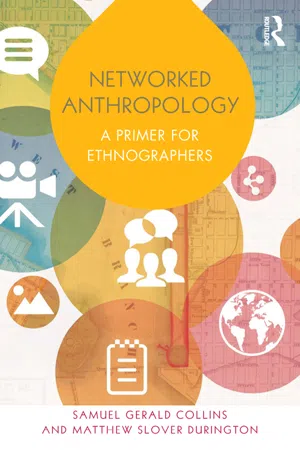
The advent of social media offers anthropologists exciting opportunities to extend their research to communities in fresh ways. At the same time, these technological developments open up anthropological fieldwork to different hazards. Networked Anthropology explores the increasing appropriation of diverse media platforms and social media into anthropological research and teaching. The chapters consider the possibilities and challenges of multimedia, how network ecologies work, the ethical dilemmas involved, and how to use multimedia methodologies. The book combines theoretical insights with case studies, methodological sketches and pedagogical notes. Drawing on recent ethnographic work, the authors provide practical guidance in creative ways of doing networked anthropology. They point to the future of ethnography, both inside and outside the classroom, and consider ways in which networked anthropology might develop.
eBook - ePub
Networked Anthropology
A Primer for Ethnographers
- 172 pages
- English
- ePUB (mobile friendly)
- Available on iOS & Android
eBook - ePub
About this book
Information
1 Anthropology confronts a networked world
DOI: 10.4324/9781315760674-1
We live in a networked age. But what does that mean? On the one hand, it refers to the particular ways we are connected to each other. We live in the age of “weak ties” (after the work of Mark Granovetter), where, by all accounts, we have more friends than ever, and even more potential “friends” – latencies that we may initiate and maintain in their latent states through various social media (Granovetter 1973; Haythornthwaite 2002). The networked age means a concomitant rise of what Rainie and Wellman (2012: 126) call the “networked self,” “a single self that gets reconfigured in different situations as people reach out, connect, and emphasize different aspects of themselves.” This self is elaborated and expressed through countless tools, notably Information and Communication Technologies (ICTs) like smartphones, and social media sites like Facebook and Twitter. With these technologies and networked sites, people can express themselves through various media – video, text, audio, photograph – and say something about the world in which they live. But this is more than a multimedia age. As Rainie’s and Wellman’s definition suggests, people extend their identities and their affiliations along multiplex, overlapping networks where different selves and relationships change according to a networked logic – the logic of connections. One’s “partying” self, one’s “activist” self, one’s “analytical” self: each enabled by a cross-work of homophily that forms the ontological support for myriad subjectivities. We can see this as liberating if we wish; many commentators do, and they adduce convincing anecdotes that demonstrate again and again how the logic of networked life can lead to new forms of creativity, of political action, and of justice. At the same time, we note that the turn to networked selves is also consistent with a general neo-liberal logic in which one’s friends, family, colleagues, and acquaintances flow together into seamless and highly instrumental social networks like Linkedin, where we are encouraged to look to our relationships as social and cultural capital to be exploited for economic gain (English-Lueck 2002). And of course, the business models of these social media platforms themselves depend upon their ability to turn our social lives and social identities into products for advertising and/or information quanta for sale to the highest bidder. In other words, it’s commodity chains all the way down, from the biggest corporations to people enacting their own precarity by commodifying themselves in the crucible of social media.
But if we stop our analysis at the impact of ICTs and social media on identity, then we will have missed quite a bit. More than a way of being, these technologies suggest a way of doing, of initiating social action through our relationships to others and to the world around us. Such subtleties are missed in many critical commentaries on our networked age, however valid their critiques may be (Trottier 2012; Turkle 2011). More important than the “who” of social media, however, is the “what” – the kinds of social action that people undertake with the help of the networked technologies around them. This is readily evident in the variety of political practices that have become associated with ICTs and social media: Occupy, Tahrir Square, Taksim Gezi Park. It also calls into question many of the dichotomies that have tended to inform work on media in anthropology, i.e., producers and consumers, actors and audience. But here we should take care not to grant these technologies and practices a transcendent power over hierarchies and inequalities. Instead, we need to understand these mediated relationships as reconfigured, occasionally revolutionary and occasionally complicit, but always implicated in the highly unequal power relations that overdetermine social life in an era of advanced capitalism. Whether or not twitter played an important role in the “Arab Spring” uprising is an important question, but even the articulation of that question suggests the ways our understandings of social action have shifted in an era of networked technologies.
Despite the salience of a digital divide, which is still a useful shorthand for indicating unequal access to computers, internet connections and knowledge about them both, the growth of smartphone adoptions in many parts of the world among different populations of otherwise disenfranchised peoples has been one strong catalyst for this book. For example, the Pew Research Center’s Internet & American Life Project has documented the rise of smartphone use among ethnic and racial minorities in the United States, and notes a comparable or slightly higher percentage of smartphone penetration among African Americans in the study (Brenner 2013). In other parts of the world, the circulation of used or “fourteen-day” phones around the globe means that smartphones and smartphone applications are available to many people who were, heretofore, only on the receiving end of mass media (Mathews 2011). Now, while people may still not be able to overcome the burdens of colonialism that place them in the “savage slot,” they may be capable of uploading from their devices other representations that may prove challenging to hegemonic discourse.
And, while we need to be profoundly skeptical of claims that access to information and communication technologies might be a panacea for various inequalities, it is nevertheless true that someone with a smartphone and a handful of free apps can make, edit, and upload a video. Indeed, it is undoubtedly true that people do make media, and upload it onto social media sites. That includes people from Baltimore who suffer the “representational burden” of mass media images of the city and its problems, as well as a flowering of alternative media in opposition to the Park Geun-hye administration in South Korea, and uploads from local hip-hop performers in Freetown neighborhoods in Liberia. And, as many educators can attest, it includes many torturous examples of trying to integrate media production into various curricular projects with less than aesthetically pleasing results.
Of course, we know that the mere presence of these media hardly indicates that the revolution is nigh. YouTube happily accepts the meaningless and the revolutionary in equal measure, turning a profit from both. But it would be equally rash to write off all social media as an agent of advanced capitalism. Instead, we consider these representations to be forms of anthropological knowledge that we cannot afford to ignore; whether we credit these community media with the power to reshape the lives of people is a question, we think, that cannot be answered in any simple way. The fact is that, in a networked world, we are connected to people and their self-representations in many ways.
The anthropological response
On the one hand, anthropologists have long acknowledged that we inhabit a world of networked people and places, one where “culture” and “identity” are never coincident in any Cartesian way with place. As Feldman (2011: 376) reminds us, “contemporary ethnography does not simply transcend the local, but rather it shows how place is composed of processes that link a multitude of locales around the globe.” In other words, the world is not neatly parsable into culture areas, and there is ample reason to contend that it never was. The challenge in anthropology has been to reflect these truths in our ethnographic work. But what do we do when, as David Novak claims in Japanoise, culture is only to be found in its circulation (Novak 2013)? What if we cannot pin culture down to a place at all? How do we study it? And how many anthropologists would be needed to screw in that light bulb? Yet, as Anna Tsing tells us, the only way “culture” has any meaning or salience is through processes of “friction” that entangle the local in global flows (Tsing 2004). We would argue that culture never exists unless it is meaningfully enacted in place. Just as Wittgenstein argued that there is no private language, we would suggest that there is no “global culture” per se. Clearly, there are hegemons that dominate the production and distribution of media, but this does not tell us anything about culture, if by that we mean something robust, practiced and, to the extent it involves transpositions into different arenas of life, holistic. One solution for anthropology has been to adopt a multi-sited approach, one that, pace the work of George Marcus, follows people, things, metaphors, and so on through their different instantiations in different places (Marcus 1995). But, Feldman points out, this presents anthropologists with little more than an opportunity to rack up frequent flyer miles. In other words, if we want to get to the bottom of culture in the twenty-first century, there needs to be more here than just the multiplication of sites.
However, the global is not just local writ large. It is more than a web of direct connections multiplied for the world stage. Instead, globalization involves qualitatively different forms of organizing society that likewise require different methodologies to apprehend it.(Feldman 2011: 379)
To turn to the problems of social media, we know that people who have developed online social relationships are not more isolated than those who have not (as Robert Putnam suggested in his widely influential Bowling Alone (Putnam 2000)). Instead, as Rainie and Wellman (2012: 119) have shown, exactly the opposite is true; people who use information and communication technologies have larger and more diverse networks of friends, and they interact with those networks more often. What is, then, the big difference? Those online networks are not localizable; there is no place “where everybody knows your name.” Rainie and Wellman emphasize “person-to-person networks” as becoming more prevalent in contemporary life rather than “place-to-place” networks. As a result, “Networked individualism means that people’s involvement in multiple networks often limits their involvement in and commitment to any one network. It is not as if they are going to the village square every day to see the same crowd” (Rainie and Wellman 2012: 124). And yet, the opposite can also be true: not being in the village square every day does not necessarily mean that you are not connecting with those people. For example, in Baltimore, there exist numerous social networking sites designed for people who formerly lived in one of its neighborhoods to connect, reminisce, and share media: on Facebook, many of them are prefaced with “I used to live in.” Are people who no longer live in a neighborhood still important to its health? In Sharp Leadenhall, several historic, African American churches depend upon people who no longer live in the area to support the church. If we were doing ethnographies of these neighborhoods, we would certainly talk to the people who lived there. But what about people who do not live there yet have an impact on those places? A networked anthropology demands that we extend our analysis in ways that may transect physical places, but are in no way coextensive with them.
“Alone on a tropical beach”
Anthropologists have not been eager adopters of networked research methods. There are many reasons for this, but at least one of them has to do with the way anthropologists have historically thought about their fieldsites. As Malinowski (1922: 4) famously urged readers in the opening pages of Argonauts of the Western Pacific,
Imagine yourself suddenly set down surrounded by all your gear, alone on a tropical beach close to a native village, while the launch or dinghy which has brought you sails away out of sight … Imagine further that you are a beginner, without previous experience, with nothing to guide you and no one to help you. For the white man is temporarily absent, or else unable or unwilling to waste any of his time on you. This exactly describes my first initiation into field work on the south coast of New Guinea.
It is no mistake that so many of the most well-known ethnographies in anthropology concern small societies of people that are said to be “isolated”: think Melanesia, BaMbuti, Yanomamo. The romantic trappings of this type of anthropology have invariably drawn practitioners into the field in the first place. Never mind that these representations were deeply flawed from the outset. In hindsight, though, we can see the ideologies that led anthropologists to make these suspect claims of cultural isolationism. Besides his racism and colonialism, however, we might additionally see Malinowski’s “ethnographic imagination” as an epistemological construction that facilitated the (ideological) perception of cultural wholes. That is, while flawed and obscuring, these strategies enabled an analysis of culture, one that allowed for “thick description” and one that in many ways underwrote the cultural relativism of twentieth century anthropology.
Early ethnographic film and visual anthropology emulated the same practice. Whether one marks the beginning of ethnographic film with Robert Flaherty’s unintended participatory project Nanook of the North, or John Marshall’s proto-anthropological teenage fascination in The Hunters, these films amongst others in the classic canon of this genre created a visual representation of supposed cultural isolates. The intention of many ethnographic filmmakers was to provide audiences, in most cases students in introductory anthropology courses, with the means to negotiate cultural relativism by witnessing how people live in various settings. These tended to follow the same contours of exotic locales and peoples that mark the classic fieldsites of anthropological research. Cultures remained “untainted” or on the fringes of modernity, a construction that created a potential appreciation, and false romanticism, for cultural wholes. While the ethical intention may have been to dismantle ethnocentrism, static and linear representations of various cultures found in classic ethnographic films may have actually produced “aberrant readings” (Martinez 1990), and reinforced ethnocentric biases amongst the audience targeted for so-called relativistic enlightenment.
Even before the scathing indictment of ethnographic film discovered through the research of Martinez, those who write about ethnographic film have for decades deconstructed and often dismissed their intended meaning at the same pace that films have been created. Early calls to represent “whole bodies” (Heider 2006), engage a reflexive mode of practice (Ruby 2000), and fashion a “shared anthropology” (Rouch 1974) evidence academia’s struggle with the power dynamics of representation and authorship. While there may be attempts to reconfigure a practice and reception of ethnographic film, visual anthropology continues to struggle with the negotiation of participatory and collaborative media production. But even with these dilemmas, ethnographic film and anthropologically intended media presented in linear “film” modes continue to flourish, a fact that speaks to the possibility of an appreciation of cultural wholes by potential audiences. On the other hand, it could simply denote an extension of the exoticism and romanticism felt by typical Western audiences toward so-called cultural isolates and the fieldsites they inhabit (a vestige of the “salvage mentality” of early anthropology).
Urban anthropology from World War II and well into the 1970s follows the same contours. For example, the 1950s and 1960s saw the publication of several notable ethnographies of urban neighborhoods (Whyte 1955; Liebow 1965; Hannerz 1969). These were textured, empathetic evocations of people living their lives amidst tremendous inequalities structured through race and class. Against hysterical pathologizations of the poor grounded in nineteenth-century writings on public hygiene and criminology, the “urban villagers” (after Herbert Gans) ethnography described richly textured, meaningful lives that “made sense” in the very best sense of the cultural relativism that the Boasians introduced to U.S. anthropology in the first decades of the twentieth century (Walkowitz 1992). However, there existed many problems attendant to this approach, problems that became more and more obvious after Daniel Patrick Moynihan reinvented the “culture of poverty” in his 1965 “Moynihan Report.” That is, the celebration of the “urban village” could just as quickly become the denunciation of its “backwards” culture, and this is where anthropology became grist for endless government intrusions in the lives of the poor (Gregory 1999).
It may be obvious in hindsight, but urban neighborhoods have never been hermetically sealed against the outside world. Structured by local, regional, national, and global political economies, poor neighborhoods in cities are every bit as much a part of larger processes of circulating capital as wealthy neighborhoods and downtowns, processes that turn people’s communities and lives into cogs for what has been called the “city as growth machine” (Molotch and Logan 1987). In other words, cities are circulatory phenomena, with each part of the apparatus linked at multiple levels – the absence of capital investment does not mean that poor neighborhoods are “separate” from other parts of the city. And the presence of a homogeneous population...
Table of contents
- Cover Page
- Half Title Page
- Series Page
- Title Page
- Copyright Page
- Table of Contents
- List of illustrations
- Acknowledgments
- Introduction: what is networked anthropology?
- 1 Anthropology confronts a networked world
- 2 Networked ecologies
- 3 Towards a networked ethics
- 4 Moving from visual anthropology to networked anthropology
- 5 Case Study 1: Sharp Leadenhall
- 6 Case Study 2: JACQUES
- Conclusion: tomorrow’s networks
- Activities
- Bibliography
- Index
Trusted by 375,005 students
Access to over 1.5 million titles for a fair monthly price.
Study more efficiently using our study tools.
Frequently asked questions
Yes, you can cancel anytime from the Subscription tab in your account settings on the Perlego website. Your subscription will stay active until the end of your current billing period. Learn how to cancel your subscription
No, books cannot be downloaded as external files, such as PDFs, for use outside of Perlego. However, you can download books within the Perlego app for offline reading on mobile or tablet. Learn how to download books offline
Perlego offers two plans: Essential and Complete
- Essential is ideal for learners and professionals who enjoy exploring a wide range of subjects. Access the Essential Library with 800,000+ trusted titles and best-sellers across business, personal growth, and the humanities. Includes unlimited reading time and Standard Read Aloud voice.
- Complete: Perfect for advanced learners and researchers needing full, unrestricted access. Unlock 1.5M+ books across hundreds of subjects, including academic and specialized titles. The Complete Plan also includes advanced features like Premium Read Aloud and Research Assistant.
We are an online textbook subscription service, where you can get access to an entire online library for less than the price of a single book per month. With over 1.5 million books across 990+ topics, we’ve got you covered! Learn about our mission
Look out for the read-aloud symbol on your next book to see if you can listen to it. The read-aloud tool reads text aloud for you, highlighting the text as it is being read. You can pause it, speed it up and slow it down. Learn more about Read Aloud
Yes! You can use the Perlego app on both iOS and Android devices to read anytime, anywhere — even offline. Perfect for commutes or when you’re on the go.
Please note we cannot support devices running on iOS 13 and Android 7 or earlier. Learn more about using the app
Please note we cannot support devices running on iOS 13 and Android 7 or earlier. Learn more about using the app
Yes, you can access Networked Anthropology by Samuel Gerald Collins,Matthew Slover Durington in PDF and/or ePUB format, as well as other popular books in Social Sciences & Anthropology. We have over 1.5 million books available in our catalogue for you to explore.