Despite the increasing numbers of Hispanic-Serving Institutions (HSIs) and their importance in serving students who have historically been underserved in higher education, limited research has addressed the meaning of the growth of these institutions and its implications for higher education. Hispanic-Serving Institutions fills a critical gap in understanding the organizational behavior of institutions that serve large numbers of low-income, first-generation, and Latina/o students. Leading scholars on HSIs contribute chapters to this volume, exploring a wide array of topics, data sources, conceptual frameworks, and methodologies to examine HSIs' institutional environments and organizational behavior. This cutting-edge volume explores how institutions can better serve their students and illustrates HSIs' changing organizational dynamics, potentials, and contributions to American higher education.
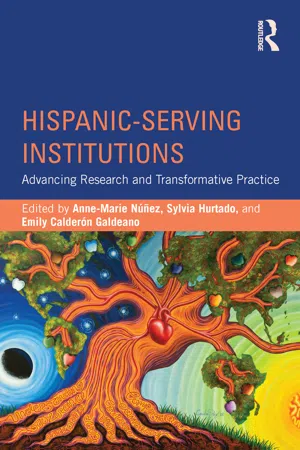
eBook - ePub
Hispanic-Serving Institutions
Advancing Research and Transformative Practice
- 228 pages
- English
- ePUB (mobile friendly)
- Available on iOS & Android
eBook - ePub
Hispanic-Serving Institutions
Advancing Research and Transformative Practice
About this book
Trusted by 375,005 students
Access to over 1.5 million titles for a fair monthly price.
Study more efficiently using our study tools.
Information
Topic
EducationSubtopic
Education General 1
Why Study Hispanic-Serving Institutions?
We are experiencing a unique moment in the history of higher education and institutional change. In recent decades, U.S. higher education has reached a point of providing nearly universal postsecondary education, including options in many different institutional types (Thelin, 2013; Trow, 1970). Yet postsecondary access is still significantly stratified by income and race/ethnicity (e.g., Carnevale & Strohl, 2013), even though the proportion of Americans in general and the share from populations that historically have had less access to higher education are both higher than they ever have been before (e.g., Thelin, 2013). External pressures to better serve diverse student populations are on the horizon.
At the same time, the United States has seen significant shifts in its demographic composition. The Hispanic1 population in particular has grown at a remarkable rate, from just 4.5% of the U.S. population in 1970, to 16.3% in 2010, surpassing African Americans as the largest non-White population in this country (U.S. Census Bureau, 2010). Latina/o youth constitute more than half of K–12 students in California and Texas (Gándara & Contreras, 2009), and Latinas/os now represent the largest non-White group of college students in the country (Fry, 2011). Some projections indicate that by 2050, at least 3 in 10 U.S. residents will be of Latina/o origin (Sáenz, 2010).
In line with this demographic transformation, we are witnessing a significant trend among established institutions in American higher education: More two-year and four-year colleges and universities are serving at least a 25% Latina/o student body, and are now federally recognized as Hispanic-Serving Institutions (HSIs) (Santiago, 2006). Currently, there are 370 institutions designated as HSIs, and an additional 277 have between 15% and 24% Latina/o enrollment, and hence are known as emerging HSIs (Calderón Galdeano & Santiago, 2014). Many recently established higher education institutions are now HSIs that have been tasked to serve historically underrepresented populations in new regions (Hurtado & Guillermo-Wann, 2013). Examples include all five California State University campuses founded within the past 50 years, as well as two out of the three new University of California and University of Texas campuses established in that time frame. Furthermore, as Latinas/os settle in more diverse parts of the country, HSIs are emerging in more diverse geographic locations (Torres & Zerquera, 2012).
While many studies have focused on Latinas/os in higher education,2 Michael Olivas (1982) and Berta Vigil Laden (1999) were the first scholars to call for specific policy and research attention to these institutions. In 1982, Olivas reported on the development of Chicana/o (Colegio Cesar Chávez) and Puerto Rican colleges (Hostos Community College and Boricua College) that had been established to serve these populations on the U.S. mainland. Based at the time on the small number of institutions with a historic mission to serve Latinas/os, he contended that, “The future of Chicanos in higher education appears to be in penetrating majority institutions [and] convincing policymakers that minority institution programs will not reach enough Chicano students” (Olivas, 1982, pp. 42–43). From a historic and legal standpoint, he accurately foretold that the model for institutions that might serve Latinas/os would not develop in the same manner as it had for those whose missions focused on serving Blacks and Native Americans. However, he did not anticipate the Latina/o population growth that would coincide with the recognition of HSIs, many of which were transformed from broad access predominantly White institutions (PWIs) to institutions with HSI status.
Once HSIs became federally recognized in 1992, Berta Vigil Laden (1999, 2001) was the first scholar to place these institutions and their stories at the center of a research agenda. When she began her scholarship in this area, she astutely acknowledged that, at the time, fewer than a handful of manuscripts had identified HSIs (Laden, 1999). As a pioneer in identifying the importance of federal recognition for these institutions, she served as a strong advocate for their support.
Since Olivas (1982) and Laden (1999, 2001) focused on and advocated for institutions that become federally designated to serve Latina/o students, limited research to date has addressed the implications of the growth of these institutions for higher education, or the institutional behaviors and changes required to address the needs of their diverse student bodies (Nora & Crisp, 2009). We do not know enough about whether changes at HSIs are evolutionary or actively managed so that institutional culture and daily practices are transformed in ways befitting their changing student populations. Moreover, we need to learn how HSIs are unique as a set of institutions that face similar changes, challenges, and external pressures. Finally, more research is needed to advance and transform practice in a way that incorporates an inclusive excellence perspective (Association of American Colleges and Universities, 2014) that integrates diversity and equity as central features.
The goal of this book is to provide new research and to advance the study of HSIs as complex organizations as they undergo change and respond to external pressures (Kezar, 2014), including demographic change, increased institutional accountability, and resource constraints. We aim to provide a better sense of the following: (1) the institutional characteristics and diversity among HSIs; (2) how HSIs are similar to or different from other higher education institutions; (3) how HSIs form organizational identities, develop organizational behaviors, and build institutional capacity to respond to diverse student bodies; and (4) why it is critical to understand HSIs’ localized contexts, particularly with regard to economic resources for institutions and students.
Organizational studies of higher education in the United States have, to date, focused on the behaviors of the most elite and selective institutions, while scant research has addressed community colleges or less selective four-year institutions with relatively (or completely) open admissions policies—institutions that enroll at least 80% of college students in this country (Kirst, Stevens, & Proctor, 2010). Thus, this book addresses a critical gap in the research on these so-called broad access institutions (Bastedo, 2012; Kirst et al., 2010). In addition, this edited volume advances organizational studies in higher education by providing examples of perspectives and empirical research that employ various lenses to understand how HSIs navigate complex and challenging environments and serve diverse students. Finally, a central goal of this book is to shift assumptions and inform competing narratives about HSIs, to illustrate how these institutions play a critical role in the U.S. higher education landscape—particularly in developing the talents of many students who may not otherwise attend college and/or who face challenges in completion—and serve as critical engines of social mobility.
Universal Higher Education, Institutional Stratification, and the Role of HSIs
HSIs have resulted from broader trends, both nationally and more specifically within U.S. higher education. U.S. income inequality is currently among the highest in the world, and has increased relative to other countries (Organisation for Economic Co-operation and Development [OECD], 2011). Many countries across the globe are increasing postsecondary opportunities, as growth in average educational attainment appears to be “the single most important factor contributing not only to reduced wage dispersion among workers but also to higher employment rates” (OECD, 2011, p. 31). This has prompted President Obama to position improved college degree attainment as an important component of efforts to strengthen the U.S. economy and increase social equity, with a corresponding interest in holding institutions accountable for degree completion rates (Espinosa, Crandall, & Tukibayeva, 2014).
Indeed, universal higher education has come to be seen as an important mechanism for providing educated and skilled workers to advance the U.S. economy (Goldin & Katz, 2009). Trow (1970) noted the movement of the U.S. postsecondary system from an elite approach—providing education to a limited number of students at a handful of institutions—to a universal approach for all individuals interested in pursuing college, including at community colleges and four-year institutions of varying selectivity, in a wide variety of locations around the country. The numbers and types of postsecondary institutions in the United States have increased as a result, leading to a diverse system of institutions stratified by prestige, racial/ethnic composition, and resources (e.g., Birnbaum, 1991; Carnevale & Strohl, 2013).
Observers have noted that the movement toward universal education has posed deep challenges for higher education (Thelin, 2013; Trow, 1970). The historical trends of increasing enrollments of students from more diverse backgrounds (in many, but not all, higher education institutions) during a time of increasing resource constraints mean that, in the words of historian John Thelin (2013), “a university will be hard pressed to maintain a high graduation rate” (p. 112). Furthermore, “such quantitative changes are accompanied by fundamental qualitative changes in what the college experience is and what the American campus is” (Thelin, 2013, p. 112). These changes call upon higher education institutions to transform their organizational cultures to serve students from different backgrounds, in response to the various historical, economic, and social contexts within which they are embedded (Hurtado, Álvarez, Guillermo-Wann, Cuellar, & Arellano, 2012).
This emphasis on universal access to postsecondary education has, in fact, incorporated a movement of holding higher education institutions more accountable, with success often measured by college graduation rates (Espinosa et al., 2014; Toutkoushian & Webber, 2011). For example, the Obama administration’s planned postsecondary ratings system—to be implemented in 2015—will provide students and families with information to compare the performance of institutions. The administration also proposes to tie these ratings to institutional performance funding. There is much concern, however, that such a policy could disadvantage broad access institutions (Espinosa et al., 2014), and specifically HSIs (Núñez, 2014), in their capacity to serve students.
HSIs are more likely than other institutions to educate a significant proportion of students from populations that have historically had less access to higher education, including low-income, first-generation, and underrepresented racial/ethnic minority students, as well as students who are less academically prepared for college (Hispanic Association of Colleges and Universities [HACU], 2012; Núñez & Bowers, 2011; Núñez & Elizondo, 2012). HSIs tend also to have fewer resources to support these students (HACU, 2012). Having fewer institutional resources and larger proportions of students from low-income backgrounds are both independently and negatively related to graduation rates (Bound, Lovenheim, & Turner, 2010; Titus, 2006a, 2006b, 2009; Webber & Ehrenberg, 2009). These same issues have contributed to less value being placed on the significant role of broad access institutions more generally in educating the majority of American college students (Kirst et al., 2010).
Because broad access institutions and community colleges enroll the majority of U.S. college students (Kirst et al., 2010), they clearly play a large role in educating individuals who contribute to the nation’s workforce and economic growth. Likewise, given the current and expected increases in Latinas/os as a share of the overall population, any efforts to raise U.S. postsecondary degree completion and attainment must target this and other groups that historically have had less postsecondary access. Thus, considering that HSIs graduate 40% of Latina/o baccalaureates in the United States (Harmon, 2012), we see the potential for HSIs ultimately to reduce the gaps in U.S. educational and economic inequality. As described in the rest of this chapter and throughout this volume, however, HSIs face tremendous challenges in supporting the success of their students.
Distinguishing HSIs among Other Minority-Serving Institutions
HSIs are the largest and fastest growing segment of a broader group of institutions that have historically targeted underserved groups of students, including Latinas/os, African Americans, and Native Americans. Many of these institutions are part of a diverse group known as Minority-Serving Institutions (MSIs). Historically Black Colleges and Universities (HBCUs) and Tribal Colleges and Universities (TCUs) have missions to explicitly support students from specific underrepresented backgrounds due to systematic exclusion from postsecondary opportunity and historic de jure segregation (Olivas, 1982). Due to their classification, they automatically receive federal funding from the government. The same is not the case for HSIs. Furthermore, the number of HBCUs (100) and TCUs (33) is relatively stable, and these institutions tend to have small student enrollments (Calderón Galdeano & Santiago, 2014), while the average enrollment size for an HSI in the 2008–2009 academic year was 6,173 students (Núñez, Crisp, & Elizondo, in press).
HSIs are federally designated not by a specific mission to serve Latina/o students, but rather by their relatively high enrollment (at least 25%) of Latina/o students. The number of HSIs is more than double that of all other MSIs (Calderón Galdeano & Santiago, 2014) and only continues to grow. Notably, “Hispanic-Serving” does not mean serving only Hispanic students—the student bodies of HSIs are diverse. In 2012–2013, HSIs enrolled 59% of all Latina/o students in higher education, and also enrolled 28% of Asian American, 16% of Black, 14% of American Indian, and 10% of White students nationally. In fact, HSIs enroll a greater share of Black students in the United States than HBCUs (16% and 10%, respectively) and a higher share of Native American students than TCUs (14% and 11%, respectively) (Calderón Galdeano & Santiago, 2014). With compositional diversity achieved among HSIs, a continuing focus on equity requires systematic study of other elements of these colleges, such as the psychological, behavioral, and organizational dimensions of the environment (see Hurtado & Ruiz Alvarado, Chapter 2, this volume). Accordingly, studies on HSIs hold the promise of generating new knowledge about diversity and equity across higher education as well as within particular institutions.
Most of the research on HSIs to date has focused on their contributions to traditional student outcomes, such as degree attainment and persistence, but the narratives that surround these institutions are sometimes in conflict. For example, HSIs have been celebrated for the quantity of graduates they produce from low-income, first-generation, and Latina/o backgrounds (Harmon, 2012). Many students have earned undergraduate or graduate science, technology, engineering, and mathematics (STEM) degrees—only about 9% of all postsecondary institutions were HSIs during the 2008–2009 academic year, yet they produced nearly 65% of the STEM certificates, 61% of the STEM associate’s degrees, and 40% of the STEM bachelor’s degrees earned by Latinas/os (Malcom-Piqueux & Lee, 2011). Thus, HSIs are preparing Latinas/os for the growth of new jobs in STEM fields. At the same time, however, HSIs are also often criticized for their relatively low persistence rates in comparison to other institutions (Contreras, Malcom, & Bensimon, 2008). Part of the reason for these competing narratives is that research to date has typically not examined the institutional characteristics, resources, and activities within HSIs that could contribute to these outcomes, nor has it looked at how these institutions operate at the ground level. Given the capacity of HSIs to impact more students, there is much to be gained from expanding research on HSIs’ contributions to degree attainments and many other outcomes connected to their mission.
While many HSIs are still primarily broad access and regionally focused (García, 2013; Núñez et al., 2014), they are often called upon by public agencies to broaden their organizational identities and to extend their purposes and functions. Specifically, in serving students from historically underrepresented backgrounds, HSIs must also respond to challenges to reinvigorate local economies (Vega...
Table of contents
- Cover
- Title
- Copyright
- Contents
- Foreword: Then and Now
- Acknowledgments
- 1 Why Study Hispanic-Serving Institutions?
- Part I Contextualizing the Culture, Structure, and Identity of Hispanic-Serving Institutions
- Part II Framing Institutional Actors and Experiences Within Hispanic-Serving Institutions
- Part III Building Capacity and Accountability in Hispanic-Serving Institutions
- Appendix
- List of Contributors
- Index
Frequently asked questions
Yes, you can cancel anytime from the Subscription tab in your account settings on the Perlego website. Your subscription will stay active until the end of your current billing period. Learn how to cancel your subscription
No, books cannot be downloaded as external files, such as PDFs, for use outside of Perlego. However, you can download books within the Perlego app for offline reading on mobile or tablet. Learn how to download books offline
Perlego offers two plans: Essential and Complete
- Essential is ideal for learners and professionals who enjoy exploring a wide range of subjects. Access the Essential Library with 800,000+ trusted titles and best-sellers across business, personal growth, and the humanities. Includes unlimited reading time and Standard Read Aloud voice.
- Complete: Perfect for advanced learners and researchers needing full, unrestricted access. Unlock 1.5M+ books across hundreds of subjects, including academic and specialized titles. The Complete Plan also includes advanced features like Premium Read Aloud and Research Assistant.
We are an online textbook subscription service, where you can get access to an entire online library for less than the price of a single book per month. With over 1.5 million books across 990+ topics, we’ve got you covered! Learn about our mission
Look out for the read-aloud symbol on your next book to see if you can listen to it. The read-aloud tool reads text aloud for you, highlighting the text as it is being read. You can pause it, speed it up and slow it down. Learn more about Read Aloud
Yes! You can use the Perlego app on both iOS and Android devices to read anytime, anywhere — even offline. Perfect for commutes or when you’re on the go.
Please note we cannot support devices running on iOS 13 and Android 7 or earlier. Learn more about using the app
Please note we cannot support devices running on iOS 13 and Android 7 or earlier. Learn more about using the app
Yes, you can access Hispanic-Serving Institutions by Anne-Marie Nunez, Sylvia Hurtado, Emily Calderón Galdeano, Anne-Marie Nunez,Sylvia Hurtado,Emily Calderón Galdeano in PDF and/or ePUB format, as well as other popular books in Education & Education General. We have over 1.5 million books available in our catalogue for you to explore.