![]()
1
What is health and safety all about?
In this chapter you will learn:
why health and safety is important; what health and safety is all about; standards for lone workers, home working and the self-employed; role and function of other external agencies; how to get started – hazards, risk assessment and control measures. 1.1 Introduction
Accidents and ill health result from ‘hazards’, like electricity and cleaning chemicals – things that are found everywhere. But these things can easily be controlled so that they do not harm people. This is true in every aspect of our lives, whether we are at home, at leisure or at work. The term ‘harm’ involves both injury to people and damage to their health. In this book we shall explain how you can manage and control these hazards so that people at work are protected and you, as a manager, employer, self-employed or employee are complying with the law. Working safely means that people work in ways that minimise the possibility of injury or damage to their health or the health of other people.
Everyone needs to work safely and this book is intended for managers as well as the people working for them. It is designed to be an easy guide to health and safety, covering in simple straightforward language the issues involved in many small businesses, which means most of the enterprises in the UK today.
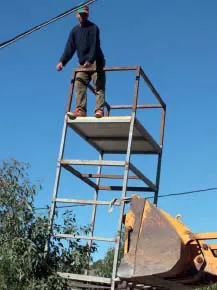
Figure 1.1 An accident waiting to happen – a man working from a crude platform tied to a digger bucket which was driven round the site while the workman attached a new wi-fi cable to the existing line. This is a dangerous way to work at height. A mobile elevating platform (MEWP) designed and built for the task should have been used. The platform should be lowered when travelling around the site. The handrails should be considerably higher than shown, with intermediate rails provided.
Falling down stairs, slipping on wet floors, hitting or being hit by objects, breathing in dangerous fumes, receiving an electric shock, and getting burnt or killed in a fire are all common examples of the sorts of accidents that happen to people at work.
This book shows the kinds of things that cause the more common accident and health problems. It lets people see what applies to their own work activities, and tells them how to get more help and information.
This is especially important for people in charge of work activities – for example, people who employ others, because they have significant legal responsibilities. Everyone at work has legal responsibilities but they fall much more heavily on those in charge.
Throughout this book useful and well-produced Health and Safety Executive (HSE) booklets are referred to. You can get these, often free, from HSE Books, or download them free from the HSE website (www.hse.gov.uk). The HSE is the central government-funded body that looks after health and safety at work.
For more sources of information, see Chapter 10.
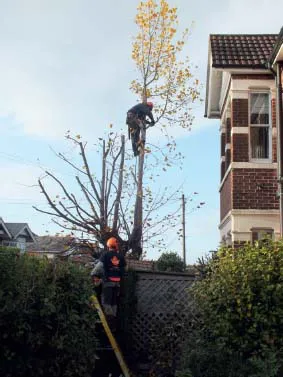
Figure 1.2 A tree surgeon at work – a very hazardous task unless, as in this case, it is done by qualified people who are following detailed safety precautions such as using full harnesses and body protection from the chainsaw and a safe system of work, including leaving a strong supporting branch until last.
1.2 Why is health and safety such an important topic?
Nobody chooses to get hurt at work, yet every year over 150 people are killed while working. About 175,000 non-fatal accidents are reported (more than seven days’ absence from work) and some 2.2 million people are estimated to suffer from ill health caused or made worse by work. If those who are killed and injured on the roads in mobile workplaces are added, this amounts to over 1,000 deaths and 260,000 injuries. That is over 100 people killed and 36,000 injured every month while at work. Putting other people’s lives and health at risk in this way is not acceptable, especially when, as is often the case, workers are not entirely aware of the risks they are taking. Everyone should be able to go to work, feeling confident that they will end each working day without being harmed.
It’s easy to believe that accidents at work are unusual or exceptional, the sort of things that never happen in your workplace. But this is not true as accidents do happen in workplaces like yours. In many cases a few basic precautions could have prevented an accident from happening.
Making your workplace safe doesn’t have to be expensive, time-consuming or complicated. In fact, working safely and efficiently will often save you money. But even more importantly, it can save lives.
The Chair of the HSE, Judith Hackett, made some comments on the fortieth anniversary of the Health and Safety at Work Act in 2014:
Arguably it is one of the best pieces of legislation on the statute books – although we know it is often misunderstood and misinterpreted. It has protected millions of British workers, and driven sharp reductions in incidents of occupational death, serious injury and ill health.
In 1974, fatalities to employees covered by the legislation in place then stood at 651. The latest figure for 2012/13 was down to 148 for employees and self employed combined. The actual reduction is probably more than this as data for sectors not covered by health and safety law pre 1974 was not collected. In the same time frame (and with the same caveat) non-fatal injuries have dropped by more than 75 percent. There is still room for improvement clearly, but the change in the last 40 years is quite remarkable.
Before the 1974 Act there was a host of different regulations – some industries swamped with prescriptive rules and others with little or no regulation at all. Something needed to be done.
The 1972 Robens Report concluded there were too many regulations and that what was needed was a regulatory regime that set broad, non-prescriptive goals for dutyholders, underpinned by a fundamental principle: ‘those that create risk are best placed to manage it’.
The Act that emerged from his review swept away detailed and prescriptive industry regulations; it created a flexible system where regulations describe goals and principles, supported by codes of practice and guidance. Based on consultation and engagement, the new regime was designed to deliver a proportionate, targeted and risk-based approach.
Forty years on this approach still applies. Despite having diversified away from an economy based predominantly on heavy industry and manufacturing, much of the original vision and framework of the Health and Safety at Work Act 1974 remains relevant. The principles have been applied time and again to new and emerging technologies and sectors. The legacy is a safety record envied around the world.
Forty years on the Health and Safety at Work Act has demonstrated it can be applied to new responsibilities and new demands, creating the framework for people to come home safe and well from a day’s work in any sector of the economy.
The Olympic stadia built for the London 2012 Games were the first in history to have been built without a fatal accident occurring. The horrific number of deaths reported in Qatar (a small but very wealthy nation) during the building of the stadia and other buildings for the 2022 World Cup demonstrates how much safer it is to work in the UK.
There is little doubt that massive improvements in health and safety standards have been made in the UK. However, we should not forget that many hazardous jobs have been outsourced to less well controlled and sometimes much poorer countries. For example, the 2013 factory collapse in Dhaka where 1,100 textile workers lost their lives is one of the largest losses of life in an industrial accident ever recorded. From 1985 to 2012 the number of people working in garment factories in Bangladesh rose from a few thousand to four million, while the UK garment industry virtually disappeared.
An initial visual inspection of 102 buildings in Bangladesh, including 60 garment factories, carried out by experts from the country’s leading engineering university after the Dhaka collapse, found that most had some structural problems. Many of the UK textile mills built in the nineteenth century are still standing today. A structural collapse is almost unheard of, although fire deaths were much m...