eBook - ePub
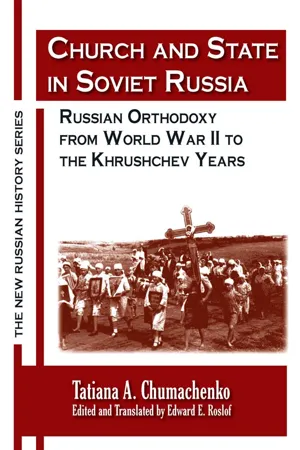
Church and State in Soviet Russia
Russian Orthodoxy from World War II to the Khrushchev Years
- 260 pages
- English
- ePUB (mobile friendly)
- Available on iOS & Android
eBook - ePub
Church and State in Soviet Russia
Russian Orthodoxy from World War II to the Khrushchev Years
About this book
Church-state relations during the Soviet period were much more complex and changeable than is generally assumed. From the German invasion of the Soviet Union in 1941 until the 21st Party Congress in 1961, the Communist regime's attitude toward the Russian Orthodox Church zigzagged from indifference and opportunism to hostility and repression. Drawing from new access to previously closed archives, historian Tatiana Chumachenko has documented the twists and turns and human dramas of church-state relations during these decades. This rich material provides essential background to the post-Soviet Russian government's controversial relationship to the Russian Orthodox Church today.
Information
Chapter 1
Church and State from World War II Until 1948
The Council for Russian Orthodox Church Affairs and Its Commissioners: Establishment of a Bureaucracy
Stalin’s intention to change the nature of church-state relations raised the issue of forming an agency that would implement the government’s new ecclesiastical policy. Stalin himself determined the status, function, and even the name for the agency before his meeting on September 4, 1943, with Georgii Karpov, a colonel in the secret police.1 When Karpov expressed his opinion in favor of creating such an agency under the auspices of the Supreme Soviet of the USSR, Stalin disagreed. He said that it should be a special committee or council for Russian Orthodox Church affairs under the direction of Sovnarkom. With these words, the head of the government clearly wanted to emphasize this essential point: the council would be formed as an organ of executive power. Stalin established its purpose with these words: “The council should be the link between the government and the patriarch. The council itself will not make decisions. Instead, it should report everything to the state and pass on government decisions to the church on the state’s behalf.”
Karpov was appointed chairman of the newly created body. In this capacity, he participated in Stalin’s conversation with the leadership of the Russian Orthodox Church (Metropolitans Sergii, Aleksii, and Nikolai) that took place late in the evening that same day. At the end of the meeting, Stalin informed the bishops that he planned to create a special organ—the Council for Russian Orthodox Church Affairs—and to name Karpov as its chairman. The metropolitans responded favorably to this information, thus showing that they knew Comrade Karpov and respected his appointment. Turning to Karpov, Stalin gave his final instructions: “Choose two or three assistants as members of your Council. Create a staff. But always remember, first that you are not the Over-Procurator of the Holy Synod* and second that your work should heavily emphasize the church’s independence.”2
The building selected for the Council for Russian Orthodox Church Affairs was a two-story detached house located at 20 Kropotkin Street in Moscow. On orders from Viacheslav Molotov,** the building’s premises were made available within two weeks—the first floor had been used as apartments, and the second floor had held the offices and library of the Communist Party organization for the city’s Frunze region. At the end of September 1943, the new Council’s personnel began their work. Its staff originally consisted of a vice chairman, an assistant to the chairman, a corresponding secretary, an assessor, a group of four inspectors, and service personnel. Agents from the People’s Commissariat for Internal Affairs (NKVD) occupied leadership positions on the Council.
Karpov headed the Fourth Department of the NKVD’s Third Secret Political Directorate from December 1941; the first subsection of his Department had responsibility for “the struggle against church and sectarian counterrevolution.” Molotov thought it was natural to combine the duties of that position and those of chairman of the Council for Russian Orthodox Church Affairs. In a conversation on October 13, 1943, he told Karpov, “As long as your official position in the NKGB is not published in the newspapers and isn’t officially known, I think it is possible to combine the two jobs. But, we will decide this later.”3 His dual responsibilities continued until March 1955 when Karpov retired from the KGB. K.A. Zaitsev, a NKGB major, was appointed vice chairman of the Council. Karpov nominated him for that position, just as he recommended NKGB Major N.I. Blinov for the post of assistant to the chairman.
The Personnel Division of Sovnarkom’s Administrative Department filled the remaining staff positions. According to Karpov’s statements, however, employees only reluctantly went to work for the Council. Molotov had to intervene by calling Ia. Chaadaev in the Administrative Department. Molotov ordered him to help the Council in all areas and, along these lines, issued instructions that “all personnel must receive special privileges.”4 As a result, salaries were raised (for example, the Council chairman’s salary was increased from 2,500 to 3,900 rubles per month), and members of the Council received the right to use both the Kremlin cafeteria and facilities under the Fourth Directorate of the Soviet Union’s Ministry of Health. All other Council personnel were given exemptions from being drafted into active military service.5 The problem of recruiting personnel for the Council was solved. Staff members of the new state administrative agency set to work.
Sovnarkom approved the “Regulations for the Council of Russian Orthodox Church Affairs” on October 7, 1943, in Decree No. 1095. The regulations defined the basic functions and tasks of the Council:
1. The Council for Russian Orthodox Church Affairs serves as the link between the government of the USSR and the Patriarch of Moscow and All Russia on issues related to the Russian Orthodox Church.…
2. The Council for Russian Orthodox Church Affairs is responsible for:
(a) preliminary review of issues raised by the Patriarch of Moscow and All Russia that require action by the government;
(b) drafting legal acts and decrees for issues concerning the Russian Orthodox Church, as well as instructions and other orders on their implementation, and presenting these to Sovnarkom USSR for its review;
(c) oversight for the proper and timely implementation of the government’s laws and decrees relating to the church throughout the USSR;
(d) presentation of recommendations to Sovnarkom USSR on issues relating to the Russian Orthodox Church and presentation of timely informational reports to the government of the USSR on the condition, status, and activity of the Russian Orthodox Church throughout the USSR;
(e) counting the total number of churches and compilation of statistical reports based on data collected by local administrative bodies.
3. The Council for Russian Orthodox Church Affairs has its own commissioners through Councils of Ministers of union and autonomous republics, regional executive committees, and city executive committees. These commissioners function in accordance with Point 3 of the “Regulations” and instructions from the Council.
4. The Council for Russian Orthodox Church Affairs has the right:
(a) to demand that central and local administrative organs present essential information and material on issues connected with the Russian Orthodox Church;
(b) to form commissions for resolution of separate issues.
5. All central administrative offices and authorities in the USSR will coordinate with the Council for Russian Orthodox Church Affairs in advance on measures being implemented in connection with issues relating to the Russian Orthodox Church.
6. The Council for Russian Orthodox Church Affairs has its own stamp and seal.6
In status, the Council had the same footing as other committees and commissions that operated under the auspices of Sovnarkom. Sovnarkom Vice Chairman Molotov supervised its activity on behalf of the government. All accounts, reports, and other documents should have been addressed to him but some, “especially on matters of principle,” were sent directly to Stalin.7
The internal structure of the Council took shape. Its leadership team—the members of the Council—consisted of three men: Chairman Karpov, Vice Chairman Zaitsev, and I.I. Ivanov, leader of the group of inspectors. In accordance with “The Staff Manual for Personnel in the Council for Russian Orthodox Church Affairs” adopted on January 15, 1944, the responsibilities of these Council members included: organization of activity by commissioners through the Council’s inspectors, control over patriotic work by the Russian Orthodox Church, control over publications by the church’s Holy Synod as well as over activities of the church’s theological schools, and organizing the registration of Orthodox bishops. Duties of other Council employees also were established. The assistant to the chairman conducted secret record-keeping. The assessor, who reported to the vice chairman, prepared overviews of the church’s activities and status while also tracking both theological schools and the personal registration documents of bishops. A legal consultant for the Council prepared draft legislation, decrees, and instructions relating to the activity of religious organizations; he also provided informational reports on matters that arose in the course of the Council’s work. The Council’s inspectors were responsible for organizing the work of regional commissioners, preparing statistical summaries, and counting the number of churches and chapels.8
During the first months of its existence, the Council experienced all the difficulties characteristic of a newly formed organization. It was plagued by the lack of simple things such as glue, paper, envelopes, and file folders. The problem of providing the Council with folders continued until the end of 1945 when, at a conference with the Council’s chairman, Senior Inspector V. Spiridonov noted that approximately three hundred files on requests to open churches had not been properly set up due to the lack of file folders. Obeying mandatory requirements for secrecy in clerical work often hindered or delayed staff members in the fulfillment of their assigned tasks. Council inspectors complained about frequent shuffling of regions under their supervision and “spontaneous” official business trips to the provinces that were often unplanned and carried out on Karpov’s personal orders. Unexpected “rush jobs” also disrupted staff work. For example, in January and February 1945 the whole office was busy preparing for a national council of the Russian Orthodox Church.9
The primary complication in these early years, however, came from another source. Workers in the Council for Russian Orthodox Affairs, the majority of whom formerly served in the state bureaucracy, lacked work experience or even knowledge essential for the specialized task of interacting with religious organizations under the new ecclesiastical policy. The Council’s leaders were significantly less educated than church leaders. The only member of the Council who had more than a secondary education was G.T. Utkin, head of the department for central church administration. Other Council staff members with higher education included a translator, the corresponding secretary K.G. Anisimov (with a degree in history), and the legal consultant I.V. Pokrovskii (with a law degree).10
Work itself provided the necessary experience. Mistakes and errors forced Council personnel to seek new and more effective methods for organizing their activity. Staff turnover led to the hiring of new people. Thus, K.A. Zaitsev was relieved of his position as vice chairman of the Council in March 1945. He was replaced by S.K. Belyshev, a lieutenant-colonel in the secret police, on Karpov’s recommendation.11 K.G. Anisimov resigned as corresponding secretary in October 1946, and P.I. Barashkov took his place. The Council’s structure was also revised many times. In January 1945, its leaders decided to create two divisions: an inspectorate and a department on central administrative affairs for the Russian Orthodox Church.
At the end of 1945, the staff makeup was discussed anew. The Council adopted a motion to form a secret section, whose staff would be responsible for receiving, expediting, registering, and filing classified documents. A new position of statistician was created to more accurately count churches and chapels. The Council also decided to increase the size of its staff.12 Karpov presented this proposal to the government at the beginning of 1946. In a report to Molotov, Karpov wrote, “The staff of the Council as approved in 1943 is not sufficient for its increased volume of work and at present requires certain structural changes as well as a negligible increase in personnel.”13
Sovnarkom ratified the new structure and staff of the Council through special Decree No. 1506 on February 2, 1946, entitled “Ratification of the Structure, Staff, and Official Salary Scales for Workers in the Council for Russian Orthodox Church Affairs.” In accordance with this decision, the Council’s staff in 1946 included thirty-two workers in operations and twenty-one people in administration.14 The number of individuals employed later changed, but the Council’s structure as a whole remained unaltered for the rest of Karpov’s tenure.
While resolving organizational problems related to the work of the staff, Karpov and other members of the Council took steps to strengthen their local representatives—the Council’s commissioners. The office of commissioner was crea...
Table of contents
- Cover Page
- Half Title page
- Series Page
- Title Page
- Copyright Page
- Contents
- List of Abbreviations and Acronyms
- Editor's Preface
- Foreword to the Russian Edition
- Introduction
- 1. Church and State from World War II Until 1948
- 2. Church-State Relations Between 1948 and 1957
- 3. The Soviet State and the Russian Orthodox Church, 1958–61
- Conclusion
- Notes
- Sources and Bibliography
- Index
Trusted by 375,005 students
Access to over 1.5 million titles for a fair monthly price.
Study more efficiently using our study tools.
Frequently asked questions
Yes, you can cancel anytime from the Subscription tab in your account settings on the Perlego website. Your subscription will stay active until the end of your current billing period. Learn how to cancel your subscription
No, books cannot be downloaded as external files, such as PDFs, for use outside of Perlego. However, you can download books within the Perlego app for offline reading on mobile or tablet. Learn how to download books offline
Perlego offers two plans: Essential and Complete
- Essential is ideal for learners and professionals who enjoy exploring a wide range of subjects. Access the Essential Library with 800,000+ trusted titles and best-sellers across business, personal growth, and the humanities. Includes unlimited reading time and Standard Read Aloud voice.
- Complete: Perfect for advanced learners and researchers needing full, unrestricted access. Unlock 1.5M+ books across hundreds of subjects, including academic and specialized titles. The Complete Plan also includes advanced features like Premium Read Aloud and Research Assistant.
We are an online textbook subscription service, where you can get access to an entire online library for less than the price of a single book per month. With over 1.5 million books across 990+ topics, we’ve got you covered! Learn about our mission
Look out for the read-aloud symbol on your next book to see if you can listen to it. The read-aloud tool reads text aloud for you, highlighting the text as it is being read. You can pause it, speed it up and slow it down. Learn more about Read Aloud
Yes! You can use the Perlego app on both iOS and Android devices to read anytime, anywhere — even offline. Perfect for commutes or when you’re on the go.
Please note we cannot support devices running on iOS 13 and Android 7 or earlier. Learn more about using the app
Please note we cannot support devices running on iOS 13 and Android 7 or earlier. Learn more about using the app
Yes, you can access Church and State in Soviet Russia by Tatiana A. Chumachenko,Edward E. Roslof in PDF and/or ePUB format, as well as other popular books in Theology & Religion & European History. We have over 1.5 million books available in our catalogue for you to explore.