![]()
1
CREATING NEW LANDSCAPES FOR OLD EUROPE
Herta Hammerbacher, Sylvia Crowe, Maria Teresa Parpagliolo
Sonja Dümpelmann
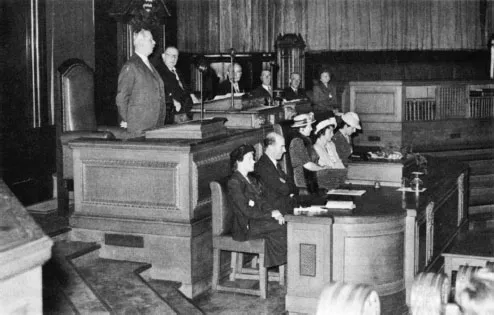
At the opening of the first International Conference of Landscape Architecture in London in 1948, which led to the foundation of the International Federation of Landscape Architects (IFLA), eight landscape architects sat on the podium: four men and four women (Figure 1.1).1 This gender equality did not, however, reflect the true percentage of women and men in the profession at the time – women were and still are in the minority. Neither did it influence subsequent historiographies in which women have been largely neglected. However, it does attest to the fact that the still relatively young discipline of landscape architecture provided women with an opportunity to enter the professional world, despite discrimination and doubts on the part of many of their male colleagues. As Thaïsa Way has shown, women can be portrayed as “a force in landscape architecture” playing an active role in the profession’s development rather than as passive professionals “helplessly subject to men.”2 In fact, as Karen Madsen and John Furlong pointed out in 1994, “garden and landscape architecture has also been a tool for women’s emancipation.”3 The three women discussed in this essay were pioneers of the profession in Europe, and they both created and seized the opportunities of this young profession. The German landscape architect Herta Hammerbacher (1900–1985), and her British and Italian colleagues Sylvia Crowe (1901–1997) and Maria Teresa Parpagliolo (1903–1974), perceived landscape architecture as a chance to lead independent professional lives at a time when most women’s activities were still limited to housekeeping and childrearing in the shadow of their husbands’ businesses and professional lives.
The international conference had been proposed in 1946 by another woman: Lady Allen of Hurtwood.4 As Marjorie Allen, she had received some informal gardeners’ training during the World War One years. After a diploma course in horticulture at University College, Reading, she had designed and promoted the establishment of roof gardens in the 1920s and 1930s and she was elected the first fellow of the British Institute of Landscape Architects in 1930. In the 1940s and 1950s, she campaigned for the implementation of adventure playgrounds in Britain, following the example of C. Th. Sørensen’s first adventure playground in Emdrup, Denmark, in the early 1940s.5 On the occasion of the 1948 conference, Allen shared the podium with the female landscape architects Brenda Colvin,6 Maria Teresa Parpagliolo Shephard and Sylvia Crowe. Crowe had chaired the organizing committee, and her Italian-born colleague Maria Teresa Parpagliolo Shephard participated in the meeting in a variety of functions, including that of translating, organizing the accompanying exhibition and leading some of the conference tours. Not present at the venue was the German landscape designer Herta Hammerbacher, whose work was influential in Maria Teresa Parpagliolo’s early years as a professional. Like all her German colleagues, Hammerbacher was excluded from participation at the conference, due to Germany’s role in World War Two. This chapter foregrounds relevant similarities in these women’s careers, in their working methods and in their roles in furthering the profession. Concentrating on the years when these women’s careers reached maturity in the 1950s, 1960s and 1970s, it also draws attention to specific events that led the lives of these women to converge directly or indirectly, even if only for short periods.
FIGURE 1.1 Four female and four male landscape architects were on the podium at the inauguration of the first International Conference of Landscape Architects, in London in 1948. The Duke of Wellington, standing on the left, is opening the conference and exhibition. To his right are Walter Owen from the London County Council, the landscape architects Geoffrey A. Jellicoe, E. Prentice Mawson, Edward Wink and Sylvia Crowe. Seated in the front row from left to right are landscape architects Lady Allen of Hurtwood, Richard Sudell, the secretary of the Institute of Landscape Architects Mrs. Douglas Browne and the landscape architects Brenda Colvin and Maria Teresa Parpagliolo Shephard. (Russell H. Butler and Loutrel W. Briggs, “The International Conference with the Institute of Landscape Architects as Hosts,” Landscape Architecture 39 (1949): 72–75 [72].)
Hammerbacher, Crowe and Parpagliolo had many things in common.7 They were of the same generation, born at the beginning of the twentieth century into liberal middle-class families. While their mothers had provided them with independent progressive female role models they found male mentors to introduce them to their prospective careers as landscape architects. Hammerbacher’s first position was among male colleagues in the design studio of the tree nursery Ludwig Späth. With a degree from the horticultural school in Berlin-Dahlem, she prepared drawings and construction documents for designs by Otto Valentien (1897–1987) and Carl Kemkes (1881–1964), a position she soon considered unsatisfying.8 Crowe trained for a while under the landscape architect Edward White (1872–1953) in London. Due to a lack of opportunities in her own country, Parpagliolo spent several months of training in the office of the British garden designer Percy Stephen Cane (1881–1976). The women began their professional education at horticultural colleges in the cases of Hammerbacher (Lehr- und Forschungsanstalt für Gartenbau Berlin-Dahlem) and Crowe (Swanley Horticultural College). Due to a lack of such colleges in Italy, Parpagliolo learned about botany and plants on her own. Their first works as landscape architects were closely related to the domestic sphere, focusing on planting and private house garden designs. However, this was the major area of occupation for European landscape designers in general at the time and, in many cases, women tended to acquire skills while working on house garden designs for members of their social networks. Although it was a woman – the German Countess Ursula Dohna – who, as early as 1874 under the pseudonym Arminius, drew attention to the necessity of “green rings” and other public open spaces in European cities, including kindergartens and playgrounds, the first garden designers to embark on the design of public urban parks and other public landscapes in Europe were men. Many of them had been trained on the job during their journeymen’s years or had been educated in the first horticultural schools founded in the early nineteenth century, such as the royal gardener’s training school near Berlin.9
Hammerbacher, Crowe and Parpagliolo were also prolific writers on a variety of subjects that included planting and garden design, and later urban design and broader environmental issues. Besides several commonalities in their biographies and careers, there were also points of direct contact among the three women. In fact, their paths crossed on a number of occasions, and they influenced each other in their work. For example, Parpagliolo’s writings and designs in the 1930s show diverse references to Hammerbacher’s house gardens and design philosophy. It appears that in 1933 she even copied the general layout of Hammerbacher’s design for the 1931 garden of the Poelzig House in Berlin-Grünewald and adopted some of its design elements.10 When the Italian visited Germany in 1936 and 1938, Hammerbacher very likely belonged to the group of German colleagues with whom she met. Furthermore, after Parpagliolo had married the Englishman Ronald Shephard in 1946, she moved to England and worked on projects in Sylvia Crowe’s newly established London office. In the same year, she collaborated on the design and planting recommendations for dune gardens in Mablethorpe on the Lincolnshire coast, a project for the reconstruction of a shoreline that had been largely transformed during World War Two, due to the construction of fortifications. An event that all three women attended and that was to influence their work was the 1964 IFLA conference in Japan, on which both Hammerbacher and Parpagliolo subsequently reported.
Hammerbacher, Crowe and Parpagliolo represent a group of independent professional women who, by the postwar years, had established themselves and had gained a high profile in their respective countries, if not internationally. They actively seized the new opportunities the profession offered in the postwar years. This meant they became involved in a variety of large-scale projects as landscape architects and consultants. Hammerbacher and Crowe embarked on projects that involved them as landscape consultants and architects for the new towns, Harlow and Basildon (Crowe), and the International Building Exhibition Interbau in Berlin (Hammerbacher). In 1954, Parpagliolo was one of the first Italian landscape architects to work for an Italian development company. Although Catherine Howett and Thaïsa Way have observed for the United States that “feminine visibility in the profession declined radically” in the war and postwar years,11 the women discussed here seized the new possibilities the profession offered after Word War Two and held representative, influential and visible positions. In fact, in 1946 Sylvia Crowe, together with her colleague Brenda Colvin, successfully argued against the merging of the Institute of Landscape Architects with the Royal Institute of British Architects.12 Having approached the field from its horticultural side rather than from architecture, as many of their male colleagues did, Crowe and Colvin were perhaps more able and more interested in seeing and maintaining a division between the two disciplines. Crowe received various honors for her work and, in 1969, was elected the first female president of IFLA. Hammerbacher became the first female professor of landscape architecture at a German university, and Parpagliolo collaborated with Pietro Porcinai (1910–1986) in an attempt to found a school for landscape architecture in Italy, a first step that smoothed the way for the organization of a qualified and professional landscape architecture practice in that country.
Not uncharacteristically for professionals of their generation, Hammerbacher, Crowe and Parpagliolo embraced modernist agendas while remaining grounded in the past. The women achieved this grounding literally by their interest in garden history, on the one hand, and in planting design, on the other. And while all three women used their plant knowledge extensively, they also pushed the profession’s boundaries by engaging in large-scale design and planning projects. They can, therefore, be described as figures of transition. Working on a variety of scales, their designs were works of synthesis that sought to elevate and promote the profession while, at the same time, firmly grounding it in its past.
Herta Hammerbacher: Hansaviertel and Stadtlandschaft
Creating a synthesis out of house and garden, landscape and city was the conceptual approach used by Herta Hammerbacher throughout her career (Figure 1.2). Born in 1900, she studied at the Höhere Lehr- und Forschungsanstalt für Gartenbau in Berlin-Dahlem from 1924 to 1926. Hammerbacher’s subsequent work as a young landscape architect, leading up to and through the years of World War Two, predominantly involved domestic garden designs, some of which she used to illustrate her 1970s publication on house gardens in Berlin. In the years 1935–1948, she worked in partnership with her first husband Hermann Mattern and the plant breeder Karl Foerster, developing the design principles that would...