- 480 pages
- English
- ePUB (mobile friendly)
- Available on iOS & Android
eBook - ePub
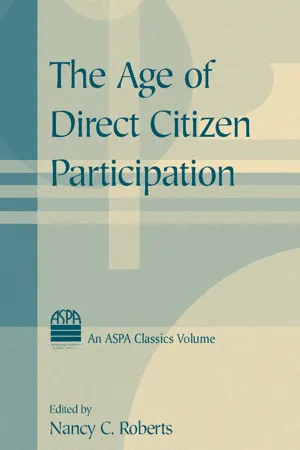
The Age of Direct Citizen Participation
About this book
Citizen involvement is considered the cornerstone of democratic theory and practice. Citizens today have the knowledge and ability to participate more fully in the political, technical, and administrative decisions that affect them. On the other hand, direct citizen participation is often viewed with skepticism, even wariness. Many argue that citizens do not have the time, preparation, or interest to be directly involved in public affairs, and suggest instead that representative democracy, or indirect citizen participation, is the most effective form of government. Some of the very best writings on this key topic - which is at the root of the entire "reinventing government" movement - can be found in the journals that ASPA publishes or sponsors. In this collection Nancy Roberts has brought together the emerging classics on the ongoing debate over citizen involvement. Her detailed introductory essay and section openers frame the key issues, provide historical context, and fill in any gaps not directly covered by the articles. More than just an anthology, "The Age of Direct Citizen Participation" provides a unique and useful framework for understanding this important subject. It is an ideal resource for any Public Administration course involving citizen engagement and performance management.
Information
PART 1
DIRECT CITIZEN PARTICIPATION
Challenges and Dilemmas
As soon as public service ceases to be the main business of the citizens, and they prefer to serve with their pocketbooks rather than with their persons, the State is already close to its ruin. Is it necessary to march to battle? They pay troops and stay home. Is it necessary to attend the council? They name deputies and stay home. By dint of laziness and money, they finally have soldiers to enslave the country and representatives to sell it.
—Jean-Jacques Rousseau
INTRODUCTION
Citizenship participation is the cornerstone of democracy, but there is a deep ambivalence about citizens participating directly in their government. On the one hand, the active role of citizens in governance is an important ideal in American life (Box 1998; Skocpol and Fiorina 1999). Direct democracy keeps community life vital and public institutions accountable. It resolves conflict through “a participatory process of ongoing, proximate self-legislation and the creation of a political community capable of transforming dependent private individuals into free citizens and partial and private interests into public goods” (Barber 1984, p. 151). Proponents of direct democracy argue that the United States has reached a point where an increase in direct involvement is not only desirable, but feasible. Citizens have the knowledge and the ability to participate more fully in the political, technical, and administrative decisions that affect them. They have demonstrated this capability when given the chance. Most important, citizens have the right to be engaged in the decisions that touch their lives (Barber 1984; Box 1998).
On the other hand, direct citizen participation in government is viewed with skepticism, even wariness. Representative democracy, or indirect citizen participation, has its advantages. It protects citizens from the dangers of direct involvement: It buffers them from uninformed public opinion; it prevents the tyranny of the majority; and it serves as a check on corruption. Representative democracy also meets the needs of a complex, postindustrial society that requires political, technical, and administrative expertise to function. Unlike public officials, citizens typically do not have the time or the interest to deliberate for the purpose of developing informed public judgment. Therefore, given the size and complexity of the modern nation-state, direct citizen participation is not a realistic or feasible expectation (Dahl 1989).
The ongoing debate about direct versus indirect citizen participation has a bearing on administrative theory and practice (Cooper 1984; Rohr 1984; Stivers 1990; Wamsley et al. 1987; Frederickson 1997; King and Stivers 1998; Warner 2001). In the course of their work, public officials and administrators make decisions and take actions that land them on either side of the great divide. They can invite direct citizen participation and include citizens in developing bureau policy, or they can discourage it, even prevent it, in the execution of their duties (Thomas 1995). Administration thus becomes an important focal point, and some would say battleground, in discussions over public involvement in government. As Camilla Stivers (1990) notes, “A key question in the history of the U.S. administrative state has been the extent to which the administration of a representative government can accommodate citizens actively involved in public decision making” (p. 88).
What makes this question even more intriguing for administrative theory and practice is the “social experiment” that has been under way over the course of the last century, especially since 1950. Citizen participation has been mandated in many public policies and programs. Citizens have been included more directly (either by law or administrative discretion) into administrative practice (Advisory Commission on Intergovernmental Relations 1979). Direct citizen participation is no longer hypothetical; it is very real, and public administrators are central to its evolution.
The first goal of this book, then, is to document and describe where we are in this “social experiment” and to identify some of the more notable efforts of direct citizen participation as reported in the literature. The articles selected for this volume provide a good overview of the scope and depth of citizen involvement in public administration. The second goal of this book is to help readers interpret the results of these social experiments. We need to understand what has succeeded, what has not, and why. This task is much more difficult than the first. There are the standard challenges of doing assessments and evaluations given value and goal conflicts, especially on such a complicated and “contested concept” as citizen participation (Day 1997). This is not a trivial undertaking in and of itself; but there is more at stake. Assessments quickly land us deep into normative territory. Knowledge of results always begs the next question: Given what we know, should citizens be directly involved in government and administrative practice? Here things get very complicated. Let us use some hypothetical examples to illustrate the point.
Suppose we find “failure” in some of these social experiments, either in terms of outcomes or in terms of the process. What exactly would that mean? There could be at least two interpretations. On the one hand, failure could “prove” that critics were right in their cautions about direct citizenship participation. Citizens should not be directly participating in administration any more than they should be directly involved in setting legislative or executive policy. Citizen involvement cannot work and does not work as predicted, and the consequences for participation are not good for the long-term health of the democracy. On the other hand, failure could document the “success” of those who have structured a system in such a way as to limit direct citizen participation. Since the system discourages, or as some would say, to a large extent prevents, substantive citizen involvement, it would be reasonable to conclude that when asked to participate, citizens either do not know how to, do not want to, or do not even care to try. Thus failures in direct participation could be attributed to learned helplessness and the “success” of a system that prevents their substantive participation in the first place.
Alternatively, suppose we find some “successes” in direct citizen participation. People actually did participate and the consequences were positive, assuming we could achieve a consensus on what positive means. How do we interpret these results? First, we would need to establish whether the study results could be generalized to all settings. Does direct citizen participation function at all levels of government, in all sectors, for all issues, during all phases in the policy process, with all mechanisms of involvement? Or does direct citizen participation only function with certain kinds of people (both leaders and participants), in small face-to-face groups, on simple, nontechnical issues? Finding answers to these questions is an enormous undertaking, given the numbers of variables, levels, and units of analysis in a federated system with three branches of government reliant on a growing involvement of businesses and nonprofits to operate. And the complications do not stop there. If we identify certain constraints and limitations on direct involvement, how do we interpret them? Are they the result of an institutional system that conditions behavior so that its removal or redesign would enable citizens to behave differently, or are people likely to behave the same way no matter what the system’s design? Sorting myths from reality becomes a major challenge under these circumstances (Reidel 1972; Buck and Stone 1981).
Thus, our examination of citizen participation in public administration research and practice has the potential of pushing us further into the normative debates about democratic and administrative theory. We might just end up where we started—enmeshed in the ambivalence about direct citizen participation and its expression. We will take our chances. The hope is that in more than fifty years of research there will be something substantive to say about the status of direct citizen participation in American administrative practice. If nothing more, we can hope for better guidance on what directions we should pursue in the future.
Before we turn to this literature, we need to lay some groundwork. This is the function of this introductory chapter. We begin by defining direct citizenship participation. Since it is a contested concept, the literature built up around it is complex and difficult. We start by acknowledging the differences between the legal and the substantive definitions. We then chose a substantive definition that includes the important elements of power and decision making. Direct citizen participation is defined herein as the process by which members of a society (those not holding office or administrative positions in government) share power with public officials in making substantive decisions related to the community. Although participation inside organizations is considered to be an important component of the overall participatory process (Vigoda and Golembiewski 2001), especially as it has a direct bearing on how citizens treat one another and interact with public officials, space considerations preclude its coverage in this volume.
Next, we provide a brief history of direct citizen participation as it pertains to administrative practice. Administrators and researchers have amassed an enormous amount of knowledge about direct citizen participation. An overview of its foundations, especially the governmental interventions that have prompted its resurgence, provides a good backdrop for the volume’s articles.
Direct citizen participation also provokes debates among democratic and administrative theorists. To help flesh out different perspectives, we include a brief summary of the reasons to be supportive and the reasons to be cautious about direct citizen participation. There are substantive arguments on both sides. The reader will find it easier to see linkages and make comparisons across the articles with this general overview in mind.
Finally, we summarize the tensions over direct citizen participation provoked by the debates. The tensions are natural outgrowths of our competing perspectives on democratic and administrative theory and some of the contradictions inherent in modern life. Coping with them is a requirement for both researchers and practitioners. Researchers need to address the questions they prompt in order to develop better theory, which at this point is not well formulated. Administrators, at the front line of daily contact with citizens, need to use the questions as a catalyst to improve administrative practice. For our purposes, we return to the tensions over direct citizen participation in the book’s conclusion. They become our guideposts in determining what progress, if any, has been made and the extent to which direct citizen participation is a viable alternative in modern democratic societies to indirect representation.
DEFINITIONS OF CITIZEN PARTICIPATION
Research on citizen participation produces a complex and untidy literature (Kweit and Kweit 1981). As a contested concept (Day 1997), it is not surprising that it is plagued with definitional problems.1 Citizen participation can refer to a range of different actions by different people (Pateman 1970).
For some, citizenship is a legal concept. It is a political status or role conferred upon people (Cooper 1984). Legal definitions emphasize the procedural aspects of involvement—the extent to which citizenship is defined in constitutions and statutes that prescribe the qualifications, rights, and obligations within a particular government’s jurisdiction (Cooper 1984). Although the U.S. Constitution is virtually silent on the role of citizens in a democratic society, it is understood that citizens owe allegiance to the republic, must abide the laws, and risk their lives for the national defense (Walzer 1980). In turn, citizens are guaranteed the rights of voting, universal suffrage, and formal equality. For proponents of legal definitions such as Schumpeter (1943), democracy becomes procedural, nothing more than an institutional arrangement used to arrive at legislative and administrative decisions with no particular goal or end in mind. Citizenship serves its purpose to the extent there are enough citizens to choose among leaders for the purpose of policy making.
For others, citizenship is more than a legal concept. It is a substantive ethical and sociological statement. “It is like John Dewey’s idea of community, Ernest Baker’s concept of duty, and Walter Lippmann’s emphasis on civility all rolled into one” (Dimock 1990, p. 21). For example, the Greek philosophers viewed “citizenship as the main goal of life” (Dimock 1990, p. 23). Central to this ideal is the belief that government must be guided by a moral purpose—the realization of values in the lives of its citizens (Hart 1984). The citizen’s primary responsibility is “to know what those values are, why they should believe in them, and what the implications for action might be” (Hart 1984, p. 114). Furthermore, “each individual should act as an independent and responsible moral agent” (p. 115). If any situation should compromise regime values, the citizen has to act with civility in defense of those values (Hart 1984).
This perspective on citizenship requires both collective and individual virtue and moral purpose. Its scope is broader than the legal definition; it extends not only to formal governmental arrangements, but also includes voluntary organizations and community involvement. Its focus is on building and sustaining community—political, economic, and social—and the development of the community’s values, norms, and traditions (Cooper 1984). Its requirements are a sense of responsibility and civic devotion to one’s commonwealth and a dedication to human and environmental betterment throughout the world (Dimock 1990). A natural expression has been in various social movements throughout U.S. history—abolitionist, populist, labor union, feminist, civil rights, environmental, and neighborhood movements (Cooper 1984). Indeed, the ethical tradition of substantive citizenship has prompted changes in legal definitions. I...
Table of contents
- Cover Page
- Half Title page
- Aspa Classics
- Title Page
- Copyright Page
- Contents
- Part 1 Direct Citizen Participation: Challenges and Dilemmas
- Part 2 Administrative Theory and Direct Citizen Participation
- Part 3 Arenas of Direct Citizen Participation
- Part 4 Mechanisms of Direct Citizen Participation
- Part 5 Assessments of Direct Citizen Participation
- Part 6 Building Theories of Direct Citizen Participation
- Part 7 Direct Citizen Participation: Coming of Age
- Index
- About the Editors
Trusted by 375,005 students
Access to over 1.5 million titles for a fair monthly price.
Study more efficiently using our study tools.
Frequently asked questions
Yes, you can cancel anytime from the Subscription tab in your account settings on the Perlego website. Your subscription will stay active until the end of your current billing period. Learn how to cancel your subscription
No, books cannot be downloaded as external files, such as PDFs, for use outside of Perlego. However, you can download books within the Perlego app for offline reading on mobile or tablet. Learn how to download books offline
Perlego offers two plans: Essential and Complete
- Essential is ideal for learners and professionals who enjoy exploring a wide range of subjects. Access the Essential Library with 800,000+ trusted titles and best-sellers across business, personal growth, and the humanities. Includes unlimited reading time and Standard Read Aloud voice.
- Complete: Perfect for advanced learners and researchers needing full, unrestricted access. Unlock 1.5M+ books across hundreds of subjects, including academic and specialized titles. The Complete Plan also includes advanced features like Premium Read Aloud and Research Assistant.
We are an online textbook subscription service, where you can get access to an entire online library for less than the price of a single book per month. With over 1.5 million books across 990+ topics, we’ve got you covered! Learn about our mission
Look out for the read-aloud symbol on your next book to see if you can listen to it. The read-aloud tool reads text aloud for you, highlighting the text as it is being read. You can pause it, speed it up and slow it down. Learn more about Read Aloud
Yes! You can use the Perlego app on both iOS and Android devices to read anytime, anywhere — even offline. Perfect for commutes or when you’re on the go.
Please note we cannot support devices running on iOS 13 and Android 7 or earlier. Learn more about using the app
Please note we cannot support devices running on iOS 13 and Android 7 or earlier. Learn more about using the app
Yes, you can access The Age of Direct Citizen Participation by Nancy C. Roberts in PDF and/or ePUB format, as well as other popular books in Politics & International Relations & International Business. We have over 1.5 million books available in our catalogue for you to explore.