Featuring work by Rigby Kelly
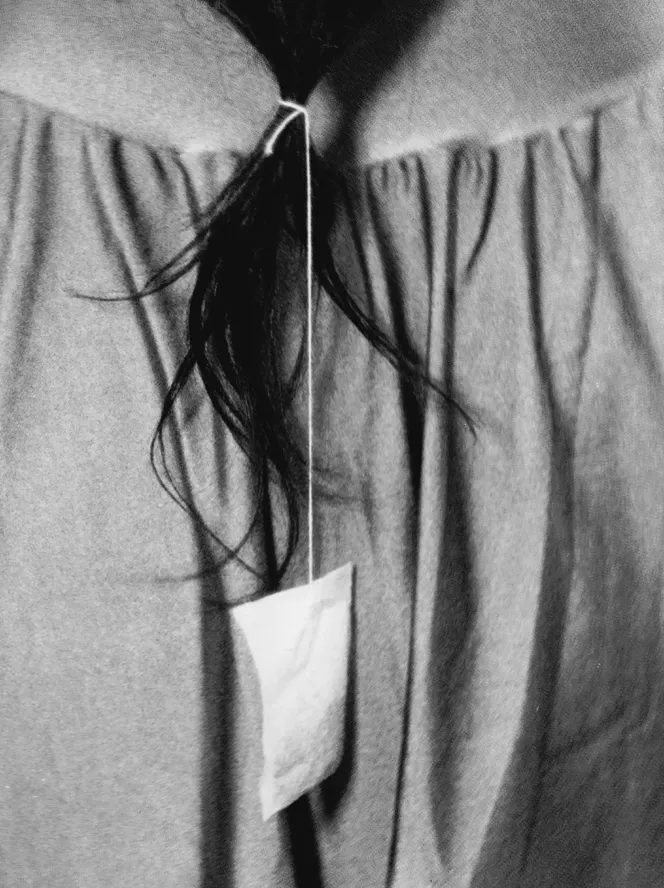
CONSIDER THE FIRST IMAGE that we will be exploring here. The takeaway from this image is how the arrangement of the utterly familiar or commonplace can lead to a very powerful and not immediately obvious narrative. The image under consideration contains benign elements—or so it seems at first glance.
What is it? It is a black and white film photograph. Yet, before we take that statement for granted, it is important to remember that many photographs no longer correspond to what we generally assume them to be. They could have been manipulated, composited, or scanned. Digital, postproduction alterations are commonplace and are often very subtle in photography today.
This does not mean that we have to encounter every photograph with distrust, looking for signs that it is not purely mediated through the lens. It simply means we should take into consideration that all images can easily be manipulated. Even the lens-mediated, black and white film photograph, which is largely unaltered relative to other types of photographic images, is, in fact, heavily manipulated.
Every photograph represents the exclusive perspective of its maker and that maker's viewpoint from one very particular position in three-dimensional space—most often during a fraction of a second. Choices made during development and printing further emphasize or de-emphasize elements in the image. Choices are continuously being made by the photographer, some barely conscious, others in a much more considered and deliberate manner, with the result that the viewer's experience can be subtly, and sometimes substantially, altered.
What Are We Looking at?
It appears to be a young woman, photographed from behind who has used a teabag to tie her hair. Many viewers might stop right here. We seem to have an almost “innate” need to understand and to process information. In fact, this is one of our primal survival mechanisms and we bring this same urge to the virtual experience of an image. It appears that we are more adept at rationality as opposed to emotionally processing visual imagery. This is why we don't jump out of the way when we see a ferocious tiger coming toward us in a photograph, yet we can feel deep grief when we see an image of the same desecrated predator, skinned for the beauty of its fur.
It is this empathy that makes the image above so powerful for me and so loaded with meaning. None of us can truly divorce ourselves from our experiences, the time we live in, and our increasing global awareness and collective consciousness. Things that are in the ether exert so much power on us.
Identify the Elements
The image under consideration here consists of only five elements: hair, string, fabric, paper, and tea. Arguably, these elements are benign on their own, but they can become volatile in combination.
Let's be slightly more precise: dark hair, thin string, creased fabric, gossamer paper, and dried tea leaves. The string, the paper, and the tea are collectively known as a “teabag.” An entire compendium could be written about tea, its various geographical origins, its leaves and blossoms, its historic and cultural significance and the traditions for serving it from the Japanese tea ceremony to afternoon tea and crumpets. If we get into the symbolism of “reading the tea leaves,” the Boston Tea Party and the contemporary “Tea Party” movement, that could be an entire other book.
Contextual Meaning of the Elements
It is quite possible that you are discussing an image similarly charged with historic, contemporary, and global meaning in class and now it is your turn to say something, but all of the above has already been mentioned. Rather than feeling daunted, the elements approach can be used to great effect. After all, there are only five elements and we haven't really dealt with them as such. What is hair? What is string? What is fabric? What is paper? What is tea?
Do they have anything in common? If so, what is it, and frankly does it matter? They all grow and age, they can all be burnt, cut, and boiled. Now you may be understandably concerned about where this is going and just how volatile any possible point can become. The simple way in which this image addresses vulnerability and transience is where the power resides for me.
The hair suggests youth—it is dark and long but it seems slightly unkempt and not recently cut or styled. The teabag has no label and therefore no identity. The fabric is about as nondescript as a crumpled up, monochromatic curtain and seems to be predominantly utilitarian—more along the lines of a hospital gown or drab uniform. Not much to go on, but that is where the image sources all of its power for me. I say “for me” because this process of interrogation also involves you. You may be considering a completely different amalgamation of these elements and this is just as valid and important as any other subjectivity, including my own.
Demonstrating the periodic table approach in this case leaves me with the teabag. It is after all the most complex and processed element in the image. Yes, the gown, if cotton, is also equally processed and if it is an artificial fiber, even more so. And it too has a string, though hidden in the collar of the bunched up fabric. Nevertheless, the teabag is the brightest part of the image and therefore the element the eye is most drawn to.
How Can the Image Be Interpreted?
Based on the approach above, I arrive at this interpretation. What is a teabag then? It is a one-time, one-use product. What could that mean in the context of an anonymous young woman? Sadly, human trafficking is one of the scourges the world is steeped in. The destruction of the individual is as shameful as the lack of resources allocated to this reality. The one-use analogy is intensified by what is most highly prized in that market, virginity. The unlabeled teabag becomes a label in itself. It says only two things: unused and unidentified. It is in this simple statement that the image finds its power and collective condemnation and becomes so powerful.
Chemical elements, if combined in a certain way, can become potentially unstable until their nucleus and orbiting electrons find balance. This quiet image talks about imbalance—morally, ethically, and legally, to say the least. Just as we can't see morals or ethics, or indeed atoms, we know they exist and impact everything in physical existence and possibly more. This image has the audacity to engage this entire discourse by proxy. It works like a velvet hammer. The soft surface makes the blow only more crushing once it is recognized.
Kelly's image speaks very softly in this instance. As many of us have experienced, it is often the quietly spoken word rather than the screaming diatribe that cuts the deepest. The shocking truth is mentioned in an almost casual, yet utterly determined way. Imagine an anti-human-trafficking campaign. How would you address the issue visually?
Conclusion
By selecting a few highly effective elements that say everything necessary without hitting the audience over the head, Kelly allows for expansive interpretations in a very successful way. The grainy quality of the print and lack, in some areas, of depth of focus suggest a possibly surreptitious printing of the image under less than ideal circumstances. This could be a message in a bottle. The nature of the print therefore supports the narrative. Were it a perfect, glitzy studio-generated image, much of the visceral impact would be “sanitized,” probably displaced, and, ultimately, lost.
I have found this to be a basic but very effective way to deconstruct any image. Hopefully, this simple deconstruction will help you engage the other images as we move along.
Assignments You May Want to Challenge Yourself With
• Human trafficking
• (Self-) portraiture
• Surprise element
• Melancholy