![]()
1
The inclusive school
A school that is educationally inclusive is an effective school. An educationally inclusive school has the following features:
- an ethos of inclusion that is understood by staff, parents, governors, pupils and the local community;
- achievements of all pupils are valued, recognised and celebrated;
- improving teaching and learning for all pupils is a constant concern to senior managers;
- the well-being of all pupils matters; their attitudes, values and behaviour are constantly challenged and developed;
- staff, pupils and parents treat each other with respect;
- senior managers put into place actions and strategies to ensure that all pupils make better progress.
Schools should offer an inclusive curriculum, in the broadest sense, that is appropriate for different groups of pupils. Each school should have appropriate systems in place to identify the needs of different groups of pupils and ensure that its provision meets these needs.
Essentially therefore, the five principles developing a more inclusive curriculum require a commitment to:
- value all learners;
- set suitable learning challenges for groups and individuals;
- respond to pupils’ diverse learning needs;
- overcome potential barriers to learning and assessment for individuals and groups of pupils;
- make the best use of resources.
![]()
2
Inclusion for pupils with an ASD
Pupils on the autistic spectrum are mainly educated in mainstream schools with a minority being placed in special schools.
Adults on the autism spectrum maintain that the goal of education should not be to change their ‘way of being’ to make them into typical individuals, but to acknowledge and appreciate their differences and create environments in which they can thrive.
(NAS)
The guidance that follows aims to achieve the above.
Most children with special educational needs have strengths and difficulties in one, some or all of the areas of speech, language and communication. Their communication needs may be both diverse and complex. The range will encompass … those who demonstrate features within the autistic spectrum….
(Code of Practice 2014)
These children may require some, or all, of the following:
- help and support in acquiring literacy skills;
- help in organising and co-ordinating spoken and written English to aid cognition;
- help with sequencing and organisational skills;
- help with problem solving and developing concepts;
- programmes to aid improvement of fine and gross motor competencies.
![]()
3
Definition
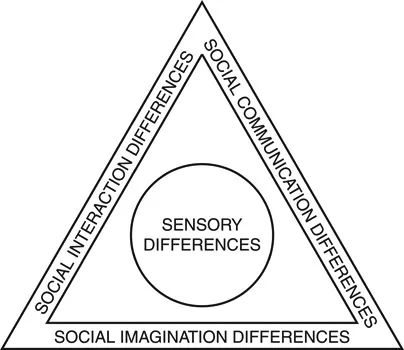
Autism is biologically based, and is characterised by a ‘triad of impairments’ (Wing 1996). This affects a person’s ability to use and understand social communication and social interaction, and to be flexible in their thinking, behaviour and use of imagination. In addition, there will issues related to hypo- or hyper-sensitivity to sensory stimuli. There are also implications in connection with motivation and generalisation. It is widely recognised that pupils across the full ability range may have this lifelong disorder and many may have additional special educational needs.
Throughout this book the term ‘autism’ or ‘on the autistic spectrum’ will be used to refer to all pupils who are at some point along the autistic continuum and therefore, will include those with Asperger’s syndrome, autism, semantic pragmatic disorder, and pathological demand avoidance syndrome. These difficulties are seen as a continuum and the degree to which pupils are affected will vary significantly.
![]()
4
Asperger’s syndrome
Asperger’s syndrome is a developmental disorder that affects a pupil’s ability to communicate effectively with others, fellow pupils or adults.
If you have Asperger’s syndrome understanding conversation is like trying to understand a foreign language.
(National Autistic Society)
Some characteristics
- It is characterised by the four areas of differences described in the diagram above.
- It is considered to be on the milder end of the autistic spectrum.
- It mainly affects boys, most of whom will be of the average if not higher intelligence range.
- Language acquisition will be within the normal range, i.e. single words by the age of 2 and phrases by the age of 3. However, interactions with other children will be more difficult.
- The development of gross motor skills may be delayed. Toe walking is often observed.
- Non-verbal communication such as eye contact and facial expressions are not easily used.
- An obsession with a particular subject such as dinosaurs, trains often develops to the exclusion of anything else.
- A limited range of imagination restricts attempts at ‘let’s pretend’ games (unless it is replaying a piece from a DVD) and the pupil will be more likely to line up cars in a particular way or organise information from their interest.
- A tendency to speak in a monotonous tone, which may be too fast.
- Finding it difficult to empathise with or be sensitive to other pupils’ feelings.
- Older pupils will give a monologue of information about their favourite interest instead of carrying out a conversation. They will not realise their companion has lost interest.
- Being very literal in their understanding of language, which can lead to confusion, e.g. ‘pull your socks up’ may result in the pupil doing just this.
- Difficulty in understanding fellow pupil’s non-verbal communication, tone of voice or the unwritten social rules, e.g. not standing too close to another person.
- A lack of understanding of humour, metaphor or sarcasm, which becomes increasingly difficult as language becomes more sophisticated with age.
- Pupils may become withdrawn but appear aloof or unfriendly.
- The condition can result in high levels of confusion and anxiety.
![]()
5
Social communication differences
Communication allows us to make our wants and needs known and to share our feelings, thoughts and ideas with others. It is what helps us to learn from relationships and make connections with the world around us and the people in it. Every pupil or young person with an ASD will have some degree of difficulty with communication.
The skills involved in communication
In order to communicate effectively we need to develop skills in a number of areas.
Processing and using verbal communication involves:
- the ability to listen and attend to relevant information;
- the ability to understand words, phrases and sentences;
- the ability to understand the literal and non-literal meanings behind spoken words and ideas;
- the ability to express our ideas with spoken words and to speak each word clearly;
- the ability to construct sentences and use English grammar correctly;
- the ability to use language for a range of purposes, such as requesting, commenting, questioning, discussing, and having conversations;
- the ability to use language appropriately in a social setting, i.e. what to say, when to say it and to whom;
- the skills involved in verbal interaction with others such as continuing the topic, monitoring topic shift and conversational repair (adjusting the content of the conversation if the speaker is aware that the listener is not responding appropriately).
Interpreting and using non-verbal communication involves a number of skills:
- engaging in ‘joint attention’, such as looking and listening together or sharing in the same moment or event with someone, with mutual enjoyment and meaning;
- using looking and eye contact both as a speaker and a listener;
- understanding and using facial expression;
- understanding and using spontaneous gestures and body posture to communicate or emphasise meaning;
- being able to interpret and use ‘prosodic’ features, i.e. how intonation, volume and rate of speech help to convey meaning and emotion;
- having the ability to take turns in social activities and conversations;
- the ability to initiate conversation and attract someone’s attention;
- the ability to change the topic or style of a conversation to suit the needs or interests of the listener;
- the ability to understand implied meanings and read between the lines of what the other person is saying.
Language and communication difficulties associated with autism
Pupils with autism will have difficulties in a number of areas:
Understanding language
- There may be a failure to respond, or the pupil does not seem interested when spoken to. The pupil can be totally unaware that he/she is expected to listen unless specifically prompted to do so, e.g. in a group or whole class discussion.
- Unusual responses to auditory stimulation can result in sensory defensiveness. The pupil may attempt to block out confusing sounds or noises by covering his/her ears or by showing signs of distress.
- The vocabulary and grammar of spoken language becomes difficult to understand as it increases in length and complexity.
- Many pupils with autism are ‘visual learners’, i.e. they find it easier to understand visually presented information than verbally presented information.
- Information tends to be processed slowly. There is often a time delay between hearing what someone says and being able to formulate a response.
- Understanding of language is over-literal and concrete. Implied or ambiguous meanings can be confusing, e.g. sarcasm, idioms and synonyms.
- Confusion arises when people talk too loudly, too fast or use too many words.
Communication
- There is an absence or a reduction in the desire to communicate with others.
- The pupil may fail to compensate for the lack of spoken language, e.g. use of natural gesture, with the exception of pulling someone, or using his/her hand as a tool.
- The development of speech may be absent or delayed.
- The pupil may only communicate socially at a basic level, i.e. to satisfy a need or gain information.
- The pupil may develop some spoken language, but fail to use this for the purposes of communication with others.
- The pupil may be quick to echo speech or repeat ‘chunks’ of language spoken by other people, often without understanding the meaning.
- The content of speech tends to be one-sided and can be repetitive.
- The pupil may experience difficulties with appropriate conversational turn-taking.
- The pupil may accept or make approaches to others, but lack the skills to follow these through.
Strategies to help the pupil with autism to ...