![]()
1
WHAT IS A RICH PICTURE
Developing visual narratives?
The Rich Picture aspiration
Walter Pater is known for the famous adage ‘all art aspires to the condition of music’. Let’s put this in a more trivial and contemporary context. Perhaps we can say that all art aspires to the condition of the selfie?
So does it? Well, we can play with this view of art being a mirror image or the self or soul as made manifest as the trivial selfie. But is the modern selfie perhaps more about vanity, narcissism and performance (‘I was there’)? it is there to cause (either negative or positive) reaction to the presentation of the self abroad – at sail on the sea of the world. It is to be shared. It is done to self-promote and even to provide an impression of immortality of the person or persons. Selfies are not new; in a sense they have been around for ever. Think Rembrandt! We have always been obsessed with ourselves, how we are seen by the world and how the world sees us. But, our thinking around Pater’s aphorism, like many, is palpably false, especially if we consider the collaboratively drawn RP. It is entirely possible one could say the selfie likeness does, in some way, reflect the individually drawn RP. It could be said the individually drawn RP looks exactly the way the artist wants the picture to be seen or at least thinks they want to be seen. We live in a world of social media and we get used to looking at people through a veil of performance. But when we consider the ‘many hands’ RP there is little similarity to this self-centric vision of the world and the inevitable limits it contains. In effect the ‘many hands’ RP goes beyond the aphorism, it aspires to factualism and embraces self-mockery and imperfection. The selfie is bold and obvious whereas the RP often offers egoless spoonerisms that are intentional (deliberate hidden meaning) or delightfully unintentional (malapropisms) just as a child might mix metaphors and create a surprising version of understanding.
The RP does not aspire to the condition of the selfie. It is not seeking to cause reaction but rather inform knowledge; it is crude in artistry and is never a simple arrangement of form or content. The RP allows the broadcasting, through spontaneous, combinatorial arrival, of many voices, in a uniquely visual way. RP aesthetics reflect a degree of democracy. RP appreciation should never be sought however; meaning and expression – communicating deep human experience and understanding – is the ‘aspiration’ of the RP.
So the RP aspires to truth but one has to acknowledge the factors that influence this desire for truth. Offer a group of individuals a chance to reflect and a platform to capture a moment of truth and what you get is many things. The perfectly harmonic group might indeed have a single voice but in our experience this is unlikely in the beginning. Many voices, many hands drawing, loudness from some and whispers or silence from others creates both dissention and unity as well as consensus and discord simultaneously. We discuss the issues of group consensus later on in the book but for now we say the RP has the ability to spontaneously convey an aesthetic message in often abstract ways. It can recreate real-world experience as well as contemplate that which has not yet happened.
In essence the RP is a visual narrative which can be interpreted in many ways. This is a good thing. Multiple interpretations lead to maximum depth of understanding. In our experience the ‘message’ of an RP can be drawn out by making use of an approach we call Eductive Interpretation (EI – which we take as meaning: drawing forth and understanding). We argue that this non-judgemental approach can lead to enlightened understanding of the pictures. EI provides a chance to scrutinise, study and analyse pictures. This is discussed in more depth in Chapters 5 and 6.
A Rich Picture ‘story’
As we have already noted, RPs are both very personal and very subjective and yet they can present individuals and groups with unique, insightful, sometimes unsettling but always provocative visions of complex, emotional and often challenging situations.
What follows is a longish anecdote which sets out some of the insights, challenges and emotions associated with facilitating RP drawing.
Anecdote from Simon: It was Nigeria in 1987 that the Rich Picture first began to ‘talk to me’. I was working as a consultant in a college environment with many mature professional ‘students’ who were topping up their education. The situation was tense with real problems such as poverty, sectarianism, huge underinvestment in basic services and professional frustrations. The main resource for problem solving was the calibre of the people.
I knew all about Rich Pictures but had rarely had the courage to try them out in reality. There is a big credibility moment which roars into the silence when you ask a bunch of sensible people to pick up a pen and begin to draw. At this point in my career of asking people to professionally doodle I had not received the range of responses which were to come at me in subsequent years – ‘you want me to do what?’ ‘Are you serious?’ ‘We have some real problems to deal with here and I have a spread-sheet to talk about.’ ‘What are we paying you for?’ ‘Do you have any idea who I am and what I have done to get to this point in my career? And you want me to draw pretty pictures??’ The list goes on and on in my memory. Almost in all of them I seem to recall standing and smiling (on the outside) shuddering and wincing (on the inside) and not looking convincing to the flies on the windows let alone the people in the room. On this occasion in Nigeria in 1987 that was all to come and I was treated with sincere kindness . . . the kind of kindness which a thirsty customer extends to a rather dim but well-intending barista who has not remembered your double espresso with caramel and skinny latte order. The men and women in the room looked at me and waited for me to stop joking and get serious. This was West Africa in 1987. Teachers did not do anything like this. The gold standard for teaching was to arrange the students in a large hot room, take to centre stage, turn on the totally unnecessary amplification and bore on for about two hours . . . often reading from a book . . . until everyone was fast asleep. What I was suggesting was very, very different.
So . . . drawing in breath and trying to look the confident teacher I did not feel I said something like: ‘I would like you to form into two groups of about eight people each. Each group take one of the tables I have prepared. You will find a large sheet of paper and some coloured pens. I would like you to talk among yourselves and, when you feel right about it, draw me a picture of your experience of this college so far. I want you to use as few words as is possible and try to make use of visual metaphors like the “Stop” sign or a clock to signify time or a stick man to represent yourself. OK? Any questions?’
What followed was one of the most profound silences of all the silences over all the workshops of all the countries of all the years which I have experienced. I can remember it clearly to this day. It had a quality to it that no other silence has since contained. It was a really, really ‘full’ silence. This was a silence with attitude. It was like the silence of the lion before the spring at the Zebra by the water hole. The silence of the black, dense clouds before the first roll of thunder, the silence of Ominous Portent. It went on for what felt like ages and I knew it was not going to be good. And then . . . and then . . . they all stood up, went to the tables and began chatting about this totally crazy man and his silly schemes.
First lesson learned in the lore of the Rich Picture. You rarely get killed by your students for being too silly. Forty five minutes later and the two groups had produced two pictures and such pictures. I had not at that stage learned any craft about how to facilitate a group or groups or how to appear to disappear and how to watch and not be seen. None of this had yet occurred to me. I think, rather goofily, I walked around the room looking at what they did (wrong!), commented on their gradually forming diagrams (wrong), made obvious notes on my pad (wrong), took some photographs (wrong) and generally acted like an idiot tourist who happened to have come across a group of sincere problem solvers in a museum of problem solving. I was ghastly.
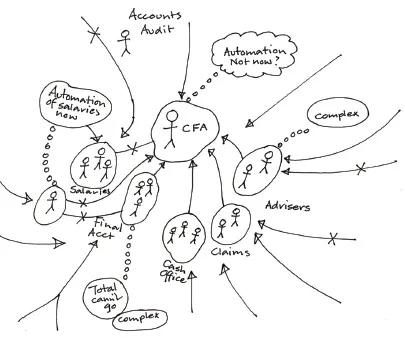
Despite all my best efforts to make the entire exercise a waste of time the two pictures were ‘from the heart’ but for different reasons. I was to get my first education in the interpretation of visual cries for help. The pictures were very different from each other. They were like chalk and cheese. One was a minimalist portrayal of the life of a stick figure who seemed to be surrounded by many rather threatening stick figures and lots of arrows . . . which all seemed to end up one way or another pointing at the small stick figure in the middle. The lines were dotted with occasional words (I had not told them not to use words and at that time was still lenient about words appearing in the picture) and most of them seemed to be of the ‘command’ and ‘accuse’ type. I do not still have the RP which they drew that day, but it was something like the version you see in the Figure 1.1.
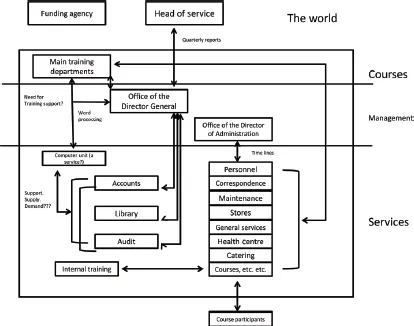
The stick figure was in a tough place. The second picture was like a circuit diagram. It showed units and departments and straight lines connecting them. It was a maze of formality and hierarchy, a plethora of structure and a bewilderment of connectivity. It was like the negation of a Rich Picture. By the structure each straight line and box and formal link spoke not so much of an organisation as of a machine which eats people. This was the Fordist dream made manifest. A reification of the concept of structural order. Order with no human side. The actual diagram was never recorded but it was similar in many ways to the image you see in the next Figure. Each diagram was a cry for help.
As the groups came together a number of things struck me.
1. They had enjoyed the process
2. The groups had coalesced around the theme of the picture
3. The picture was about them all
4. They had drawn what they could not say
5. The picture was therapy
6. They wanted to do it again!
Panic! What had I done? I was not a psychologist and I was not prepared to begin a self help scheme for a kind of ‘Academic Allumni Anonymous’ group. We talked the pictures through and I realised some more things:
1. I was privileged to have this view of their lives
2. Telling me their picture put a lot of trust on me and I needed to treat this with care and respect
3. This was more meaningful to them than just about any other activity I could think of
4. They wanted more because it was useful
5. They had given of themselves in a way which I was having trouble dealing with
6. That I had to do it again!
So began my fascination for, and massive sense of surprise about, Rich Pictures. If they were so good and had so much to offer how come, in 1987, they had not gone further and done more? Why were they not in the academic literature? Where was the rich evidence of practitioners? All was quiet or just about quiet. Like a sleeping Princess in a magical tower surrounded by a forest, the Rich Picture was a device which was yet to awake and be found out to be the terrific power which it is.
The rest of this book tells you more about the waking up.
Visual thinking
Rich Pictures are a visual thinking device and visual thinking has been an underutilized area of human thinking. Linda Silverman considered the place of visual thinking in our culture. She compares the auditory-sequential thinker and the visual-spatial thinker. Culturally our species has tended to be left-hemisphere, auditory-sequential biased. Silverman argues: