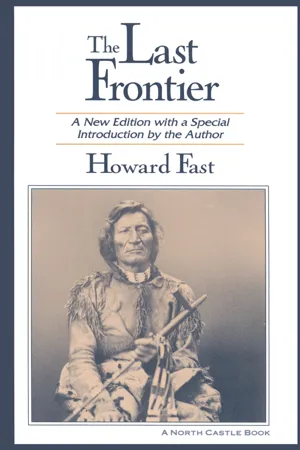
Originally published in 1941, The Last Frontier is the story of the Cheyenne Indians in the 1870s, and their bitter struggle to flee from the Indian Territory in Oklahoma back to their home in Wyoming and Montana. Some 300 Indians, led by Little Wolf, fought against General Crook and 10,000 troops, with only 60 finally making it through to freedom. Fast extensively researched this book in the late 1930s, visiting and speaking with Cheyenne experts in Norman, Oklahoma. This was the first of Fast's many books to gain a wide popular audience; it was eventually made by John Ford into the classic film Cheyenne Autumn (1964).
- 320 pages
- English
- ePUB (mobile friendly)
- Available on iOS & Android
eBook - ePub
The Last Frontier
| PART ONE | July 1878 |
THE INCIDENT AT DARLINGTON
IT WAS a hot day, midsummer in Oklahoma. The metallic, cloudless sky appeared ready to loose its bolt of molten sun. The heat came from everywhere, from the sky and the sun, from the Texas desert, blown by the south wind, from the ground itself. The ground had given up its moisture, and now it was dissolving in little puffs of fine red dust. The red dust spread up and out and over everything. It coated the stunted, blackjack pine and it coated the yellow grass. It fell on the unpainted houses and gave their warped boards an affinity with the earth from which they had recently come.
Everything shimmered to distortion in the heat. A rabbit, bounding across the clearing, was like a brown rag blown by the hot wind.
Agent John Miles paused in his morning walk of inspection over the agency grounds. He had been six years in Indian Territory, yet he could not grow used to Oklahoma summers. Each one was hotter, or else he forgot how bad the last one had been.
He passed a careful finger around the inside of his starched collar. It was now eleven o’clock, and by noon, usually, the last bit of starch had lost its grip, leaving the collar a wilted wreck. Aunt Lucy, his wife, had often pointed out to him how foolish it was to wear a starched white collar all summer long. A neckerchief, which also served as a handkerchief, was more comfortable and more practical, nor did it mean a loss of dignity.
As to the last, he wasn’t quite sure. Dignity and authority were composed of a host of little things; give up one of them and you’re on the road to give up all of them. And the further you are from civilization, the more those little things matter.
He could not conceive of any place further from civilization than Darlington, the agency for the Cheyenne and Arapahoe Indians.
He took out his handkerchief and wiped his face. Then, after glancing about quickly to see whether he was observed or not, he bent down and wiped the red dust from his black shoes. He folded the handkerchief carefully, so that the dirty part would be hidden if he took it out of his pocket again. Then he sighed and continued his walk toward the agency schoolhouse.
The schoolhouse had been one of his first achievements after he had been appointed Indian Agent. He was very proud of it, just as he was proud of his other improvements at Darlington; yet he knew that his pride could be humbled, quickly and mercilessly. He was a Quaker, a more or less devout one, so he hid his pride carefully. When it was humbled, along with despair came something that was almost satisfaction.
Now he realized that the schoolhouse needed painting again. In other climate, the cold of winter wore paint, but here the merciless heat fairly boiled it from the boards. He shook his head, knowing it was hopeless to ask for increased paint rations when even the food supply was being cut down.
He crossed a pocket of sifted dust in which he sank to his ankles. There was no use wiping his shoes again. He walked on, coughing in the swirling red cloud that had sifted up and over him.
An Arapahoe, barefoot and wrapped in a dirty yellow blanket, barred his path and loosed a stream of soft Indian words. The dust from the Indian’s shuffling feet rose between them.
Miles knew the man, whose name was Robert Bleating-Hawk. The man could speak some English. Six years had not made Cheyenne or Arapahoe much more intelligible to Miles; and often he thought that sixty years would not.
“Speak English, man,” he said impatiently.
“My wife—she say dat chicken no lay egg, dat damn chicken.”
“Well, see Mr. Seger about that.”
“Johnny, he no give damn about egg,” the Indian said stolidly.
“I’ll talk to him,” Miles said, forcing himself to be patient.
“You see, we eat dat damn chicken.”
“Then you’ll get no more chickens from us,” Miles said, and walked on.
He was glad to get into the shade of the schoolhouse veranda. It was a little less hot there, and the house was some protection from the dust. By now, a tight, knotty pain was gathering at the point where his brows met. That meant that he would have a headache in the afternoon, and Lucy would scold him for exposing himself to the sun. She wanted him to carry an umbrella and make himself the laughingstock of every Indian on the place. Still her scolding would give him an excuse to take a cold bath before dinner.
He stood on the veranda, listening to the hum of voices from inside the schoolhouse, and thinking comfortably of the cold bath that would come later in the day. From where he stood, he could see the fall of land to the dry bed of the Canadian River, dust and withered yellow grass, on which somehow thickets of blackjack pine managed to find an existence. Beyond, the yellow and red Oklahoma landscape dashed headlong to the metal sky. The Indian village of cone-shaped lodges sucked futilely at the dry riverbed. Aside from the shuffling shape of Robert Bleating-Hawk, not a thing was alive in all that braised surface. Most of the Indians had already left on their summer buffalo hunt, from which they would return bitter and empty-handed. The rest would not move from the shelter of their lodges until the sun had set.
The schoolbell rang and the doors opened, and the Indian boys and girls came tumbling out, shrieking and laughing. They were already scattering onto the grass when Mrs. Hudgins, the matron, came out and saw Miles standing on the porch. She was a large, powerful woman, with heavy thighs and a bosom like a pouting pigeon; she had loose cheeks, tiny blue eyes, and gray hair. Sweat poured from her face and neck, staining the collar of her dress.
When she saw Miles, she clapped her hands together and cried: “Boys and girls, boys and girls—I want you to say a proper good morning to Agent Miles.”
A few paused, but the rest ran on.
“That’s quite all right,” Miles said.
“I’m so sorry. In the summer everything’s so difficult. It’s so hot. You can’t concentrate in the heat.”
Miles nodded sympathetically.
“I’m not complaining,” Mrs. Hudgins said.
The two other teachers came out onto the porch now. Joshua Trueblood and his wife, Matilda, were also Quakers. They had followed the call to Indian Territory, and the territory was beating them into jelly-like submission. Joshua Trueblood was a small man with a limp, straw-colored mustache. His life was hell and his fear of the Indians was exceeded only by his wife’s. As a teacher, he was futile and plodding. His wife was a mouse-like woman, a sort of shadow to him. For all that, a strange sort of moral conviction had kept them at the agency.
“It seems a shame,” Joshua said, “that they should have school in the summer.”
“I know,” Miles nodded. “We’ll let them off in a few days more. I didn’t want them along on the hunt. It’s bad enough for their fathers and mothers to go wandering through this wasteland, looking for buffalo where no buffalo exist, without dragging their children with them.”
Matilda clicked her tongue, and Mrs. Hudgins said: “Things are so difficult in the heat.”
Miles stirred himself. His head ached now, and it required an effort to leave the shade of the porch. “I’ll be going along,” he said. “I’ll see you at lunch—”
He forced himself to walk down the slope toward the Indian village. He passed the fields where the Indians, under the supervision of the agency farmers, had put in a crop of corn and potatoes and cabbage. The fields were a spread of dust, like refuse from a swept floor. No force on earth could bring the Indians out to work under that sun.
He passed through a flock of chickens. They drove the dust into his face and eyes, and he coughed. Pain in his head was like hammer blows. He turned and watched the chickens rooting in the fields.
On his way back to his house, he passed several of the newly constructed shacks which were to replace the tepees the Indians lived in now. They had not been painted, and already the green pine boards were curling and warping with the heat, drawing the nails that held them to the beams. Miles shook his head, set his face stolidly, and plodded home.
There were five of them at lunch, Agent John Miles and his wife, Lucy, Joshua and Matilda Trueblood, and John Seger, man of all work about the agency. Seger, a dark-haired, dark-skinned, dark-eyed rock of a man, had been at the agency almost as long as Miles. Coming originally as a handyman, he had by now turned his hand to everything from teaching school when the situation became too much for the Truebloods, to hunting down whiskey smugglers.
The Indians called him Johnny Smoker, from the refrain of a little nursery rhyme he taught the children at the school. He, of all that group at the table, was the only one who loved his work. He understood the Indians, and they understood him.
Now he came into the dining room hot and sweating and angry, hardly able to contain himself until after Agent Miles had said a long and leisurely grace. Then Mr. Bunk, the cook, entered, following Aida, their Arapahoe serving girl. She was carrying a bowl of hot pea soup, and Bunk was edging after her, watching fearfully that she didn’t drop it.
“I do believe that hot soup is cooling in weather like this,” Mrs. Miles said.
“Maybe it is, Aunt Lucy,” Bunk nodded, standing back from the table and not taking his eyes from the Indian girl until she had set the soup in its place. “Maybe it is, but my God almighty and lovely Jesus, that kitchen is so hot. My God almighty, I had to come out or else just go crazy. Sure as God almighty, it’s no wonder so many cooks go crazy.”
“It looks like rain tomorrow or the next day.” Mrs. Miles smiled sweetly. “And you shouldn’t take the Lord’s name in vain, Bunk.”
“Sorry as the devil, Aunt Lucy,” Bunk said, and then he wiped his hands on his apron and returned to the kitchen, pushing the Indian girl in front of him.
Mrs. Miles began to dish out the soup, and Seger, who could contain himself no longer, growled:
“I ran two buffalo hunters off the place today.”
“Buffalo hunters?” Miles asked uneasily. “There’s no buffalo here—no buffalo anywhere near the agency.”
“I call them buffalo hunters,” Seger said, nodding at Mrs. Miles and Matilda Trueblood. “Lord knows what I’d like to call them. Scum and riffraff. Dirty-shirts—you know the kind, in buckskin. Maybe they hunted hides once, but they don’t no more. There’s more low characters and rustlers and two-bit gunmen right here in the territory than in all the rest of the states together.”
Miles shook his head. “What do you suppose they wanted here?”
Seger nodded at the women, and then said in a whisper: “Squaws.”
“That’s no good.”
“Lord, don’t I know it. And in this weather. I go to bed and dream about something setting them off. And when the tribes come back from the hunt without seeing hide or hair of a buffalo, it’ll only be worse.”
“We’ll finish eating,” Miles said slowly, choosing his words carefully and trying to hear them through the throbbing pain in his head, “and then you can ride over to Fort Reno and have Colonel Mizner send a detail back here. We’ll all feel better then.”
“I hope so,” Seger said, without enthusiasm.
They had almost finished their meal when Miles, who sat facing the window, saw the Indians riding toward his house. At first it seemed to him that his eyes were deceiving him, that this was a mirage, a heat-manufactured dream of some sort. There were about twenty of the Indians, half naked and painted; their ponies were lean as skeletons, a leanness which the riders matched. They rode in billows of sun-soaked dust, red clouds on which their horses’ bellies appeared to float.
“God bless me,” Miles whispered. Then the others followed his eyes.
“God bless me,” Miles said again, and Seger murmured: “It never rains but it pours.”
Seger led the way out to the porch, sighing with relief when he saw that the Indians, who were now filing around to the front of the house, were without weapons. They were Cheyennes, and Seger recognized the two old chiefs who led them—Dull Knife and Little Wolf.
Dull Knife’s band of Northern Cheyennes were the last Indians to come into the Cheyenne and Arapahoe Agency. Their original home was in the Black Hills of Wyoming; from time beyond memory they had lived there, making seasonal trips onto the plains of Montana and North Dakota to hunt buffalo, but always returning to their home in the hills. Of all the Cheyenne bands, they were the last to be touched by civilization. In their hills and in the lush fertility of the Powder River valley, they had all that they wanted, and the white men were a long time coming.
In 1865...
Table of contents
- Cover
- Half Title
- Title Page
- Copyright Page
- Table of Contents
- Introduction
- Foreword
- Part One July 1878 The Incident at Darlington
- Part Two August 1878 Three Men Who Ran Away
- Part Three September 1878 The Chase Begins
- Part Four September 1878 A Washington Interlude
- Part Five September 1878 Cowboys And Indians
- Part Six September 1878 The Trap Closes
- Part Seven September–October 1878 Matters of Justice
- Part Eight October–November 1878 The Victors and the Vanquished
- Part Nine November 1878–January 1879 Freedom
- Part Ten January 1879–ApriL 1879 The end of the Trail
- An Afterword
Trusted by 375,005 students
Access to over 1.5 million titles for a fair monthly price.
Study more efficiently using our study tools.
Frequently asked questions
Yes, you can cancel anytime from the Subscription tab in your account settings on the Perlego website. Your subscription will stay active until the end of your current billing period. Learn how to cancel your subscription
No, books cannot be downloaded as external files, such as PDFs, for use outside of Perlego. However, you can download books within the Perlego app for offline reading on mobile or tablet. Learn how to download books offline
Perlego offers two plans: Essential and Complete
- Essential is ideal for learners and professionals who enjoy exploring a wide range of subjects. Access the Essential Library with 800,000+ trusted titles and best-sellers across business, personal growth, and the humanities. Includes unlimited reading time and Standard Read Aloud voice.
- Complete: Perfect for advanced learners and researchers needing full, unrestricted access. Unlock 1.5M+ books across hundreds of subjects, including academic and specialized titles. The Complete Plan also includes advanced features like Premium Read Aloud and Research Assistant.
We are an online textbook subscription service, where you can get access to an entire online library for less than the price of a single book per month. With over 1.5 million books across 990+ topics, we’ve got you covered! Learn about our mission
Look out for the read-aloud symbol on your next book to see if you can listen to it. The read-aloud tool reads text aloud for you, highlighting the text as it is being read. You can pause it, speed it up and slow it down. Learn more about Read Aloud
Yes! You can use the Perlego app on both iOS and Android devices to read anytime, anywhere — even offline. Perfect for commutes or when you’re on the go.
Please note we cannot support devices running on iOS 13 and Android 7 or earlier. Learn more about using the app
Please note we cannot support devices running on iOS 13 and Android 7 or earlier. Learn more about using the app
Yes, you can access The Last Frontier by Howard Fast in PDF and/or ePUB format, as well as other popular books in History & 19th Century History. We have over 1.5 million books available in our catalogue for you to explore.