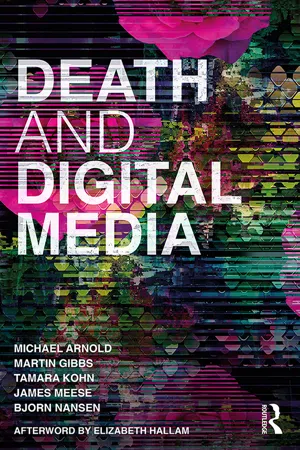
Death and Digital Media provides a critical overview of how people mourn, commemorate and interact with the dead through digital media. It maps the historical and shifting landscape of digital death, considering a wide range of social, commercial and institutional responses to technological innovations. The authors examine multiple digital platforms and offer a series of case studies drawn from North America, Europe and Australia. The book delivers fresh insight and analysis from an interdisciplinary perspective, drawing on anthropology, sociology, science and technology studies, human-computer interaction, and media studies. It is key reading for students and scholars in these disciplines, as well as for professionals working in bereavement support capacities.
eBook - ePub
Death and Digital Media
- 178 pages
- English
- ePUB (mobile friendly)
- Available on iOS & Android
eBook - ePub
Death and Digital Media
About this book
Information
1
Death and digital media
An introduction
News of a friend’s unexpected death is received in a tweet; heartfelt messages are left on a recently deceased friend’s Facebook page; an online memorial is created to allow people to share their stories and their grief; a collection of avatars hold an in-game service for a departed player in World of Warcraft; Facebook Live is used to stream the suicide of a teenager; selfies are taken at funerals; millions of strangers use social media to mourn the death of a celebrity; some memorial websites attract no visitors, others ‘go viral’, many carry advertising; at some point in the future the number of dead Facebook account holders will exceed the number who are living; social media memorial pages set up by family compete with pages set up by strangers; the dead remain saved to our contacts list, and are not deleted; a start-up company is hoping to replicate a dead person’s personality by processing their digital data; a remote-controlled robot enables attendance at a funeral anywhere on earth …
Death and digital media have intersected over the last two decades in interesting, sometimes confronting, and usually complicated ways. While digital media are widely understood to be increasingly shaping our daily lives, people are now discovering that these media also affect our death, and in particular, how we are commemorated and remembered. This signifies something of a new terrain for death practices and for digital and social media practices, as the two come together to allow novel commemorative practices to both flourish and be contested.
Our book focuses on this important meeting point of death and digital media. We provide a detailed account of these new forms of digital commemoration across a variety of media, discuss how the funeral industry is reacting to these developments, and consider how these emergent practices fit into a broader social, cultural, and religious history of memorialisation and mourning. Taking this intersection as our point of departure provides a unique perspective on many important aspects of humanity’s contemporary situation. We are able consider the variety of ways people respond to death, how and why people use digital technologies at this particularly significant time, and how this use shapes our experience. We consider how technological innovation participates in reimagining the deceased and reimagining relations between the living and the deceased.
Of course, it is not just death and digital media that are interacting in this space. Long-standing practices continue to shape our responses to death and inform the role digital media play in commemoration and memorialisation. Institutions of considerable standing and history continue to play their part. Religious institutions in particular are considering what role digital media might play in their policies and rituals. To this we might add the spiritual and metaphysical beliefs of people who might not be a part of an institutionalised religion, but expect to see a reflection of spirituality in all responses to death, including the digital. Secular institutions also overlay a framework of legislation and regulation that governs many aspects of a response to death, and businesses that provide the products and services associated with death are subject to this framework. In the developed world death is at the centre of a very large industry sector, and the commercial imperatives and motivations of funeral homes and digital application providers play an important part in the dynamics of our changing responses to death, in turn energising innovation and entrepreneurship in death products and services. And while this book’s focus is an examination of digital technologies and practices of memorialisation and commemoration, we are mindful that this occurs against a backdrop of traditional practices, emotional responses, institutional positions, metaphysics and spirituality, legal and regulatory frameworks, and business and commercial interests, all of which contribute to these still comparatively nascent digital interventions in the experience of death.
Digital technologies
The proliferation of digital media across society in such a short and recent timeframe has been remarkable. The mobile phone, for example, has reached more people in a quicker time than any other technology in history, and its mobility, computational power, networked synchronicity, and user interfaces are embedding it in the daily life of billions.1 In a similar fashion, digital networks that were experimental curiosities fifty years ago are now indispensable, have gone on to transform numerous industries from finance to tourism, and are used by billions of people.2 Moreover, the progressive development of the World Wide Web and social media has affected interpersonal communication, altering how we socialise with one another (see Baym, 2010). Similarly, the horizon of ubiquitous computing, augmented reality, and the Internet of Things promises to dramatically impact the experience of social life.
Considering these developments, it is not surprising that entrepreneurs and innovators have attempted to transform the very conservative death industry, a significant economic sector, worth an estimated US$16–20 billion per annum in the United States, AU$1 billion per annum in Australia, and £2 billion per annum in the UK, at the time of writing. These actors rightly identify the funeral industry as rich and relatively unexplored territory, but funeral directors and funeral homes are relatively resistant to new technologies, certainly in comparison to other service industries. In this context, much of the digital innovation in this industry has not been at the instigation of funeral homes, but is occurring as a consequence of developments in other areas of digital media innovation and use, or through the interventions of ordinary people who have suffered bereavement, or who are preparing for their own death.
Although the public at large does not use these terms, within the death industry, the services and products offered are referred to as ‘pre-need’ (prior to a particular death), ‘at-need’ (at time of death), or ‘post-need’ (after the death), and in this introduction and the chapters that follow, we see how digital media act in all three stage-related categories.
To take one example, funeral companies are starting to seek expert advice on their use of digital and social media, and will use social media ‘pre-need’ to build their profile in the market place. At the retail level, funeral companies are local businesses (though the ownership structure is often global), and this use of social media positions the funeral company as part and parcel of the local community and in the consciousness of people who will inevitably become potential customers.
Digital media are also widely used by the industry in response to the occurrence of a death, or as the industry terms it, ‘at-need’. At this time, the bereaved will often use online sources to locate and research the services offered by funeral companies, and funeral companies need to have a strong web presence to capture these customers. At the time arrangements are made for the funeral, companies often use large flat-screens running custom-designed software applications to display and sell coffins, car hire, flowers, and other products. Alternatively, the bereaved may be visited at home, in which case tablets may be used. These companies have decided that digital media are a better form of product and service presentation than brochures or product display rooms. At the funeral, digital products and services are also prominent. Very commonly a relatively simple slideshow of projected images backed with music prepared by a friend or family member will feature in the service, but more sophisticated uses of digital media are also to be found. A professionally produced, high production-value biographical video may be shown, and retained in remembrance. Funerals are being live-streamed online to cater to increasingly dispersed groups of families and friends, and digital kiosks are being developed to allow mourners to ignore the condolence book and directly post to a commemorative social media page from the funeral.
‘Post-need’, after the death and after the funeral, is a time of mourning and a time for commemoration and memorialisation. Digital media are widely used following a death in ways that are sometimes a reflection of long-standing practices, and are sometimes radical departures from what has gone before. In this context, it is not uncommon for notifications of death to be received via social media, sometimes from the death bed, and sometimes months or years after the death. The use of websites to construct memorials to the dead is now commonplace and Facebook plays host to tens of millions of memorial sites for dead account holders. Virtual worlds and digital games like World of Warcraft also now play host to memorials and commemorative ceremonies, whilst several novel digital products, such as memorial holograms and services that enable social media posts to be made in the name of the dead long after death, are emerging.
One way of understanding commemoration and memorialisation is as a set of practices that in different ways maintain social and material relations between the living and dead. The eulogy, for example, gives expression to the significance of a person’s life on behalf of those still living, and the headstone does not allow a person’s life on earth to pass unmarked. Digital memorials also maintain relations between the living and the dead, but in significantly different ways. Digital memorials on websites and social media sites often extend the social interactions between mourners indefinitely and certainly well beyond the funeral. This continues the commemoration of the dead and thus continues relations between the dead and the living, and shifts these relations from acts of private contemplation and intimate expression to public declarations.
Larger publics are also invited to share in the commemoration of the dead. In the case of popular social media sites, commemorative participants and witnesses could potentially number millions of people. These new technologies change what previously might have been thought of as the separate domains of death as an intimate experience, and the public expression of death. While communing with the dead through a soliloquy delivered at the graveside implies a sense of intimacy, communing with the dead through a post to a publicly accessible website implies the interpolation of witnessing and the construction of a public. This moves grief from the private realm to the public sphere. These acts also collectively provide a context for a new form of posthumous biography to be created. This biography unfolds over time rather than being fixed in the eulogy, is authored by many people – intimates, friends and strangers alike – and animates a dynamic and ongoing relation between the living and the dead.
Through these digital media, the dead maintain a presence in the lives of the living. The dead often remain our Facebook friends, as contacts on our phone, or as search results in Google. The dead also persist on digital memorials. Mourners will converse with one another but also with the dead in a way that gives the dead an ongoing and active social life in the media-scape of the living. Our understanding of the relationship between biological death and social death is challenged by media that enable the living to animate the dead through online conversation – or computational processes such as algorithms that directly animate the dead by automating the dead’s social media posts.
As well as challenging the link between biological death and social death as necessary and concurrent, the application of some of these digital technologies also challenges our understanding of the sacred and the profane. Is it profane to send notification of a death to intimates via a Facebook status update? Is it necessary to convey the sad news in person, even though many of the deceased’s intimates may have used digital communications almost exclusively? Is it profane for the funeral altar to be draped with a football scarf rather than religious iconography; for the coffin to exit the catafalque and enter the cremator to the strains of AC/DC’s ‘Highway to Hell’; for shrines and memorials to breach the confines of the cemetery and to spring up on highways and suburban streets all over the world; for pre-recorded videos of long-dead relatives to be viewed on occasions such as a great-great-granddaughter’s twenty-first birthday; for funeral ceremonies to take place on beaches and in public parks and forests; for cremains (‘cremated remains’) to be turned into jewellery; for the body to be composted and used to fertilise plants; for crematoriums to capture residual heat from their furnaces to heat schools and swimming pools?
Digital technologies are part and parcel of this move away from the institutionally mandated and sometimes rigid protocols that have governed the funeral ceremony, the conduct of mourners and the final disposition of the body, towards what is often referred to as a ‘more personalised’ ceremony and form of body disposal. A response to death that purports to recognise the individuality of the deceased rather than the requirements of traditions or institutions, and purports to reflect the characteristics of the deceased’s life and their values, is a response that is authentic to some, but profane to those who take the view that hyper-individualised responses to death trivialise the event and lack the dignity and gravitas of tradition. Where the deceased led a life entwined with digital technologies one might expect these technologies to play a part in a response to their death, but like the football scarf, rock-song and compost, this part is likely to be contested.
Understanding digital commemoration
From the mid-90s, as the internet became increasingly popular, scholars from a variety of disciplines have studied how the dead have been commemorated and remembered through digital media. Early studies focused on private commemorative pages that started to appear on the pre-web internet, as well as on bulletin boards, news groups and chat rooms, which were also used by the bereaved to gather around the deceased and seek mutual support (de Vries and Rutherford, 2004; Roberts, 2004; Roberts and Vidal, 2000; Veale, 2004). Carla Sofka, for example, noted that the interconnected nature of the web supported national and transnational mourning practices, like the creation of an internet sympathy card, ‘for victims and survivors of the Oklahoma City bombing’ (1997: 560). However, the most prominent and notable finding amongst this early literature was that online memorials were not designed and used according to the traditions of formal obituaries, but were used by individuals to communicate either to a perceived audience of like-minded grievers, or directly to the deceased (de Vries and Rutherford, 2004). The sites also functioned as a ‘returning’ space, allowing a continual ‘point of contact between the bereaved and the afterlife’ (Socolovsky, 2004: 474). These studies identified new forms of memory and commemoration that were being created, and indeed, some of these practices are still in evidence today (see Marwick and Ellison, 2012).
The emergence of social networking in the early to mid-2000s only intensified these engagements as it provided a new communal space for intimacy between friends and family (Hutchings, 2012; Walter, Hourizi, Moncur, and Pitsillides, 2011). This online intimacy did not stop once an individual had died, with scholars finding that the bereaved expressed feelings of loss on numerous social networking sites (Aitken, 2009; Brubaker and Vertesi, 2010; Carroll and Landry, 2010; Kasket, 2012). Myspace and Facebook pages were turned into a space for public mourning and, in a similar fashion to memorial webpages, the bereaved often returned to post to profiles of the deceased year after year, as well as update the deceased about their own life events, such as the birth of a baby or a wedding (Brubaker and Hayes, 2011). People were looking to maintain some sort of connection with the dead and, as Jed Brubaker and Janet Vertesi note, ‘the dead [were] assumed to still be active “in heaven” and continuing to amass experiences’ (2010: 3). These memorials were also regularly accessed by strangers who noted through comments on pages ‘that they either had also lost a friend, they did not know the deceased but were saddened by the loss, or they distantly know the deceased’ (DeGroot, 2014: 79).
These studies reveal one of the most interesting things that have been found around these emergent practices of online memorialisation: the bereaved seek to maintain ties with the dead. While this phenomenon of establishing ‘continuing bonds’ is not new (Moss, 2004) (consider, for example, individuals who return to a loved one’s gravesite year after year), what is novel about these online memorials and social media profiles is the ease with which these bonds can seemingly be maintained, and the new forms of commemoration and engagement that emerge through this process. Social media profiles have also been shown to be tightly linked to the identity of the deceased, and thus the decision to remove a profile can be a particularly fraught act. Within this broader literature around death and digital media, a subset of scholars has specifically attended to the ontological issues around these active posthumous lives online, with many arguing that while numerous people are biologically dead they are very much socially alive and somewhat ‘present’ online (Kasket, 2012; Meese et al., 2015; Stokes, 2012).
The above body of work has provided important insights around the commemoration of the deceased online, outlining some of the common practices individuals are undertaking as well as the ongoing issues in the area. However, there has not yet been a comprehensive survey of how these interactions between death and digital media have progressed over time, or indeed an overarching study of how these emergent practices should be understood in relation to wider cultural and social changes around commemoration and memorialisation. This book is as an attempt to do so, providing the first substantial review of death and digital media. In addition to this, the monograph also details a range of newly emerging commemorative practices in digital games, through the application of data-mining and artificial intelligence, and on social media. Finally, the book offers an in-depth account of how the funeral industries in the US, the UK, and Australia are responding to the challenges and opportunities digital media offer. With much of the extant literature around death and digital media ignoring these commercial elements of death (Sanders, 2012 is a notable exception), this book offers an important account of how commercial practices work in tandem with emergent social practices to shape the commemorative digital landscape.
We position the aforementioned literature and our own research in relation to the wider body of work situated in death studies. In the next chapter, we discuss this field in more detail, but it is worth noting at the outset the broader trends emanating from this area. Scholars of death and commemoration have observed that there has been a shift away from mourning, with commemoration increasingly functioning as a celebration of a life lived (Sanders, 2009), and religion now plays a diminishing (but not entirely absent) role in this process (Walter, 2011). The growing tendency of public mourning (Brennan, 2008) and the production and maintenance of vernacular memorials (Hartig and Dunn, 1998) has also been described. These social and cultural developments provide a broader context for this monograph and directly inform our examination and interpretation of commemoration online.
Key themes
Several key themes have emerged as we have examined the relationship between death and digital media. Taken together these themes constitute what might be thought of as the strands of interconnection that bring death and digital media together and enable them to lock into one another: the themes are personhood, relationality, materiality, and temporality.
Important among these are notions of just what it is to be a person, and the ways in which digital media are challenging and reshaping concepts of ‘personhood’. To be a person is not a matter of unproblematic biological fact. Indeed, persons are social, cultural, and legal constructions rather than just biological entities. In many places and at many times not all humans have been accorded the status of persons, and not all persons are biological humans. For example, it is clear from the beginning of the etymology of the Latin persona that personhood did not refer to a singular, biological human being, delimited by the body. Roman law allowed some humans to possess multiple personas (citizen, landowner, father), whereas other humans (slaves, non-Romans) were not afforded the status of personhood at all. Intertwined with the ontological status of personhood is the agency of being afforded that status or denied that status. Persons have agency that non-persons do not have, and so in the United States, for example, the Supreme Court has afforded corporations the status of persons in regard to free speech, whereas prisoners, though biological humans, are not persons in this regard, and so may not, for example, have social media accounts. Important in the agency expressed by persons is the performance of social interaction. Persons have social standing, and may interact with other persons even in the absence of a living biological human. Anthropological research, for example, illustrates many instances of situations in which dead persons continue to interact meaningfully with living persons and continue to play a part in t...
Table of contents
- Cover
- Half Title
- Title Page
- Copyright Page
- Dedication
- Table of Contents
- List of figures
- Acknowledgements
- 1. Death and digital media: an introduction
- 2. Pre-digital mediums, media, and mediations
- 3. The materialities of gravesites and websites
- 4. Death and social media: entanglements of policy and practice
- 5. Mixing repertoires: commemoration in digital games and online worlds
- 6. The funeral as a site of innovation
- 7. Looking to the future of life after death
- Death and digital media: an afterword
- References
- Index
Trusted by 375,005 students
Access to over 1.5 million titles for a fair monthly price.
Study more efficiently using our study tools.
Frequently asked questions
Yes, you can cancel anytime from the Subscription tab in your account settings on the Perlego website. Your subscription will stay active until the end of your current billing period. Learn how to cancel your subscription
No, books cannot be downloaded as external files, such as PDFs, for use outside of Perlego. However, you can download books within the Perlego app for offline reading on mobile or tablet. Learn how to download books offline
Perlego offers two plans: Essential and Complete
- Essential is ideal for learners and professionals who enjoy exploring a wide range of subjects. Access the Essential Library with 800,000+ trusted titles and best-sellers across business, personal growth, and the humanities. Includes unlimited reading time and Standard Read Aloud voice.
- Complete: Perfect for advanced learners and researchers needing full, unrestricted access. Unlock 1.5M+ books across hundreds of subjects, including academic and specialized titles. The Complete Plan also includes advanced features like Premium Read Aloud and Research Assistant.
We are an online textbook subscription service, where you can get access to an entire online library for less than the price of a single book per month. With over 1.5 million books across 990+ topics, we’ve got you covered! Learn about our mission
Look out for the read-aloud symbol on your next book to see if you can listen to it. The read-aloud tool reads text aloud for you, highlighting the text as it is being read. You can pause it, speed it up and slow it down. Learn more about Read Aloud
Yes! You can use the Perlego app on both iOS and Android devices to read anytime, anywhere — even offline. Perfect for commutes or when you’re on the go.
Please note we cannot support devices running on iOS 13 and Android 7 or earlier. Learn more about using the app
Please note we cannot support devices running on iOS 13 and Android 7 or earlier. Learn more about using the app
Yes, you can access Death and Digital Media by Michael Arnold,Martin Gibbs,Tamara Kohn,James Meese,Bjorn Nansen in PDF and/or ePUB format, as well as other popular books in Social Sciences & Human-Computer Interaction. We have over 1.5 million books available in our catalogue for you to explore.