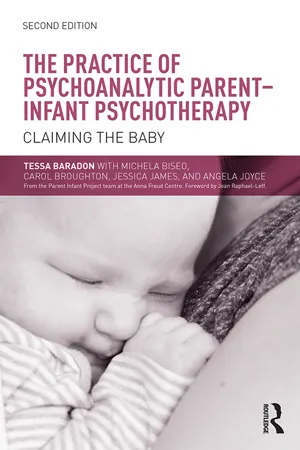
The Practice of Psychoanalytic Parent-Infant Psychotherapy
eBook - ePub

The Practice of Psychoanalytic Parent-Infant Psychotherapy

Claiming the Baby

  1. 214 pages
  2. English
  3. ePUB (mobile friendly)
  4. Available on iOS & Android
eBook - ePub

The Practice of Psychoanalytic Parent-Infant Psychotherapy

Claiming the Baby

About this book

The Practice of Psychoanalytic Parent-Infant Psychotherapy is a comprehensive handbook, addressing the provision of therapeutic help for babies and their parents when their attachment relationship is troubled and a risk is posed to the baby's development. Drawing on clinical and research data from neuroscience, attachment and psychoanalysis, the book presents a clinical treatment approach that is up-to-date, flexible and sophisticated, whilst also being clear and easy to understand.

The first section: The theory of psychoanalytic parent infant psychotherapy – offers the reader a theoretical framework for understanding the emotional-interactional environment within which infant development takes place. The second section, The therapeutic process, invites the reader into the consulting room to participate in a detailed examination of the relational process in the clinical encounter. The third section, Clinical papers, provides case material to illustrate the unfolding of the therapeutic process.

This new edition draws on evidence from contemporary research, with new material on:

  • Embodied communication between parent and infant and clinician-patient/s
  • Fathers and fathering
  • Engagement of at-risk populations

Written by a team of experienced clinicians, writers, teachers and researchers in the field of infant development and psychopathology, The Practice of Psychoanalytic Parent-Infant Psychotherapy will be an essential resource for all professionals working with children and their families, including child psychiatrists, psychoanalysts, psychotherapists, and clinical and developmental psychologists.

Frequently asked questions

Yes, you can cancel anytime from the Subscription tab in your account settings on the Perlego website. Your subscription will stay active until the end of your current billing period. Learn how to cancel your subscription.
No, books cannot be downloaded as external files, such as PDFs, for use outside of Perlego. However, you can download books within the Perlego app for offline reading on mobile or tablet. Learn more here.
Perlego offers two plans: Essential and Complete
  • Essential is ideal for learners and professionals who enjoy exploring a wide range of subjects. Access the Essential Library with 800,000+ trusted titles and best-sellers across business, personal growth, and the humanities. Includes unlimited reading time and Standard Read Aloud voice.
  • Complete: Perfect for advanced learners and researchers needing full, unrestricted access. Unlock 1.4M+ books across hundreds of subjects, including academic and specialized titles. The Complete Plan also includes advanced features like Premium Read Aloud and Research Assistant.
Both plans are available with monthly, semester, or annual billing cycles.
We are an online textbook subscription service, where you can get access to an entire online library for less than the price of a single book per month. With over 1 million books across 1000+ topics, we’ve got you covered! Learn more here.
Look out for the read-aloud symbol on your next book to see if you can listen to it. The read-aloud tool reads text aloud for you, highlighting the text as it is being read. You can pause it, speed it up and slow it down. Learn more here.
Yes! You can use the Perlego app on both iOS or Android devices to read anytime, anywhere — even offline. Perfect for commutes or when you’re on the go.
Please note we cannot support devices running on iOS 13 and Android 7 or earlier. Learn more about using the app.
Yes, you can access The Practice of Psychoanalytic Parent-Infant Psychotherapy by Tessa Baradon,Michela Biseo,Carol Broughton,Jessica James,Angela Joyce in PDF and/or ePUB format, as well as other popular books in Psychology & Mental Health in Psychology. We have over one million books available in our catalogue for you to explore.

Information

Index

AAI. See Adult Attachment Interview (AAI)
abandonment issues/feelings 106–107
absences, from therapy 106–107. See also dropout
acting out. See enactment
Adult Attachment Interview (AAI), 81
affect, negative 52, 89. See also emotional dis/regulation; security feelings
affective/behavioural risk factor 116
Ainsworth, Mary 20
ambivalence, to parenting 23
annihilation anxiety 8
anxiety 8–9, 26
arousal state: contagious viii; vigilant 26, 28, 68
assessing problem, observation of infant 76–77
attachment. See also object relations: case study 164–165; disorganized 185–186; Down syndrome 19; and early development 6, 7; and emotional regulation 69; group as attachment object 147–148; insecure 38; patterns, parental 7, 68–69; promoting positive 37; theory 3, 53
attention, joint 10, 18
attribution, parental 90, 116. See also projection
attunement, fostering parent-infant 21–22, 99, 148
avoidance, defensive 8–9; in end-phase of therapy 128–129, 134–135; gaze avoidance 8, 95
awareness, parental: infant needs 116–117, 119; states of mind 36
babies. See infant/s
Beebe, B. 177, 185
beginning-phase, group work. See also engagement: boundaries 140; establishing baby in group 143–144; preparing group for newcomers 142–143; preparing new member for group work 141–142; setting 141
beginning-phase, individual/family therapy 67. See also engagement; aims 70–71; assessing capacity for change 83–84; confidentiality/secrecy 72; end of initial phase 86; establishing baby as partner 77–79; first session 75–77; intake process 71–73; preliminary psychodynamic formulation 84–85; risk assessment 84; therapist’s role, summary 86; treatment, agreeing 85–86
belonging, by fathers 111–112
birth 14–15, 18–19
Biseo, Michela 161
body language. See communication
body memories 12
borderline personality disorder 8, 60
boundaries, setting: cross...

Table of contents

  1. Cover Page
  2. Half Title page
  3. Title Page
  4. Copyright Page
  5. Contents
  6. Foreword
  7. Preface
  8. Contributors
  9. Acknowledgements
  10. Key Terms
  11. Section I The Theory of Psychoanalytic Parent–Infant Psychotherapy
  12. Chapter 1 The Parent–Infant Relationship and Infant Mental Health
  13. Chapter 2 The Theory of Psychoanalytic Parent–Infant Psychotherapy
  14. Chapter 3 The Clinical Framework and Participants
  15. Chapter 4 The therapist and therapeutic techniques
  16. Section II The Therapeutic Process
  17. Chapter 5 Parent–Infant Psychotherapy
  18. Chapter 6 The Middle Phase
  19. Chapter 7 Fathers
  20. Chapter 8 Consideration of Risk in the Parent–Infant Relationship
  21. Chapter 9 Endings in Parent–Infant Psychotherapy
  22. Chapter 10 Parent–Infant Psychotherapy in Groups
  23. Section III Clinical Papers
  24. Chapter 11 Finding Father Through the Regulating Function of the Parent–Infant Psychotherapist
  25. Chapter 12 Knowing and Being Known
  26. References
  27. Index