eBook - ePub
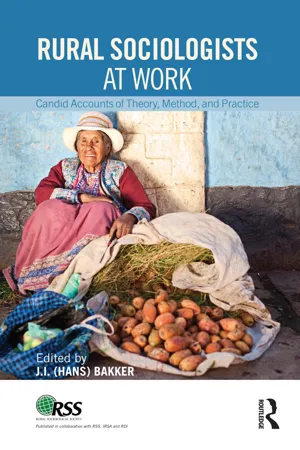
Rural Sociologists at Work
Candid Accounts of Theory, Method, and Practice
- 202 pages
- English
- ePUB (mobile friendly)
- Available on iOS & Android
eBook - ePub
About this book
This collection of original chapters, written by prominent social scientists, elucidates the theory and practice of contemporary rural sociology. The book applies lessons from the careers of sociologists and their field research endeavors, covering a wide range of topics: agricultural production, processing, and marketing; international food security and rural development; degradation of the bio-physical environment across borders; and the study of community, family, health, and many other issues in an increasingly globalized world. The authors' candid accounts provide insight into possibilities for enhancing opportunity and equality and serving basic human needs.
Information
Background Accounts
1
GENERAL INTRODUCTION
The past forty years have brought profound changes in both rural societies and Rural Sociology, many of which are reflected in the biographical sketches contained in this volume. Whereas even as late as the 1970s an argument could be made that US cities were dependent on farms, there is little doubt today that farms are dependent on cities. Put differently, virtually no US farms produce their own food. Nearly all farm products are inputs into either food manufacturing (despite growing interest in farmers’ markets and community-supported agriculture), and the vast majority of farmers are now dependent on the agricultural input industry for seeds, pesticides, fertilizers and machinery. Indeed, led by the poultry industry in the 1940s (Sawyer 1971), farm practices are more and more delimited by the demands of input producers and output purchasers. Input producers determine who can plant what seed and what can(not) be done with the harvest. If Monsanto is successful, it will even determine planting, harvesting, irrigation and other aspects of farm production (Bennett 2014) for many farmers. And output processors increasingly demand particular seed varieties, cosmetic qualities, harvest dates, packaging and delivery times so as to serve the food-processing and supermarket sectors. The situation is hardly different in Canada, and in much of Europe, Japan, Australia, and New Zealand.
Of course, there are still far too many poor farmers in the world, each trying to eke out a living—often on very small farms. As a result of improved transportation and better communications, as well as declining trade barriers, they are often in direct competition with small producers in other nations and/or with far better capitalized and subsidized farmers in the rich world. Hence, in many instances, those remaining in rural areas are those who, for one reason or another, could not make it in the city. And it was noted recently that the world has reached the tipping point in terms of settlement: more than half of all people now live in cities.
Moreover, environmental concerns, hardly discussed in terms other than of conservation a century ago, were only on the horizon for many people in the 1970s. There was certainly concern about overuse of pesticides and of “the limits to growth” (Meadows, Meadows, Randers, and Behrens, 1972), but the contemporary environmental issues with respect to agriculture—methane from cows, fertilizer runoff, energy consumption in production and distribution, declining biodiversity in crop plants and farm animals, among others—were rarely noticed or discussed by rural sociologists. Today, environmental issues are front and center; entirely rural issues are perhaps too rapidly becoming a residual category.
Similarly, while forty years ago there were still many vibrant though often declining rural communities, today there are fewer of them and they are far less isolated and different from larger urban areas. Readers of this volume will already be aware that the technology treadmill (Cochrane 1993) has led to ever-larger farms. With the decline of the farm population, the rural communities that serviced those farmers and their families have declined as well. Similarly, in mining and fishing communities, new technologies have displaced thousands of workers. In addition, the Wal-Mart-ization of the countryside, combined with the aging of the rural and farm populations, has played a considerable role in hollowing out the downtowns of hundreds of rural communities.
But of arguably greater consequence is how the Internet has begun to dissolve the rural/urban differences that were once the central concerns of Rural Sociology. By this I mean not the superficial differences, such as those rightly derided by Howard Newby (1980) as analogous to the difference between Sunday morning and Tuesday afternoon behavior, but the profound differences in outlook and behavior that once made for sharp distinctions. As the British essayist, G. K. Chesterton (1919, 180), put it nearly a century ago:
The man who lives in a small community lives in a much larger world. He knows much more of the fierce varieties and uncompromising divergences of men. The reason is obvious. In a large community we can choose our companions. In a small community our companions are chosen for us. Thus in all extensive and highly civilized societies groups come into existence founded upon what is called sympathy, and shut out the real world more sharply than the gates of a monastery.
Today, this distinction between small communities and large urban agglomerations is evaporating. It is not merely that the transport and communications systems are far better than they were in the past. Nor is it that cities, especially in the United States, now sprawl over vast suburbs. It is that, largely because of the embrace of personal computers, the Internet and the cell phone, even many of the residents of small rural villages can choose their companions. The interests for a small town banker or grocery store owner are such that he (and it is still mostly he) can be in touch instantly with other like-thinking persons. Even farmers, especially those with large operations, once seen as the quintessential example of rural life, are far more likely to be in contact with those with similar views in farm organizations, agricultural supply chains and like-minded friends located some distance from their respective farms. As Davis and Hinshaw (1957) foresaw, many farmers now wear a business suit; they are as much at home with commodities brokers and input suppliers as they once were with their neighboring farms.
It appears to me that, as a result of these transformations, Rural Sociology has come to the proverbial fork in the road. It is nearly impossible to go forward since much of the subject matter no longer exists, but it is possible to pursue other roads not yet taken. Many of those other roads involve interdisciplinary activities with other social sciences such as geography, as well as with various branches of the biological sciences.
The goal of the book is to allow the background story to become a bit clearer. Some of the chapters are fairly candid about the trajectories that rural sociologists have had in their careers. Several authors came to rural sociology somewhat by chance. Indeed, I was one of those persons, coming to rural sociology largely as a result of the cancelation of a Peace Corps program for junior high school social studies teachers in Nigeria and reassignment to an agricultural program in Guinea. After three and a half years in Guinea and Togo as a beekeeper, I was hooked.
However, after obtaining my Ph.D. at Cornell, I was somewhat frustrated by the directions in which the field was going at that time, both in terms of theory and methods. After several years of largely fruitless attempts to use county-level data to examine rural industrialization and healthcare delivery, I realized that the agricultural scientists across the hall offered a more interesting and more important topic— at least to me. Study of the organization of agricultural research in partnership with Bill Lacy (Busch and Lacy 1983) led to further studies of specific issues in plant biology—the (then) new biotechnologies and crop biodiversity, among others. As I entered these fields previously unknown to me, I also began to realize the limitations of sociology; by participating in meetings, as well as engaging in discussions and joint research with biological scientists, philosophers and economists, among others, I began to realize that rural sociology need not stop at the narrowly defined social, that material culture mattered as well.
Then, again fortuitously, I was confronted with endless talk about standards—for seeds, grain, meal, oil, and margarine—while wandering around in canola fields in Saskatchewan. I began to realize that standards were not merely technical rules, but also the means by which social life was organized (Busch 2011). Moreover, I learned that when standards became taken for granted they took on a life of their own.
As I approach the end of my career, I realize that students interested in the discipline of rural sociology or the broader field of rural studies will find this a helpful way to be introduced to topics that cannot be covered in quite the same way in textbooks. I myself learned a few things about colleagues who I have known for years. Also, some of the authors in this collection have pursued topics with which I am less familiar. I recommend this book to anyone interested in the “candid accounts” and the cogent comments on theory, methods and practice found in separate chapters. Moreover, the various contributions to this volume should help to provide some options by re-examining the past so as to orient the future.
Bibliography
Bennett, Drake. 2014. “What are They Doing at Monsanto?” BusinessWeek, July 7–13, pp. 52–59.
Busch, Lawrence. 2011. Standards: Recipes for Reality. Cambridge, MA: MIT Press.
Busch, Lawrence and William B. Lacy. 1983. Science, Agriculture, and the Politics of Research. Boulder, CO: Westview Press.
Chesterton, Gilbert K. 1919. Heretics. London: John Lane.
Cochrane, Willard. 1993. The Development of American Agriculture. Minneapolis, MN: University of Minnesota Press.
Davis, John H., and Kenneth Hinshaw. 1957. Farmer in a Business Suit. New York: Simon & Schuster.
Meadows, Donella H., Dennis L. Meadows, Jørgen Randers, and William W. Behrens III. 1972. The Limits to Growth. New York: Universe Books.
Newby, Howard. 1980. “Trend Report: Rural Sociology.” Current Sociology 28: 3–109.
Sawyer, Gordon. 1971. The Agribusiness Poultry Industry. New York: Exposition Press.
2
RURAL SOCIOLOGY
A SLIGHTLY PERSONAL HISTORY
This chapter presents a brief history of American Rural Sociology. It discusses the key early figures, such as C.J. Galpin, Kenyon Butterfield, Dwight Sanderson, and Thomas Carver Nixon. But the focus is on the next generation, and the distinctive institutional character of rural sociology as it developed in the twenties and thirties, and evolved in relation to events in the postwar period. Rural sociology shared many features with the “Social Survey” movement, including its commitment to community development, and to some extent its methods. The “Survey Movement” petered out, for reasons having to do with the willingness of communities to subject themselves to the kind of scrutiny needed for reform. The community studies of Rural Sociology were caught between similar forces, and were also politically vulnerable. Postwar rural sociology responded to these vulnerabilities, but faced changes in agriculture that undermined the original purpose of improving rural life. The field nevertheless retained its commitment to engagement, and found new ways of doing so. In this respect, it deviated significantly from general, which had an acrimonious split from the survey movement. Ironically, however, general sociology has returned to engagement, at a time that rural sociology has lost its original subject matter and raison d’être.
Introduction
American rural sociology has a distinctive history, deeply rooted in the tradition of land grant universities, with its arrangement of three institutions, the college of agriculture, the agricultural experiment station, and the cooperative extension service, but also rooted in the campaigns to improve Rural Life of the Country Life Commission, and beyond that the social reform movements of the late nineteenth century. The interest in rural sociology was not simply American, however. There are international analogues to all of these institutions, as well as to the early efforts to survey rural life: both Germany and Sweden had large-scale surveys around the turn of the twentieth century. The German one was done by the Verein für Sozialpolitik, the Social Policy association, contributed to by a youthful Max Weber, who also produced a dissertation on agrarian history ([1909] 1976).1 Yet these studies did not lead directly to institutionalization in universities and to an academic discipline operating alongside and in relation to general sociology, as they did in America, though a variant form, of folk studies, became important in central Europe and Romania.
The Country Life Commission, and the extensive, fretful, discussion of the decline of the Rural Church that accompanied and followed it, were both part of the vast movement for social reform of the late nineteenth and early twentieth century. Rural sociology, as a discipline and institution, in ways that contrast to parallel developments in “General Sociology,” retained features of these origins in reformism. The passage from reform movement to academic discipline was complex and fraught. But the history repays study. Rural sociology is one of the most elaborate and sustained cases of the institutionalization of engaged scholarship, that is to say scholarship that has simultaneously attempted to speak to, for, and about its audience, and to do so within complex larger structures with which it was necessary to conform and creatively adapt: universities and schools of agriculture and the ever-changing structure of governmental agricultural work, including extension, federal research and policy, and the political structures that support this system.
This volume of autobiographies is significant because it records a significant new phase in the history of the field, during which there was the need to adapt to radical changes, indeed, the disappearance, of its original subject matter, a disappearance in which this same set of institutions played a role. In this introduction, I will give a history, though a personal history, of...
Table of contents
- Cover
- Title
- Copyright
- Dedication
- Table of Contents
- Acknowledgments
- Candid Accounts by Rural Sociologists: Editor’s Introduction
- Part I: Background Accounts
- Part II: Candid Accounts
- Part III: Theory and Method
- List of Contributors
- Index
Trusted by 375,005 students
Access to over 1.5 million titles for a fair monthly price.
Study more efficiently using our study tools.
Frequently asked questions
Yes, you can cancel anytime from the Subscription tab in your account settings on the Perlego website. Your subscription will stay active until the end of your current billing period. Learn how to cancel your subscription
No, books cannot be downloaded as external files, such as PDFs, for use outside of Perlego. However, you can download books within the Perlego app for offline reading on mobile or tablet. Learn how to download books offline
Perlego offers two plans: Essential and Complete
- Essential is ideal for learners and professionals who enjoy exploring a wide range of subjects. Access the Essential Library with 800,000+ trusted titles and best-sellers across business, personal growth, and the humanities. Includes unlimited reading time and Standard Read Aloud voice.
- Complete: Perfect for advanced learners and researchers needing full, unrestricted access. Unlock 1.5M+ books across hundreds of subjects, including academic and specialized titles. The Complete Plan also includes advanced features like Premium Read Aloud and Research Assistant.
We are an online textbook subscription service, where you can get access to an entire online library for less than the price of a single book per month. With over 1.5 million books across 990+ topics, we’ve got you covered! Learn about our mission
Look out for the read-aloud symbol on your next book to see if you can listen to it. The read-aloud tool reads text aloud for you, highlighting the text as it is being read. You can pause it, speed it up and slow it down. Learn more about Read Aloud
Yes! You can use the Perlego app on both iOS and Android devices to read anytime, anywhere — even offline. Perfect for commutes or when you’re on the go.
Please note we cannot support devices running on iOS 13 and Android 7 or earlier. Learn more about using the app
Please note we cannot support devices running on iOS 13 and Android 7 or earlier. Learn more about using the app
Yes, you can access Rural Sociologists at Work by Johannes Hans Bakker in PDF and/or ePUB format, as well as other popular books in Social Sciences & Agricultural Public Policy. We have over 1.5 million books available in our catalogue for you to explore.