- 256 pages
- English
- ePUB (mobile friendly)
- Available on iOS & Android
eBook - ePub
Sufism in the Secret History of Persia
About this book
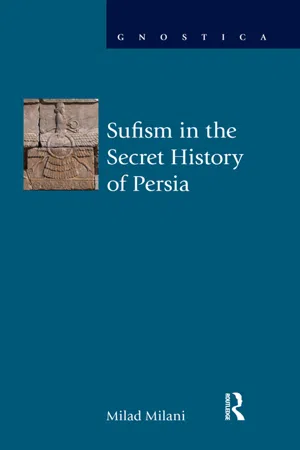
Sufism formed one of the cultures of resistance which has existed in the social fabric of Persia since antiquity. Such resistance continues to manifest itself today with many looking to Sufism as a model of cooperation between East and West, between traditional and modern. 'Sufism in the Secret History of Persia' explores the place of Sufi mysticism in Iran's intellectual and spiritual consciousness through traditional and contemporary Sufi thinkers and writers. Sufism in the Secret History of Persia examines the current of spirituality which extends from the old Iranian worship of Mithra to modern Islam. This current always contains elements of gnosis and inner knowing, but has often provided impetus for socio-political resistance. The study describes how these persisting pre-Islamic cultural and socio-religious elements have secretly challenged Muslim orthodoxies and continue to shape the nature and orientation of contemporary Sufism.
Information
CHAPTER 1
THE MACROHISTORICAL PURSUIT OF SECRET PERSIA AND THE SUFI MYTH-HISTORY
PRE-ISLAMIC SUFISM AND THE IRANIAN ROOTS OF SUFI MYSTICISM
Sufism does not predate Islam. Certain features of it that are characteristic of pre-Islamic traditions common among Iranians, however, can be detected in Sufism generally, but specifically pertaining to Sufis of Iran. These include the heroic tradition of champions (ghahreman), now known in Sufism as javanmardi or futuwwat; aspects of which include service (khedmat) and a selfless attitude of generosity (sekhavat) and sacrifice (ithar). Others require greater in-depth appreciation of ancient Persian ideas and heritage both religious and moral, which flow into Islamic Iran and are appropriated by early mediaeval Moslem-Iranian thinkers, such as Ferdowsi and Sohravardi. Earlier on, Salman-e Farsi (Chapter 8) is a paradigmatic example of this transition and flow of ideas from past to present.
Of those who contend for the pre-Islamic origins of Sufism, the previous head of the Khaneqahi Nimatollahi Sufi order, Javad Nurbakhsh (1926–2008), insisted that “Persian Sufism” is a distinctly Iranian phenomenon – independent of Islamic history – and one that assuredly predated Islam (Chapter 9). The nature of Nurbakhsh’s claims are largely ahistorical, but they do warrant further review if only for their delineation of Persian cultural components, now part of Islamic mysticism. The case of the Nematollahiya, however, is also relevant to the present study because Nurbakhsh surmised the existence of a legitimate line of masters that are connected through a secret sapiential tradition referred to as hekmat-e khosravani (Chapter 2). Although the validity of such a “line of wisdom” is the subject of proper historical investigation in this book, there is little reason to believe it to be anything more than conjecture and properly identified as a composite attribute of Khaneqahi Nematollahi Sufi imagination or myth-history.
Indeed, what might be a better case to argue is that Sufism is an Iranian invention; but, to be exact, it has to be the product of an Iranian–Islamic marriage in which the offspring of these two great cultures harbours the genetic tendencies of both its parents. There is no way that Sufism could literally predate Islam, but there is no reason why it could not carry the germs of a distant ancestral religion within it. The fact of the matter is that Iranian and Arab cultures are intimately bound following the Arab-Islamic conquest of Sasanid Iran. This is verified by the fact that Salman the Persian, who was the first Persian convert, was also the first to translate the Qur’an and hadith into Persian. Moreover, the majority of Moslem scholars who laid the foundation of Arabic-Islamic sciences and arts were of Iranian and generally non-Arab origin. It remains the case that the Arabs and Iranians of this era immediately following the conquests had a close bond that was founded on the ideals of the early Islamic community, and which was headed under the guidance of the caliph al-rashidun. However, this bond is severed gradually during the Umayyad period, whereby the new Arab overlords ruled with a firm and elitist method that belittled and devalued the non-Arab. The rise of the Shi’a, proper, is a direct result of the non-Arab Moslem population taking control of the situation in a bid to avenge the unjust murder and usurpation of the members of the Prophet’s House (bait al-nabi). The very special relationship of Iranian Moslems and the Islamic tradition is that Iranians saw themselves as the special guardians of the Prophet’s House, and stewards of his true teachings (Islam), until the return of the rightful heir and leader of Islamic community, Imam Mahdi (imam ghayeb).
MACROHISTORY AND THE SUFI MYTH-HISTORY
Wherever the hints of a hidden macrohistory are provided, there are problems in detecting and following its “traces”. A very difficult task faces anyone trying to make up for missing materials just by “tracking footprints” (sometimes seeming to “chase shadows”) until reaching the Sufis – when the whole, strange exercise falls into place. Methodologically, there are genuine problems for the enterprise. From the very start, there are huge gaps or lacunae of evidence that can only be filled by inference. One danger in this method is that of subjective deduction, of being too keen to theorize in the endeavour to explain what has been repressed. However, upon collecting and sieving through all the available material on relevant-looking “religious” ideas and movements, what remain are crucial indicators in “periodic pockets”, or “nuggets”, that constitute the “stepping-stones” of a larger underground trajectory. It has been of some advantage to have access to the phenomenon and awe-inspiring, hard-to-fathom body of Sufi poesis. This book is not the first in its attempt to explain the peculiarity of the Iranian spiritual story; others have done so, but simply in terms of non-hidden (“exoteric”) historical materials, albeit including the special and “public” nature of Shi’ite gnoseology and immamology. What is unique about the approach of this book is the appropriation of the rich ingredients of Sufi poetry to better explain the proposed macrohistory of religious currents, trajectories, threads and factors that have been “shelved” by the mainstream, this mainstream not just being the Islamic establishment, but also the Zoroastrian one earlier on. Indeed, Sufism has absorbed the impulses of ideas and movements that have been partly (or almost) hidden from view, and so it is adequately “placed” through the efforts of this book by tracking down the repressed elements that have gone into its making. Sufi poetry, therefore, serves as a useful point of entry into the highly nuanced character of Persianate Sufism.
This brings us to a related problem to do with the “esoteric”, a term with at least three meanings in the following pages. The first is to do with the excavated subterranean currents being a “hidden history” (i.e. not open to easy view, as with the kind of exoteric history of the Islamic world written by Jarir al-Tabari). The second is that the materials (i.e. ideas/movements) making up the hidden history are of an esoteric nature anyway, and in this connection at least three specific elements need to be considered: the “inner life”, the idea of “occultation” (as with the grand Imams) and secrecy (people often cannot afford to expose themselves). And third, coming to the final chapter on Sufi poets, one can find that they defy academic inquiry in many different ways – this being through a still deeper esotericism than the two former meanings can reveal. The endpoint of this work is thus very difficult to discuss and divulge under ordinary methods, but this volume is about the background for understanding what are undoubtedly very profound matters that can really only be hinted at through objective empirical research such as this. These matters certainly impinge on gnostika, that is, matters of an inner knowing that sit alongside yet should be explored in tandem with exoteric research. Yet of course not everything in Persian spirituality that is esoteric will be considered here. Except where the material is pertinent, this book is not about the “formerly esoteric side” to establishment traditions (such as Zoroastrianism or Islam in the case of Persian history),1 but it more persistently pursues what comes out of a study of materials that have been “left behind”, or in a “minority” position, or made “marginal”, or had only “temporary prominence” before being forced “underground”. Indeed this book is very often about what has been put “under threat” of extinction and “de-memorialization”, but has somehow “survived”, if only as covert and subtle impresses picked up by the trained and discerning eye.
The methods for this book derive mainly from the discipline of Studies in Religion (History of Religions/Comparative Religion), which is already polymethodic and multidisciplinary. This discipline provides the flexibility to examine sensitive “religious materials” from various viewpoints. Above all, the sub-disciplines of the History of Religions and the History of Religious Ideas, including the manifold possibilities of the discipline of History itself, have assisted with the major procedures used in this study. The methods of these disciplines help develop a keen eye and special appreciation for the underlying “stream of consciousness” that alternatively bubbles up and apparently disappears in Iran’s mysterious past. Indeed, the task here is a historical one: to uncover a hidden subterranean history over at least four and a half millennia, spotting the special lineaments of Persian thought and spirituality from Mithra to Rumi that best unravel the intriguing phenomena of Sufism. Therefore, this undertaking is indeed macro-historical.
“Macrohistory” we take to be “the representation of history as a whole”, or the representation of a great passage of time. Macrohistory implies that all or a great sweep of history can somehow be held in the “mind’s eye” of any putative observer and interpreter. Doing “macrohistory”, moreover, is not exclusively the act of those critical minds probing “real” or “actual” history (or historical occurrences); it could be, in fact, highly fictional or imaginary, even a travesty of the past. As Garry Trompf explains:
[Macrohistory] comprises all general(ized) visions of human destiny, whether as great stages or a procession of cycles through time, as an overall progress or regress, or as an encasement of the known order between determinative primordial events and some extraordinary eschaton. Macrohistory encompasses but is not limited to metahistory … Macrohistory must also take in any broad prospectus of change that is decidedly imaginal, or highly speculative.2
Sufis themselves have propagated macrohistories, and somewhat suspicious as they may be, they are treated as “mythic” in some way, furthermore providing crucial assistance when discerning the “macro-historical prehistory” of their poetry, that is, the prior, hidden material into which they delve or to which they allude. The relevant materials of this great “prior history” are received in quite variable ways. Sometimes, in special contexts, one finds “full-blown” schemata or schemes of history that reflect the trajectory being traced, where they can be written into the current grander one as documents that fill out the whole story and make up for our “lack” in evidence of an overall hidden history. Most often one only gets a “scent” of what is going on, and every past attempt to derive an “alternative vision” of Persia’s heritage will be grist to our research mill. Sufi suggestions of this “different overview” have been the most important macrohistorical materials of all for this project; the book alludes to them along the way and attempts to expound their purport.
Among Sufi (mythic-)macrohistories, one in particular, the Khaneqahi Nematollahi Sufi order, a major branch of the Nematolliya, attracts the interest of this book. In what is their alleged view, the past is quite remarkably explained in terms of the hidden wisdom tradition of Persia, hekmat-e khosravani or “the Khosravan Wisdom”, also referred to as the “Khosravan Path”. The Nematollahis do not imagine their macrohistory as an esoteric current or “movement”, but rather see it as a doctrinal consistency passed on along a line of designated masters, unofficially beginning with Zarathushtra right down to noted Persian Sufis. This macrohistory and others like it offer crucial clues for unravelling the repressed past we seek to probe, claiming to preserve the pre-Islamic origin and subtle development of “Persian Sufism”. This research is inspired by such available “Sufi” macrohistories, received first-hand from time spent with their purveyors (although their identities cannot be revealed for reasons of their safety). This book, however, provides a far more structured, critical investigation and a much fuller coverage than they have offered; so it is an independent historical exposition of a likely history. The macrohistory offered here really goes on to interpret Sufi visions of the past and what they are trying to convey esoterically. It should be noted that the intention of this book is not to impart esoteric truth, or a claim to construct a hypothetical “esoteric history” of human and cosmic affairs (like, for example, Abu Razi’s).3 This book is about esoteric issues, strictly concerned with the “esoteric macrohistory” of alternate or hidden lineaments in Persian culture or ones hitherto neglected. The approach is from an “esotericist” (rather than an “esoterist”) point of view. The difference being that the “esoterist” is one who in fact subscribes to a single theosophical theory or model, while the “esotericist” is one who writes and thinks about esoteric thought.4 This book is a history of ideas and hidden currents with special reference to esoteric forms of spirituality, and as such those holding them have had to be careful to protect themselves and their sensitive knowledge from “religious establishments”, often choosing anonymity.
It should also be pointed out that a major premise of this undertaking takes its cue from Garry W. Trompf, in his attempt to set an agenda for Persian studies.5 He maintains that certain conundrums in Persia’s history demand better explaining, among them the non-Islamic features of mediaeval Persian mystical poesis, and this book follows this quest, paying careful attention to ignored components in the previous histories of Iranian religious consciousness. As the book deals with such huge spaces of time, of course, it does not presume to expostulate on every known movement and idea within the proposed period, but rather to deal with what comes into focus as the landmarks – those stepping-stones – in the current macrohistorical reconstruction.
In presenting the scale of Iranian history – from approximately 3000BCE until now, or from pagan Iran to the Islamic Revolution – the present reconstruction finds real difficulties with standard approaches. These tend to read things by “establishments”, be they Zoroastrian or Moslem, neglecting many other long-term and continuing impulses of Persian heritage, such as Mithraism and Mazdakism. The task here is to detect and take a fairer and proper note of “unnoticed” or “ignored” elements that often sit apart from a normative cultural and religious progress. Consider establishment and exoteric Islam in Iran: there are peculiarities in Persian Islam, even Islam eo ipso, that have not yet been adequately accounted for in scholarship, and one of our tasks is to comprehend these properly, for the Moslem establishment tends to “paper over” many subterranean contours spread over a long period of time (with movements often kept at bay, or rejected and/or persecuted). There is a need to uncover these covert currents, because their continuing life through the history of Persian consciousness not only constitutes an alternate hidden history, but also explains the “public peculiarities” of Iranian Islam, and more especially Persian Sufism.
CHANGING HATS: ZOROASTRIANISM AND ISLAM
The Pahlavi dynasty of Reza Shah “The Great” – as dubbed by his successor and son Mohammad Reza Shah – was an attempt to radically modernize Iran. Muhammad Reza Shah, a more religious man than his father, took the ancient Achaemenian tributary titles of Shahanshah “King of Kings” and Aryamehr “Light of the Aryans”, but his rather superficial attempt to fuse Persian heritage and its Islamic identity did not work to his favour. The founding of the Pahlavi dynasty was the last attempt at a restored “Kayyanid”-styled Persia – a native Persian dynasty – claiming the ancestry of the Achaemenians (Mohammed Reza Shah was the second ruler of the Pahlavi dynasty and the last Shah of the Persian monarchy). Although a closer analysis of the Pahlavi dynasty would be pertinent for a better understanding of Iranian identity, it is an exercise better suited to a modern historical endeavour. Here the more relevant example of the Sasanian dynasty (224–651CE) vitally demonstrates the point at hand. Its period marks the beginning of a major paradigm shift: the traditional line of the kings of Persia was broken with the coming of Islam and Arab domination of the Umayyads (660–750). The subsequent Abbasid rule (750–1248), however, brought a Persian renaissance, moving the capital from Damascus to the more “Persianized” Iraq (building the capital on the Tigris in Baghdad), the seat of the ancient kings of Persia. The Abbasids’ rule was still an Arab one, however, and as their grip on Iran weakened, several independent dynasties arose that were particularly important for the continual revival of Persian cultural and religious elements, re-establishing the line of kings that lasted until the 1979 Islamic Revolution of Iran. Among the first independent native Iranian dynasties were the Saffarids (861–1003), who annexed the regions of Greater Khorasan (from the first official dynasty independent of the Abbasids, the Tahirids [821–873]). The Saffarids’ power lasted until the death of their founder, Yaqub ibn Laith al-Saffar (d. 879); they were defeated by the Samanids (819–999), a line of dynasts founded by the ex-Zoroastrian and theocratic convert to Sunni Islam, Saman Khoda (flor. 720s). Out of t...
Table of contents
- Cover
- Half Title
- Title Page
- Copyright Page
- Dedication
- Table of Contents
- Preface
- Acknowledgements
- Abbreviations
- Introduction: Iranian or Persian? The religious landscape of Iranian identity
- 1 The macrohistorical pursuit of secret Persia and the Sufi myth-history
- 2 From Mithra to Zarathushtra
- 3 The Gathas and Mithra
- 4 Mithraism and the parallels of Sufism
- 5 The resurgence of “Persianate” identity in the transmission and fusion of ancient Iranian ideas within Islam
- 6 From late antiquity to neo-Mazdakism
- 7 Later antiquity: Mazdak and the Sasanian crisis
- 8 Between late antiquity and Islam: The case of Salman the Persian and Waraqa (the Christian scribe)
- 9 The end of the journey: Persian Sufism
- Conclusion
- Select bibliography
- Index
Trusted by 375,005 students
Access to over 1.5 million titles for a fair monthly price.
Study more efficiently using our study tools.
Frequently asked questions
Yes, you can cancel anytime from the Subscription tab in your account settings on the Perlego website. Your subscription will stay active until the end of your current billing period. Learn how to cancel your subscription
No, books cannot be downloaded as external files, such as PDFs, for use outside of Perlego. However, you can download books within the Perlego app for offline reading on mobile or tablet. Learn how to download books offline
Perlego offers two plans: Essential and Complete
- Essential is ideal for learners and professionals who enjoy exploring a wide range of subjects. Access the Essential Library with 800,000+ trusted titles and best-sellers across business, personal growth, and the humanities. Includes unlimited reading time and Standard Read Aloud voice.
- Complete: Perfect for advanced learners and researchers needing full, unrestricted access. Unlock 1.5M+ books across hundreds of subjects, including academic and specialized titles. The Complete Plan also includes advanced features like Premium Read Aloud and Research Assistant.
We are an online textbook subscription service, where you can get access to an entire online library for less than the price of a single book per month. With over 1.5 million books across 990+ topics, we’ve got you covered! Learn about our mission
Look out for the read-aloud symbol on your next book to see if you can listen to it. The read-aloud tool reads text aloud for you, highlighting the text as it is being read. You can pause it, speed it up and slow it down. Learn more about Read Aloud
Yes! You can use the Perlego app on both iOS and Android devices to read anytime, anywhere — even offline. Perfect for commutes or when you’re on the go.
Please note we cannot support devices running on iOS 13 and Android 7 or earlier. Learn more about using the app
Please note we cannot support devices running on iOS 13 and Android 7 or earlier. Learn more about using the app
Yes, you can access Sufism in the Secret History of Persia by Milad Milani in PDF and/or ePUB format, as well as other popular books in Theology & Religion & Islamic Theology. We have over 1.5 million books available in our catalogue for you to explore.