eBook - ePub
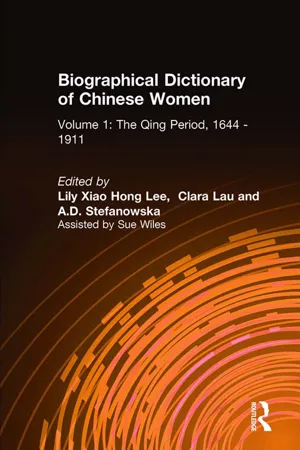
Biographical Dictionary of Chinese Women: v. 1: The Qing Period, 1644-1911
- 600 pages
- English
- ePUB (mobile friendly)
- Available on iOS & Android
eBook - ePub
Biographical Dictionary of Chinese Women: v. 1: The Qing Period, 1644-1911
About this book
The first biographical dictionary in any Western language devoted solely to Chinese women, this reference is the product of years of research, translation, and writing by a team of over 60 China scholars from around the world. Compiled from a wide array of original sources, these detailed biographies present the lives, work, and significance of more than 200 Chinese women from many different backgrounds and areas of interest.
Information
Print ISBN
9780765600431
Subtopic
Historical BiographiesL
Lalu Nathoy: see Bemis, Polly
Leng Yujuan
Leng Yujuan, c. 1657–?, zi Shanshan, pen name Renjian Yezhe, was born in Laiyang County, Shandong Province. The year of her birth is estimated to be 1657 from the record of the ceremony performed for the start of her adulthood in 1676.
From her own preface to her collected poems we know that Leng Yujuan was born into a lowly family, adopted as a maidservant and named Yujuan by her master, Zhou Zheng. Because they liked her for her brightness, Zhou and his wife taught her to read and write instead of making her do chores like washing and cleaning. One source suggests she was a courtesan at Zhou’s home. As she grew older, for three years the couple taught her to write poetry and she composed more than one thousand poems. The couple invited three famous scholars—Zhang Huaping, Zhao Taiqi, and Liu Yinqing—to help her revise her poems.
Leng Yujuan became a concubine of Song Shiyuan, who was the head of Wuchuan County, in 1676 when she was about twenty sui. Two years later her five-volume collection of poems entitled Yanluge shiji (Collected poems from Yanlu Gallery), which includes 250 poems, was compiled and published by her former master, Zhou. Leng Yujuan wrote a preface to it in which she named herself Renjian Yezhe and Lengshinü. Besides the forewords by Zhang Chongren, Song Lian, and Sun Xi, compliments by Zhou Zheng and a review by the scholars Zhang, Zhao, and Liu were also attached to the poems. Comments by Li Hugong, Lu Xuanpu, and Wang Jingzhou and concluding remarks by Zhou Zheng were appended at the end.
The famous scholar Deng Zhicheng (1887–1960) pointed out in his book Qingshi jishi chubian that Leng Yujuan followed the Seven Poets (Qizi) of the Ming dynasty, so that her poems have strength and power. In her time the Song dynasty style of poetry was popular but Leng Yujuan retained her own style and remained uninfluenced by this trend. Deng Zhicheng especially treasured her eight poems entitled “He Qiuxing” (Response to ‘Autumn Thoughts’) because he believed they expressed her profound aspiration. Deng Zhicheng also expressed surprise at discovering poems of such fine quality in a woman’s collection.
From Hu Wenkai’s Lidai funü zhuzuokao we learn that both the Gazetteer of Shandong Province and the [Guixiu] Zhengshi ji record Yanluge shiji and another collection of her works, entitled Keyue ji (Jade moon).
WANG Dongfang
(Translated by Jiang Chongyue)
(Translated by Jiang Chongyue)
Deng Zhicheng, Qingshi jishi chubian (Hong Kong: Zhonghua shuju, 1976), 6.672.
Hu Wenkai, Lidai funü zhuzuokao (rev. and enlarged ed.; Shanghai: Shanghai guji chubanshe, 1985), 9.296–9.297.
Leng Yujuan, Yanluge shiji (1678 ed.).
Xu Kuichen, ed., Guochao guixiu xianghai ji (Shenbaoguan ed.), 8.3b–8.4b.
Yun Zhu, comp., Guochao guixiu zhengshi ji (Hongxiangguan ed., 1831), 3.22a–3.23a.
Li Changxia
Li Changxia, fl. mid nineteenth century, zi Dexiao, hao Qizhai, was a native of Ye County in Shandong Province. She married Ke Heng, a scholar native to Jiaozhou; their children were also known for their literary writings.
Li Changxia lived during a time of great crisis in China. Between 1851 and 1875 the Nian Uprising was at its height and the northeast was ravaged by war. In 1861 the Nian bandits moved eastward to Shandong where they burnt houses and entire cities, plundering and killing as they went and forcing people from their homes. Li Changxia fled with her elderly and sick mother-in-law and her young children. They suffered great hardship and lived in constant fear as they roamed from place to place. When they finally returned they found their home in ruins. Li Changxia’s mother-in-law died of illness and Li Changxia and her children also became ill. They were soon forced to flee the fighting again, this time going to Wei County. Still, the situation remained turbulent and unsettled.
Such unforgettable experiences found expression in Li Changxia’s poems. Her long poem “Xinyou jishi yibaiyun” (Memories of the xinyou year) detailed what she went through. The cruelty of war and the family’s feelings when on the run were also reflected in her poems “Fu Weixian” (Going to Wei County), “Weicheng zhong zuo” (Written in a besieged city), “Sushi wubai zi ji Jihou di” (Narrative poem to my brother Jihou) and “Bikou haishang” (Refugees on the sea). At the same time Li Changxia saw the problems in the rural areas and voiced her grief for the ordinary people. The concern she showed for society was rare among women of affluent families.
Li Changxia was taught by her father, Li Tu, from an early age. She was good at composing poems and wrote a collection called Qizhai shiji (Collected poems from Qi Studio). In addition, her Qizhai riji (Diaries from Qi Studio) and Jiao Wenxuan Lizhu (Textual study of Li’s commentary to the Wenxuari) were cited by the Gazetteer of Shandong Province. More than eighty of her poems also appeared in Qingshi hui.
Apart from recording current events, Li Changxia also wrote in her poems about her memory of home, recalling acquaintances as well as scenery and travel experiences. Her poems were somber but elegant, her thoughts remote and deep. Both the content and the style of her poetry followed those of Tang poet Du Fu (712–770) in their pronounced spirits of realism. Although little material on Li Changxia’s life is available, her poetic works gained her a position that cannot be overlooked in the circle of female poets of the Qing dynasty.
CHUNG Hui-ling
(Translated by W. Zhang)
(Translated by W. Zhang)
Xu Shichang, Wanqingyi shihui (Beijing: Zhongguo shudian, 1988 photocopy of 1928 Tuigeng tang ed.), vol. 4, 735.
Zhong Huiling [Chung Hui-ling], “Qingdai nü shiren yanjiu” (Ph.D. thesis, National Chengchi University, Taibei, 1981), 390.
Li Huixian
Li Huixian, 1868–1924, was the youngest daughter of Li Chaoyi, prefect of Guizhu in Guizhou Province, whose family was scholarly but not rich. In 1891, at the age of twenty-three sui Li Huixian married the famous reformer Liang Qichao (1873–1929) in Beijing. In 1889 Liang Qichao ranked eighth as provincial graduate (juren) in the Guangdong examination where the main examiner, Li Duanfen, was Li Huixian’s older brother. He appreciated Liang Qichao’s talent and asked the assistant examiner Wang Kan to act as middleman to betroth his younger sister Li Huixian to Liang Qichao.
When Li Huixian married into the Liang family, Liang Qichao’s mother had been dead for six years and his father had remarried. His stepmother was just two years older than Li Huixian. As Li Huixian was pleasant and showed filial respect for her young mother-in-law, she gained her mother-in-law’s fondness.
In 1898 Jing Yuanshan (1841–1903) established Jingzheng Girls’ School (also called Jingshi Girls’ School) in Guishu Lane in Shanghai. The school was one of the first girls’ schools established by Chinese in modern China and was the first case in modern China in which women jointly operated a school. All internal posts, including administrative and managing personnel, personnel officers, officers and internal directors, were filled by women and, apart from one expatriate woman who taught English, all teaching staff were Chinese. The internal directors of Jingzheng Girls’ School also organized a female students’ association and launched a newspaper called Guanhua nüxue bao, doing their utmost to promote education for females. Among the key founders of the girls’ school were Kang Tongwei (1879–1974; daughter of Kang Youwei, 1858–1927), Mrs. Jing Yuanshan, and Li Huixian. These women were among the most outstanding figures in the feminist movement and the female education movement at that time.
After the failure of the Wuxu coup d’état of 1898 Liang Qichao escaped overseas. Li Huixian escorted his parents and her daughter to Macao and later stayed with her husband in Japan for some time. Devoting his life to the affairs of his country, Liang Qichao lived a peripatetic existence, relying on writing to generate income to support his family. Fortunately he had Li Huixian, who endured all hardships and administered the household so well that neither the elderly nor the young suffered from hunger. Leading an extremely frugal life herself, Li Huixian always used what she saved to treat her guests and help scholars in need.
Over a period of more than ten years she exhausted herself mentally and physically. Compassionate, determined, decisive and full of common sense, she performed her duties as a wife and mother diligently. Li Huixian should also be credited for her contribution to Liang Qichao’s success, for her organization and discipline in dealing with domestic matters freed her husband to devote all his efforts to his work.
In 1915 Li Huixian was diagnosed with breast cancer. After two operations she died on 13 September 1925 and was buried east of Wofo Temple in the Fragrant Hills near Beijing.
CHOW Hon Kwong
(Translated by S.M. Kwan)
(Translated by S.M. Kwan)
Ding Wenjiang, Liang Rengong xiansheng nianpu changbian chugao (Taibei: Shijie shuju, 1972), 1020–1021.
He Jing, “Zunzhong gongquan ge si’ai, xujiang shen zuo houren shi—Liang Qichao de aiqing gushi,” Lishi daguanyuan 2 (February 1986), 6–7.
Yang Shiping, “Zhongguo jindai nüxue de xiansheng,” Lishi zhishi, 2 (February 1989), 31.
“Zhongguo nüxue ni zengshe baoguan gaobai,” Zhixin bao, 21 April 1902.
Zhu Chuanyu, ed., Liang Qichao zhuanji ziliao (Taibei: Tianyi chubanshe, 1979), 21–22.
Li Pingxiang
Li Pingxiang, fl. late nineteenth–early twentieth centuries, often known as the “poet courtesan” (shiji), was famous in early-twentieth-century Shanghai by virtue of her education and literary talent. She was born Huang Jingyi, probably in the 1880s. Her birthplace is variously reported as Jiaxing or Songjiang, although some sources say her family was originally from Anhui. She was said to be the daughter of a Suzhou tax official (lichai), one of a long line of Confucian scholars, who personally taught her writing and poetry. It is said he bragged of her erudition, calling her the family’s “uncombed metropolitan graduate” (buzhi jinshi).
She was betrothed at the age of fourteen to Liu Ziren but her father died before the marriage and responsibility for the family’s livelihood fell upon her mother. Near the Huang family lived a family named Pan, whose son, Pan Qingyuan, was of an age with Huang Jingyi; they had been close friends since childhood. Pan Qingyuan is described as handsome, although of humble origins, and he had illicit sexual relations with Huang Jingyi, who did not want to marry her official fiancé, Liu Ziren. She was able to persuade her mother to let her continue to see her lover, Pan Qingyuan, although she went ahead with the Liu marriage. Less than three months after the marriage she fled to Hangzhou with her mother and her lover on the pretext that she was going there to worship. While the fugitive lovers took up residence in a temple Huang Jingyi’s mother wrote to Liu Ziren telling him that her daughter had died suddenly of disease. Liu Ziren sent for her coffin, which he had buried at Tianma shan. Huang Jingyi and Pan Qingyuan continued to live in Hangzhou and ...
Table of contents
- Cover
- Half Title
- Title Page
- Copyright Page
- Table of Contents
- Preface
- Editors' Note
- Guide to Chinese Words Used
- Acknowledgments
- Contributors
- Translators
- Chronological List of Qing Dynasty Emperors
- Finding List by Background or Fields of Endeavor
- Biographies A
- B
- C
- D
- F
- G
- H
- J
- K
- L
- M
- N
- P
- Q
- R
- S
- T
- W
- X
- Y
- Z
- Biographies of Consorts
- Glossary of Chinese Names
Trusted by 375,005 students
Access to over 1.5 million titles for a fair monthly price.
Study more efficiently using our study tools.
Frequently asked questions
Yes, you can cancel anytime from the Subscription tab in your account settings on the Perlego website. Your subscription will stay active until the end of your current billing period. Learn how to cancel your subscription
No, books cannot be downloaded as external files, such as PDFs, for use outside of Perlego. However, you can download books within the Perlego app for offline reading on mobile or tablet. Learn how to download books offline
Perlego offers two plans: Essential and Complete
- Essential is ideal for learners and professionals who enjoy exploring a wide range of subjects. Access the Essential Library with 800,000+ trusted titles and best-sellers across business, personal growth, and the humanities. Includes unlimited reading time and Standard Read Aloud voice.
- Complete: Perfect for advanced learners and researchers needing full, unrestricted access. Unlock 1.5M+ books across hundreds of subjects, including academic and specialized titles. The Complete Plan also includes advanced features like Premium Read Aloud and Research Assistant.
We are an online textbook subscription service, where you can get access to an entire online library for less than the price of a single book per month. With over 1.5 million books across 990+ topics, we’ve got you covered! Learn about our mission
Look out for the read-aloud symbol on your next book to see if you can listen to it. The read-aloud tool reads text aloud for you, highlighting the text as it is being read. You can pause it, speed it up and slow it down. Learn more about Read Aloud
Yes! You can use the Perlego app on both iOS and Android devices to read anytime, anywhere — even offline. Perfect for commutes or when you’re on the go.
Please note we cannot support devices running on iOS 13 and Android 7 or earlier. Learn more about using the app
Please note we cannot support devices running on iOS 13 and Android 7 or earlier. Learn more about using the app
Yes, you can access Biographical Dictionary of Chinese Women: v. 1: The Qing Period, 1644-1911 by Lily Xiao Hong Lee,Clara Lau,A.D. Stefanowska in PDF and/or ePUB format. We have over 1.5 million books available in our catalogue for you to explore.