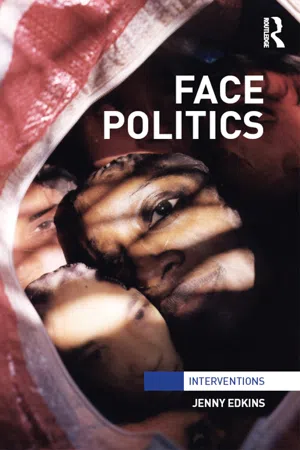
The face is central to contemporary politics. In Deleuze and Guattari's work on faciality we find an assertion that the face is a particular politics, and dismantling the face is also a politics.
This book explores the politics of such diverse issues as images and faces in photographs and portraits; expressive faces; psychology and neuroscience; face recognition; face blindness; facial injury, disfigurement and face transplants through questions such as:
What it might mean to dismantle the face, and what politics this might entail, in practical terms?
What sort of a politics is it?
Is it already taking place?
Is it a politics that is to be desired, a better politics, a progressive politics?
The book opens up a vast field of further research that needs to be taken forward to begin to address the politics of the face more fully, and to elaborate the alternative forms of personhood and politics that dismantling the face opens to view. The book will be agenda-setting for scholars located in the field of international politics in particular but cognate areas as well who want to pursue the implications of face politics for the crucial questions of subjectivity, sovereignty and personhood.
The face crystallizes all redundancies, it emits and receives, releases and recaptures signifying signs.
(Deleuze and Guattari, A Thousand Plateaus, 115)
When we look at a photograph of a face, we tend to search the image for some indication of what the person depicted is thinking or feeling, or what sort of person they are.1 We position ourselves as observers, able to take a long look at the image in a way that we might not stare at the person if we were face-to-face. Whereas the photographer has captured an instant, a fleeting expression, as observers we have all the time in the world to study the face in front of us, unseen ourselves, to try to figure out what it means and to make sense of it.To read the face and the signifying signs it emits. Movement is frozen, time expanded. Observer and subject are disconnected. Reciprocity disappears. Time is out of joint. This is the lesson we learn: the photograph teaches us to look at a person as if at an object, and to see ourselves being seen in that way.
Usually, the photograph comes with a context. Often this is a caption: words that frame the location, name the individual: signifying signs.The image does not stand alone. The caption pins the photograph down, limiting or colouring our interpretation of its meaning. It inserts the image into a textual milieu, and demands it be understood in those terms, as indeed we ourselves as persons are inserted into particular regimes, forced to identify with their roles, even if we want to resist them. And for Deleuze and Guattari, the face itself is “the Icon proper to the signifying regime.”2 But sometimes it appears that a face in a photograph does something other than ‘make sense’ or surrender to an interpretation. It escapes recapture. It does something else. What, then, does the photograph do? And what does it demand from us? What does the photograph want?
Welsh poet Gillian Clarke, in her poem Front Page, tells us of an image of “a man howling for his child,” an image that becomes “a rucksack of sorrow | on your shoulder, on your mind,” an image that you can’t get rid of, that remains with you, that is “indestructible.”3 The response she suggests is not to think about it, to do something about whatever injustice caused the suffering portrayed, but a reciprocation: instead of observing a one-minute silence, she proposes, “standing together, eyes closed, | we should throw back our heads | for a one minute howl.” For her, it is what the photograph does to us, and what it demands we do, that is crucial, not what it represents or what it is as an object.4 It prompts a response in kind.
I begin the chapter by examining how people look at images of the face—in this case still photographs—and how photographers work to organise that look. I consider a collection of images where the artist has chosen to capture the faces of those who are presumed to have experienced horror: US soldiers returned from combat. In the case of these images, I examine accounts of academics and of people in the street who were asked to give their verbal response to the images, and the accounts of the photographer who took them and the curator who displayed them. I look at what sort of accounts these are, and the controversies the images generated when displayed outside the context of the gallery.
In the second part of the chapter, I discuss two collections of images that are more ambiguous than the soldier photographs, and deliberately so: one evoking the Rwandan genocide and another the Cambodia of the Khmer Rouge. Here the artists attempt to destabilise the viewer’s approach to the face and the assumption that we can read faces—or, at least, that we can read them as if they were emitting signifying signs, as if they fitted our pre-known framework.
Finally, I return to the question of what the photograph does, and whether there might be a way in which the photograph, and the event of photography in which it is embedded, escapes the dominant regime of signification. I examine a series of writings on photography, and consider the relation between the temporality of the photograph and that of trauma.
Reading faces: Suzanne Opton's Soldier face
Photographer Suzanne Opton’s portraits of soldiers between tours of duty in Iraq and Afghanistan present the faces of young men and women close up and in detail. The first images in the catalogue of the exhibition, held in New York in 2006, show head and shoulders in a fairly conventional manner, though the eyes of the subjects are in general turned away from the camera: they appear lost in thought.5 Another set shows the soldier’s head held in the hands of their wives, their girlfriends, or another soldier.6 The partner’s hands, and sometimes a part of their face, are visible. Sometimes the head appears strangely disconnected from the body, entirely framed in the hands that hold it. Another series of portraits is particularly striking: images of the young soldiers with their heads laid sideways on a flat surface. It is as if the artist was struggling to locate a means of capturing what she sought and suddenly, shockingly, found it.This last series is the one that has generated the most attention, and that formed the basis for a public display not in only the gallery but in the street or on the metro, on huge advertising billboards.7
Opton describes how she came to take the photographs.8 It was not easy at first to get permission or access to her potential subjects. She contacted numerous military bases, each time with a negative response. Eventually, when she had almost given up, she was surprised by a positive answer from Fort Drum in upstate New York. The Public Affairs Officer asked whether the project was political, but Opton replied that, no, it was not: it was portraits, just art. It was agreed she could come at first for five days and photograph a dozen people a day. She took two large format 4 × 5 cameras and two assistants and made her way in some trepidation to the base. She had never been on a military base before and was afraid of being asked to leave. She felt she had to know exactly what she was doing. Her aim, she decided, was to show the soldier as vulnerable. She had taken a number of photographs before of people with their head resting on a surface, so this was part of her ‘repertoire’, but “when I got the invitation to go to the military base, I thought ‘That’s where that pose belongs.’”9
The military had organised a number of soldiers to volunteer to take part, and the photographer set up her camera and began. She started by taking conventional portraits of people standing, in part as a means of getting to know her subjects a little—and she talked to them while taking these first images.Then she asked them to go to another area and put their head on a table. She showed them how to do it, but gave them no explanation of why or what to do next. They were fixed in this rather awkward pose while she set up the camera in silence. Her idea was that the pause while she was adjusting the camera, and the slow process of taking the photograph, would give her subjects time to ‘reveal’ themselves, rather than being ‘caught’.While she disappeared with a hood over her head as she went through her preparations, they could retreat into their own thoughts, rather than relating to her. As she explains,”From this vantage point the head becomes a single object. I meant the head to be isolated and vulnerable, and for the soldiers to forget that a camera was trained on them. Part of the challenge was to get the soldiers to trust me.”10 The soldiers didn’t demur at her request, perhaps because “You ask a soldier to do something—he takes it as an order.”11 She was “asking them, in effect, to lie down for her, to prostrate themselves for the camera,” and doing this in a context where “the recumbent, objectified or docile body is usually female.”12 But Opton gave the soldiers credit for knowing what she was up to. For her, it seemed they realised these pictures might look as if they were dead—but then, she assumed, soldiers think about this all the time.
Figure1.1Suzanne Opton “Soldier: Birkholz—353 Days in Iraq, 205 Days in Afghanistan”
She says later that she thought asking them to lie like that would remind them of “the possibility of being shot down, close calls they’ve had, it would bring them back to their war experience.”13 Her aim was to isolate the head like the head of a fallen statue, so that we “might be able to see on their face something of what they had experienced in war.”14 For her it was not an anti-war statement, but about the soldiers’ humanity:
I believe that by giving subjects a provocative position, and leaving them alone, they may reveal something of themselves and their experience. In this case it was an odd request, but I believe it resonated with these soldiers. I’ve been asked why anyone would want to be photographed in this position— as if they were dead. Although I don’t know the answer to that, I surmise that these soldiers went along with my request because it resonated with them. They must think about dying all the time. And aside from the fallen statue aspect, this is a very intimate view—like seeing someone opposite you with their head on the pillow.15
In that sense, in the way it conveys an intimate view of the subject, the subject as vulnerable, it is a woman’s point of view—the soldier as seen by a wife or a mother.16 Viewers of these images are summoned to take up that close relation. It takes us beyond the image of a soldier in uniform, upright, ready for combat. As Opton explains again:
We see our lovers and our children in that pose. They look like the heads of fallen statues, and they afford the viewer an intimate look at the face of the young person whose life is at risk, and that was the point. When you see soldiers on the news you have no idea who they are.They’re representing the United States and they have all that gear on. I wanted to get past all that.17
There are other ways, other attempts to do this. In another book of photographs of combat veterans, by Laura Browder, When Janey Comes Marching Home, the portraits themselves, in contrast with Opton’s images, are fairly traditional pictures of figures in uniform.18 But the book ‘gets past all that’ through its interviews with the soldiers.The soldiers talk.19 Opton herself uses interview material alongside her portraits in a work she called ‘Citizen,’ produced in parallel with her ‘Soldier’ images. Her ‘Citizen’ series comprises images of people from Iraq living in exile in Jordan—civilians affected by the war. And in a way, it is the stories the subjects of the photographs tell, as much as the images, that enable us to get beyond our stereotype of Iraqis as war victims and nothing more.20
The Soldier Billboard Project, a collaboration between Opton and curator Susan Reynolds, took her intimate images of soldiers and enlarged them to fill huge billboards, accompanied only by the word ‘SOLDIER.’ The billboards were displayed in August 2008 in Denver during the Democratic National Convention. It had been intended to show them in Minneapolis-St Paul alongside the Republican National Conventio...
Table of contents
Cover Page
Half-Title Page
Title Page
Copyright Page
Table of Contents
Illustrations
Epigraph
Preface
Introduction
1 Faces in Photographs
2 Moving Faces
3 From Face Capture to Face Blindness
4 Facelessness
Bibliography
Index
Trusted by 375,005 students
Access to over 1.5 million titles for a fair monthly price.
Study more efficiently using our study tools.
Frequently asked questions
Yes, you can cancel anytime from the Subscription tab in your account settings on the Perlego website. Your subscription will stay active until the end of your current billing period. Learn how to cancel your subscription
No, books cannot be downloaded as external files, such as PDFs, for use outside of Perlego. However, you can download books within the Perlego app for offline reading on mobile or tablet. Learn how to download books offline
Perlego offers two plans: Essential and Complete
Essential is ideal for learners and professionals who enjoy exploring a wide range of subjects. Access the Essential Library with 800,000+ trusted titles and best-sellers across business, personal growth, and the humanities. Includes unlimited reading time and Standard Read Aloud voice.
Complete: Perfect for advanced learners and researchers needing full, unrestricted access. Unlock 1.5M+ books across hundreds of subjects, including academic and specialized titles. The Complete Plan also includes advanced features like Premium Read Aloud and Research Assistant.
Both plans are available with monthly, semester, or annual billing cycles.
We are an online textbook subscription service, where you can get access to an entire online library for less than the price of a single book per month. With over 1.5 million books across 990+ topics, we’ve got you covered! Learn about our mission
Look out for the read-aloud symbol on your next book to see if you can listen to it. The read-aloud tool reads text aloud for you, highlighting the text as it is being read. You can pause it, speed it up and slow it down. Learn more about Read Aloud
Yes! You can use the Perlego app on both iOS and Android devices to read anytime, anywhere — even offline. Perfect for commutes or when you’re on the go. Please note we cannot support devices running on iOS 13 and Android 7 or earlier. Learn more about using the app
Yes, you can access Face Politics by Jenny Edkins in PDF and/or ePUB format, as well as other popular books in Politics & International Relations & Political History & Theory. We have over 1.5 million books available in our catalogue for you to explore.