In a very understandable, practical, and accessible manner, this book applies recent groundbreaking findings from behavioral neuroscience to the most complex and vexing challenges in organizations today. In particular, it addresses managing large-scale organizational changes, such as mergers and acquisitions, providing lessons and tactics that can be usefully applied to in many different settings. In addition to discussing successful practices, it also identifies the reasons that most past comprehensive, long-term change projects have failed and unmasks the counterproductive effects of the typical evolutionary or emotion-based attempts to change group and individual behavior, using neuroscience as its principal tool.
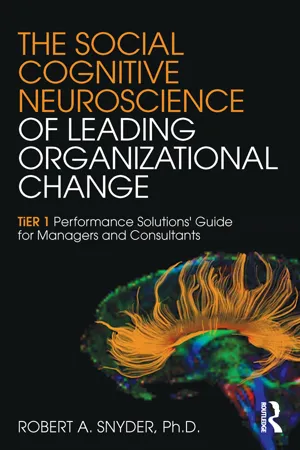
eBook - ePub
The Social Cognitive Neuroscience of Leading Organizational Change
TiER1 Performance Solutions' Guide for Managers and Consultants
- 214 pages
- English
- ePUB (mobile friendly)
- Available on iOS & Android
eBook - ePub
The Social Cognitive Neuroscience of Leading Organizational Change
TiER1 Performance Solutions' Guide for Managers and Consultants
1
INTRODUCTION TO ORGANIZATIONAL CHANGE AND CHANGE LEADERSHIP
Starting Point
Here’s what I’m not going to do. I’m not going to start out—as so many books and articles on change management do—with a bunch of supposedly awe-inspiring (and panic attack-inducing) statistics or metaphors about change. You know the kind of thing:
There has been more knowledge created in the last seven seconds than in the previous seven billion years!
Change is like being in the eye of a hurricane AND in the funnel of a tornado while rats chew off your toes!
None of that for me. I’m not here to scare you. Quite the opposite, really. I hope to comfort you by providing you with insights into the Change Leadership process that will help you deal effectively with change (if not master it entirely) in a specific, but vitally important, part of the organizational world: Leading enterprise-wide (or at least large-scale) organizational changes. These insights focus on both the “big picture” as well as what you should consider, do and say in very specific circumstances. This is not to claim that, if you become involved with a large-scale change after reading this Guide, your task will be easy. Far from it. Enterprise-wide changes test the sanity and resilience of even the most experienced and competent leaders.
So what if you never become involved with a large-scale organizational change? Well, I think that that’s unlikely in today’s workplaces. More importantly, I sincerely believe that the knowledge and skills you develop by reading this Guide have wide applicability. And practicing what I’m preaching can even be a key to your overall ability to contribute to your organization. In fact, change management skills are becoming recognized as so important to the success and overall effectiveness of organizations that many of today’s top corporations are making change management skills training a key part of their leadership development programs. Likewise, change management competencies are finding their way into prominent academic theories of leadership. For example, Zenger and Folkman’s (2002) influential and oft-cited model of “Extraordinary Leadership” posits five poles in the “leadership tent”: Character, focus on results, interpersonal skills, personal capability and leading organizational change. So, whether viewed in terms of business practice, or purely “theoretically,” competency in change management has an extremely high personal and organizational utility.
What’s wrong with this picture? World-wide research by the most respected thought-leaders in leadership development (e.g., Cegos Asia Pacific (Blaine, 2013), Center for Creative Leadership (Leslie, 2009; Gentry, Eckert, Stawiski & Zhao, 2014), Development Dimensions International (Boatman & Wellins, 2011), etc.)consistently find that: 1) change management skills are currently crucial for effective leader performance, 2) the need for high-level change management skills will become much greater in the future and, yet, 3) change management skills remain among the very weakest competencies of leaders at all levels of organizations today.
Reading and reflecting on this Guide can help you greatly improve your change management skills whether your current skill level is low or very high. Two experts in change management, both with decades of experience but little knowledge of recent SCN research, each reported that they learned a lot—and a lot that they can use in their consulting—by reading a pre-publication copy of the Guide.
Effective Change Leaders: Characteristic Predispositions
and Behaviors
The focus of this Guide is what I call “Change Leadership.” The choice of the word “leadership” rather than “management” here has two connotations. First of all, I want to convey that my goal is not to simply help you and your organization survive (i.e., “manage” to get through) the change process. I want to show you how to get the absolute maximum number of organizational benefits from each change initiative. Examples (provided earlier) include using the change process to develop employee skills that would have applications in other settings, to open (and maintain) new communication channels among departments, or to field-test the leadership abilities of particular staff members.
The second connotation is more elemental. Here I want to convey that major change initiatives must be led—just as a department, a division or an entire organization is. That is, if you are at the forefront of a major change initiative and hope to be truly effective, it will be necessary for you to maintain the same attitudes and consistently manifest the very same behaviors that are expected of all outstanding leaders in the performance of their roles.
Effective leaders come in all sizes, shapes, ages, genders, sexual orientations, nationalities—whatever. But, the vast majority of them share important characteristics. That is, they are predisposed to consciously do these eight things with great consistency. They:
• act with integrity;
• focus on performance improvement and adhere to what are called change-facilitative values;
• maintain a positive disposition;
• monitor themselves carefully and are sensitive to how their behaviors are perceived and interpreted by others;
• make things (results) happen;
• help people understand and internalize the organization’s overall strategy and how the planned changes are necessary for the strategy’s successful execution;
• maintain a high energy level;
• take time to step back/to reflect.
Acting with Integrity
Research in many disciplines and using many methods has determined that acting with integrity, having character, being honest, etc. is the most critical leader behavior. However, many people have a limited understanding of the full notion of integrity that is implied in these studies. When asked to provide a meaning for or definition of integrity, most people say that it is consistency between what you say and what you do. No argument there. However, integrity1 is a lot more than that. Its key dimensions are:
• consistency among words, actions and the values of the organization (assuming that those values are admirable);
• consistently (i.e., always) telling the truth;
• consistently (i.e., always) treating people with respect;
• consistently (i.e., always) maintaining confidences;
• consistently (i.e., as “always” as circumstances allow) fulfilling promises.
Show this list to managers and the likely response from each would be something like, “Yep, that’s me! I know that these things are important and I do them.” The truth is, however, that virtually all of us—leaders or not—don’t do any of these things with real consistency. Let me just use one example: Always telling the truth.
Lying or deceiving others has traditionally been viewed as “bad” or as an aberration or at least as something that shouldn’t happen. However, for good reason, the circuitry of our brains evolved to make lying come easily—as those non-human animals or humanoids who used lies well were more likely to survive, having learned to escape responsibility for behaviors that run counter to the clan’s or tribe’s or group’s norms. The neurophysiological reward for, or instinctual basis of, lying is amusingly demonstrated by higher-order primates who experience what amounts to glee or happiness when they get away with fooling another ape or chimp (Leslie, 2011).2
Perhaps more powerfully (and certainly, hypocritically), from our earliest years we are taught to lie and that lying can be a “good” thing. Do any of these sound familiar?
• “It’s time to go to bed so that Santa and his reindeer can come.”
• “No matter how you really feel, you have to give grandma a big kiss and tell her that you love the birthday present she sent you.”
• “If the server asks how old you are, be sure to say that you’re 12 so we can save half of the cost of your dinner.”
• “If you don’t stop acting up I’m going to leave you right here in the airport.”
• “Don’t tell the baby sitter that you were up sick all night.”
• “Sticks and stones will break your bones, but words can never hurt you.”
• “Don’t tell your teacher how much I helped you with this project.”
No wonder that by the time that people are employed, most have become proficient at and quite at ease with lying.3 Studies have found that lying is not only prevalent in the workplace; there are organizations whose official policies require employees to lie (e.g., Shulman, 2007).4
“And it must follow, as the night the day, thou canst not then be false to any man.”
(Shakespeare, Hamlet, Act I, Scene III)
Without question, it is extremely difficult to always tell the truth and always treat people with respect, etc. But, the best/most effective Change Leaders and consultants fully enact the several consistencies listed above. And, I didn’t use the word “enact” without conscious intent. Great leadership has a whole lot in common with great acting on the live stage. And, that’s ironic in a way—because when people are asked to define integrity, the second most common definition they provide runs along the lines of “just being yourself” or “what they see is what they get.” Well, Yorick, if you agree, that’s an idea that you need to get out of your skull right now.
Hamlet is Shakespeare’s longest play and requires a marathon-like performance of the lead. For that reason alone, it is considered a very, very difficult role. Often listed among the greatest performers to play the role are Laurence Olivier, Richard Burton, Derek Jacobi and Kenneth Branagh. Those are four guys that you’d never find on the same bowling team. Definitely not birds of a feather. And, as you might expect, their approaches to the role of Hamlet were as different as their personalities and their world views. In fact, if you were to cut the audio and just watch their recorded performances on four TV screens simultaneously, some people would guess that four different plays were being performed. Again, the approaches of the actors couldn’t be much less similar. Yet, one thing is common and most assuredly contributed directly to these actors’ reputations for greatness. If you were to watch any one of them perform the play, you would see him hit precise marks, make the same gestures in exactly the same way (etc.) in every one of their more than 200 performances each. They were never out of character for even the twitch of an eyebrow.
Great leaders (not just Change Leaders) know that a reputation for integrity must be painstakingly earned and very carefully managed. They know that they can only acquire that reputation by performing the role of the Great Leader, day after day after day, while never stepping out of character. Great leadership is not just “being yourself,” it’s being your best self at all times.5
EXPERTS’ INSIGHTS: INTEGRITY, VALUES AND BEHAVIOR
Perhaps the most famous quote by former President Richard M. Nixon is, “I am not a crook!” (1973). By all accounts, Nixon truly believed...
Table of contents
- Cover
- Half Title
- Title Page
- Copyright Page
- Dedication
- Table of Contents
- Foreword
- Prologue
- 1 Introduction to Organizational Change and Change Leadership
- 2 The Brain and Human Behavior at Work (and Everywhere Else)
- Part I The Infrastructure of Enterprise-Wide Organizational Change Management
- Part II Implementation Issues and Challenges: How to “Do” Change Leadership
- Part III Application and Anticipation
- Index
Trusted by 375,005 students
Access to over 1.5 million titles for a fair monthly price.
Study more efficiently using our study tools.
Frequently asked questions
Yes, you can cancel anytime from the Subscription tab in your account settings on the Perlego website. Your subscription will stay active until the end of your current billing period. Learn how to cancel your subscription
No, books cannot be downloaded as external files, such as PDFs, for use outside of Perlego. However, you can download books within the Perlego app for offline reading on mobile or tablet. Learn how to download books offline
Perlego offers two plans: Essential and Complete
- Essential is ideal for learners and professionals who enjoy exploring a wide range of subjects. Access the Essential Library with 800,000+ trusted titles and best-sellers across business, personal growth, and the humanities. Includes unlimited reading time and Standard Read Aloud voice.
- Complete: Perfect for advanced learners and researchers needing full, unrestricted access. Unlock 1.5M+ books across hundreds of subjects, including academic and specialized titles. The Complete Plan also includes advanced features like Premium Read Aloud and Research Assistant.
We are an online textbook subscription service, where you can get access to an entire online library for less than the price of a single book per month. With over 1.5 million books across 990+ topics, we’ve got you covered! Learn about our mission
Look out for the read-aloud symbol on your next book to see if you can listen to it. The read-aloud tool reads text aloud for you, highlighting the text as it is being read. You can pause it, speed it up and slow it down. Learn more about Read Aloud
Yes! You can use the Perlego app on both iOS and Android devices to read anytime, anywhere — even offline. Perfect for commutes or when you’re on the go.
Please note we cannot support devices running on iOS 13 and Android 7 or earlier. Learn more about using the app
Please note we cannot support devices running on iOS 13 and Android 7 or earlier. Learn more about using the app
Yes, you can access The Social Cognitive Neuroscience of Leading Organizational Change by Robert A. Snyder in PDF and/or ePUB format, as well as other popular books in Business & Leadership. We have over 1.5 million books available in our catalogue for you to explore.