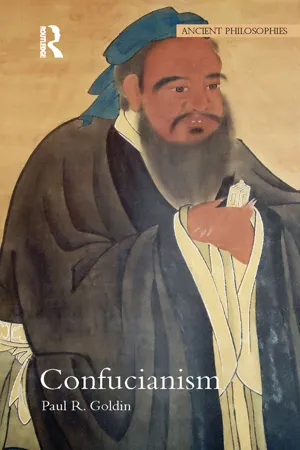
- 240 pages
- English
- ePUB (mobile friendly)
- Available on iOS & Android
eBook - ePub
Confucianism
About this book
"Confucianism" presents the history and salient tenets of Confucian thought, and discusses its viability, from both a social and a philosophical point of view, in the modern world. Despite most of the major Confucian texts having been translated into English, there remains a surprising lack of straightforward textbooks on Confucian philosophy in any Western language. Those that do exist are often oriented from the point of view of Western philosophy - or, worse, a peculiar school of thought within Western philosophy - and advance correspondingly skewed interpretations of Confucianism. This book seeks to rectify this situation. It guides readers through the philosophies of the three major classical Confucians: Confucius (551-479 BCE), Mencius (372-289 BCE?) and Xunzi (fl. 3rd cent. BCE), and concludes with an overview of later Confucian revivals and the standing of Confucianism today.
Information
ONE
Confucius and his disciples
The Master said: “People can enlarge the Way. It is not that the Way can enlarge people.”(Analects 15.28)1
Confucius is the most influential thinker in Chinese civilization and the first whose philosophy can be reconstructed to any significant degree. In China, he has been known by many posthumous names and titles, the most revealing being xianshi 先師, which can be understood as both “the teacher from the past” and “the foremost teacher”. For Confucius was, as far as we can tell, the first teacher of his kind and the inaugurator of one of the most glorious philosophical ages of any ancient culture.
Confucius was a ritual master, and there were surely many ritual masters in the generations preceding him. Museum-goers know that, in the bounteous Chinese Bronze Age, kings and elite lineages produced untold numbers of bronze vessels in various typical forms with precise ritual functions.2 It is clear from assemblages in burials that each type of vessel was necessary for the full concert of rituals, and archaic literature – including the many inscriptions cast on these bronze vessels – tells us that the correct performance of these rites was crucial to securing the blessing of the spirits. Deceased ancestors were thought to perdure after death as spirits who had to be properly cultivated with sacrifices and other ritual obsequies. As early as the Shang 商 dynasty (c.1600-c.1045 BCE), for example, kings would divine about the source of their toothaches; for only after it was determined which ancestral spirit was responsible for the affliction could the appropriate steps be taken to placate him or her. (Ancestresses were no less terrifying in this respect than ancestors.) And the toothache was understood as a warning to rectify whatever wrongdoing or oversight had irked the spirit in question. Toothache today – flood or earthquake or some comparable catastrophe tomorrow.3
Doubtless, then, the ritual culture implied by the numerous surviving bronze artefacts required ritual masters who could explain to new generations how each vessel was to be used. And there are hints in ancient texts that some of these ritual masters began to incorporate moral principles into their curriculum: it was not enough simply to carry out the appropriate sacrifice correctly; it was necessary also to live up to the right moral standard. What these high ancients really said, however, is for the most part beyond recovery, as there are only the scantest records of their utterances. Confucius was apparently the first to have his teachings documented by his disciples, and, not coincidentally, seems to have emphasized the moral aspect of correct ritual practice to an unprecedented degree. Thus he transformed the ancient role of ritual master, expert in the ways of cauldrons and platters, into something that we would call a moral philosopher.
The prime difficulty facing any modern reader of Confucius, however, is that he did not leave behind any written work. Tradition has ascribed to him the redaction of certain canonical texts, such as the Springs and Autumns (Chunqiu 春秋) and Changes of Zhou (Zhouyi 周易), but the attribution is not fully convincing, and in any case no one suggests that he composed these texts – only that he arranged pre-existing material in a morally revealing way. There are dozens of sources that record this or that saying as having been uttered by Confucius, the most authoritative of which is the so-called Analects (Lunyu 論語), but these were all produced after his death.
There are two main reasons why Confucius never felt compelled to leave behind a treatise or similar written text. First, in his day, writing was not the most important means of communication. In our world, for the past several centuries, the surest way to publish one’s ideas has been to put them in writing, and even as today’s technology has created useful media besides the old-fashioned book, writing is unlikely to disappear soon – as ubiquitous texting and Hogging attest. But Confucius’s society was small enough that oral communication sufficed for many more purposes than we might assume. When a wise man advised a king, he would typically say, “Your servant has heard…”, not “Your servant has read…” Any idea worth repeating would be transmitted from one mouth to the next. And as soon as people stopped repeating it, it died. To be sure, writing had already been known for a good millennium by Confucius’s time, but its uses seem to have been mostly hieratic.4 If you needed to communicate with ancestral spirits, you needed a scribe. But if you wished to discuss right conduct with your neighbour, you just started talking. Thus one reason why Confucius never wrote down his teachings is that he never imagined it would be necessary to do so. His legacy would continue through his disciples, who would pass it on – orally – to disciples of their own.
Second, Confucius may have deemed writing incompatible with one of his most important ideas: that people need to think for themselves. “I begin with one corner”, he said; “if [a student] cannot return with the other three corners, I do not repeat myself” (Analects 7.8). A teacher can be expected to lay down the guidelines, but students must then fill out the rest of the picture on their own.5 Throughout the Analects, Confucius is shown to be uneasy about affirming any universal principle; Tightness and wrongness must be judged anew in every situation. Thus, in teaching, it is a mistake merely to deliver insensate lectures to audiences of students with disparate needs:
Zilu 子路 [i.e. Zhong Yóu 仲由, 542–480 BCE] asked: “Should one practise something after having heard it?”The Master said: “You have a father and elder brother who are still alive; how would you practise something after having heard it?”Ran Yǒu 冉有 [b. 522 BCE] asked: “Should one practise something after having heard it?”The Master said: “One should practise something after having heard it.”Gongxi Hua 公西華 [i.e. Gongxi Chi 公西赤, b. 539 BCE] said: “When You [i.e. Zilu] asked whether one should practise something after having heard it, you said: ‘Your father and elder brother are still alive.’ When Qiu [i.e. Ran Yǒu] asked whether one should practise something after having heard it, you said: ‘One should practise something after having heard it.’ I am confused, and venture to ask about this”.The Master said: “Qiu is withdrawn; thus I urged him forward. You [has the eagerness] of two men; thus I held him back.”(Analects 11.22)
This exchange is included in the Analects for the insight that two different students should not necessarily be taught the same lesson. But in a written document, to be read by strangers not in his presence (or indeed after his death), it would have been impossible for Confucius to tailor his teachings in this manner. Even with the best of intentions, his philosophy might then have become what he despised most: an authority telling you what is right in all times and places. Writing fixes statements, and Confucius wished his statements to remain fluid. (It is rather like the difference between hearing a great musician in a live performance, where there can be inexhaustible variation, and hearing him or her through a recording, which is the same no matter how many times you play it.)
For this reason, Confucius also avoided full expositions of his thinking. Western philosophers may be disappointed to see no sustained treatises, no tight syllogisms in his work. Rather, Confucian rhetoric typically uses allusive language – often invoking nature and sometimes reaching a level of discourse that can only be considered poetic – in order to spur students to think through the morals on their own. For example: “The Master said: ‘Only after the year has grown cold does one know that the pine and cypress are the last to wither’” (Analects 9.27).
A memorable meiosis – for pines and cypresses are not merely the last to wither; they almost never wither. As anyone in Confucius’s society would have known from daily exposure to the living world, pines and cypresses not only remain green throughout the year, but also are among the longest-lived trees on earth. Usually Analects 9.27 is understood as a comment on friendship: fair-weather friends may, like beautiful plum or cherry blossoms, seem attractive in times of abundance, but true friends resemble evergreens, maintaining their colour in all seasons of the year. But it is also, on a deeper level, a statement about the usefulness of looking to patterns in nature as a guide through the perplexities of life, as well as a reminder that the value of things cannot be gauged by their momentary appeal. At the same time, it is an assertion of the need for experience, and not just reason, in judgement: for if the character of pines and cypresses cannot be appreciated before the year has grown cold, then someone who has never experienced winter cannot possibly comprehend how they surpass the gaudy blooms of springtime. Thus it is not surprising that names bearing the word song 松, “pine”, were favoured by literati in traditional China,6 and the hardy pine – often shown gnarled and twisted in snowy landscapes – was a mainstay of Chinese nature painting.7
After Confucius’s death, his disciples knew that they had lost an icon, and resolved to select for posterity’s benefit the most important sayings and exchanges that they could remember from their encounters with the Master. This is, at any rate, the traditional story behind the text known as Analects, whose Chinese title, Lunyu, means “selected” (lun) “sayings” (yu). There are various scholarly theories about the provenance of the received text by that name, which contains twenty chapters and has come to be regarded as the most respected of several repositories of sayings attributed to Confucius. One unavoidable difficulty is that it seems to be unattested before the Han 漢 dynasty (206 BCE-220 CE).8 But the language is demonstrably older than Han-dynasty language,9 and it is possible to reconstruct a coherent philosophy from its core chapters; therefore, like most (but not all)10 scholars, I accept the first fifteen chapters as the closest we can come today to reading Confucius’s own words. (Chapters 16–20, as has been observed for centuries, are written in a more expansive style and probably contain additions from later times;11 consequently, they will be cited below only when their testimony can be corroborated by passages in Chapters 1–15.) There are many other early texts that attribute sayings to Confucius, but it is always necessary to interpret these critically. The Zhuangzi 莊子, for example, which imparts a philosophy uncompromisingly opposed to that of Confucius, shows hi...
Table of contents
- Cover
- Half Title
- Title Page
- Copyright Page
- Table of Contents
- Chronology
- Introduction: What Confucianism is and what Confucianism is not
- 1. Confucius and his disciples
- 2. Interlude: Great Learning and Canon of Filial Piety
- 3. Mencius
- 4. Xunzi
- 5. Neo-Confucianism and Confucianism today
- Appendix: Manhood in the Analects
- Notes
- Guide to further reading
- Bibliography
- Index of passages
- Index
Trusted by 375,005 students
Access to over 1.5 million titles for a fair monthly price.
Study more efficiently using our study tools.
Frequently asked questions
Yes, you can cancel anytime from the Subscription tab in your account settings on the Perlego website. Your subscription will stay active until the end of your current billing period. Learn how to cancel your subscription
No, books cannot be downloaded as external files, such as PDFs, for use outside of Perlego. However, you can download books within the Perlego app for offline reading on mobile or tablet. Learn how to download books offline
Perlego offers two plans: Essential and Complete
- Essential is ideal for learners and professionals who enjoy exploring a wide range of subjects. Access the Essential Library with 800,000+ trusted titles and best-sellers across business, personal growth, and the humanities. Includes unlimited reading time and Standard Read Aloud voice.
- Complete: Perfect for advanced learners and researchers needing full, unrestricted access. Unlock 1.5M+ books across hundreds of subjects, including academic and specialized titles. The Complete Plan also includes advanced features like Premium Read Aloud and Research Assistant.
We are an online textbook subscription service, where you can get access to an entire online library for less than the price of a single book per month. With over 1.5 million books across 990+ topics, we’ve got you covered! Learn about our mission
Look out for the read-aloud symbol on your next book to see if you can listen to it. The read-aloud tool reads text aloud for you, highlighting the text as it is being read. You can pause it, speed it up and slow it down. Learn more about Read Aloud
Yes! You can use the Perlego app on both iOS and Android devices to read anytime, anywhere — even offline. Perfect for commutes or when you’re on the go.
Please note we cannot support devices running on iOS 13 and Android 7 or earlier. Learn more about using the app
Please note we cannot support devices running on iOS 13 and Android 7 or earlier. Learn more about using the app
Yes, you can access Confucianism by Paul R. Goldin,Paul Goldin in PDF and/or ePUB format, as well as other popular books in Theology & Religion & Philosophy History & Theory. We have over 1.5 million books available in our catalogue for you to explore.