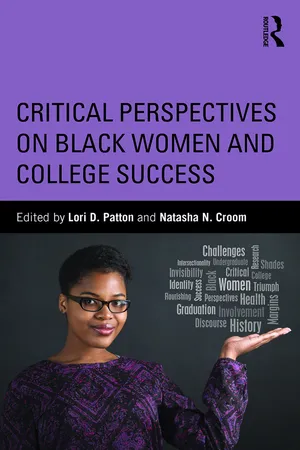
In this comprehensive volume, research-based chapters examine the experiences that have shaped college life for Black undergraduate women, and invite readers to grapple with the current myths and definitions that are shaping the discourses surrounding them. Chapter authors ask valuable questions that are critical for advancing the participation and success of Black women in higher education settings and also provide actionable recommendations to enhance their educational success. Perspectives about Black undergraduate women from various facets of the higher education spectrum are included, sharing their experiences in academic and social settings, issues of identity, intersectionality, and the services and support systems that contribute to their success in college, and beyond. Presenting comprehensive, theoretically grounded, and thought-provoking scholarship, Critical Perspectives on Black Women and College Success is a definitive resource for scholarship and research on Black undergraduate women.
eBook - ePub
Critical Perspectives on Black Women and College Success
- 224 pages
- English
- ePUB (mobile friendly)
- Available on iOS & Android
eBook - ePub
Critical Perspectives on Black Women and College Success
About this book
Information
1
CRITICAL PERSPECTIVES ON UNDERGRADUATE BLACK WOMEN
Lori D. Patton and Natasha N. Croom
If I didn’t define myself for myself, I would be crunched into other people’s fantasies for me and eaten alive.
Audre Lorde
This project is one of reclamation, an attempt to explore and name Black undergraduate women’s experiences in higher education scholarship. As a Black queer trans person, Audre Lorde knew all too well the ways in which society defined Black women and the dangers associated with the confinement embedded in those definitions. Today, there are many fantasies about Black women in higher education that must be critically interrogated and examined to illuminate the complexities of our experiences across the higher education landscape. This project is one effort devoted to the interruption of epistemic violence enacted to silence, marginalize, and dehumanize Black women, particularly at the undergraduate level. Scholars and practitioners know little about the experiences of Black undergraduate women, and what is presumed to be known has in large part been constructed outside Black women’s communities, devoid of a critical lens, and treated as insignificant.
The limited body of scholarship currently available about Black women in college is helpful in illuminating their isolating experiences as they endure racism, sexism, and other forms of marginalization (Chambers and Sharpe, 2012; Howard-Hamilton, 2003; Journal of Blacks in Higher Education [JBHE], 2006; Moses, 1989; Winkle-Wagner, 2009). Most scholarship however, rarely if ever centers on the voices of Black women. Instead, Black women’s experiences exist as part of a larger discussion of “diverse” populations in higher education. A mere exploration of peer-reviewed journal articles on access, retention, leadership, persistence, discipline-specific foci, or any other topical area that is not solely couched within diversity discourses would reveal very little that primarily emphasizes the experiences of Black undergraduate women. This book disrupts the usual by placing an intentional and thoughtful emphasis on research and scholarship devoted to the experiences of Black undergraduate women. We invite readers to grapple with the current fantasies and definitions that are shaping the discourses surrounding Black women undergraduates. Some of these recent, albeit not entirely new, fantasies include being defined as more academically successful than Black men, being referenced as the “new” model minority, and the Black Girl Magic moniker.
Fantasies of Academic Success
A major existing narrative about Black women and success in college is fueled by statistical comparisons of traditional outcomes data (enrollment, retention, graduation rates) between Black women and Black men in college. While the statistics paint a picture of success for Black undergraduate women, these same women are not central to the success discourse. More explicitly, Black women’s successes are certainly included, but their experiences are either subsumed under the study of “Black students” broadly, or they are used as props to sustain a zero-sum argument for initiatives to support Black men. As the narrative goes, Black women are faring better than their Black men counterparts because they are entering higher education in greater numbers and earning more degrees than Black men; thus they are successful (Butler, 2013; McDaniel, DiPrete, Buchmann, and Shwed, 2011; Roach, 2001; Strayhorn, 2016). This well-intentioned and seemingly neutral narrative singlehandedly contributes to a divisive discourse that positions Black women and men against one another for no substantiated reason. This discourse also fails to account for an analysis (and definition) of success beyond numbers, one that considers a larger context in which intersections of identities and systems of oppression create uniquely raced, gendered, and classed experiences for Black women. The failure to account for racism/white supremacy and gender/patriarchy when considering Black collegiate women’s experiences is nonsensical at least and absurd at best. Despite the failure of their acknowledgment, we contend, however, that such contexts matter.
If the definition of college success is limited only to enrollment, retention (or persistence), and graduation rates provided via the National Center for Education Statistics (NCES) data, a positive narrative could be constructed. For example, in 2013, 37.6 percent of Black women ages 18–24 were enrolled in degree-granting postsecondary institutions (NCES, 2013). Black women receive more than 50 percent of all degrees conferred to Black students across degree and institutional types (NCES, 2012). The fact that Black women exceed their male counterparts on narrowly defined predictors of success should not be surprising. The same is true across most racial ethnic groups, including White, Latina, and Asian women. Yet, Black women are treated as exceptional for numerically outpacing their men counterparts. We wonder why this is the case? How does the critical mass, or numerical representation narrative, support or hinder Black women in college? How does this narrative mask oppressive, systemic, and structural barriers these women face? Scholars suggest that Black women are “resilient,” rely on spirituality and religion to cope (Donahoo, 2011; Patton and McClure, 2009; Watt, 2003), and participate in communities of women of color, sister circles, or sororities (Lee Williams and Nichols, 2012; Patton and Harper, 2003) to survive toxic campus environments. These research findings are undoubtedly important; however, they also point to a larger issue facing Black undergraduate women—that is, Black women have been navigating higher education, while postsecondary institutions have been overwhelmingly irresponsible in addressing racism, sexism, classism, and other forms of oppression that affect Black women.
Moreover, beyond the numerical conversation, little is known about how Black women access college, what shapes their college choice, which experiences and opportunities contribute to their retention (or attrition), and the costs associated with their survival and capacity to thrive in college. For example, Black women are primarily entering the postsecondary sector through community colleges and for-profit institutions. According to data presented by Iloh and Toldson (2013), 41 percent of Black undergraduate women are attending public two-year institutions, and 23 percent are attending for-profit institutions. Twenty-four percent of Black collegiate women are enrolled in public four-year institutions and 10 percent in private nonprofit four-year institutions. Where Black women attend college matters because it has implications for (four-year and advanced) degree attainment, career choice, and lifetime earnings. While community colleges serve a necessary function, providing opportunities for some in minoritized communities to pursue postsecondary education in more equitable ways, these institutions have been critiqued as organizations that in many ways reproduce the inequities they were intended to disrupt (Iloh and Toldson, 2013). With regard to for-profit education, Black women are disproportionately matriculating at these institutions, many of which are known to engage in predatory admissions and financial aid practices (Iloh and Toldson, 2013). Similar to community colleges, they provide access to communities who might not otherwise have these opportunities; however, for-profit institutions have been scrutinized for their high costs (read: high student debt) and low job-attainment outcomes (Iloh and Toldson, 2013). Entry via these mediums has not provided radical shifts in the overall wealth gaps of Black women in US society (Cohen and Nee, 2000; Insight Center for Community Economic Development [Insight], 2010; National Association for the Advancement of Colored People [NAACP], 2011). Overall, the discourse about Black women’s college success is woven with incomplete and in most cases nonexistent information, aside from numerical figures about their access, retention, and graduation. Simply stated, more information and research is needed about Black women that moves beyond their treatment as a monolithic group and explicitly grapples with the systemic inequities that shape and influence their lives while attending college. If Black women represent an academic success story, why aren’t there more proof-positive narratives in peer-reviewed academic journals, books, the media, and other relevant venues? What is the benefit of wrapping Black women’s collegiate experiences in nice fantasies that ignore their realities?
The “New” Model Minority Fantasy
One of the narratives more recently assigned to Black women is the “new model minority” (Kaba, 2008). Kaba (2008) asserted, “If the central argument of the model minority concept in the USA pertains to groups that once experienced severe economic, social, and political isolation and managed to rise up despite those difficulties, then one could expand the model minority concept to include Black American females” (p. 310). We completely disagree. Ironically, Kaba contends that Black women are the new model minority while simultaneously acknowledging they continue to lag behind other communities with respect to economic, social, and educational factors. Most problematic about Kaba’s analysis is the failure to consider how the model minority narrative was initially constructed and the extent to which it is even appropriate or necessary to consider Black women within this framework. While model minority status may be a seemingly positive signifier that indicates Black women’s abilities to work hard and succeed in higher education despite the odds, numerous scholars have argued against the use of this framing. The original model minority narrative has been used to perpetuate stereotypes, particularly within and across Asian communities (Museus and Kiang, 2009; Wing, 2007). In order to problematize and question the appropriateness of defining Black women as the second wave of model minorities or the “new model minority,” it is important to briefly explore the underpinnings of the concept.
Prior to the 1960s, Asian communities, both domestic and international-born, were constructed in less than model ways, including being “portrayed as uncivilized, sinister, heathen, filthy, yellow hordes that threatened to invade the US and ‘mongrelize’ the white ‘race’” (Wing, 2007, p. 457). Chinese communities were racialized as the “Yellow Peril” in the media, and Japanese communities were placed in internment camps during World War II. A full description of acts against Asian diaspora communities in the United States is beyond the scope of this book; however, it is important to note that up until the Civil Rights Movement, individually and collectively Asian communities were constructed (and treated) in dehumanizing ways. Sociologist William Petersen, a professor at the University of California Berkeley, coined the concept of model minorities in a 1966 article in the New York Times. In “A success story, Japanese-American style,” Petersen wrote:
Once the cumulative degradation has gone far enough, it is notoriously difficult to reverse the trend. When new opportunities, even equal opportunities, are opened up, the minority’s rejection to them is likely to be negative—either self-defeating apathy or a hatred so all-consuming as to be self-destructive. … we barely know how to repair the damage that the slave traders started. The history of Japanese Americans, however, challenges every such generalization about ethnic minorities, and for this reason alone deserves far more attention that it has been given. Barely more than 20 years after the end of the wartime camps, this is a minority that has risen above even prejudiced criticism. They have established this remarkable record, moreover, by their own almost totally unaided effort. Every attempt to hamper their progress resulted only in enhancing their determination to succeed. (p. 1)
In the article, Petersen argued that despite the oppression faced by Japanese communities in the United States, including denial of citizenship, myriad forms of discrimination, and the internment camps, they were able—collectively through family, education, religion, and ultimately hard work and respect for authority—to overcome their circumstances and integrate successfully into American culture with little to no aid. Following Petersen, other press and media outlets (i.e., Newsweek, U.S. News & World Report, Time) began to also tell “success” stories about other Asian groups turning the tide of racial, ethnic, and economic oppression through hard work, perseverance, and self-determination. Moreover, these articles perpetuated the idea that Asian groups made these strides without the resentment and anger displayed by other racially and ethnically marginalized groups (Petersen, 1966).
Scholars have engaged in unpacking the model minority myth in higher education at multiple levels. For example, Museus and Kiang (2009) posited that the model minority stereotype is problematic because it prompts some Asian students to attempt to emulate this achievement stereotype simply because they are Asian identified. Additionally, others have found that Asian students may grapple with internalized oppression due to pressures associated with this stereotype and may be less likely to seek student support services on campuses (Yang, Byers, Ahuna, and Castro, 2002). In relation to group level membership, critical scholars argue that the model minority myth is harmful because it (1) essentializes and homogenizes Asian communities; (2) positions them as not racially or ethnically minoritized, therefore not experiencing racism; and (3) suggests that Asian communities do not require institutional support or resources (Museus and Kiang, 2009). Collectively, these narratives mask the needs of Asian students and absolve institutions of any responsibility for providing resources to the diverse communities that comprise “Asian” student populations (Suzuki, 2003). Furthermore, scholars have noted how the model minority myth results in the theoretical absence and erasure of Asian communities in higher education research and scholarship (Museus and Kiang, 2009).
At structural and systemic levels, the extension of the model minority stereotype to Black women is overwhelmingly dangerous and leads to similar stereotypes directed toward this population. The “new model minority” also treats Black women as a monolithic group, while simultaneously dismissing the matrix of oppression that is ever-present in their lives. The “new model minority” myth suggests that Black women enter and graduate from college free of any real challenges or obstacles. The myth also insidiously operates to discourage Black women from engaging in campus politics or solidarity building with other groups, since they are positioned as “exceptional” or “not like the others.” As a result, this myth also promotes divisiveness among Black students,...
Table of contents
- Cover
- Half Title
- Title Page
- Copyright Page
- Dedication
- Table of Contents
- Figures
- Tables
- Acknowledgements
- 1 Critical Perspectives on Undergraduate Black Women
- SECTION I Historical and Generational Perspectives on Black Undergraduate Women
- SECTION II Ruling Discourses and Identity Politics in the Lives of Black Undergraduate Women
- SECTION III Black Undergraduate Women, Respectability, and Resistance on Campus
- SECTION IV Socialization, Well-Being, and Support for Black Undergraduate Women
- About the Editors
- About the Contributors
- Index
Trusted by 375,005 students
Access to over 1.5 million titles for a fair monthly price.
Study more efficiently using our study tools.
Frequently asked questions
Yes, you can cancel anytime from the Subscription tab in your account settings on the Perlego website. Your subscription will stay active until the end of your current billing period. Learn how to cancel your subscription
No, books cannot be downloaded as external files, such as PDFs, for use outside of Perlego. However, you can download books within the Perlego app for offline reading on mobile or tablet. Learn how to download books offline
Perlego offers two plans: Essential and Complete
- Essential is ideal for learners and professionals who enjoy exploring a wide range of subjects. Access the Essential Library with 800,000+ trusted titles and best-sellers across business, personal growth, and the humanities. Includes unlimited reading time and Standard Read Aloud voice.
- Complete: Perfect for advanced learners and researchers needing full, unrestricted access. Unlock 1.5M+ books across hundreds of subjects, including academic and specialized titles. The Complete Plan also includes advanced features like Premium Read Aloud and Research Assistant.
We are an online textbook subscription service, where you can get access to an entire online library for less than the price of a single book per month. With over 1.5 million books across 990+ topics, we’ve got you covered! Learn about our mission
Look out for the read-aloud symbol on your next book to see if you can listen to it. The read-aloud tool reads text aloud for you, highlighting the text as it is being read. You can pause it, speed it up and slow it down. Learn more about Read Aloud
Yes! You can use the Perlego app on both iOS and Android devices to read anytime, anywhere — even offline. Perfect for commutes or when you’re on the go.
Please note we cannot support devices running on iOS 13 and Android 7 or earlier. Learn more about using the app
Please note we cannot support devices running on iOS 13 and Android 7 or earlier. Learn more about using the app
Yes, you can access Critical Perspectives on Black Women and College Success by Lori D. Patton,Natasha N. Croom in PDF and/or ePUB format, as well as other popular books in Didattica & Didattica generale. We have over 1.5 million books available in our catalogue for you to explore.