In this new and expanded edition of The Art Direction Handbook, author Michael Rizzo now covers art direction for television, in addition to updated coverage of film design. This comprehensive, professional manual details the set-up of the art department and the day-to-day job duties: scouting for locations, research, executing the design concept, supervising scenery construction, and surviving production. Beyond that, there is an emphasis on not just how to do the job, but how to succeed and secure other jobs. Rounding out the text is an extensive collection of useful forms and checklists, as well as interviews with prominent art directors.
- 544 pages
- English
- ePUB (mobile friendly)
- Available on iOS & Android
eBook - ePub
The Art Direction Handbook for Film & Television
About this book
Information
Pre-Production Process
Chapter 1
Introduction
Art directing is somewhat like snowboarding or skydiving—the essence of the activity is in the doing. In that way, an art director is by nature an action figure. The definitive art director is also a unique amalgam of contradictions. On one hand, creativity reigns with few boundaries; on the other hand, practicality takes primary focus. Balancing pairs of opposites, like art and commerce, make the job of art directing unique and challenging. Getting right down to it, an art director is best described as a design manager.
How can this be? Doesn’t the job description of art direction include phrases like “seminal creative force” or “visionary?” It certainly does, but indirectly so. As a design manager, the Art Director on a film project operates as a department manager in form but as an artist in substance. In other words, business decisions for the art department are made on a daily basis, enabling the physical side of creative film production to happen according to schedule, while creativity provides the foundation for those decisions. Before we venture too far, perhaps it’s best to establish a fundamental difference between the “Production Designer” and the “Art Director.”
Clarification
Talent and title are important aspects of filmmaking, generally referred to as billing. When we examine the art department hierarchy, the Production Designer is found at the top with the Art Director close at hand (see Figure 1.1). As a side-by-side relationship, the production designer and art director complement one another. Although the terms “production designer” and “art director” are constantly used in substitution for one another, they are not interchangeable or synonymous. Why? Sharing the same hierarchy level of the film pyramid with the Director and Cinematographer, the Production Designer delivers the visual concept of a film through the design and construction of physical scenery. In this sense, the designer is the seminal, creative force of the art department. Referring back to the image of the action figure, an art director drives the process of design from sketch to actual physical scenery. The Art Director, or design manager, heads and runs the art department, interfaces with all other departments, supports the art department arm of the shooting crew, oversees scenery fabrication, and controls all aspects of the department expense and scenery budgets. Although an art director’s creative input is essential to support the initial creative ideas of the designer, the totality of the design in terms of conception and responsibility belongs solely to the designer. This idea of symbiotic, creative support is echoed in a recent interview with art director Linda Berger (Angelmaker, Forrest Gump, Death Becomes Her):
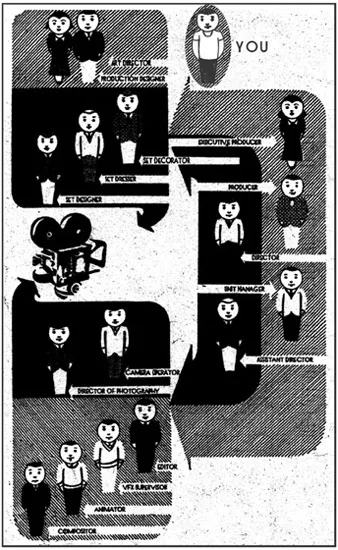
Figure 1.1 Film Hierarchy, Simplified.
Interview with Linda Berger
- ■ Why are you an art director?
I have been thinking about the silent film designers most of my adult life. In the past ten years [1994—2004], especially through my work with the Art Directors Guild Film Society, I have begun to look at them within the whole context of art direction. As a professional in the field of moviemaking who started out in the theater, my earliest adventure in the networking process was to go to New York City right out of design school at the Goodman and the Art Institute of Chicago— with no connections, no anything except my education, a handful of very close friends, and two seasons of professional summer stock in Pennsylvania and upstate New York. When I arrived in New York City, I did everything I could to find my way and continue to learn. I was an Off-Broadway lighting electrician, a lighting designer’s assistant at the Brooklyn Academy of Music for the ballet and modern dance, and worked in costume shops at Lincoln Center and in the individual shops of costume designers. I worked props and painted scenery. I also worked in television as an animation assistant and did lots of commercials. Eventually, I became an Off-Broadway theatrical designer. The first time I saw my name on the marquee from across the street, I almost fainted. Regardless, I challenged myself to meet people and explore the possibilities. It thrilled me to walk around the city and actually stand in the places where great designers stood. Now, many years later, I continue to do exactly that when I work with a production designer. And, to have eventually met some of them, I allow myself to climb within their skins so I can see from their angle of vision in order to fully understand how to contribute to their vision. That’s how I view art direction.I can’t speak for everyone, but I think most people look at art direction from the outside in. There’s nothing wrong with that. I tend to do it from the inside out; it’s my instinct to do it that way. Expressing myself as an art director in this way allows me to leapfrog through time and enter the mind and spirit of any great artist or designer. Oftentimes, certain art directors have such a difficult time doing their jobs because they are in competition with the designer. Most importantly, they’re missing a great opportunity. In its own way, projecting myself into the designer’s mind that way is very gratifying because I learn so much about myself in the process. It’s thrilling to make another person’s vision a reality. - ■ Art directors share a great creative component with the designer, but do you also see yourself as a creative manager, for the most part?
I’m not fully doing my job if I’m just nuts-and-bolts managing the art department. The daily process is a creative process in how I deal with people, how I process instructions from above, how I convey ideas to those who need answers from me, and how I think on my feet when I’m on set. Understanding my designer’s tastes and aesthetic responses supports how I supply what is needed at any given moment. How I fulfill my job changes slightly as I work with different designers, given the differences in perspective. In the same way, the designer has to think the way the director thinks in order to do his or her job properly.
There’s a line of thought and function that connects everything in a collaborative environment like a movie. Storytelling drives what we do. Two questions are always asked. What is the story we want to tell, and how are we going to tell it? The biggest part of my job, then, is storytelling through the interpretation of the production designer and director’s vision.1
Together, both the designer and the creative manager strategize about the functioning of the art department and scenery output, but the Art Director alone spearheads design management on a tactical level by delegating responsibility and guiding each task to completion. With the creative integrity of art directing kept in mind, this book will deconstruct this creative department head more as a marketing and operations manager rather than a seminal creative force. In the end, the reader will view the Art Director not only as a peerless, organizing force for the art department but also as a powerful shaper of policy and systems management for the larger film or television project.
The First Art Director: Wilfred Buckland
All production designers are art directors, and formerly, there were no production designers at all—there were only art directors. In earliest American film memory, the first creative moviemaker to be given the title of “Art Director” was Wilfred Buckland (Figure 1.2) who is widely credited as one of the most important influences “on the look of Hollywood cinema.”2
Previously, he had designed Broadway theatrical productions, and later for the fledgling movie business developed a form of minimalist, Caravaggio-like lighting that engulfed the characters in darkness except for a single source of side illumination. This dramatic theatrical effect quickly became a silent film trademark known as “Lasky lighting,” after the production company that made The Cheat (1915), his most successful film (see Figure 1.3). It was also one of Cecil B. DeMille’s masterpieces, shot in Standard 35mm spherical 1.37:1 format, combining all the ingredients typical of the infamous DeMille style “a mixture of sex, sadism, and sacrifice, washed down with lurid melodrama.”3 Buckland’s lighting contributions were groundbreaking. Two signature scenes in the film—the branding of the heroine by her wealthy Japanese paramour and the subsequent shooting scene—are lit with such theatrical richness and integrity that our attention is just as adroitly manipulated today as it was during its initial release.
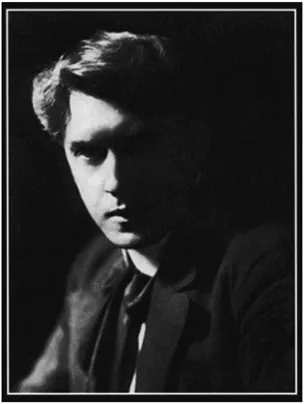
Figure 1.2 Wilfred Buckland, the first Hollywood Art Director.
This early maverick’s scenic designs created an equally powerful tour de force for filmgoing audiences in the early 1920s. Towering 40 feet above Santa Monica Boulevard and La Brea Avenue, King Richard’s castle, the centerpiece for Douglas Fairbank’s Robin Hood (1922), is arguably the largest set ever constructed in Hollywood history. It took 500 workmen three solid months to build. Considering Los Angeles was more of a wide spot in the road then, the silhouette of the com pleted castle set could be seen for miles. It exemplified Buckland’s penchant for creating extravagant, naturalistic sets, and it attests to his flair and flexibility as an early art director. Allan Dwan, director and trained engineer, recalled:
We worked out a couple of interesting engineering stunts for the big sets. On the interiors, the walls meshed together with a matrix, which we designed and built, so they could be put together rapidly in sections. The interior of the castle was very vast—too big to light with ordinary arcs. We didn’t have enough. It was an open set, and certain sections were blacked out to give the right atmosphere. So to light them we constructed huge tin reflectors, about twenty feet across, which picked up the sun and shot the light back onto the arches inside. Then we could make effects. 4
This set was larger than life in all ways—from the completion of the steel-frame, reinforced, working drawbridge, signifying the end of set construction, to the fact that the shooting of the film on its massive sets was a big tourist attraction (see Figure 1.4). And the magic of the Dream Factory continues to stir our imaginations.
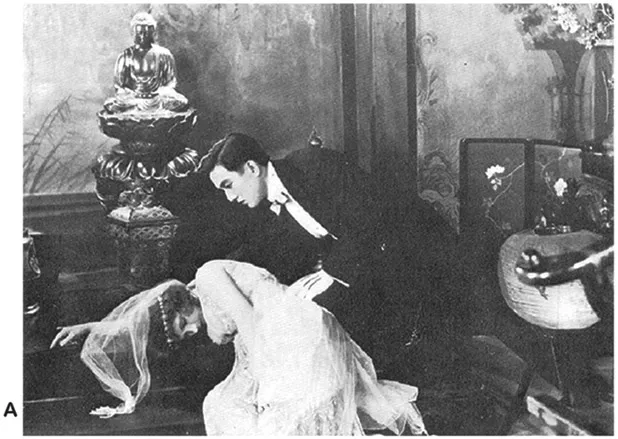
Figure 1.3
A) Production still from The Cheat,
A) Production still from The Cheat,
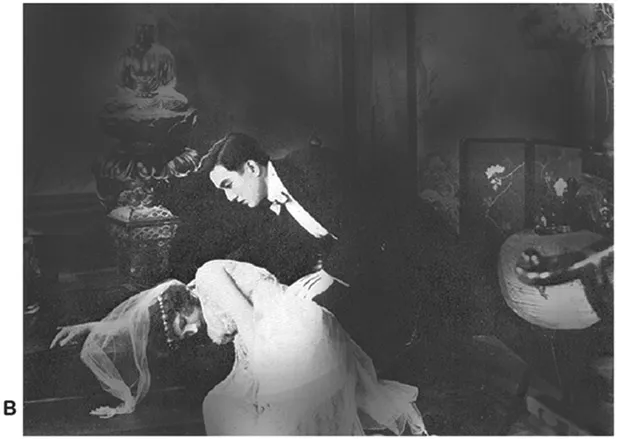
B) An example of a “Lasky Lighting” effect for the same scene, designed by Wilfred Buckland.
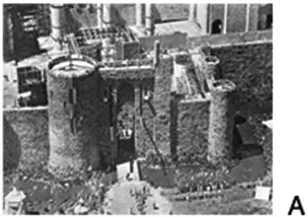
Figure 1.4
A) Perspective aerial close-up of Robin Hood castle,
A) Perspective aerial close-up of Robin Hood castle,
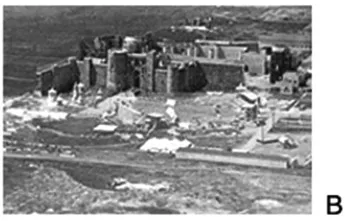
B) High aerial shot of Robin Hood castle,
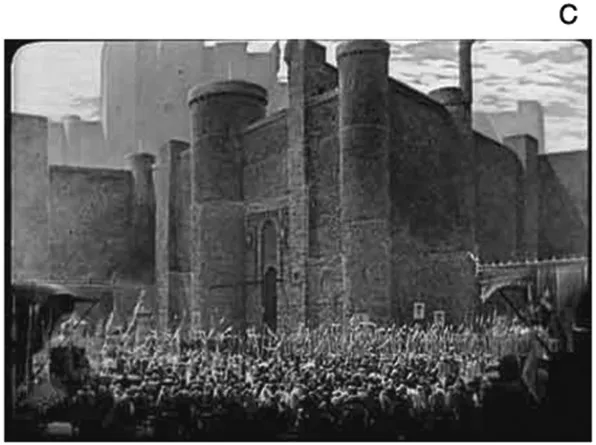
C) Production shot of the Robin Hood castle: The glass painted matte above the existing set suggests additional architecture within or beyond,
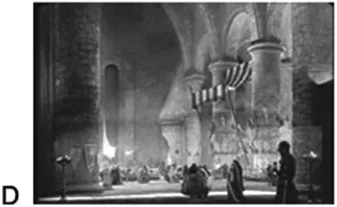
D) Interior: Great Hall with the Robin Hood castle,
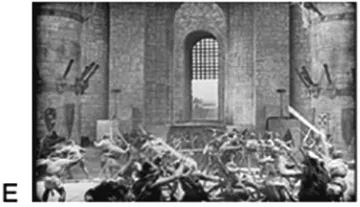
E) Interior: A battle scene is fought just inside the main courtyard entrance of the castle set,
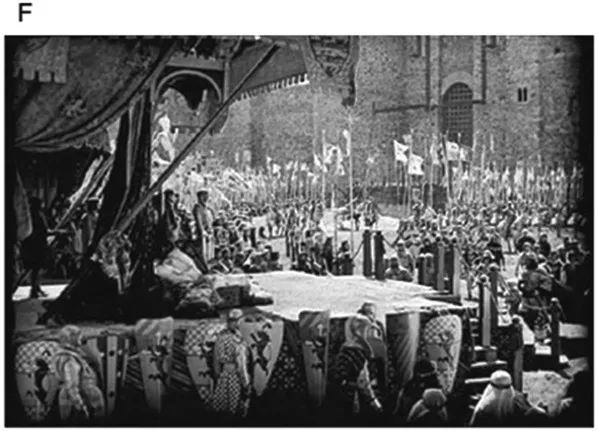
F) Holding court just outside the Robin Hood castle walls.
Under the steady but tumultuous employ of Cecil B. De Mille, Buckland was a prolific film designer—more than 80 f...
Table of contents
- Cover Page
- Halftitle Page
- Title Page
- Copyright Page
- Dedication
- Table of Contents
- Acknowledgments
- Preface
- SECTION I: Pre-Production Process
- SECTION II: Production and Post-Production Processes
- SECTION III: Appendices
- Index
Trusted by 375,005 students
Access to over 1.5 million titles for a fair monthly price.
Study more efficiently using our study tools.
Frequently asked questions
Yes, you can cancel anytime from the Subscription tab in your account settings on the Perlego website. Your subscription will stay active until the end of your current billing period. Learn how to cancel your subscription
No, books cannot be downloaded as external files, such as PDFs, for use outside of Perlego. However, you can download books within the Perlego app for offline reading on mobile or tablet. Learn how to download books offline
Perlego offers two plans: Essential and Complete
- Essential is ideal for learners and professionals who enjoy exploring a wide range of subjects. Access the Essential Library with 800,000+ trusted titles and best-sellers across business, personal growth, and the humanities. Includes unlimited reading time and Standard Read Aloud voice.
- Complete: Perfect for advanced learners and researchers needing full, unrestricted access. Unlock 1.5M+ books across hundreds of subjects, including academic and specialized titles. The Complete Plan also includes advanced features like Premium Read Aloud and Research Assistant.
We are an online textbook subscription service, where you can get access to an entire online library for less than the price of a single book per month. With over 1.5 million books across 990+ topics, we’ve got you covered! Learn about our mission
Look out for the read-aloud symbol on your next book to see if you can listen to it. The read-aloud tool reads text aloud for you, highlighting the text as it is being read. You can pause it, speed it up and slow it down. Learn more about Read Aloud
Yes! You can use the Perlego app on both iOS and Android devices to read anytime, anywhere — even offline. Perfect for commutes or when you’re on the go.
Please note we cannot support devices running on iOS 13 and Android 7 or earlier. Learn more about using the app
Please note we cannot support devices running on iOS 13 and Android 7 or earlier. Learn more about using the app
Yes, you can access The Art Direction Handbook for Film & Television by Michael Rizzo in PDF and/or ePUB format, as well as other popular books in Media & Performing Arts & Film & Video. We have over 1.5 million books available in our catalogue for you to explore.