The Routledge Companion to World Cinema explores and examines a global range of films and filmmakers, their movements and audiences, comparing their cultural, technological and political dynamics, identifying the impulses that constantly reshape the form and function of the cinemas of the world. Each of the forty chapters provides a survey of a topic, explaining why the issue or area is important, and critically discussing the leading views in the area. Designed as a dynamic forum for forty world-leading scholars, this companion contains significant expertise and insight and is dedicated to challenging complacent views of hegemonic film cultures and replacing outmoded ideas about production, distribution and reception. It offers both a survey and an investigation into the condition and activity of contemporary filmmaking worldwide, often challenging long-standing categories and weighted—often politically motivated—value judgements, thereby grounding and aligning the reader in an activity of remapping which is designed to prompt rethinking.
eBook - ePub
The Routledge Companion to World Cinema
- 522 pages
- English
- ePUB (mobile friendly)
- Available on iOS & Android
eBook - ePub
The Routledge Companion to World Cinema
About this book
Information
p.21
PART I
Longitude
p.23
1
THE CINEMATIC AND THE REAL IN CONTEMPORARY CHINESE CINEMA
Yingjin Zhang
Introduction: the cinematic and the real
In the cinematic landscape, the real is never a pure ontological entity transferred directly from the external world. At the birth of cinema, when the Lumière Brothers were thrilled at capturing reality in documentary shorts such as L’Arrivée d’un Train en Gare de La Ciotat (Arrival of a Train at La Ciotat, 1895, France), Georges Méliès would soon discover the cinematic capacity for manipulating images and visualising fantasies in fiction films such as Le Voyage dans La Lune (A Trip to the Moon, 1902, France). Méliès’s fantasy and Lumière’s reality were subsequently postulated as two distinct traditions in early cinema, although filmmakers tend to posit reality as their primary end and fiction as the means to that end; indeed, scholars believe the two traditions eventually merged in Hollywood’s classical cinema (Katz 1994: 854, 927). Yet, with the advent of postmodernism, the real is increasingly seen as mediated by technological apparatus and human intervention, and “reality” is claimed as “always-already present in people’s minds as textual fabrication, model, or simulation that in fact precede reality or even generate it” (Shaul 2008: 48). In documentary film studies, the tension between reality and representation is perceived as unresolvable in
the perennial Bazin vs Baudrillard tussle, both of whom—from opposite perspectives—argue for the erosion of any differentiation between the image and reality, Bazin because he believed reality could be recorded, Baudrillard because he believes reality is just another image.
(Bruzzi 2000: 4)
In contemporary Chinese cinema, this sense of the real as a creatively constructed image rather than a politically postulated, “objective” referent to the empirically verifiable external world would exert a tremendous impact on filmmaking in the post-Mao period (since 1976). After three previous decades of strict ideological control and oftentimes-brutal political repressions, in the early 1980s Chinese filmmakers gradually learned to expand their visions of the real beyond those authorised by the Communist Party. Thirty-five years since then, the real in Chinese cinema has appeared to pertain more to individual perception and interpretation than to ideological promulgation and political administration, although the party-state still maintains the power of propaganda and censorship. Given this situation, the cinematic landscape of the real has developed into a site of contention, and realities of various kinds have gone through continual reconstructions, often in relation to what is alleged to be unreal or no longer real.
p.24
On China’s post-Mao screen, socialist realism—the “official brand” that “forgets realism’s realist potential and capacity for critical questioning of established conventions and reality”, has become “no longer real and is out of touch with the actual conditions of society” (Wang 2008: 498). With its formulaic typical characters and its teleological vision of history, socialist realism (Y. Zhang 2004: 202–205) was discredited by two prominent groups of Chinese avant-garde filmmakers. First, in the mid-1980s, the Fifth Generation of directors (e.g., Chen Kaige, Zhang Yimou), who were so named because they mostly came from the fifth class admitted to the Beijing Film Academy, began to distance themselves from the urban centre of realpolitik by directing their camera at the breath-taking rural landscape in an attempt to retrieve memories of Chinese national culture and history repressed in dominant Communist narratives. Second, in the early 1990s, the Sixth Generation (e.g., Zhang Yuan, Wang Xiaoshuai) started to delve into the mindscape of alienated urban souls so as to reinstate their own individual perceptions of the real; along the way they challenged both the official media’s hackneyed versions of Chinese reality and the Fifth Generation’s reinvented Chinese tradition in its “ethnographic cinema”, which was popular in the international arthouse circuit for a while (Chow 1995; Y. Zhang 2002: 207–239). Entering the twenty-first century, several young independent directors (e.g., Jia Zhangke, Ying Liang) have reconstructed the cinematic real by revisiting rural and hinterland landscapes, but this time not to fix them as readily decipherable symbols of China or Chineseness but to project a precarious sense of landscape in motion.
The idea of “landscape in motion” derives from twin realisations that nature and culture specific to a locality are increasingly subjugated to transnational, translocal flows in the current age of globalisation and that sometimes the cinematic is the only means of capturing the real in transformation or even in ruins. The flows of capital and labour have further compelled independent directors to move toward the ethnoscape, which Arjun Appadurai defines as
the landscape of persons who constitute the shifting world in which we live: tourists, immigrants, refugees, exiles, guest workers, and other moving groups and individuals [who] constitute an essential feature of the world and appear to affect the politics of (and between) nations to a hitherto unprecedented degree.
(1996: 33)
In addition to ethnoscape, Appadurai delineates four other major spheres of globalisation: mediascape, technoscape, financescape and ideoscape. To reframe Appadurai’s vision of current global flows for Chinese cinema, we can conceptualise the party-state sector of film enterprise as a propagandist ideoscape centred on politics and power, the commercial sector as a mediascape anchored on capital and profits, the art film sector as a mindscape inclined toward aesthetics and prestige, and the independent sector as an ethnoscape aligned with marginality and truth (Y. Zhang 2010: 43–48).
In what follows, I first discuss the Fifth Generation’s rediscovery of “the real” by way of confronting the natural landscape, which enabled them to project a vision of national culture distinct from that endorsed by Communist historiography. Second, I analyse the Sixth Generation’s passion for individual perception, their exploration of the mindscape of urban youths and their persistent claims to truth and reality. Third, I turn to a group of young independent directors who emphasise polylocality and the deliberate integration of fiction and documentary in their depiction of an ethnoscape of precarious mobility and private memory. By analysing landscape, mindscape, and ethnoscape as three intertwined tropes, as well as nature, truth, and polylocality as three focal concerns, this chapter seeks to advance our understanding of a complex, on-going process of negotiation between the cinematic and the real in contemporary Chinese cinema.
p.25
The Fifth Generation’s landscape of nature: in search of national culture
Martin Lefebvre draws attention to two issues when approaching landscape and cinema. First, according to Sergei Eisenstein, landscape is “the least burdened with servile, narrative tasks, and the most flexible in conveying moods, emotional states, and spiritual experiences” (1987: 217). In other words, cinematic landscape enjoys certain autonomy from narrative and therefore induces interpretations and emotions that may not fit a film’s plot-driven actions. Second, for cultural geographers, “landscapes do not exist independently of human investment toward space, which is one way of distinguishing them from the idea of ‘nature’ [. . . for nature] would likely continue to exist” without human intervention (Lefebvre 2006: xiii). It is through human actions that nature and the environment are transformed into the landscape. The etymology of “landscape” (along with its earlier versions, “landskip” and “landtskip”) traces its suffix to “-shaft”, “-scipe”, “-ship” and other related terms such as “gesceape”, “gescape”, and “ishapen” all of which mean “to give form or shape”. Lefebvre reasons that human perception through certain mental “framing” is what gives form to the otherwise “formless” natural environment: “With that frame nature turns into culture, land into landscape” (Lefebvre 2006: xv). Landscapes, therefore, reflect human experiences.
The Fifth Generation announced their arrival with two avant-garde films that feature the significance of landscape over that of narrative plot and dialogue. In Yi ge he ba ge (One and Eight, 1984, China, Zhang Junzhao) and Huang tu di (Yellow Earth, 1984, China, Chen Kaige), the experimental use of minimal plot and dialogue compels the viewer to contemplate the awe-inspiring barren landscapes in central China. Yellow Earth, in particular, presents the lands and ravines of Loess Plateaus along the meandering Yellow River in Shaanxi province (Figure 1.1). In sharp contrast to its overwhelming visual images, Yellow Earth contains very little in terms of narrative or character development, and its uncanny landscapes puzzled contemporary viewers who had been entrenched for decades in socialist realism that insisted on explaining every detail of a film.
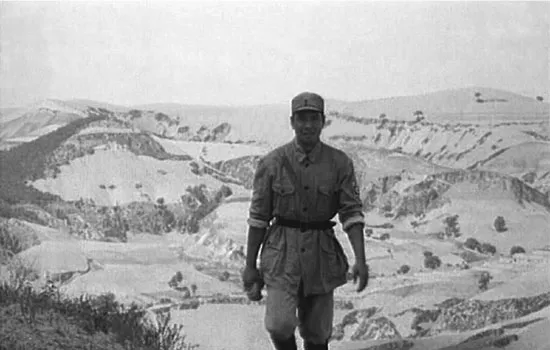
Figure 1.1 Communist soldier Gu Qing emerging into the horizon of Loess Plateaus in Huang tu di (Yellow Earth, 1984, China, Chen Kaige). ©Guangxi Film Studio.
p.26
Chen Kaige offered this instruction to his film crew: “in terms of cinematic structure, I want our film to be rich and variable, free to the point of wildness [. . .] The quintessence of our style can be summed up in a single word: ‘hanxu’(concealment)” (Barmé and Minford 1988: 259). This style of hanxu was radical then in that it refused to restage the party-endorsed myths of the Chinese revolution, its prolonged shots of the natural landscape challenging the film establishment. Xia Yan, a ranking film bureaucrat and veteran screenwriter from the 1930s, admitted his discomfort: “I simply fail to understand how people so close to Yan’an could remain completely untouched by the new spirit that came from Yan’an” (Barmé and Minford 1988: 267)—Yan’an here being the Communist headquarters in the early 1940s. What is absent in Yellow Earth is the received historical wisdom—namely that Chinese peasants always awakened to their innate revolutionary spirit once they were mobilised by the Communists.
This absence is most powerfully staged in the film’s final scene, where the Communist solider Gu Qing returns to a village devastated by drought. After a long sequence of an all-male crowd of superstitious peasants praying for rain to a dragon king statue, the taciturn boy Hanhan seems to catch sight of Gu and rushes against the frenetic crowd to greet him. However, through a series of cross cuts, Gu appears to be caught on the horizon, as if he were a mirage flickering between the empty sky and the parched land. The off-screen song sung by Cuiqiao, Hanhan’s elder sister, only intensifies this optical illusion, for the viewer knows by this point that Cuiqiao was forced into an arranged marriage and was drowned while attempting to escape across the Yellow River, singing a revolutionary song without finishing the phrase “Communist Party”, the organisation that would “save the people”.
Two interpretations of the final sequence are worth contemplating. First, Esther Yau hints at an unyielding presence in Yellow Earth, namely a “simple Taoist philosophy which (dis)empowers the text by (non)affirming speaking and looking: ‘Silence is the Roaring Sound, Formless is the Image Grand’” (1987–88: 32). This idea, taken from the Daoist classic Dao de jing, “great music has no sound (dayin wusheng), the great image has no form (daxiang wuxing)”, supports the film’s extensive use of silence and empty space, which works to empower the viewer to distance themselves from the illusion promulgated by the rhetoric of realpolitik and to reconnect with the real through the wordless contemplation of the natural landscape. Second, even though the Fifth Generation was initially fascinated with the Daoist rendition of landscape, their ultimate concerns remained with the human world. According to the film’s cinematographer Zhang Yimou, their landscape images were designed to capture “the sustaining strength and endurance of a nation” (Barmé and Minford 1988: 259). Through wordless images and avant-garde techniques, the emergent Fifth Generation sought to articulate a new sense of the real radically different from the socialist construction of history and reality, ultimately aspiring to present a new representation of the Chinese nation.
In hindsight, it is ironic that the Fifth Generation first found their receptive audiences not inside China but overseas, and their growing international fame would soon undermine the radical manner in which they redefined the cinematic real through uncanny landscape. After Red Sorghum (Zhang Yimou, 1987) won the first Golden Bear for Chinese cinema at the 1988 Berlin Film Festival, natural and cultural landscapes took on a different meaning on the international screen. Increasingly, exotic cultural practices characterised Fifth Generation productions, and erotic sexuality became prominent. From Ju Dou (1989, China/Japan) to Da hong deng long gao gao gua (Raise the Red Lantern, 1991, China/Hong Kong/Taiwan), Zhang Yimou’s overseas-funded art films of the period showed increasingly less open landscapes and more enclosed—even claustrophobic—spaces. Just as Zhang’s screen protagonists quickly changed from rebels to conformists, his audiences were lured into a mesmerizing display of Orientalist motifs as quintessential images of “Chinese” culture. In the meantime, even the natural landscape had lost its transformative power at the hands of the Fifth Generation, and the stunning beauty of desolate terrains in western China provided but an empty stage for enacting an enigmatic tale of dedication, desire, and desperation.
p.27
The Sixth Generation’s mindscape of youth: in defence of individual perception
In the early 1990s, the emergent Sixth Generation began to question cultural traditions reinvented by the Fifth Generation and lamented the lack of a “sense of reality” (xianshi gan) in Chinese filmmaking (Cheng and Huang 2002: 31). For them, to return to the real was to venture from history to reality, from the countryside to the city, from overloaded symbols to contingent situations, from gorgeous landscapes to precarious mindsca...
Table of contents
- Cover Page
- The Routledge Companion to World Cinema
- Title
- Copyright
- Contents
- List of Illustrations
- List of Contributors
- Acknowledgements
- Introduction: The Longitude And Latitude of World Cinema
- Part I Longitude
- Part II Latitude
- Index
Trusted by 375,005 students
Access to over 1.5 million titles for a fair monthly price.
Study more efficiently using our study tools.
Frequently asked questions
Yes, you can cancel anytime from the Subscription tab in your account settings on the Perlego website. Your subscription will stay active until the end of your current billing period. Learn how to cancel your subscription
No, books cannot be downloaded as external files, such as PDFs, for use outside of Perlego. However, you can download books within the Perlego app for offline reading on mobile or tablet. Learn how to download books offline
Perlego offers two plans: Essential and Complete
- Essential is ideal for learners and professionals who enjoy exploring a wide range of subjects. Access the Essential Library with 800,000+ trusted titles and best-sellers across business, personal growth, and the humanities. Includes unlimited reading time and Standard Read Aloud voice.
- Complete: Perfect for advanced learners and researchers needing full, unrestricted access. Unlock 1.5M+ books across hundreds of subjects, including academic and specialized titles. The Complete Plan also includes advanced features like Premium Read Aloud and Research Assistant.
We are an online textbook subscription service, where you can get access to an entire online library for less than the price of a single book per month. With over 1.5 million books across 990+ topics, we’ve got you covered! Learn about our mission
Look out for the read-aloud symbol on your next book to see if you can listen to it. The read-aloud tool reads text aloud for you, highlighting the text as it is being read. You can pause it, speed it up and slow it down. Learn more about Read Aloud
Yes! You can use the Perlego app on both iOS and Android devices to read anytime, anywhere — even offline. Perfect for commutes or when you’re on the go.
Please note we cannot support devices running on iOS 13 and Android 7 or earlier. Learn more about using the app
Please note we cannot support devices running on iOS 13 and Android 7 or earlier. Learn more about using the app
Yes, you can access The Routledge Companion to World Cinema by Rob Stone, Paul Cooke, Stephanie Dennison, Alex Marlow-Mann, Rob Stone,Paul Cooke,Stephanie Dennison,Alex Marlow-Mann in PDF and/or ePUB format, as well as other popular books in Media & Performing Arts & Film History & Criticism. We have over 1.5 million books available in our catalogue for you to explore.