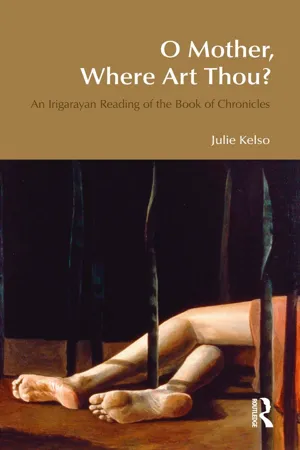
According to Kelso, the Book of Chronicles silences women in specific ways, most radically through their association with maternity. Drawing on the work of two feminist philosophers, Luce Irigaray and Michelle Boulous Walker, she argues that we may discern two principal strategies of silencing women in Chronicles: disavowal and repression of the maternal body. In its simplest form, the silencing of women takes place through both an explicit and implicit strategy of excluding them from the central action. Largely banished from the central action, they are hardly able to contribute to the production of Israel s past. On a more complex level, however, women are most effectively silenced through their association with maternity, because the maternal body is both disavowed and repressed in Chronicles. The association of women with maternity, along with the disavowal and repression of the maternal body as origin of the masculine subject, effects and guarantees the silence of the feminine, enabling man to imagine himself as sole producer of his world. These strategies of silencing the feminine need to be understood in relation to the relative absence of women from the narrative world of Chronicles. Kelso argues that Chronicles depends on the absence and silence of women for its imaginary coherence. This argument is enabled by Irigarayan theory. But more importantly, Kelso suggests that Irigaray also offers us a viable mode (not method) of reading, writing, listening, and speaking as woman (whatever that might mean), in relation to the so-called origins of western culture, specifically the Hebrew Bible or Old Testament. She argues that Irigaray enables a not only rigorous, feminist critique of patriarchy and its many texts, but also, somewhat more charitably, a mode of reading that enables women to read the past differently, seeking out what remains to be discovered, especially the forgotten future in the past.
- 247 pages
- English
- ePUB (mobile friendly)
- Available on iOS & Android
eBook - ePub
PART I
FEMINISM, PSYCHOANALYSIS, AND THE HEBREW BIBLE: “INTRODUCING” LUCE IRIGARAY
No one method, form of writing, speaking position, mode of argument can act as representative, model or ideal for feminist theory. Instead of attempting to establish a new theoretical norm, feminist theory seeks a new discursive space, a space where women can write, read and think as women. This space will encourage a proliferation of voices, instead of a hierarchical structuring of them, a plurality of perspectives and interests instead of the monopoly of the one – new kinds of questions and different kinds of answers (Grosz, 1986: 203–204)
My reading and analysis of the books of Chronicles takes place through the double lens of feminism and psychoanalysis. While certain feminist methods across a multitude of disciplines have long been associated with various psychoanalytic approaches (i.e. Freudian, Lacanian, Kleinian Object Relations, etc.), it is acknowledged that feminism and psychoanalysis have a complex and contentious relationship, one, however, I interpret as ultimately productive.1 This problematic, yet productive relationship is radically evident in the work of Luce Irigaray, the feminist philosopher and psychoanalyst2 with whom I engage in this book. In the next two chapters, I shall outline those theoretical and methodological aspects of Irigaray’s earlier work that I insist are most relevant to the task of providing a feminist psychoanalytic reading and analysis of Chronicles.
While biblical studies is relatively familiar with psychoanalytic theory, particularly Freudian, Jungian, Lacanian, and Kristevan analytic theory, the work of Luce Irigaray has had very little impact, to date, on studies of biblical texts, with currently only two introductory discussions provided by the Postmodern Bible Collective (1995: 217–21, 258–60) and Faith Kirkham Hawkins (2000). The Bible and Culture Collective includes Irigaray in their discussions of psychoanalysis and feminist criticism, and Kirkham Hawkins (in the Handbook of Postmodern Biblical Interpretation) provides a brief discussion of Irigaray’s theoretical interventions and suggests possible ways of bringing Irigaray to biblical studies. However, no sustained engagement has yet been attempted with Irigarayan thought by feminist biblical scholars when analysing and interpreting specific biblical texts, her name appearing only occasionally and briefly to augment theoretically related arguments concerning feminist interpretation.3 Directly related to this lack of dialogue between biblical studies and the work of Irigaray is the fact that, to date, Irigaray’s engagement with Hebrew biblical literature is cursorial.4 That feminist biblical scholars have given her little attention is no doubt due to the perceived paucity of related material. Unlike other recent French thinkers such as Julia Kristeva, Hélène Cixous, and the late Jacques Derrida, Irigaray has not engaged in a necessarily substantial manner with the Hebrew Bible to warrant the same attention from biblical scholars. And yet, the current popularity of European philosophy and literary theory within biblical studies extends beyond those texts concerned explicitly with biblical material to embrace the range of theoretical and methodological implications of European thought (understood largely outside of France as deconstruction, inter-textuality, transferential reading, and such like).
So far, it is the theological dimension of Irigaray’s work that has proved most enticing for religionists,5 and has received the most attention in biblical studies. Indeed, within the two most extensive engagements with Irigaray’s work within biblical studies mentioned above (Bible and Culture Collective and Kirkham Hawkins), their discussions quickly turn to this theological aspect of her work, with minimal interest given to her distinctive form of psychoanalytic reading. Importantly, as we shall see, for Irigaray it is psychoanalysis that provides feminists with a particular mode of reading and encountering the past that is radically non-nostalgic. Thus, such a mode of reading is radically political in that the past must be encountered (traumatically) only for the purpose of change in the present and future. We really cannot begin to understand Irigaray’s theological writings until we understand the politics, and indeed ethics, of her reading practice. Given this, I have decided to leave Irigaray’s theological writings to the side, despite the fact that they might seem to be an obvious choice for a feminist reader of the Bible. Instead, I shall focus, in detail, on what it means to read.
Psychoanalytic theory and the biblical story are, of course, intimately related: from Freud’s images of himself as Joseph, Moses, even as the slayer of Moses,6 and his thesis on the “birth” of civilization and religion in Moses and Monotheism (1939) to Lacan’s “Name of the Father” (1977: 199). As David Jobling (1998: 23) points out, bringing the two together effects a transferential relationship between them, meaning that neither the biblical text nor psychoanalytic theory remain unchanged by the encounter. As will become clear in the following two chapters, for Irigaray, this mutually dependent (and thus ethical) catharsis is the most important facet of psychoanalytic reading, but also perhaps the least practised despite intentions otherwise. As we shall see, Irigaray is scathingly critical of certain analysts (whether professional psychoanalysts or literary and cultural critics) who perform psychoanalytic theory as a universal scientific method upon an “object” of analysis.
Outside of biblical studies there have been three main psychoanalytic approaches to reading literature: analysing the author using psychoanalytic concepts (a method favoured by Freud himself);7 analysing the literary characters; and finally, a focus on both the reader and the literary text as simultaneous players in the psychoanalytic scenario. In contemporary post-structural scholarship, the first approach has largely been discredited because the idea that a work of literature can be analysed in place of – and as equivalent to – the author is, arguably, quite naive in that it depends on a simplistic theory of the subject of representational practice (that is, the writing subject) as unproblematically reflective of the psychic subject in general. The most popular approach has been the second, where characters are analysed using psychoanalytic concepts, as if the character is an actual analysand.8 As Jobling points out, this particular use of psychoanalysis is weak because, while a literary character resembles a “real” human being, he or she, of course, is not a real individual living in the world (Jobling, 1998: 21). Or, as Ilona Rashkow puts it in relation to the analysis of biblical literary characters:
biblical characters are both more and less than real persons. This presents a problem. While one aspect of narrative characterization is to provide a mimetic function, that is, to represent human action and motivation, another aspect is primarily textual, that is, to reveal information to a reader or conceal it (Rashkow, 1993: 18).
The third approach is the one most closely related to Irigaray’s own form of psychoanalytic reading. It is also the approach taken by biblical scholars who arguably provide us with some of the best examples of how fruitful the interpretive and analytical relationship between psychoanalysis and the Bible can be.9 For David Jobling, Ilona Rashkow, and (honorary biblical scholar) Mieke Bal, psychoanalytic criticism does not so much involve the analysis of author or character, where the author or character functions as the analysand and the critic/reader as the analyst. Indeed, such an imperialist epistemological model ignores one of the fundamental innovations of psychoanalysis: the breakdown of distinct boundaries between subject and object of knowledge. Instead, according to these advocates of the third approach, psychoanalytic theory must be refused the hegemonic status given to it by the first two approaches. What is argued is that psychoanalytic criticism is more about the unconscious “networks” created in the encounter between two: text and critic/reader.
It is this notion of “transference” that distinguishes these approaches to reading and interpreting biblical literature from the older forms of author or character psychoanalysis, and it is a form of psychoanalytic reading with many debts to feminist scholarship (namely Shoshana Felman, Jane Gallop, and Toril Moi, among others). For Bal, transference
is the competition between the dramatic and the narrative form. There the analytic subject seeks to play; to repeat the past, rather than to recount it. In this way, the subject of analysis privileges an open subjectivity rather than a deceptive objectification of the narration, a “direct” presentation rather than a past representation, and a dialogue rather than a narrative monologue (Bal, 1991b: 147).
What I want to suggest is that all these elements – the drama of transference and countertransference, the thwarting of diachronic temporality, and the relation “between two” – are fundamental to Irigaray’s mode of psychoanalytic reading. I shall explain this in detail in Chapter 2. For Bal, the psychoanalytic notion of transference details the inevitable complicity of the reading/analysing subject with the world of the text, and viceversa. On the one hand, the reading subject is indeed “created” within the representational frameworks of the text itself, ultimately “finding” him or herself in the text. On the other hand, the reader brings with him or her already established representational frameworks within which meaning arises. It is this interplay “between two” that constitutes transference as part of the drama of interpretation and reading.
This is also David Jobling’s understanding of transference. However, I think Jobling’s reading practice is far more productively “transferential” than Bal’s, which is ultimately at times rigidly structural (she herself admits this). I am referring here to Bal’s work on biblical literature (Bal, 1987, 1988, 1989). Her later work, especially Reading Rembrandt (Bal, 1991a), foregrounds transference more so than the earlier works. With respect to her work in biblical studies, Bal’s interests as a narra-tologist lean towards the development of a model of analysis produced by the productive encounter between narratology and psychoanalysis.10 Her insistence on psychoanalytic criticism as an analogue or model (based on her admiration for the Habermasian position of psychoanalysis as a science which has managed to incorporate self-reflection; Bal, 1991b: 35ff) is a position entirely rejected by Irigaray. The incorporation of psychoanalysis as a method or model of interpretation and reading is, according to Irigaray, problematic indeed. I discuss this aspect of Irigaray’s critique of psychoanalysis as interpretive practice at length in Chapter 2.
For both Jobling and Rashkow, however, their status as both subject and object of representation is never concealed in the process of interpretive readings.11 For example, in his commentary on 1 Samuel, Jobling sets up his discussion by outlining his development as a biblical scholar (Jobling, 1998: 4–24). More importantly, in the final chapter of his book he focuses on the question of why certain stories or verses (in his case 1 Sam. 26:19) resonate with different readers, almost re-presenting for the reader their own story:
We need to take such experiences seriously. Those of us who are brought up with the Bible (and this includes everyone who is a product of Western culture) are enmeshed in it in ways that are often unconscious or semiconscious. We need to find ways of examining these strange associations, these “hauntings” – ways of bringing them to the surface. One reason why we need to come to terms with them in our scholarly work is that they operate at a level far deeper than our intentional scholarship. They inhabit our scholarship, so that we may be playing out internalized biblical scenarios just when we think we are being most objective… If for Freud dreams are the “royal road” to the individual unconscious, for me transference is the royal road to the “biblical unconscious.” So deeply is the Bible inscribed within us that the processes by which we read it are simply the rehearsal at another level of what we find in it (Jobling, 1998: 283).
The “mirage” of one’s own history or theoretical-methodological activity at work, impossibly, in an ancient text alerts us to a different process that arises as an effect of the reader-text coupling. In the case of Chronicles (and preempting my discussion of the psychoanalytic process to come in this part), the very project of Chronicles seems to be to return to (even confront) “the past” and re-narrate that (traumatic) past in terms that allow for the possibility of a better future. This is precisely what psychoanalysis as a therapeutic process is said to enable. Is it simply that the logic of psychoanalysis is equivalent to that of Chronicles? Hardly. What transference enables is the silences (“these ‘hauntings’ ”) of the text “to speak.” In other words, the...
Table of contents
- Cover Page
- Half Title page
- Series
- Title Page
- Copyright Page
- Dedication
- Contents
- Acknowledgments
- Introduction: A Question of Silence
- I Part I Feminism, Psychoanalysis, and the Hebrew Bible: “Introducing” Luce Irigaray
- 1 1 “The Monopoly of the Origin” and the Mute Foundation of Psychoanalysis: The Theoretical Interventions of Luce Irigaray
- 2 2 Remembering the Forgotten Mother: Engaging with Chronicles in an Irigarayan Mode
- II Part II Our Production of a Past, in the Present of Analysis: Engaging with the Book of Chronicles
- 3 3 Who Begets Whom? Disavowing the Maternal Body: 1 Chronicles 1–9
- 4 4 The Debt-Free Masculine Subject: The Repressed Maternal Body in 1 Chronicles 10–2 Chronicles 36
- Conclusion
- Notes
- Bibliography
- Index
- Index of Authors
Trusted by 375,005 students
Access to over 1.5 million titles for a fair monthly price.
Study more efficiently using our study tools.
Frequently asked questions
Yes, you can cancel anytime from the Subscription tab in your account settings on the Perlego website. Your subscription will stay active until the end of your current billing period. Learn how to cancel your subscription
No, books cannot be downloaded as external files, such as PDFs, for use outside of Perlego. However, you can download books within the Perlego app for offline reading on mobile or tablet. Learn how to download books offline
We are an online textbook subscription service, where you can get access to an entire online library for less than the price of a single book per month. With over 1.5 million books across 990+ topics, we’ve got you covered! Learn about our mission
Look out for the read-aloud symbol on your next book to see if you can listen to it. The read-aloud tool reads text aloud for you, highlighting the text as it is being read. You can pause it, speed it up and slow it down. Learn more about Read Aloud
Yes! You can use the Perlego app on both iOS and Android devices to read anytime, anywhere — even offline. Perfect for commutes or when you’re on the go.
Please note we cannot support devices running on iOS 13 and Android 7 or earlier. Learn more about using the app
Please note we cannot support devices running on iOS 13 and Android 7 or earlier. Learn more about using the app
Yes, you can access O Mother, Where Art Thou? by Julie Kelso in PDF and/or ePUB format, as well as other popular books in History & Ancient History. We have over 1.5 million books available in our catalogue for you to explore.