Located in the center of Asia with one of the largest land frontiers in the world and 14 neighbors whose dispositions could not easily be predicted, China has long been obsessed with security. In this handbook, an internationally renowned team of contributors provide a comprehensive and systematic analysis of contemporary thinking about Chinese national security. Chapters cover the PRC's historical, ideological and doctrinal heritage related to security, its security arrangements and policies targeting key regions and nations of the world, the security aspects of the PRC's ground, air, sea, space and cyber forces, as well as the changing and expanding definition and scope of China's security theory and practice.
eBook - ePub
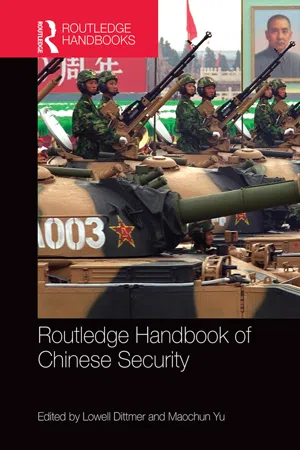
Routledge Handbook of Chinese Security
- 376 pages
- English
- ePUB (mobile friendly)
- Available on iOS & Android
eBook - ePub
Routledge Handbook of Chinese Security
About this book
Information
Chinese national security
1
The historical legacy of Chinese security policy
China has a rich tradition of military writings and a long history of warfare for over two thousand years. In ancient China during the Warring States period, the Military School (bing jia) contended for influence on policymakers with other schools of thought including Confucianism, Legalism, Daoism, and Moism. The military corpus continued to grow as subsequent dynasties confronted various security threats. Thousands of military treatises were written over the centuries, many of which were lost, but some survived the test of time. In the eleventh century, the Song Dynasty compiled the Seven Military Classics, including Sun Zi’s famous Art of War. These canonized texts are still widely read today.1 Military writings aside, official dynastic histories preserved numerous accounts of Chinese warfare. Each of these accounts presented a Chinese perspective—though not necessarily that of China’s adversary—of what had transpired in the war, including the cause of war, the number of troops, war aims, logistics, conduct of war, and casualties. Given the enormous size of the literature, it is not possible to present a comprehensive account of Chinese strategic thought and practice in the space available here. This limitation notwithstanding, we can still identify important recurrent themes in the traditional military writings and actual strategic behaviors.
There are five themes that characterize the historical legacy of Chinese security policy. First, Sinocentrism puts China at the center of the known world, manifested in the hierarchical tribute system. Second, Confucian pacifism affects China’s perception of itself as a peaceful, defensive, and nonaggressive nation and infuses morality into its foreign policy rhetoric. Third, Chinese realism guides actual strategic behavior and shows amoral pragmatism in the conduct of military affairs. Fourth, stratagems based on historical anecdotes may inform Chinese tactical maneuvers to deceive and outsmart the opponent. Finally, geography, along with the historical change in military technology, has a profound effect on resource allocation in Chinese defense planning, affecting the development of land power and sea power. These five themes reveal a diverse tradition in Chinese security policy, which I discuss below.
Sinocentrism
Historically, the Chinese saw themselves not as an empire or as a nation-state but as the center of civilization. The Chinese term for “China,” Zhongguo, literally means “the country at the center” or “the central states.” In this worldview, China stood at the center of the known world, or all-under-Heaven (tianxia). Foreigners, attracted by the splendor and superiority of the Chinese civilization, came to the Chinese court to pay tribute to the Son of Heaven and accepted their status as a vassal of the Chinese emperor. The Chinese way of diplomacy was hierarchical and non-egalitarian. Foreign relations were arranged in a concentric circle with China at the center, surrounded by tributary states and then by barbarians. The farther away from China, the less civilized the region. Unlike the Westphalian nation-state system, the concept of sovereign equality between states did not exist in the Chinese world order.
This Sinocentrism affected how traditional China conducted its frontier policy. John Fairbank popularized the notion of the “tribute system” to describe the Chinese world order. Non-Chinese rulers participated in the tribute system by observing appropriate rituals and ceremonies and were given a patent of appointment for their rulership as well as a seal for use in official communications. Leaders of tributary states could address themselves only as “king” (wang); the term “emperor” (huangdi) was reserved exclusively for the ruler of China. Tributary states adopted the Chinese calendar and dynastic reign-title. Their envoys periodically brought local products as tribute and performed appropriate ceremonies, including the full kowtow (kneeling three times, each time tapping their head to the ground for another three times, for a total of nine taps), in the Chinese court and received lavish gifts in return. The Chinese court granted tributary states with trading privileges at the capital and at the frontier. Polities that embraced Chinese culture and writing, such as Korea and Vietnam, were considered civilized and received a higher status in the tribute system, while those that did not, such as nomadic polities, were viewed as uncivilized and received a lower status. In Confucian thinking, the influx of tribute-paying foreign envoys strengthened the legitimacy of the Chinese throne, because the tribute symbolized his status as the accepted ruler of all-under-Heaven. For tributaries, Chinese recognition and investiture had the effect of enhancing the legitimacy of the local rulers, a process similar to diplomatic recognition of states today.2
The tribute system took shape in the Han Dynasty (206 BC–AD 220) and waxed and waned throughout the ages until its collapse in the nineteenth century under European gunboats. Material power was indispensable in creating and sustaining the tribute system.3 Chinese rulers used the tribute system to organize foreign relations in a way that helped the country achieve its security objectives. By obliging foreigners to pay tribute, it was hoped, China would transform them into civilized and unthreatening peoples. Tributary states could call for Chinese help if attacked. China, as the leader of all tributaries, provided the public good of security. Trading privileges were granted as reward to those who accepted the tribute system or were withheld as punishment to those who refused to obey. Preponderant material capacity enabled China to set the “rules of the game” and to dictate the boundaries of appropriate behavior.
Sinocentrism does not mean that China was always the hegemonic power in Asia. Although there are periods in Asian history when China was predominant, there are also substantial periods when China was the weaker state or was divided into several competing ones. An oft neglected fact is that China was unified for less than 50 percent of the time in the last two thousand years,4 which means that for the majority of Asian history there was no single hegemon. It is historically inaccurate to assume that the Asian state system was always hierarchic with China at the center. Sinocentrism is mainly a civilizational concept.5
Sinocentrism gave rise to a Chinese tendency to give paternalistic advice to others. As the leader of the civilized world, Chinese rulers were obliged to admonish deficient behavior on the part of their tributary states and to guide them into good governance. For instance, on hearing from his envoy that Korea lacked sufficient fortifications against Japanese pirates (which were also a threat to China), Ming Emperor Hongwu sent a rescript in 1369 to the Korean king stating that “we cannot neglect to counsel you of the ways of avoiding danger and protecting your kingdom.” He went on to instruct the Korean king in the proper way to beef up defense, replenish food supply, and construct buildings to conduct government affairs.6 Along with the tendency to give out advice was a moralistic approach to foreign policy announcements. Communications to foreign polities were often couched in moralistic language. As the superior culture, Sinocentrism placed China on the moral high ground when it reprimanded foreign rulers for insubordinate behavior or when it launched a punitive war against an allegedly immoral regime. Imperial China demanded respect, sincerity, and submission on the part of tributary states, and when those demands were not met, it put the blame entirely on the offending party.
The legacy of Sinocentrism did not disappear after China adopted the modern Westphalian system of sovereign equality. We still observe a Chinese tendency to give advice to foreign visitors. During the Cold War, leaders of pro-Mao Communist parties from around the world traveled to Beijing to pay symbolic tribute and to hear from the teachings of Mao Zedong.7 Official photographs and television footage frequently show foreign dignitaries listening attentively and nodding appreciatively as Chinese leaders lecture them. PRC foreign policy announcements are frequently couched in moralistic language. Chinese leaders have employed the Five Principles of Peaceful Coexistence (mutual respect for sovereignty and territorial integrity, mutual nonaggression, noninterference in internal affairs, equality and mutual benefit, and peaceful coexistence) as an alternative to the US-dominated international order that limits the rights of sovereign states to pursue policies inconsistent with US interests and values. Chinese propaganda sharply criticized US imperialism and Soviet expansionism during the Cold War, accusing them of pursuing a policy of hegemony. Today, by saying that it will “never seek hegemony,” Beijing attempts to stake out a morally superior foreign policy to the alleged US policy of pursuing “sole hegemony.” The sloganeering of “peaceful rise” (later “peaceful development”) and “harmonious world” taps into the human desire for peace and cooperation. It goes without saying that China’s relatively weaker power position in the international system makes it easier to make these moralistic proclamations, which are consistent with its national interests.8
Confucian pacifism
Since Chinese culture is distinct, it is tempting to essentialize Chinese military writings and contrast them with the Western style of warfare. A popular view holds that the Chinese have traditionally prioritized defense, used war as a last resort, preferred an indirect approach, and shunned wars of total annihilation, while the West emphasized all of the opposite. The Great Wall of China is frequently cited as a symbol of this alleged preoccupation with defense and denigration of offensive use of force. This essentialized version of Chinese military tradition is often traced back to Confucianism. In the seventeenth century, the Jesuits who came to China were struck by a bureaucracy dominated by Confucian scholar-officials and its seemingly anti-militarist orientation. The Jesuit accounts of China later influenced Enlightenment thinkers such as Voltaire who wrote about the moral superiority of a benevolent China and praised its laws for rewarding moral behavior.9 Max Weber was so impressed with the “pacifist character of Confucianism” that he wrote about how the Confucianists “faced military powers with aversion.”10 John K. Fairbank highlighted the “pacifist bias” of Confucianism that forbade expansion through brute force and conquest.11
Confucianism was the state ideology of Imperial China. Through its emphasis on the ruler’s cultivation of virtue, Confucianism provided an important source of legitimacy for Chinese emperors. Learning Confucian classics was an essential element of the emperor’s early education. For career-aspiring young Chinese, mastery of the Confucian classics was crucial to success in the imperial civil service examination. As a result, virtually all Chinese officials were well versed in the Confucian precepts. In matters of national security, Confucianism downplayed the efficacy of military force and instead prioritized the cultivation of virtue and morality. A virtuous ruler, like a shining city on the hill, will attract the submission of adversaries and face no threat around the world. Chaos and disobedience arise when the ruler is morally corrupt. Military conquests undermine the legitimacy of the ruler and are therefore counterproductive and self-defeating. A virtuous ruler should avoid wars of conquest. The Confucian literature is replete with passages that denigrate warfare and military expansion. This emphasis on moral virtue at the expense of the martial spirit produced a disdain for the military in Imperial China. “Disparagement of the soldier,” writes Fairbank, “is deeply ingrained in the old Chinese system of values.”12
The antimilitarism of Confucianism does not rule out war in certain situations. Confucius himself was in favor of military preparedness, but ranked its importance behind people’s livelihood and trust in government. For the Confucians, war must serve a higher moral purpose in the form of a “righteous war” (yizhan). A state can use force only when reasons for doing so are morally justifiable. Once a righteous war is launched, the conduct of war must follow the principle of benevolence and justice, for instance, not attacking civilians and withdrawing after the just cause is served. There are two morally justifiable reasons for using force: self-defense and punitive war. If a state that practices moral statecraft is invaded by another state, then the victim can justifiably mobilize the country for war in self-defense. Alternatively, if the ruler of a state is found to be unjust or abusing its people, a punitive expedition can be launched to punish the abusive ruler and rescue the suffering people. This principle still holds even if the abusive state is stronger in p...
Table of contents
- Cover
- Title
- Copyright
- Contents
- List of figures
- List of tables
- List of contributors
- Editors’ note and acknowledgements
- Introduction: China’s security perspective
- PART I Chinese national security
- PART II Geostrategic perspectives
- PART III China’s security forces
- Index
Trusted by 375,005 students
Access to over 1.5 million titles for a fair monthly price.
Study more efficiently using our study tools.
Frequently asked questions
Yes, you can cancel anytime from the Subscription tab in your account settings on the Perlego website. Your subscription will stay active until the end of your current billing period. Learn how to cancel your subscription
No, books cannot be downloaded as external files, such as PDFs, for use outside of Perlego. However, you can download books within the Perlego app for offline reading on mobile or tablet. Learn how to download books offline
Perlego offers two plans: Essential and Complete
- Essential is ideal for learners and professionals who enjoy exploring a wide range of subjects. Access the Essential Library with 800,000+ trusted titles and best-sellers across business, personal growth, and the humanities. Includes unlimited reading time and Standard Read Aloud voice.
- Complete: Perfect for advanced learners and researchers needing full, unrestricted access. Unlock 1.5M+ books across hundreds of subjects, including academic and specialized titles. The Complete Plan also includes advanced features like Premium Read Aloud and Research Assistant.
We are an online textbook subscription service, where you can get access to an entire online library for less than the price of a single book per month. With over 1.5 million books across 990+ topics, we’ve got you covered! Learn about our mission
Look out for the read-aloud symbol on your next book to see if you can listen to it. The read-aloud tool reads text aloud for you, highlighting the text as it is being read. You can pause it, speed it up and slow it down. Learn more about Read Aloud
Yes! You can use the Perlego app on both iOS and Android devices to read anytime, anywhere — even offline. Perfect for commutes or when you’re on the go.
Please note we cannot support devices running on iOS 13 and Android 7 or earlier. Learn more about using the app
Please note we cannot support devices running on iOS 13 and Android 7 or earlier. Learn more about using the app
Yes, you can access Routledge Handbook of Chinese Security by Lowell Dittmer, Maochun Yu, Lowell Dittmer,Maochun Yu in PDF and/or ePUB format, as well as other popular books in Politics & International Relations & Asian Politics. We have over 1.5 million books available in our catalogue for you to explore.