eBook - ePub
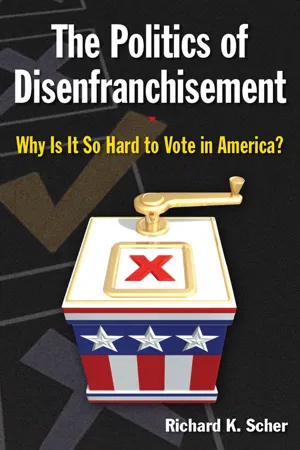
The Politics of Disenfranchisement
Why is it So Hard to Vote in America?
- 216 pages
- English
- ePUB (mobile friendly)
- Available on iOS & Android
eBook - ePub
About this book
We think of our American democracy as being a model for the world--and it has been. But today it compares unfavorably in some respects, especially when it comes to the universal franchise. The right to vote is more conditional and less exercised in the United States than in many other mature democracies. As became clear to all in the presidential election of 2000, when the stakes are high, efforts to define voter eligibility and manage the voting and vote-counting process to the advantage of one's own side are part of hard-ball politics. It is that experience that gave rise to this book.
Written by an author with wide expertise on Southern and Florida politics and districting, the book begins with a deceptively simple question--why is it so hard to vote in America? It proceeds, in seven chapters, to examine the ways that some people are formally or effectively disenfranchised, and to review how control of the ballot and the voting process is constrained, manipulated, and contested
Information
1
Trying to Vote in America
Why is it so hard to vote in America?
This deceptively simple question constitutes the heart of this book. It is in part an investigation of the barriers that prospective voters in the United States must overcome in order to exercise their franchise, cast a vote, and have it recorded and counted. But the book will also look more deeply at these matters, and ask why these barriers exist in the first place. After all, it is not enough to point out what has become all too well known, namely, that voting in America is often a struggle for the individual citizen. The real question is, why have we structured our voting procedures and mechanics so that this happens? Surely it is not just an accident, a matter of accumulated bad voting practices over time. Rather, it is much more likely, as Jonathan Kozol has eloquently and movingly written in another context, to be the result of conscious human decisions—or sometimes nondecisions. What, then, does the difficulty of exercising the franchise say about attitudes toward voting in America? What are its implications for our democratic elections, or indeed, our democratic system of governance?
It is no secret that problems have arisen in American elections since the founding of the nation, including during the twenty-first century, to the extent that too often their legitimacy, fairness, and accuracy have been called into question. We know that eligible voters are not always able to cast ballots, or have them counted even if they do vote. For this situation to exist in a modern, mature democracy is both anomalous and intolerable. We know how to structure election systems that expand rather than restrict the franchise. We know how to fashion election procedures so that voting is a non-burdensome activity. And we can construct voting and counting machines such that the results of elections are not matters of doubt and controversy, or their legitimacy in question. Other democracies do so all the time.
Yet our policy and practice is not to do this. This book asks why.
Let’s be clear at the outset about what this book is and is not. It is an investigation of what is wrong with the American voting system. But unlike many—even most—critiques of American voting, it does not inquire from a top-down, bird’s-eye view. Instead, it looks at voting from the perspective of the individual voter—from a street-level view, in other words. Although my approach is certainly systemic (and systematic), my task is to deconstruct the steps individual prospective voters have to take, and hurdles they have to overcome, in order to successfully exercise the franchise and have their vote recorded and counted accurately.
The word “prospective” is crucial in the preceding sentence. There are numerous studies—long shelves in libraries, in fact—that explore the reasons why Americans vote, or do not. This book is not one of them. I start from the premise that there are people out there who want to vote, for whatever reasons, and head out of the house or take time from a job to do so. The question then becomes, will they be able to? Why or why not? And, equally importantly, does their vote really count? Or matter?
This is also not a book about election systems. I am not concerned, in this text, with whether the way in which most elections take place in this country is “the best” (the plurality, first-past-the-post system is the most commonly used, although other systems are used as well, especially in some local contests), or whether it should be replaced with something else (instant runoffs, for example, or approval or cumulative voting, or one of a dozen or more other types). My concern in this book is with the individual voter: whether or not he will be able to cast a ballot regardless of the type of ballot offered to him or the kind of election system he confronts.
Nor is this book an “encyclopedia” of the structures, rules, laws, and processes of voting machinery in fifty different states. Rather, its purpose is to synthesize the experience of voters throughout the nation who sought to vote but could not, and to see what is common among the barriers and hurdles that the different states erect to keep people away from the polls, or, if they are allowed to vote, to ignore, reject, or miscount their ballots.
Finally, this book is not an examination of the legal issues in voting rights. I am not a lawyer and am not competent to make such an analysis. Nonetheless, the politics of legal issues permeate this book. Indeed, it is a reasonable argument that the political forces that interpret and implement the legal issues of voting rights are just as important as what happens in courtrooms, and that will be our touchstone in this text.
The Political Context
There is a powerful ethos—even mythology—about voting in this country that holds that there are few if any problems or barriers associated with casting ballots. With few exceptions, anybody eighteen and over who is a citizen can vote: you register, you show up at your polling place on election day, you vote, the ballot is recorded and counted, and you go about your business. The whole process is said to be mechanical, neutral, and value-free. It doesn’t matter who you are or where you live or what is your race or color or nationality or religion or social class. If you don’t want to register, or if you choose not to vote, it’s because you’re too lazy, or don’t care, or don’t recognize your civic duty. In other words, it’s your problem, not your fellow citizens’ and certainly not the state’s. And besides, over 120 million Americans managed to vote in the 2004 presidential election, nearly 70 million in 2006, and more than 133 million in 2008; how hard can voting really be? Our voting system, according to the mythology, works for most people.
So the myth is repeated endlessly from parents’ laps to grade school, onward through the life cycle, and perpetuated more or less intact. True, one occasionally hears or reads voices suggesting that there are limitations on the franchise, but the general view seems to be that if you are not eligible to vote, or cannot, or don’t, something is wrong with you. Perhaps you belong to one of the many groups of marginalized Americans (maybe you can’t speak English, for example, or you have a serious disease or disability) who somehow don’t have the “capability” or “qualities” or “wherewithal” or “prerequisites” or “credentials” required to be a voter. Maybe you’ve been a crook and have had your voting rights taken away. In other words, the exclusionary policies of the franchise are often rationalized by blaming the disenfranchised, by believing that somehow they don’t “measure up.” And, to be blunt, it is likely that many Americans think there is nothing wrong with this—that it is just the way things are. Voting is not like walking into a restaurant or buying a ticket to a movie—something just about anybody can do. You have to meet some preexisting but not always articulated or specified standard, or you have to jump through a series of basically arbitrary hoops before you can be awarded the franchise.
It is long past time to bury the myths. The extent of disenfranchisement, and particularly the way in which the franchise is differentially and unequally awarded across the range of the U.S. population (disenfranchisement disproportionately affects African Americans and other peoples of color) fatally undermines our voting mythology.
But the matter of “trying to vote in America” extends beyond the question of who has the franchise and who does not. In fact, even those persons who have the franchise face considerable hurdles—for some, impenetrable structural barriers—to its free exercise. We will discuss in detail these barriers in subsequent chapters; all we need note here is that they range from qualifying and registering to vote, through the actual act of casting a ballot, to concerns over whether it is accurately recorded and tallied, to the very fundamental question of whether the ballot cast has any significance or meaning.
As readers will learn, the list of stumbling blocks and impediments goes on and on, but the point is clear. It is difficult beyond belief to vote in America. The whole process is stacked against many of those wishing to exercise the franchise, and it completely ignores the substantial obligation that the state has to the voter. Voting in America is much more a matter of faith and belief that the system “works right” than that it is sound, reliable, fair, and accurate. The evidence I present in this book will suggest that these words—and similar ones like “transparent” and “accountable”—apply to our system of voting only minimally, and too often not at all.
Indeed, in spite of repeated efforts at “reform,” recent studies continue to document just how difficult it is to vote in the United States: those of the Century Foundation (2005) and Cooperative Congressional Election Survey conducted by MIT (2009) come to mind.1 It is the premise of this book that most of the “reform” efforts are doomed to failure and that problems will persist because of the fundamental structure of elections and voting in this country.
The Intellectual Context
This book is not solely a study of barriers to voting. It will additionally address two major theoretical questions, one based on constitutional issues and one rooted in mainstream American democratic theory.
First, the existence of a range of voting rules and procedures across the states raises a Fourteenth Amendment question. If voting is a right, and if one person’s vote is worth the same as another’s irregardless of location, then does not the equal protection clause demand far more uniformity in voting procedures, across the board, than currently exists? The U.S. Supreme Court in Bush v. Gore (2000) raised the possibility that variations in election practices might trample on the Fourteenth Amendment. It backed away from pushing the point, but it remains very much problematic—a 900-pound gorilla that sooner or later has to be confronted.
I am neither a lawyer nor a published constitutional scholar. As a political scientist, however, I am qualified to outline the political ramifications of a possible Fourteenth Amendment issue on how we vote in America. Indeed, I believe I have a scholarly obligation to provoke such a discussion. This will be done in the concluding chapter.
Second, much of mainstream American democratic theory since its origins rests on the view that a politically inert, passive, nonparticipatory citizenry is neither noteworthy nor harmful to democracy. Beginning in the late nineteenth century, scholars such as Woodrow Wilson and Arthur Bentley, and continuing through giants of American political science like Lawrence Chamberlain, David Truman, Harold Lasswell, Robert Dahl, Gabriel Almond, Sidney Verba, and Heinz Eulau, among many others, have advanced variations on this theme. These theorists argue in different ways, and with different data sets, that elite rule, in which the mass public merely votes occasionally to confirm the position of one or another set of elites, preserves stability and continuity in democracy. It is fair to say that in one way or another, all are far more elitist than populist in their views of politics. Limiting the franchise and making voting onerous are neither a problem nor a liability in their writings, but are in fact functional steps for us to take because they ensure that nonelite “outsiders,” not to mention extremists or the lunatic fringe, cannot vote, let alone be elected.
This book takes serious issue with these views. Its theoretical reference point is rooted in the work of such authors as V.O. Key, Floyd Hunter, C. Wright Mills, Grant McConnell, William Domhoff, and Howard Zinn, among others, who question whether the political and social stability brought on by apathy and low rates of participation caused in part by hurdles to voting is indeed healthy. It takes as its starting point Carole Pateman’s sardonic comment about Giovanni Sartori: “political apathy is not, as one writer dismissively claimed, ‘nobody’s fault’ … but … is a socially structured and maintained phenomenon.” As Jonathan Kozol more recently put it in another context, the existence of social pathologies, including inequality and discrimination, is not a matter of inevitability or a result of “naturally occurring” conditions, but one created by the deliberate decisions—or nondecisions—of human beings.
This book will address the question of whether the difficulty hundreds of thousands of citizens face in voting is “nobody’s fault.” If it is a systemic (if not systematic) characteristic of our electoral system, what does this say about how we really regard the right to vote? Indeed, what does it say about the nature of American democracy?
The Politics of Disenfranchisement and Other Works
Although The Politics of Disenfranchisement is a unique book, it rests on the shoulders of two distinguished intellectual and political traditions in this country. The first might be called “progressive populism.” It has its roots in the Jefferson/Jackson political tradition celebrating everyday Americans and their struggle to participate in the American dream. This tradition was carried on in the late nineteenth and early twentieth centuries by such figures as William Jennings Bryan and Upton Sinclair, and still later by John Dos Passos, Dorothy Parker, John Steinbeck, the artist Diego Rivera, and the musician Aaron Copeland, among a host of others. None were social scientists, of course, but they provided an intellectual and artistic, as well as political, foundation for understanding the struggle of the dispossessed, marginalized, poverty-stricken characters depicted in their art against huge social, economic, and political forces allied against them, forces that they could only dimly imagine but whose impact on their lives they knew all too well.
By mid-twentieth century a well-conceived social science literature had developed that systematically and empirically examined what the artists and writers had imagined; writers would include such political scientists and sociologists as Key, Mills, and Hunter. Social science writings continued in this vein, on a more theoretical level, with Peter Bachrach and his collaboration with Morton Baratz, Noam Chomsky, and others. At the journalistic level, the progressive/populist tradition has most recently been given expression by (among others) I.F. Stone, Jim Hightower, Studs Terkel, and Barbara Ehrenreich, and by such periodicals as the Nation, Mother Jones, and the Village Voice. Emerging blogs and online “magazines” (the American Prospect comes to mind, among others) have pursued similar themes.
The second tradition on which this book rests can be called “the struggle for full and equal rights.” It reaches back to the Bill of Rights, ratified in 1791, and extends through the Thirteenth, Fourteenth, and Fifteenth Amendments of the post-Civil War era, each of which was concerned with providing civil and voting rights for former slaves. These efforts moved forward with the ratification in 1920 of the Nineteenth Amendment, which afforded unqualified suffrage to women. In that same year, the American Civil Liberties Union was founded, whose many reports and documents have informed the present project. But the most powerful intellectual foundation for this book is unquestionably Dr. Martin Luther King, Jr.’s 1963 “Letter from a Birmingham Jail.” In this extraordinarily profound statement, King successfully melds the themes of full civil rights and voting rights for all Americans, not solely African Americans. He understood better than most that if these rights are not granted and fully realized, then the promise of American democracy becomes a hollow shell, a chimera, a lie, for all Americans; to deprive even one person of his civil and voting rights is to undermine and cheapen those of everyone else. And yet, King saw, Americans spend as much time running away from this profound idea, especially but not only as it applies to the poor and marginalized, as embracing it. It is King’s remarkable insight into American democracy’s heart of darkness that permeates and energizes this whole study.
Why the Hurdles, Difficulties, and Impediments?
Why do the hurdles, difficulties, and impediments placed in front of the prospective voter exist, and persist? Why perpetuate practices that demean the value and meaning of the vote? Why not get rid of them, and make voting easy and meaningful? After all, if we really believe in popular participation and democratic governance, our goal should be to maximize ready access to the polls, and ensure that voters can exercise their franchise s...
Table of contents
- Cover
- Half Title
- Title Page
- Copyright Page
- Table of Contents
- Preface
- 1. Trying to Vote in America
- Part I: Disenfranchisement as Public Policy: The Great American Tradition
- Part II: The Mechanics of Voting
- Part III: Trying to Vote in America: Disenfranchisement as Public Policy
- Index
- About the Author
Trusted by 375,005 students
Access to over 1.5 million titles for a fair monthly price.
Study more efficiently using our study tools.
Frequently asked questions
Yes, you can cancel anytime from the Subscription tab in your account settings on the Perlego website. Your subscription will stay active until the end of your current billing period. Learn how to cancel your subscription
No, books cannot be downloaded as external files, such as PDFs, for use outside of Perlego. However, you can download books within the Perlego app for offline reading on mobile or tablet. Learn how to download books offline
Perlego offers two plans: Essential and Complete
- Essential is ideal for learners and professionals who enjoy exploring a wide range of subjects. Access the Essential Library with 800,000+ trusted titles and best-sellers across business, personal growth, and the humanities. Includes unlimited reading time and Standard Read Aloud voice.
- Complete: Perfect for advanced learners and researchers needing full, unrestricted access. Unlock 1.5M+ books across hundreds of subjects, including academic and specialized titles. The Complete Plan also includes advanced features like Premium Read Aloud and Research Assistant.
We are an online textbook subscription service, where you can get access to an entire online library for less than the price of a single book per month. With over 1.5 million books across 990+ topics, we’ve got you covered! Learn about our mission
Look out for the read-aloud symbol on your next book to see if you can listen to it. The read-aloud tool reads text aloud for you, highlighting the text as it is being read. You can pause it, speed it up and slow it down. Learn more about Read Aloud
Yes! You can use the Perlego app on both iOS and Android devices to read anytime, anywhere — even offline. Perfect for commutes or when you’re on the go.
Please note we cannot support devices running on iOS 13 and Android 7 or earlier. Learn more about using the app
Please note we cannot support devices running on iOS 13 and Android 7 or earlier. Learn more about using the app
Yes, you can access The Politics of Disenfranchisement by Richard K. Scher in PDF and/or ePUB format, as well as other popular books in Politics & International Relations & Finance. We have over 1.5 million books available in our catalogue for you to explore.