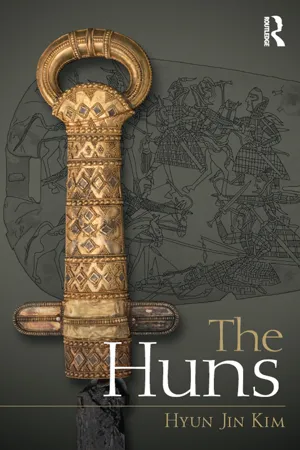
This volume is a concise introduction to the history and culture of the Huns. This ancient people had a famous reputation in Eurasian Late Antiquity. However, their history has often been evaluated as a footnote in the histories of the later Roman Empire and early Germanic peoples. Kim addresses this imbalance and challenges the commonly held assumption that the Huns were a savage people who contributed little to world history, examining striking geopolitical changes brought about by the Hunnic expansion over much of continental Eurasia and revealing the Huns' contribution to European, Iranian, Chinese and Indian civilization and statecraft. By examining Hunnic culture as a Eurasian whole, The Huns provides a full picture of their society which demonstrates that this was a complex group with a wide variety of ethnic and linguistic identities. Making available critical information from both primary and secondary sources regarding the Huns' Inner Asian origins, which would otherwise be largely unavailable to most English speaking students and Classical scholars, this is a crucial tool for those interested in the study of Eurasian Late Antiquity.
eBook - ePub
The Huns
1 THE XIONGNU HUN EMPIRE
POLITICAL ORGANIZATION OF THE XIONGNU HUNS
Any discussion on the Huns must first begin with the story of the mighty Xiongnu, the original Huns of Inner Asia. The Xiongnu (匈奴) Empire is in many cases called a ‘nomadic’ empire or confederacy. Actually, as we will see later on in this chapter, in the discussion on Xiongnu archaeology, it was in reality an agro-pastoralist society, not purely nomadic.1 It is hotly debated among scholars whether this ‘nomadic’ Xiongnu constituted a state or simply a super-complex tribal confederacy with imperial dimensions.2 Underlying this debate is the assumption among some scholars that ‘nomadism’ is an insurmountable barrier to organized statehood. However, as explained earlier in the introduction, ‘nomadism’ or rather pastoralism by no means implies a lack of fixed boundaries or less organizational capacity. The existence of well-defined territories and regular movements under an authoritative leader was essential for the survival of the ‘nomadic’ tribal community in a very fragile ecological environment.3 Therefore, we must first of all dismiss the erroneous preconception that ‘nomadism’ means political anarchy. What is not at all in dispute is the fact that the political organization of the Xiongnu provided an excellent model on which all subsequent steppe political entities built their ‘confederacies’ or ‘states’.4 Therefore, it is worthwhile to examine in some detail the political organization of the Xiongnu, which in all likelihood influenced also the later Hunnic political systems in Central Asia and Europe.
Much of the dispute regarding the nature of Xiongnu political organization arises from the differing understanding among scholars of what actually constitutes a ‘state’ and an ‘empire’. The Russian scholar Kradin has argued that a state should have the following characteristics:
1. access to managerial positions by a form of merit-based, extra-clan and non-kin-based selection;
2. regular taxation to pay wages to officials;
3. a special judicial power separate from political power;
4. a ‘class’ of state functionaries engaged in running a state machinery consisting of services for the administration of the whole political community.
Each of these criteria is obviously debatable and it is to be wondered whether this definition of the state is too modernist and not nearly as relevant to or appropriate in defining pre-early-modern states. However that may be, Kradin assumes that based on these criteria the Xiongnu achieved ‘statehood’, at best, merely at an ‘embryonic’ level and therefore should not be categorized as a state.5 A much looser and perhaps more appropriate definition of the state is provided by Krader, who argues that all steppe empires of Eurasia were actually state-level polities.6 However, for the sake of clarity it will be examined henceforth whether the Xiongnu by Kradin’s definition constituted a state or simply a complex chiefdom.
According to the Chinese source Shiji by the renowned historian Sima Qian (a historian of the Chinese Han dynasty (206 BC–220 AD)) the Xiongnu political system was a highly centralized ‘autocracy’, a complex hierarchy descending from the emperor (called Shanyu/Chanyu) to lesser kings and sub-kings. It was a structure that has been described as essentially ‘quasi-feudal’.7 Sima Qian writes:
Under the Shan-yü8 are the Wise Kings of the Left and Right, the left and right Lu-li kings, left and right generals, left and right commandants, left and right household administrators, and left and right Ku-tu marquises. The Hsiung-nu word for ‘wise’ is ‘t’u-ch’i’, so that the heir of the Shan-yü is customarily called the ‘T’u-ch’i King of the Left’. Among the other leaders, from the wise kings on down to the household administrators, the more important ones command ten thousand horsemen and the lesser ones several thousand, numbering twenty-four leaders in all, though all are known by the title ‘Ten Thousand Horsemen’. The high ministerial offices are hereditary, being filled from generation to generation by the members of the Hu-yen and Lan families, and in more recent times by the Hsü-pu family. These three families constitute the aristocracy of the nation. The kings and other leaders of the left live in the eastern sector, the region from Shang-ku east to the land of the Hui-mo and the Ch’ao-hsien peoples. The kings and leaders of the right live in the west, the area from Shang province west to the territories of the Yüeh-chi and Ch’iang tribes. The Shan-yü has his court in the region of Tai and Yün-chung. Each group has its own area, within which it moves about from place to place looking for water and pasture. The Left and Right Wise Kings and the Lu-li kings are the most powerful, while the Ku-tu marquises assist the Shan-yü in the administration of the nation. Each of the twenty-four leaders in turn appoint his own ‘chiefs of a thousand’, ‘chiefs of a hundred’, and ‘chiefs of ten’, as well as his subordinate kings, prime ministers, chief commandants, household administrators, chü-ch’ü officials and so forth.
(Shiji 110: 9b–10b)9
What this record shows is that the Xiongnu constructed their administrative system in the following way. The supreme power within the system lay with the emperor, the Shanyu (單于, also sometimes transliterated as Chanyu, but likely to have been pronounced dàn-wà, representing the Xiongnu word darγwa in Early Middle Chinese (ancient Chinese used during the Han dynasty and Late Antiquity)).10 The Shanyu was the recognized head of the central government. The actual administrative tasks within the central government, however, were handled by the so-called gu-du marquesses who also coordinated the affairs of the empire as a whole and managed communications with governors and vassals on behalf of the emperor.
Under the control of this central government were four principal, regional governorships in the east and west (also called the ‘horns’): the Worthy King of the Left and the Luli King of the Left in the east, and the Worthy King of the Right and the Luli King of the Right in the west. Each of these four governorships in turn had its own government bureaucracy11 and the kings, who were usually the sons or brothers of the reigning Shanyu/Chanyu (emperor), were the highest ranking aristocrats in the Xiongnu Empire. Incidentally the practice of four pre-eminent sub-kings ruling under a supreme king is also found among the later Volga Bulgars (Hunnic descendants who established a state in what is now roughly the Tatarstan Republic of the Russian Federation) and also among the Göktürks who succeed the Huns and the Rouran12 as masters of the eastern steppes.
When we combine Sima Qian’s information with the information we find in a later source the Hou Hanshu (recording the history of the second half of the Han dynasty; Sima Qian himself was active in the first half during the first century BC), we learn a little bit more about the upper tier of Xiongnu administrative hierarchy, that there was apparently also a supreme aristocratic council of six top ranking nobles. This council included the so-called ‘Rizhu kings’ of the Left and Right, which were titles originally only given to the sons and younger brothers of the Shanyu (Hou Hanshu 79. 2944). However, later as the Xiongnu political system evolved, these titles were transferred to the aristocratic Huyan clan, which was related to the royal family by marriage. The other four nobles making up the council were the Wenyuti kings of the Left and Right, and the Zhanjiang Kings of the Left and Right. The Hou Hanshu calls these Lords the six corners or horns. It has been suggested that this hierarchy and the political ranks of aristocratic and ruling clans may have changed somewhat between the time of Sima Qian (earlier Han period) and the later Han period (first–third century AD). By the time of the later Han dynasty the empire of the Xiongnu had splintered into two separate entities, the Northern and Southern Xiongnu. What the Hou Hanshu describes therefore (about the six horn nobles, etc.) may be a reference to political innovation among the Southern Xiongnu (who were allied to the Chinese) rather than the exact old Xiongnu system of governance. However, it is clear that these later developments, if they were of any significance, in any case derived from the political traditions of the original Xiongnu Empire or it may simply be that the Han Chinese had a better understanding of the Xiongnu political system by this time and elaborated on the original description of Xiongnu political organization left in the Shiji by Sima Qian.13
Below these ten top-ranking nobles (or including these ten) there were the 24 imperial leaders/ministers (each titled Ten Thousand Horsemen), who seem to have been the imperial governors of the key, major provinces of the Xiongnu Empire. These lords again consisted of the close relatives of the Shanyu/Chanyu or members of the Xiongnu aristocracy that were related to the royal house. These senior nobles were divided into eastern and western groups in a dual system and the designated successor to the Xiongnu imperial throne was usually appointed the Wise King of the Left, who was the titular ruler of the eastern half of the political unit. All political appointments were tightly controlled by the reigning emperor (the Shanyu) in order to strengthen the power of the central government vis-à-vis the provinces and the periphery.
At the bottom of this complex administrative hierarchy was a large group of subordinate or vassal tribal leaders (labelled in the Shiji sub-kings, prime ministers, chief commandants, household administrators, chü-ch’ü officials etc.). These officials were under the control of the 24 imperial governors, but at times enjoyed a level of local autonomy.14 Some former rulers of conquered peoples were also allowed to remain sub-kings/chiefs under appropriate Xiongnu oversight and over-kings. For the government of the more distant western parts of their territory the Xiongnu created the office curiously titled the ‘Commandant in charge of Slaves’, which under the overlordship of a Xiongnu sub-king had the power to tax minor states such as Karashar and Kalmagan (in what is now Xinjiang province in western China) and to conscript corvée labour. In addition certain Chinese defectors were also appointed sub-kings, e.g. Wei Lu as king of the Ding Ling people and Lu Wan as king of the Donghu people. However, the upper echelons of power and positions of political, administrative and military importance close to the Shanyu/Chanyu and key strategic areas were almost exclusively reserved for members of the imperial clan and a few select Xiongnu aristocratic families.
A non-decimal system of ranks was used for the political administration of tribes and territory within the empire during peacetime and these included groups of many different sizes. However, a tighter system of decimal ranks (thousands, hundreds, tens, etc.) was used in wartime when large-scale armies were formed from troops conscripted from different parts of the empire under a single command structure.15 A census was also taken to determine the empire’s reserve of manpower and livestock.16 Chinese sources report that Modu, the first pre-eminent Shanyu/Chanyu, had annexed some 26 states north and west of China and had reduced them all to complete obedience as constituent parts of the Xiongnu nation. In war the Shanyu could reputedly mobilize an army of 140,000 men from among his subjects.17
What all this shows is that Kradin’s reluctance to define the Xiongnu as a state is quite unwarranted. As Di Cosmo points out the Xiongnu Empire even by Kradin’s rigid definition was much more similar to a well-organized state than a loosely controlled chiefdom. The Xiongnu administration possessed distinct military and civilian apparatuses separate from kin-based hierarchies. Top commanders and functionaries received their wages (in various forms) from a political centre headed by the Xiongnu emperor (Shanyu/Chanyu), who was also in charge of ceremonies and rituals that were meant to include the entire political community, not just his kin group. The incredibly complex organization of Xiongnu armies, its imperial rituals, government structure and politically centralized functions of trade and diplomacy all bear witness to what Di Cosmo calls a political machinery and supratribal, imperial ideology.18 Kradin himself concedes that special judicial manpower (i.e. judges) was also available in the Xiongnu Empire and that there were special state functionaries (gu-du marquesses) who assisted the emperor in the overall administration of the empire.19 Therefore, the Xiongnu Empire can in all probability be defined as a state or an ‘early state’ entity.20
Also, there can be absolutely no doubt at all that the Xiongnu constituted an empire,
a political formation that extended far beyond its original territorial or ethnic confines and embraced, by direct conquest or by the imposition of its political authority, a variety of peoples and lands that may have had different types of relations with the imperial center, constituted by an imperial clan and by its charismatic leader.21
On this point the vast majority of Xiongnu experts, including Kradin are in full agreement.
Another important aspect of Xiongnu political organization is the degree to which the Xiongnu absorbed and adapted neighbouring Chinese practices with regard to their state organization and administration. The putative Chinese influence on the Xiongnu is rejected by some scholars who see the resemblances and similarities between Xiongnu and Chinese administr...
Table of contents
- Cover
- Half Title
- Title Page
- Copyright Page
- Table of Contents
- List of figures
- List of maps
- List of tables
- Acknowledgements
- INTRODUCTION
- 1 THE XIONGNU HUN EMPIRE
- 2 THE SO-CALLED ‘TWO-HUNDRED YEARS INTERLUDE’
- 3 THE HUNS OF CENTRAL ASIA AND SOUTH ASIA: THE KIDARITE AND HEPHTHALITE WHITE HUNS
- 4 THE HUNS OF EUROPE
- 5 ATTILA THE HUN
- 6 THE HUNS AFTER ATTILA
- 7 THE HUNS OF THE PONTIC STEPPES: THE UTIGUR-KUTRIGUR ‘BULGAR’ HUNS
- 8 THE LEGACY OF THE HUNS
- CONCLUSION
- Select bibliography
- Index
Trusted by 375,005 students
Access to over 1.5 million titles for a fair monthly price.
Study more efficiently using our study tools.
Frequently asked questions
Yes, you can cancel anytime from the Subscription tab in your account settings on the Perlego website. Your subscription will stay active until the end of your current billing period. Learn how to cancel your subscription
No, books cannot be downloaded as external files, such as PDFs, for use outside of Perlego. However, you can download books within the Perlego app for offline reading on mobile or tablet. Learn how to download books offline
Perlego offers two plans: Essential and Complete
- Essential is ideal for learners and professionals who enjoy exploring a wide range of subjects. Access the Essential Library with 800,000+ trusted titles and best-sellers across business, personal growth, and the humanities. Includes unlimited reading time and Standard Read Aloud voice.
- Complete: Perfect for advanced learners and researchers needing full, unrestricted access. Unlock 1.5M+ books across hundreds of subjects, including academic and specialized titles. The Complete Plan also includes advanced features like Premium Read Aloud and Research Assistant.
We are an online textbook subscription service, where you can get access to an entire online library for less than the price of a single book per month. With over 1.5 million books across 990+ topics, we’ve got you covered! Learn about our mission
Look out for the read-aloud symbol on your next book to see if you can listen to it. The read-aloud tool reads text aloud for you, highlighting the text as it is being read. You can pause it, speed it up and slow it down. Learn more about Read Aloud
Yes! You can use the Perlego app on both iOS and Android devices to read anytime, anywhere — even offline. Perfect for commutes or when you’re on the go.
Please note we cannot support devices running on iOS 13 and Android 7 or earlier. Learn more about using the app
Please note we cannot support devices running on iOS 13 and Android 7 or earlier. Learn more about using the app
Yes, you can access The Huns by Hyun Jin Kim in PDF and/or ePUB format, as well as other popular books in History & Ancient History. We have over 1.5 million books available in our catalogue for you to explore.