![]()
Part I
What is Catalan?
![]()
Chapter 1
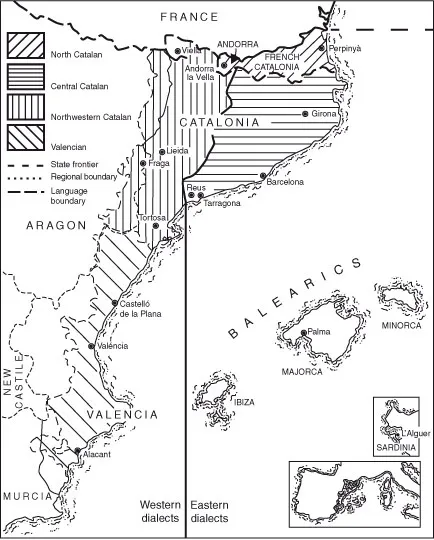
Catalan-speaking areas
Catalan is spoken in the eastern part of the Iberian peninsula (Catalonia, Valencia, a small part of Aragon close to the Catalan border, and a much smaller part of the Murcia region close to the Valencian border), in the Balearic Islands, in a region between the two eastern branches of the Pyrenees (Albera and Corbera Massifs) normally called ‘Northern Catalonia’, in Andorra, and the city of Alghero in Sardinia. This distribution includes four states (Spain, France, Andorra, and Italy), and a different status in every state and region. Catalan is the only official language in Andorra according to its constitution, and it is co-official with Spanish in the autonomous regions of Catalonia, Valencia, and the Balearic Islands in Spain. It is also a protected language according to the Law of Cultural Heritage (2016) of the autonomous region of Aragon, due to its presence in the most eastern part of this region, known as ‘La Franja’ (‘The Strip’). Co-officiality in Catalonia, Valencia, and the Balearics is unbalanced. According to the Spanish constitution, all citizens must know Spanish; according to the regional constitutions, citizens also have the right to use Catalan (also called Valencian – the Spanish High Court recognises Valencian and Catalan as two different names for the same language). In 2006, the new Catalan autonomy statute (effectively the constitution for the region) made knowing Catalan a legal requirement, but this was dismissed in 2010 by the Spanish Constitutional Court, leading to the current institutional crisis (as we write in 2016) and giving new impetus to the Catalan independentist movement.
Map of the Catalan-speaking areas and dialects
![]()
Chapter 2
Catalan among the other Romance languages
The Catalan language has been shaped by the region’s history, and each stage has left a mark on the modern language: there are the pre-Roman languages surviving the Roman invasion of 218 BC, such as Basque and Iberian, especially in the North-West (Pallars, Ribagorça, and Vall d’Aran escaped initial Romanisation); there is the Germanic invasion in 415 which led to the establishment of the kingdom of Toulouse (Tolosa by its Occitan name); then the Arabic invasion after 711 which affected in various degrees the whole of the mainland Catalan-speaking territories and the Balearics, and north of the Pyrenees reached the Roussillon, occupying that northern territory for 40 years (719–759). As a reaction, the Franks fought back, reaching Barcelona (801). Frankish counties were established over half of present-day Catalonia and Northern Catalonia. These counties were eventually unified, and the Catalans enlarged their territories by annexing the Arabic kingdoms of Tortosa and Lleida, a process complete in the 12th century. In the following century, the Balearics and Valencia followed. In the 14th century (1354), Alghero was populated with Catalans after a victory over Genoa.
All this contact together with the influence of indigenous peoples in the territories where Catalan is spoken gives the language its particular shape among all of the other Romance languages. Occitan is its closest relative. Indeed, Catalan troubadours used Occitan for their work up to the 15th century. However, Occitan poetry in Catalonia was seen as a courtly activity, detached from real language, and thus requiring constant attention to preceptive books on poetics. Vocabulary in non-literary works shows the influence of a language already different from Latin by the 10th century. The first texts in Catalan appeared in the 12th century, such as the Llibre jutge, a translation in vulgar language of a Visigothic law code. Also in the late 12th or early 13th century, the Homilies d’Organyà was written, a fully developed text in Catalan, probably used as a help for delivering sermons in the vulgar language. The 13th century is undoubtedly the century of Ramon Llull (Majorca, 1232–1315), who wrote novels, philosophy, and theology works in Catalan. It is also the century when historiographic texts in the language began, with books translated from Latin (De rebus Hispaniae, 1268; Gesta comitum Barcinonensium, 1267–1283) and others written in Catalan (Llibre dels fets, 1274; Crònica de Bernat Desclot, 1288). In the 15th century, Ausiàs March opened new paths for poetry, in Catalan and bridging the troubadour tradition and new, Renaissance verse.
Catalan maintained its role as a full national language even after the Aragonese and Castilian crowns united under Isabella of Castile and Ferdinand II of Aragon. Ferdinand himself was of Castilian origin, after the last king of Aragon belonging to the House of Barcelona, Martin, died without an heir in 1410, and Ferdinand I, grandfather to Ferdinand II, was elected king. The decline of Catalan as a national language began in 1659 in Northern Catalonia when under the Treaty of the Pyrenees the territory was annexed by France. South of the Pyrenees, the decline began after defeat in the War of Succession (1715), when the Spanish crown was consolidated and the laws and customs of Castile were progressively imposed on Catalan territories. Even so, Catalan remained the only language of everyday (albeit non-official) usage until the arrival of mass internal migration from Spanish-speaking territories in the second half of the 20th century.
After 1834, a strong movement to recover the Catalan language took hold in literature and other artistic fields, leading to the restoration of Catalan identity, and to the modern standardisation of the language. Antoni Maria Alcover (1862–1932) and Pompeu Fabra (1868–1948) are the two main linguists who worked to recover and restore the language. In 1911 the Philological Section of Institut d’Estudis Catalans was founded as the language academy of Catalan. This institution is in charge of the official dictionary and grammar of the language, and it also issues surveys and other research matters on the use of Catalan.
In recent times, the greatest obstacle to normalising Catalan has been Franco’s dictatorship (1936/1939–1975). After the transition of Spain to democracy, Catalan-speaking territories under Spanish control have recovered official use of the language, and this is explored below.
![]()
Chapter 3
Catalan in the twenty-first century
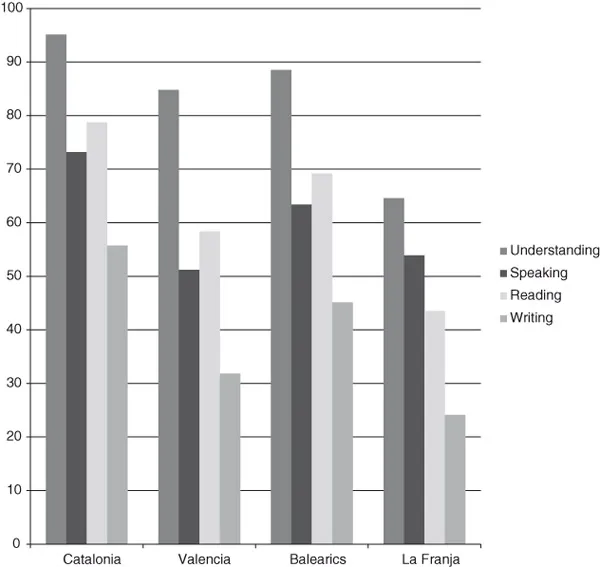
According to the latest official reports (2013–2014) on language skills in the main speaking areas (data from the 2011 official census in Catalonia, Valencia, the Balearics, and the Aragonese Catalan-speaking area, known as ‘La Franja’), knowledge of Catalan is as follows1 (Graph 1.1), with precise figures in the following table:
Graph 1.1 Percentage of inhabitants who can understand, speak, read and write Catalan, by geographic area
| Catalonia | Valencia | Balearics | La Franja |
Understanding | 95.1 | 84.8 | 88.5 | 64.6 |
Speaking | 73.2 | 51.2 | 63.4 | 53.9 |
Reading | 78.7 | 58.4 | 69.2 | 43.5 |
Writing | 55.7 | 31.8 | 45.1 | 24.1 |
The population of all the Catalan-speaking areas reached 13,497,830 inhabitants in 2013, distributed by territories2 as:
Catalonia | 7,509,000 |
Valencia | 4,252,000 |
Balearics | 1,103,000 |
Northern Catalonia | 465,000 |
Andorra | 76,950 |
La Franja | 47,630 |
Alghero | 43,510 |
El Carxe (in Murcia) | 740 |
Learning Catalan in primary and secondary education is compulsory in Catalonia, Valencia, the Balearics, and Andorra, and possible in the rest of territories (except in the tiny area of El Carxe, Murcia). Catalan can be studied to degree level in the universities of these three main territories, and in the University of Perpinyà (Perpignan), in Northern Catalonia.
5,966 books and pamphlets were published in Catalan in Spain in 2014, making 27.15% of the total production in Catalonia, Valencia, and the Balearics (5,381 out of 19,818). 54 were published in Aragon and 531 in other parts of Spain: