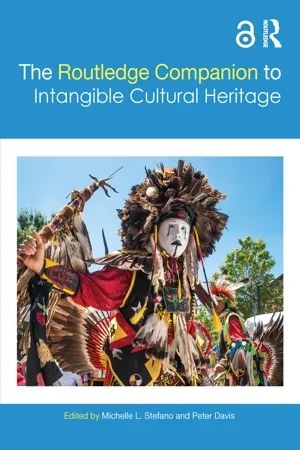
This collection provides an in-depth and up-to-date examination of the concept of Intangible Cultural Heritage and the issues surrounding its value to society. Critically engaging with the UNESCO 2003 Convention for the Safeguarding of the Intangible Cultural Heritage, the book also discusses local-level conceptualizations of living cultural traditions, practices and expressions, and reflects on the efforts that seek to safeguard them. Exploring a global range of case studies, the book considers the diverse perspectives currently involved with intangible cultural heritage and presents a rich picture of the geographic, socioeconomic and political contexts impacting research in this area. With contributions from established and emerging scholars, public servants, professionals, students and community members, this volume is also deeply enhanced by an interdisciplinary approach which draws on the theories and practices of heritage and museum studies, anthropology, folklore studies, ethnomusicology, and the study of cultural policy and related law. The Routledge Companion to Intangible Cultural Heritage undoubtedly broadens the international heritage discourse and is an invaluable learning tool for instructors, students and practitioners in the field.
eBook - ePub
The Routledge Companion to Intangible Cultural Heritage
- 502 pages
- English
- ePUB (mobile friendly)
- Available on iOS & Android
eBook - ePub
The Routledge Companion to Intangible Cultural Heritage
About this book
Information
PART I
A decade later
CRITICAL REFLECTIONS ON THE UNESCOICH PARADIGM
1
DEVELOPMENT OF UNESCO’S 2003 CONVENTION
Creating a new heritage protection paradigm?
Introduction
It is possible to assert that the 2003 Convention has created a ‘new paradigm’ in heritage protection. In many ways this is true in terms of policy- and law-making at the international level and, through a trickle-down effect, on national approaches towards heritage and heritage communities. At the same time, it should be recognized that safeguarding ICH1 has, in reality, been an important issue for the large majority of countries and people around the globe long before the 2003 Convention was adopted.2 The ‘problem’ of ICH that the international community sought to address through UNESCO in the late 1990s, leading to the adoption of the 2003 Convention, was, in large part, a lack of formal international recognition having hitherto been shown to this reality. Up until that moment, the cultural heritage protection paradigm was one that prioritized monumental ‘European’ cultural forms over local and Indigenous ones and that, when it addressed ‘traditional culture’, did so from a position that favored the interests of the research community over those of culture bearers (Blake, 2001).
Indeed, the success of this Convention since 2003 in securing ratifications3 is testament to the fact that it was answering a present need of many Member States of UNESCO and one that responded well to some of the international policy priorities that were strongly felt at that time and continue to be today. In particular, the experience of countries that are Parties to the 2003 Convention demonstrates clearly that, for many of them, ICH in its diverse forms is a rich social, economic and even political resource that provides a variety of possible routes towards sustainable models of development. The variety of manifestations of ICH – both intangible and associated material elements – is itself determined by a number of social, cultural, economic, political and environmental factors. In this way, ICH is also seen to make a particularly significant contribution to the value of cultural diversity that had been recently recognized in the 2001 UNESCO Universal Declaration on Cultural Diversity, including its important human rights dimensions (UNESCO, 2001a).
This wider context within which the 2003 Convention was developed is therefore essential not only to understanding why it took the form that it did, but also to interpreting the way in which it caught the international mood of the time, and contributed towards a paradigm shift that was occurring not only in the field of cultural heritage, but also in related fields of development, human rights, environmental protection and intellectual property protection. In the following section, therefore, I wish to draw out some of the main lines of these evolutions of international cultural policy and law, demonstrating the growing recognition of the power and value of this aspect of heritage. Following that, I will attempt to show how the 2003 Convention has reflected and continues to reflect these trends, as well as what our experience of its implementation, since its enforcement in April 2006, has shown us about these and other key questions.
The international policy context
First, I consider developments in international policy-making from the 1970s to the 1990s that can be regarded as milestones leading up to the preparation and adoption of the 2003 Convention. These can also be tracked through the experience of the early years of its implementation as is described in more detail in a following section. In terms of development, up until the 1970s, this had generally been conceived of in terms of a purely economic phenomenon in which GDP growth was the primary, if not the sole, indicator of success (Arizpe, 2004, 2007). In this dominant model of development, culture was often viewed as a brake on development, with the ‘traditional cultures’ of the less-developed countries being especially poorly regarded (Douglas, 2004) by the Bretton Woods Institutions4 and other lending bodies. The earliest challenges to this economic model – that was being imposed by mostly external lending institutions on less developed countries – came from countries of Africa and Latin America that experienced an intellectual shift towards the notion of ‘endogenous development’ in which local and ethnic cultures (and languages) were given greater value (Arizpe, 2007). Significantly, in this approach, culture was substituted for the economy in the development model and traditional ways of life were emphasized.
The World Conference on Cultural Policies (MONDIACULT), held in Mexico in 1982, articulated for the first time on the international stage a view of culture as a broad notion that went beyond the material culture of archaeological remains or high, artistic cultural productions to one that embraced ways of life, social organization and value/belief systems, as well. In defining ‘culture’ it also, importantly, linked this with the idea of cultural identity:
[‘Culture’ is] the whole complex of distinctive spiritual, material, intellectual and emotional features that characterize a society or social group. It includes not only the arts and letters, but also modes of life, the fundamental rights of the human being, value systems, traditions and beliefs.(UNESCO, 1982, Preamble)
It is really quite striking to see how closely the definition of ICH in the 2003 Convention drew on the overall approach taken by the MONDIACULT meeting over 30 years previously. In Article 2, ICH is defined for the purposes of the 2003 Convention as meaning:
[T]he practices, representations, expressions, knowledge, skills – as well as the instruments, objects, artefacts and cultural spaces associated therewith – that communities, groups and, in some cases, individuals recognize as part of their cultural heritage. This intangible cultural heritage, transmitted from generation to generation, is constantly recreated by communities and groups in response to their environment, their interaction with nature and their history, and provides them with a sense of identity and continuity.(UNESCO, 2003)
Moving forward in time, the early to mid-1990s also provided a moment at which important new thinking occurred in international development theory. At this time, we observe first the evolution of the fundamentally important notion of human development, which was formulated initially by the Nobel Prize-winning economist Amartya Sen (Sen, 1999; UNDP, 1994; UNESCO, 2000). This approach was adopted by the United Nations Development Programme (UNDP) for its Human Development Reports series from 1990 and, crucially, brings much closer together the idea of development with human rights (UNESCO, 2000). At around the same time, the concept of sustainable development was also being developed, first articulated by the World Commission on Environment and Development in its Report (WCED, 1987, Chapter 2) as ‘development that meets the needs of the present without compromising the ability of future generations to meet their own needs’. This concept was, of course, further refined, elaborated and given formal international endorsement in 1992 in the Rio Declaration (UNCED, 1992; Boyle and Freestone, 1999), mentioned later.
In 1995, the World Commission on Culture and Development, which had been established by UNESCO, reported and stressed both the role of culture as a constituent element in the development process rather than the contingent one it was often thought to be, as well as the key part played by ICH in this (WCCD, 1995). Another key document in this area was the Action Plan on Cultural Policies for Development (UNESCO, 1998), which recognized in its first Principle that, ‘[s]ustainable development and the flourishing of culture are interdependent’, and then led to the formulation of its first objective as seeking to ‘make cultural policy one of the key components of development strategy’, including the requirement to ‘[d]esign and establish cultural policies or review existing ones in such a way that they become one of the key components of endogenous and sustainable development’. With regard to cultural heritage, Objective 3 calls on Member States to ‘[r]einforce policy and practice to safeguard and enhance the cultural heritage, tangible and intangible, moveable and immovable, and to promote cultural industries’, and this would include renewing the traditional conception of heritage as including ‘all natural and cultural elements, tangible or intangible, which are inherited or newly created. Through these elements social groups recognize their identity and commit themselves to pass it on to future generations in a better and enriched form’ (UNESCO, 1998). Hence, the connection is made explicitly here between heritage as a holistic concept, the interaction between cultural and natural elements of heritage, the imperative to safeguard it and pass it on to future generations (possibly in an enhanced condition) and the role of heritage in the formation of group identity.
More recently, UNESCO has been working to place this role of culture in development back onto the international agenda, especially in recognition of the fact that the Millennium Development Goals (MDGs) (UN, 2000) failed to include any explicit cultural goal (despite the fact that those relating to education, in particular, and health, more tangentially, clearly contain important cultural components) (Alston, 2005; Alston and Robinson, 2005). UNESCO’s involvement in the Millennium Development Goals Achievement Fund (MDG-F) initiative has been one of the ways in which it has attempted to make the role of culture more prominent in international development policy-making. Established in December 2006 by the UN (with a contribution of 710 million USD from the Spanish Government), the MDG-F was designed as a mechanism for international cooperation to facilitate achievement of the MDGs worldwide through supporting national governments, local authorities and civil society organizations in eight ‘Thematic Windows’, one of which was in the area of culture and development, with UNESCO playing the leading role. The main purpose of the Culture and Development Thematic Window was to demonstrate, although not explicitly mentioned in the MDGs, that culture and cultural resources are essential for national development, particularly in relation to alleviating poverty and ensuring social inclusion?(UN, 2006).
Among the aforementioned shifts in the international development paradigm, the adoption of the 1992 Rio Declaration was without doubt the most far-reaching at the time and one that has had the most lasting effect up until now. Among other points, it reflected the fact that the value of local and Indigenous cultures and their heritage were becoming increasingly recognized within wider society as a resource for its overall development.5 With the adoption of the Rio Declaration, not only was sustainable development first given universal international endorsement, but one of the three ‘pillars’ of sustainable development was also understood to be a sociocultural one, operating alongside the two central economic and environmental ones. In its Preamble, the 2003 Convention refers to ‘the importance of the intangible cultural heritage as a mainspring of cultural diversity and a guarantee of sustainable development’, but fails to elaborate on what this means either in terms of principle or practice. As we shall see later, several Parties have now started to elaborate cultural and development policies in which this role of ICH is becoming more clearly defined; although, this remains a ‘work-in-progress’ and it is too early to establish in very explicit terms what policy and other instruments are needed for governments to ensure and maximize this important potential of ICH.
Indeed, following the adoption of the 2003 Convention and the Convention on the Protection and Promotion of the Diversity of Cultural Expressions in 2005 (UNESCO, 2005a), UNESCO began to consider more deeply the relationship between cultural heritage, creativity and sustainability of development. It should be remembered that both of these treaties make explicit reference to the role played by cultural heritage and cultural goods and services in sustainable development; with regard to ICH, the 2003 Convention notes its importance:
[A]s a mainspring of cultural diversity and a guarantee of sustainable development, as underscored in & the UNESCO Universal Declaration on Cultural Diversity of 2001, and in the Istanbul Declaration of 2002 adopted by the Third Round Table of Ministers of Culture.(UNESCO, 2003, Preamble)
An internal UNESCO evaluation of the 2003 Convention undertaken in 2013 offered two recommendations (Recommendations 3 and 5) specifically referring to how sustainable development as an objective can be better incorporated into the Convention’s operation to: ‘[e]nhace cooperation with sustainable development experts for integrating ICH into non-cultural legislation and policy, and for other work related to ICH and sustainable development’; and ‘[c]ooperate with sustainable development experts when supporting State Parties with the integration of ICH into non-cultural legislation and policy, and with other work related to ICH and sustainable development’ (Torggler and Sediakina-Rivière, 2013, pp. 30–31). In response, the Intangible Cultural Heritage Committee (hereafter ICH Committee) that was established under Article 5 of the 2003 Convention adopted a decision at its ninth meeting in Paris in November 2014 to achieve this purpose (UNESCO, 2014). This movement not only reflects the desire of UNESCO to make the cultural aspects of sustainable development more prominent in the international agenda, but also the need for a more profound and developed appreciation of what this means in reality for safeguarding ICH. This latter point is well made in the aforementioned UNESCO evaluation which noted that:
[W]hile people involved in the Convention generally agreed that the link [with sustainable development] was important, clarifying the nature of this link, identifying the potential that these linkages hold both for sustainable development on one hand and for the viability of ICH on the other, identifying the potential risks that development, if not sustainable, holds for ICH, etc. were still very much a work in progress.(Torggler and Sediakina-Rivière, 2013, p. 22)
The 2005 Convention goes even further by including in its purposes the objective to ‘reaffirm the importance of the link between culture and development for all countries, particularly for developing countries, and to support actions undertaken nationally and internationally to secure recognition of the true value of this link’, as well as including sustainable development as one of its foundational principles (UNESCO, 2005a, ...
Table of contents
- Cover
- Half Title
- Title Page
- Copyright Page
- Table of Contents
- List of figures and tables
- Notes on contributors
- Acknowledgements
- Common abbreviations
- Introduction
- Part I A decade later: critical reflections on the UNESCO-ICH paradigm
- Part II Reality check: the challenges facing intangible cultural heritage and its safeguarding
- Part III Intangible cultural heritage up close
- Part IV Intangible cultural heritage and place
- Part V Intangible cultural heritage, museums and archives
- Part VI Alternative approaches to safeguarding and promoting intangible cultural heritage
- Index
Trusted by 375,005 students
Access to over 1.5 million titles for a fair monthly price.
Study more efficiently using our study tools.
Frequently asked questions
Yes, you can cancel anytime from the Subscription tab in your account settings on the Perlego website. Your subscription will stay active until the end of your current billing period. Learn how to cancel your subscription
No, books cannot be downloaded as external files, such as PDFs, for use outside of Perlego. However, you can download books within the Perlego app for offline reading on mobile or tablet. Learn how to download books offline
Perlego offers two plans: Essential and Complete
- Essential is ideal for learners and professionals who enjoy exploring a wide range of subjects. Access the Essential Library with 800,000+ trusted titles and best-sellers across business, personal growth, and the humanities. Includes unlimited reading time and Standard Read Aloud voice.
- Complete: Perfect for advanced learners and researchers needing full, unrestricted access. Unlock 1.5M+ books across hundreds of subjects, including academic and specialized titles. The Complete Plan also includes advanced features like Premium Read Aloud and Research Assistant.
We are an online textbook subscription service, where you can get access to an entire online library for less than the price of a single book per month. With over 1.5 million books across 990+ topics, we’ve got you covered! Learn about our mission
Look out for the read-aloud symbol on your next book to see if you can listen to it. The read-aloud tool reads text aloud for you, highlighting the text as it is being read. You can pause it, speed it up and slow it down. Learn more about Read Aloud
Yes! You can use the Perlego app on both iOS and Android devices to read anytime, anywhere — even offline. Perfect for commutes or when you’re on the go.
Please note we cannot support devices running on iOS 13 and Android 7 or earlier. Learn more about using the app
Please note we cannot support devices running on iOS 13 and Android 7 or earlier. Learn more about using the app
Yes, you can access The Routledge Companion to Intangible Cultural Heritage by Michelle Stefano, Peter Davis, Michelle Stefano,Peter Davis, Michelle L. Stefano, Peter Davis in PDF and/or ePUB format, as well as other popular books in Social Sciences & Museum Studies. We have over 1.5 million books available in our catalogue for you to explore.