Understanding tourism
Humans have always traveled. In the earliest civilizations, people journeyed to secure vital resources, such as food and water, and to trade with other civilizations. Travel as a form of recreation or for cultural experiences was also a pursuit of early individuals. The first known travel guide was written by Pausanias in 170 AD for Roman visitors traveling in his home country of Greece. Yet it is only recently that travel has become a worldwide phenomenon. Ease of travel is directly related to technology; as different modes of transportation developed, so too did the ability to tour. Wind-powered boats were replaced by horse-drawn stagecoaches, which in turn have been superseded by motorized vehicles such as automobiles, cruise liners, and airplanes. As travel times shortened and travel became less costly, tourism became a reality for more than just the upper classes. Today, travel is fairly efficient and most of the world—even Antarctica—is accessible to large numbers of people.
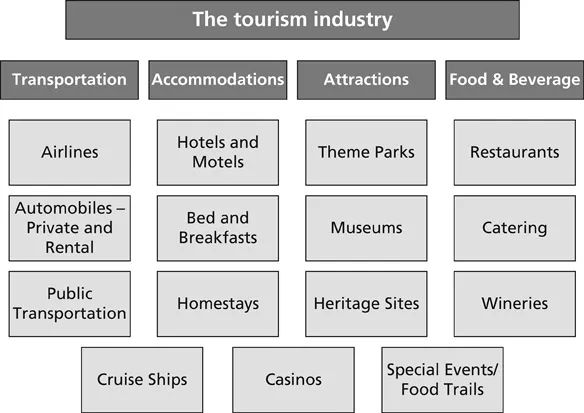
Tourism has a variety of definitions, but in its simplest form, tourism is an economic endeavor. Therefore, the most common definition of tourism is “the temporary movement of people to destinations outside their normal places of work and residence, the activities undertaken during their stay in those destinations, and the facilities created to cater to their needs” (Mathieson & Wall, 1982, p. 1). As an economic venture, tourism consists of a number of industries that develop and promote the travel experience, such as airlines and hotels. Tourism involves numerous types of service activities and physical commodities (see Figure 1.1).
Figure 1.1 The tourism industry
Tourism can also be defined from the tourist’s perspective, emphasizing the experiential nature of visiting foreign or exotic places. The United Nations World Tourism Organization (UNWTO) (2014) defines tourism as “a social, cultural, and economic phenomenon” (p. 1) that begins long before any actual travel occurs and extends long after the trip has been completed. Excitement builds as travelers plan their trip, usually focused around a particular interest or activity, such as skiing, sunbathing, or exploring a natural area or a specific culture. Travelers frequently choose their destination based on many factors, such as recommendations from family and friends, marketing materials available on the Internet, or guidebooks. Most tourism purchases occur before the trip even starts, including transportation, tour packages, and accommodations. Tourists also purchase many items while they are traveling, including food, souvenirs, and gasoline. After the trip is complete, tourists often share their experiences through stories, photos, and mementos. The pre-and post-travel experiences are as much a part of tourism as is the actual trip.
There is still much debate about the difference between tourism and leisure activities. Some definitions of tourism require visitors to be a certain distance away from home (usually more than 150 miles or 240 kilometers) or require them to spend the night away from home in order to be strictly classified as tourists. Other definitions recognize day trippers, or excursionists, as tourists. Excursionists are generally classified as visitors who use tourism services but live in close proximity to the destination and only stay for a short period of time (a few hours to a single day). Regardless of the type of traveler included in the definition, the experience is often the same. For example, a farm-based enterprise, such as a farm shop, may have customers who are local residents, people from nearby communities, and travelers from far-away countries. For the purposes of this book, both nearby and distant visitors can be classified as tourists. Much of the practical information in this book can be used regardless of whether tourists are local, domestic, or international.
Tourism is often classified as the world’s largest industry, with an estimated 1 billion travelers generating US$1.4 trillion in direct spending worldwide in 2013 (UNWTO, 2014). This translates to US$2.3 trillion in economic impact and 292 million jobs, which accounts for 1 in 10 jobs in the global workforce (World Travel and Tourism Council, 2017). However, tourism is not a standalone economic industry but is made up of numerous economic sectors such as accommodations, transportation, food and beverage, and attractions, just to name a few. These economic components of tourism are explained later in this chapter.
Understanding agriculture
Agriculture is the world’s oldest industry, and humans began domesticating flora and fauna for human consumption approximately 15,000 years ago. Evidence of trade networks among pre-agricultural ancient civilizations is even older. As particular foods thrive in different climates, trade in food quickly spanned the globe. The most extensive trade route in historical times was the Silk Road, over which exotic spices, among other goods, traveled from China, India, and the Far East to the tables of Northern Africa and Europe.
Agriculture is defined as the science or practice of farming and ranching, including cultivating the soil for growing crops and the rearing of animals to provide food and other products. Agriculture is practiced in every country in the world. Trade in agricultural merchandise represented US$8.0 trillion in 2014 worldwide, representing 10% of the world’s gross domestic product (Food and Agriculture Organization of the United Nations, 2016). China is currently the world’s largest agricultural producer, followed by India and the United States.
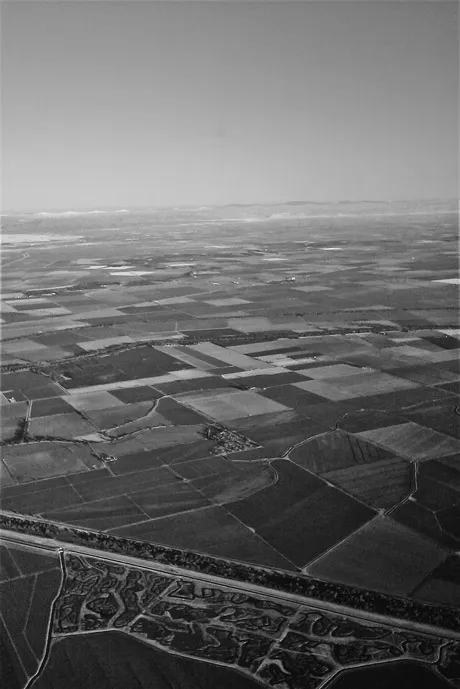
The global food trade is still a vital component of regional economies. Even today, certain areas—particularly those with lower wages or higher crop yields—specialize in agricultural production, which is often traded with other countries. Globalized food chains are discussed in more detail in Chapter 4. For example, California generated US$54 billion in agricultural production in 2014 and exported almost US$22 billion of that (California Assembly Committee on Jobs, Economic Development, and the Economy, 2014). These food items—including milk, fruits and tree nuts (almonds), and livestock—were sent
Image 1.1 Agriculture as viewed from an airplane outside Sacramento, California, USA
mainly to the European Union, Canada, China, Hong Kong, Japan, and Mexico (California Department of Food and Agriculture, 2014). In the same year, California imported US$10.8 billion worth of agricultural products from Mexico, China, Vietnam, and Chile including coffee, tropical fruits (bananas), and preserved meats (California Assembly Committee on Jobs, Economic Development, and the Economy, 2014).
However, globalized food chains have created challenges for both consumers and producers. Food that travels long distances must be picked before it is ripe to prevent spoilage in transport, so it is treated with preservatives and ripening agents. One such ripening agent, calcium carbide, has been associated with mood disturbances, mental confusion, seizures, and hypoxia in humans (Asif, 2012). Additionally, outbreaks of food-borne illnesses—such as salmonella, listeria, and E. coli—have increased consumers’ interest in knowing the geographic origins of their food. Food safety is covered in detail in Chapter 11.
Agricultural producers also face numerous challenges such as decreasing commodity prices, increasing operational costs, and fluctuating consumer demand in a global food market. Furthermore, increased regulation associated with food safety and crop insurance have created additional burdens on the profitability of small farms. Consider where the money goes when a cereal grain (such as rice, wheat, or corn) is purchased (see Figure 1.2). A majority of the revenue generated by the sale goes to retail profit, food processing, and wholesale; only 7.4% of the retail price goes to the farmer. For a loaf of bread that costs $5, farmers receive only $0.37. At the same time, farmers are experiencing rising costs for production inputs such as fuel, wages, water, and fertilizer....