In recent years there have been tremendous advances in understanding how brain development underlies behavioural changes in adolescence. Based on the latest discoveries in the research field, Eveline A. Crone examines changes in learning, emotions, face processing and social relationships in relation to brain maturation, across the fascinating period of adolescent development.
This book covers new insights from brain research that help us to understand what happens when children turn into adolescents and then into young adults. Why do they show increases in sensation-seeking, risk-taking and sensitivity to opinions of friends? With the arrival of neuroimaging techniques, it is now possible to unravel what goes on in an individual's brain when completing cognitive tasks, when playing computer games, or when engaging in online social interactions. These findings help reveal how children learn, control thoughts and actions, plan activities, control emotions and think about intentions of others, offering a new perspective on behaviour and motivations of adolescents.
This is the first comprehensive book to cover the many domains of adolescent brain development, stretching from cognitive to affective to social development. It is valuable reading for students and researchers in the field of adolescent development and developmental cognitive neuroscience and those interested in how the developing brain affects behaviour in the teenage years.
Why do adolescents always wake up so late? Why don’t they plan their homework better? Why do they drive fast on motorcycles without helmets, or ride their skateboards on dangerous roads? Why do they come home much later than what they agreed upon with their parents when leaving the house? Why do they chat for hours with their friends on the phone or online, but don’t take time to discuss their daily activities with their parents?
These are some of the many questions that parents and teachers wonder about when children grow up. For many parents it remains a mystery what goes on in their child’s brain when entering adolescence; a new time period between childhood and adulthood and a natural time for exploration and trying new things.
This book will cover new insights from brain research that help us to understand what happens when children turn into adolescents, and from adolescents into young adults. With the arrival of neuroimaging techniques, it is now possible to unravel what goes on in an individual’s brain when completing cognitive tasks, when playing computer games or when engaging in online social interactions. These findings inform us how children learn, control thoughts and actions, plan activities, control emotions and think about intentions of others. These findings offer a new perspective on behaviour and motivations of adolescents.
Neuroscience has taken large steps in the last decades, which has been a great source of new information that was not available 25 years ago. Methods have improved considerably in the last years, and studies have been developed with more targeted hypotheses and participant selections. At the same time, we need to be cautious not to take neuroscience findings as the golden standard too quickly, for example when the findings are quickly implemented in educational settings without a well-performed validation. In this book, I will present the newest findings in research on adolescent neuroscience with a broad focus on the different aspects that are important for cognitive, social and emotional development in adolescence.
What is adolescence?
Adolescence can be best described as the transition phase between childhood and adulthood. The word ‘adolescence’ comes from the Latin word adolescere, which means growing up. The age range for the start and the end of adolescence differs by culture, but generally it is agreed upon that adolescence is the period between ages 10 and 22 years (Steinberg, 2008).
Around 1900 the famous psychologist Stanley Hall described adolescence as a period of Storm and Stress (after the German Sturm und Drang movements) (Hall, 1904). According to Hall, there were three important aspects that characterized adolescence: conflicts with parents, mood swings and risky behaviour. This view of adolescence has for a long time been highly influential, and underscored that adolescence is a developmental period with its own problems and possibilities. Hall made a strong case for adapting the school requirements to the developmental phase of the adolescent, but it was not accepted at that time. Later, the idea of Storm and Stress was adapted, because it was documented that not all adolescents experience difficulties. Not all adolescents have conflicts with parents, and not all adolescents are risk takers. This adaptation to the Storm and Stress theory was important, because some researchers or theorists were so charmed by the Storm and Stress theory that they argued that Storm and Stress were necessary for healthy development, but this turned out not to be the case (Arnet, 1999). Nevertheless, more adolescents do, than do not experience Storm and Stress, and if Storm and Stress happens in a certain period of life, it is more likely to occur in adolescence than in another life period (Steinberg et al., 2008).
Pubertal hormones
Puberty and adolescence are often intermixed, but puberty is only the starting point of adolescence, the period of hormonal change that results in sexual maturation (Shirtcliff, Dahl and Pollak, 2009). Puberty typically involves the period between ages 10 and 15 years, although there are marked individual differences, and in general puberty starts approximately 1 to 1.5 years earlier in girls than in boys (Braams, van Duijvenvoorde, Peper and Crone, 2015). The bodily changes that occur as a result of puberty are different for girls than for boys. Both girls and boys undergo the growth spurt and develop pubic hair, but in girls this goes together with changes such as breast growth and wider hips, and approximately 6 months after these bodily changes the menstrual cycle starts. In boys, puberty involves other changes such as lower voices and beard growth (Scherf, Behrmann and Dahl, 2012).
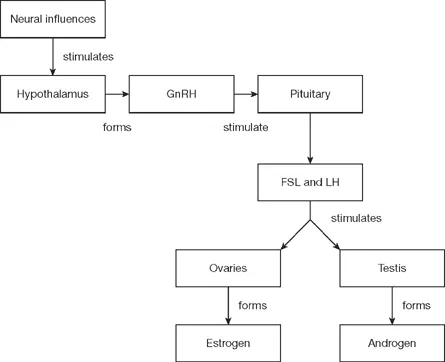
The start of these bodily changes is the result of the release of pubertal hormones that affect the pineal gland (Grumback and Styne, 2003). The pineal gland is connected – through the blood flow – to an important brain region, the hypothalamus. The hypothalamus and pineal gland are constantly communicating with each other about the hormone levels that should be released. The hypothalamus regulates these levels and thereby controls the hormone levels that are released by the pineal gland. The start of puberty is characterized by the release of gonadotropin-releasing hormone (GnRH). GnRH is also released before puberty, but at a much lower level, and therefore has no influence yet on the sex-specific characteristics. The increase in both frequency and release of GnRH is what starts pubertal development. GnRH stimulates the pituitary, which releases luteinizing hormone (LH) and follicle stimulating hormone (FSH). LH causes the increase in oestrogen in girls and FSH causes the increase in testosterone in boys. This second phase of hormonal development (the first phase takes place in the uterus) contributes to sex-specific behaviour in both physical appearance and social behaviour (Scherf et al., 2012).
Besides changes in bodily characteristics, hormones also influence how we feel and what we do. This is well illustrated by Sam, a 13-year-old boy who has felt quite insecure lately. He used to make friends easily, but now he feels awkward about looking different and he doesn’t like that his voice and his skin are changing. Girls seem to make fun of him, which makes him feel uneasy. He doesn’t understand where this is coming from, he never used to care about what girls were thinking, but now it makes him shy. He would prefer that everything would go back to howit used to be, and he has decided to ignore girls altogether. Now, he mainly hangs out with his friends from the soccer team, which makes him feel least insecure.
FIGURE 1.1 Neural influences and the development of pubertal hormones
Sam notices that not only his body is changing, but also his feelings are different. The influence of pubertal hormones works in two directions. First, the increase in hormone levels ensures that neurons in certain brain regions are temporarily activated. This occurs not only in puberty, but also in adulthood (Bos, Hermans, Ramsey and van Honk, 2012; van Honk et al., 2011). Hormone fluctuations can influence our moods, and this also occurs in puberty. Second, hormones also have an organizational influence on brain development, which is specific for puberty. During puberty brain organization changes and the presence or absence of certain hormones can have a long-term influence on brain function (Sisk and Foster, 2004; Sisk and Zehr, 2005). For example, in animal studies it was found that testosterone has direct effects on the development of the rat’s brain (Melcangi et al., 2003; Pesaresi et al., 2015). Furthermore, in certain rare human childhood disorders, the release of GnRH is delayed, which causes a delay in the start of puberty (Grumback and Styne, 2003). This disorder can be overcome by hormone treatment, during which those hormones that are usually released naturally are externally given to the body. If the hormone treatment is started before or during the period in which puberty would usually start, this has no influence on intellectual capacities. However, when the hormone treatment is not given, or is started late, this can have consequences for certain cognitive abilities, such as spatial information processing (Linn and Petersen, 1985; Sisk and Zehr, 2005). Apparently, there is a constant communication between the brain and the pineal gland: they do not function well without each other. When the hypothalamus does not signal the pineal gland that GnRH should be released, then the absence of this hormone has again an influence on the development of the brain.
How do pubertal hormones influence brain and behaviour? It is well documented that hormones have a direct influence on bodily changes. This again has a large influence on how adolescents view themselves and others. Take the example of Sam. Because of the changes in the way he looks, he feels much more self-conscious and pays more attention to how his peers act. Given that the timing of puberty is different between boys and girls, and that the onset of puberty also varies within boys and girls, this causes large individual differences between adolescents. Where one 13-year-old girl can already be undergoing a growth spurt, developing breasts and wider hips, the other 13-year-old is much less advanced in puberty. Given that girls start puberty approximately 1.5 years earlier than boys, differences in pubertal development between boys and girls are especially apparent in the age range of 10–13 years. There are some indications that the onset of puberty has moved to younger ages. For example, large-scale studies have measured the onset of menarche and found a decline in the age of menarche since the 1800s (average age 17 years), until approximately 1940 (average age 13 years), after which it appears to have stabilized. These declines have been attributed to improved nutrition and health provision (Sorensen et al., 2012), although some have also argued that maladaptive environmental circumstances, such as good chemicals, may influence the onset of puberty (Parent et al., 2003). It remains debated if the age of puberty onset declined further after the 1940s (this seems to be the case for some, but not all puberty indices) (Euling et al., 2008).
The timing of puberty can influence social identity (Brooks-Gunn and Warren, 1989). At a school party at Sam’s school there were two groups of children who did not hang out together. The first group consisted of boys and girls who liked to act goofy and they were excited about their first school party. The second group consisted of the ‘cool’ boys and girls, who appeared much more mature than the first group. It was clear that they felt way too old to act goofy. Two boys from the ‘cool’ group secretly brought alcohol to the party, while the first group was happy to drink coke or sprite. Even though both groups were exactly the same age, the first group was less advanced in pubertal development than the second group. It has been documented in prior studies that while controlling for age, more advanced puberty is associated with more alcohol consumption (de Water, Braams, Crone and Peper, 2013).
Girls who are more advanced in puberty relative to their peers are more likely to develop depression and eating disorders (DeRose, Shiyko, Foster and Brooks-Gunn, 2011; Hamlat, Stange, Abramson and Alloy, 2014). The exact reason for this difference is not yet understood. The increase in depression rates in girls could be a direct consequence of hormones on the brain, but could also be due to the reaction from others and self on the bodily changes and physical appearance as a result of the hormonal effects on the body. The hormonal influences on the body generally cause the adolescent’s physical appearance to change in such a way that it becomes more distanced from the ideal body image as displayed in the media. Especially in girls, the individual differences in the gain of body fat can make them feel insecure (McCabe, Ricciardelli and Banfield, 2001). Furthermore, dieting is often not successful, which causes feelings of failing. In boys, a maturer body is more accepted, leading to higher popularity and social dominance of those boys who are more advanced in puberty (Rowe, Maughan, Worthman, Costello and Angold, 2004).
Feeling jet lagged
Jim is 16 years old and he delivers the early morning newspaper in order to earn extra money to go on vacation with his friends to Spain. Even though he tries really hard to be on time, he has already overslept three times. The last time despite setting two alarms, he still failed to wake. The first two times that he overslept, his mother helped him: his boss called him at home and his mother drove him to work and helped him to deliver the papers, nearly delivering them on time. But the third time she did not feel like helping out anymore believing that as a 16-year-old, he should be responsible for waking himself up on time. It is not that he does not want to wake up, but it just seems impossible to get out of bed on time.
Going to bed late, having a hard time waking up, sleeping in on the weekends; these are all characteristics of the sleeping patterns of adolescents. During puberty, the release of the hormones changes to more adult-like patterns. This causes a huge change in the biorhythm of adolescents, and the related sleeping patterns (Crowley, Acebo and Carskadon, 2007). Young children typically get tired earlier in the evening, which makes them fall asleep at a suitable time. In adolescents, the system that makes them feel tired gets delayed to later in the evening, which causes them to be awake until much later, not feeling tired until possibly 11 p.m. Yet, all the bodily changes associated with entering puberty take a lot of energy, which causes a difficult situation for adolescents – they cannot fall asleep until late in the evening but have a hard time waking up in the morning. It constantly feels like having a jet lag (Malone et al., 2015).
On average, young children need 10 hours of sleep per night, whereas adults feel rested when they sleep 8 hours a night. Adolescents need on average approximately 9–9.5 hours sleep to feel rested but they almost never get...
Table of contents
Cover
Half Title
Title Page
Copyright Page
Table of Contents
Acknowledgements
1 Introduction: imaging the adolescent brain
2 The learning brain: executive functions
3 Complex decisions and risky choices
4 You’re not angry, are you? The importance of recognizing facial emotions
5 Do I fit in, or not? Acceptance and rejection
6 It’s all about me: self-concept
7 What will other people think? Perspective-taking
8 What should I do without friends? Friendships and relationships
Index
Trusted by 375,005 students
Access to over 1.5 million titles for a fair monthly price.
Study more efficiently using our study tools.
Frequently asked questions
Yes, you can cancel anytime from the Subscription tab in your account settings on the Perlego website. Your subscription will stay active until the end of your current billing period. Learn how to cancel your subscription
No, books cannot be downloaded as external files, such as PDFs, for use outside of Perlego. However, you can download books within the Perlego app for offline reading on mobile or tablet. Learn how to download books offline
Perlego offers two plans: Essential and Complete
Essential is ideal for learners and professionals who enjoy exploring a wide range of subjects. Access the Essential Library with 800,000+ trusted titles and best-sellers across business, personal growth, and the humanities. Includes unlimited reading time and Standard Read Aloud voice.
Complete: Perfect for advanced learners and researchers needing full, unrestricted access. Unlock 1.5M+ books across hundreds of subjects, including academic and specialized titles. The Complete Plan also includes advanced features like Premium Read Aloud and Research Assistant.
Both plans are available with monthly, semester, or annual billing cycles.
We are an online textbook subscription service, where you can get access to an entire online library for less than the price of a single book per month. With over 1.5 million books across 990+ topics, we’ve got you covered! Learn about our mission
Look out for the read-aloud symbol on your next book to see if you can listen to it. The read-aloud tool reads text aloud for you, highlighting the text as it is being read. You can pause it, speed it up and slow it down. Learn more about Read Aloud
Yes! You can use the Perlego app on both iOS and Android devices to read anytime, anywhere — even offline. Perfect for commutes or when you’re on the go. Please note we cannot support devices running on iOS 13 and Android 7 or earlier. Learn more about using the app
Yes, you can access The Adolescent Brain by Eveline A. Crone in PDF and/or ePUB format, as well as other popular books in Psychology & Developmental Psychology. We have over 1.5 million books available in our catalogue for you to explore.