![]()
The Guaraní of the Forest
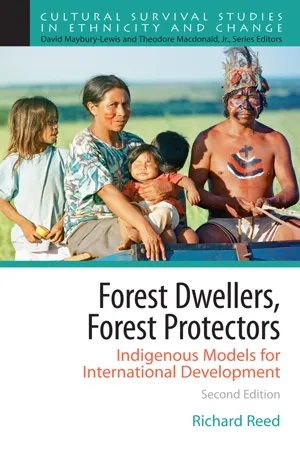
The Guaraní of Paraguay and Brazil occupy one of the largest remaining subtropical forests of the New World. In the shade of the trees' high canopy, they fit our stereotypes of indigenous peoples. The Guaraní are small, bronze-skinned, and prefer to wear a minimum of clothing. Their communities are set in forest clearings, connected with one another by footpaths through the dense underbrush. Houses are small, with thatched roofs and few furnishings. Social groups are led by old men wearing feather headdresses; These people use their religious knowledge to counsel the group.
The Guaraní differ from our images of indigenous people in one very important aspect. They have not been isolated in their deep forests. In fact, the Guaraní have been in contact with the larger world since the sixteenth century, when the early Spanish explorers became their allies. Conquistadors took their wives from among the Guaraní women, and explored the region alongside the Guaraní men. Jesuit and Franciscan missionaries trekked through the territory and built churches in the forest for the Guaraní to worship in.
International economies invaded the South American forests long ago and drew the indigenous people into the world system. In the nineteenth century, merchants came into the forests of the Guaraní looking for timber, skins, plant oils, and tea for the rest of the world. Rather than resisting this expansion of the commercial system, the Guaraní entered it with enthusiasm. They collected goods from the forest to sell and purchased goods such as machetes and salt in return.
Commerce with the larger world has not destroyed the Guaraní. They have not been assimilated into Paraguayan or Brazilian society. As Europeans carved South America into nation-states, the Guaraní maintained their communities in the dense forests. Even as the descendants of the Europeans came to predominate in the region, Guaraní retained their indigenous religious, kinship, and political systems.
Guaraní production has been the key to their ethnic survival. Although they entered the international commodity market, they refused to abandon their traditional subsistence production. While they worked for cash, the Guaraní continued to produce their own food in gardens and/or collect it in the forest. They have had access to soap and axes, clothes and sunglasses, but they also have produced the corn and venison they need to eat. With subsistence assured outside the commercial sector, the Guaraní have maintained their communities and social systems. Kin connections continue to be the primary network for establishing a home, appointing leadership, and organizing religious ceremonies. In sum, the Guaraní have adapted the larger system to their own purposes; they have become linked to it without giving up their traditional social, economic, and ecological systems.
After centuries of contact with the larger world, the relationship between the Guaraní and the larger society is threatened. In the last 20 years, new kinds of production have moved into the forests of eastern Paraguay. Population growth and international investment are opening the area to intense colonization and development. In eastern Paraguay, cattle ranching and monocrop agriculture are replacing the traditional economy of timber, skins, oil, and tea. The forests are being felled and the new farmers are using soils for soybeans, pasture, tobacco, and cotton. In the 1990s, Paraguay had the highest rate of deforestation in Latin America, destroying most of the country's forests.
As entrepreneurs buy and clear the land, the Guaraní are forced onto small reservations. On these small reserves, sometimes only a tenth of their previous area, they do not have the extensive forests they need for hunting, gathering, and shifting agriculture. As the Guaraní are forced to abandon their traditional production systems, they lose control of their relationship with the larger society. Traditional residence patterns, kinship systems, religious beliefs, and political institutions are giving way to the authoritarian and hierarchical relations of the larger society.
Recent development not only destroys the existing forest and indigenous societies, it also devastates the soil and water. Land clearing ravages the very resources that support the new agriculture and ranching. Declining profits force farmers and ranchers to abandon their land and clear new fields in the forest.
The Guaraní can teach us better ways of using the forest. Guaraní forest residents manage the forest with great care. They earn a profit while protecting the resources they use, and have sustained this commercial development over centuries. This book describes Guaraní production systems and suggests them as an alternate model for using the forest. Preserving the forest not only protects indigenous people, but allows the continued economic development that all depend on.
Guaraní Demographics
Most of the indigenous people in the lowlands of South America's southern cone belong to a series of related groups called the Tupi-Guaraní. Local groups speak related, although distinct, languages. In addition, these distinct groups have social similarities in the ways they organize kinship, residence, religion, and politics.
This book focuses on the Guaraní who live in the forests of Brazil, Argentina, and Paraguay. Of the total population of 80,000, almost half are settled in eastern Paraguay. Anthropologists divide these Paraguayan Guaraní into three subgroups: the Ava-Guaraní, the Pai-tavyterá, and the Mbyá. The Pai-tavyterá reside in the north, the Ava-Guaraní in the central regions, and the Mbyá in the southern forests near the Brazilian border. Although these groups differ in some aspects of language and culture, they are very similar. The labels tend to exaggerate differences between the groups and ignore variation within them. In the forest, every village and often every kin group has a sense of its own unique culture and ethnic identity.
The Paraguayan Guaraní live in over 300 communities, which range from hamlets of three or four houses, called tapyí, to large settlements of several hundred families (Dirección General de Estática Encuestas y Censos 2002). Nuclear families occupy individual houses, which are clustered along paths that meander through the forest. They cut gardens into the forest that surrounds their house lots. Kinship connections tie households into larger communities; young couples build their houses near those of their parents. As a result, most households in a community are connected by ties between siblings and cousins.
Most of the Guaraní in eastern Paraguay are settled on small plots of land that are reserved for them by the national government. Since 1976, the Paraguayan government has been attempting to guarantee land to all indigenous communities in Paraguay. Almost two-thirds of the recognized communities have title to at least some land. Although not enough, as we will see below, these reservations provide at least a modicum of security for the Guaraní of Paraguay.
A fourth indigenous group, the Aché, inhabit the forests of eastern Paraguay. The Aché are distinct from the Guaraní in physique, language, and culture. They forage for subsistence, rather than garden, and differ from the Guaraní in their relation to the larger society. Consequently, the Aché are not considered in this book.
The final important ethnic group of eastern Paraguay is made up of descendants of Europeans who migrated into the area. Europeans intermarried with the Guaraní of the region, producing descendants called mestizos or criollos. Today, this group makes up most of the population of rural Paraguay. Over the centuries, they have come to form a group with a strong sense of ethnic identity, neither indigenous nor European, but Paraguayan. They speak the Guaraní language and live and eat much as the Guaraní do, yet they are Catholic and have a firm allegiance to the Paraguayan nation.
The indigenous Guaraní of eastern Paraguay have not been isolated from these mestizos, but have learned to live in their midst. The Guaraní have accommodated the national system without sacrificing their economic independence or ethnic autonomy. As forests are cleared, however, the Guaraní are having increasing difficulty defending themselves and their culture from the larger society.
Geography
Eastern Paraguay is geographically diverse. As a traveler moves eastward, the low, flat wetlands along the Paraguay River slowly give way to high-forested hills. The region lies on the western escarpment of the Paraná Plateau, a raised area that extends east to the Atlantic River. Erosion of the western flank of the Paraná Plateau has created a series of low hills along Paraguay's eastern border with Brazil. These sierras have Guaraní names: Mbaracayú, Yvvtyrusú, and Amambay.
Eastern Paraguay is just south of the Tropic of Capricorn, about 25° below the equator. The distance from the equator gives the region clear seasons. Rainfall cycles in a single annual pattern between February highs and July lows, amounting to an average of 1500–1700 mm each year. Temperatures climb to 40°C for a few days in February and drop to freezing in July. Weather is generally moderate, usually ranging between 16 and 30°C. Temperature variation throughout most days varies more than the seasonal changes.
The Paraná Plateau is drained by a network of streams and rivers that flow south to Buenos Aires and the Atlantic Ocean. Watersheds are separated from one another by low hills. The waterways start as babbling brooks in the highlands and work their way downhill, eventually flowing into the broad and meandering Paraná and Paraguay rivers.
High canopied forests cover the Paraná Plateau, made up of hardwoods such as lapacho (Tabebuia ipe) and cedro (Cedrela tubiflora). The overstory shelters thick growth on the forest floor, a tangle of underbrush and vines that makes it difficult to walk through the forest. Low scrub forest grows along the regions' many streams and rivers, where the high canopy is broken by dense growths of coco palms (Cocos romanzoffiana) and bamboos. As one moves off the high plateau toward the Paraguay River, the topography becomes lower and flatter and the high forests give way to marshy grasslands.
History
When Europeans arrived in South America, over a million Guaraní and related groups dominated the region from the Andes to the Atlantic Ocean. They were a massive and diverse ethnic group. Over the centuries, the group size and geographic region has greatly diminished. Nevertheless, the Guaraní continue to be an important ethnic group in the forests of eastern Paraguay.
Even before the arrival of Europeans in their midst, the Guaraní were changing and developing. Archaeologists believe that the ancestors of the Guaraní previously lived along the Amazon River. For thousands of years, they cultivated manioc (Manihot esculenta), a starchy tuber that grows well in the thin soils of the rain forest. About a millennium ago, these forest people began a process of technical innovation that led to a massive migration throughout the forests of southern South America. First, they began to produce corn and beans, probably imported from the Andes. This provided better nutrition, but demanded more fertile soils than the rain forest could provide. The early Guaraní were forced to seek better land on the high plains south of the Amazon River. As they moved south, they discovered an environment that was abundant in new resources. Even as they continued to cultivate gardens, they harvested game, and managed the growth of useful trees in the forests. The Guaraní model of production can be best described as agroforestry. Agroforestry integrates tree crops with cash crops, food crops, and often animal raising. Agroforestry uses forests, rather than replacing them with single-crop agriculture or pasture. It builds on the existing system, managing its diversity to maximize the productivity.
With the benefits of these technical innovations, the Guaraní population grew dramatically. They were forced to colonize larger areas south of the Amazon floodplain to feed their expanding population. Thus, technical innovation and population growth led to a demographic expansion that carried the Guaraní throughout the southern cone. They migrated south into the Paraná Plateau, east to the ocean, and up the Atlantic coast to the continent's easternmost regions. These migrations forced them into the lands of other ethnic groups, and the Guaraní were forced to fight for the territory they occupied. Thus, one could say that the Guaraní preceded the Spanish as the conquerers and colonists of South America's southern cone. It is very possible that the Aché are the remnants of one of these earlier subjugated peoples.
The arrival of the Spanish in 1537 integrated directly into the Guaraní expansion. In the decades before the arrival of the Spanish, the Guaraní were trying to expand into the foothills of the Andes. Between 1400 and 1430, emissaries of the Guaraní trekked across the hot, dry Chaco lowlands to contact the Andean outposts of the Inca empire. On one hand, the Guaraní were interested in settling in the fertile foothills of the Andes. On the other, the Guaraní were interested in commerce. By the time the Spanish arrived, the Guaraní had established trade routes from the Andes to the Paraná Plateau. They already had access to gold and silver from Inca mines.
In a story that has acquired the feeling of myth, we are told that when Sebastian Cabot (1476?–1557) first sailed south along South America's Atlantic coast he met a boat loaded with gold and silver coming down the region's major river. The vision of easy wealth attracted him up the river, which he suitably called the Rio de la Plata (“River of Silver”). When he entered the region we now call Paraguay, he encountered a population of Guaraní of what seemed like several hundred thousand. Guaraní villages filled the forests and powerful political leaders could assemble armies of thousands of soldiers.
These first conquistadors record the very comfortable life of the Guaraní. In 1541, the region's first governor, Cabeza de Vaca, traveled from the Atlantic overland to Asunción, passing through many Guaraní communities. He writes,
They are … the richest people of all the land and province both for agriculture and stock raising. They rear plenty of fowl and geese and other birds; and have an abundance of game, such as boar, deer, and dantes (anta), partridge, quail and pheasants; and they have great fisheries in the river. They grow plenty of maize, potatoes, cassava, peanuts and many other fruits; and from the trees they collect a great deal of honey (1555/1891:118).
Unlike European society, which was organized around feudal power, the Guaraní were a fairly egalitarian society, linked to one another by kinship and religious ties. Hans Staden, a sailor captured by the Guaraní in 1550 reported, “I have seen no particular authority among them, except that by custom the young defer to the elders. They obey the orders of the chief of the hut; this they do of their own free will” (1557/1928:151). Extended families occupied large dwellings and acted as independent communities. Political leaders were able to bring dispersed groups together to migrate or make war, but they had no coercive power over their followers.
The Guaraní welcomed the first conquistadors. They needed military alliances to carve trading routes to the Andes, and the Spanish gratefully accepted local support in this large and unexplored area. The alliances were sealed as conquistadors set up households with Guaraní women, establishing a kin relationship with their new allies. The isolation of their newfound land helped create a distinct national identity very early. Conquistadors took Guaraní women as consorts and Guaraní men as allies. They also adopted the Guaraní language and diet. The first generation of mestizos born to these men maintained a strong and proud identification with both their European and Guaraní ancestors.
The Spanish and their Guaraní compatriots reached the Andes in 1546, only to find that Pizarro (1475–1541) had already conquered the Inca empire. Having lost the golden prize, they set out to get wealth from the forests and residents of Rio de la Plata. The forests of the Guaraní held no gold but did have a native plant called yerba máte (Ilex paraguayensis). The waxy, thick foliage of yerba máte harbors considerable caffeine. When the leaves are dried and pulverized, the caffeine is quickly released into infusions of hot or cold water. The Guaraní collected yerba leaves to make a stimulating and pleasant drink. When drunk cold, called tereré, Guaraní added sweet and refreshing herbs, such as cilantro or mint. When steeped in boiling water, called máte, Guaraní added bark or leaves that had medicinal properties as astringents, purgatives, or decongestants. The dawn air around Guaraní fires was filled with pungent aromas, as hot máte was passed between family members.
The conquistadors in the Andes sought yerba from the lowlands. They sought its stimulating effect as a tea to induce slaves to work harder in the mines and fields. As the tea gained popularity among both the conquistadors and the conquered, markets developed in Buenos Aires and Lima. The Spanish of Rio de la Plata first asked their Guaraní relatives to collect the yerba for shipment downriver. That failing to satisfy their greed for wealth, the Spanish turned on their compatriots and forced them to collect the leaf. These labor drafts, called encomiendas, gave each conquistador rights to the labor of a specific group of Guaraní men. The Spanish set their laborers to work in the forests, collecting yerba máte, as well as honey and skins for the international market.
The Guaraní population declined precipitously after the conquest; 90 percent of the natives died in the first century of the European era. The Spanish brought new diseases, such as smallpox, measles, and even the common cold, to which the Guaraní were extremely vulnerable. In addition, men were removed from their households to work in the yerba forests, called yerbales, and the birthrate dropped dramatically. Encomienda labor not only disrupted indigenous family life, it forced Guaraní to work under conditions that increased their susceptibility to disease. Thus, one Guaraní leader complained to the governor in 1630 that
They have carried off our brothers, sons and subjects repeatedly to the Mbaracayú, where they are all dying and coming to an end…. Those máte forests remain full of the bones of our sons a...