![]()
Chapter 1
Early warnings and Risk Registers
Question 1.1 Is there a standard format within the NEC3 contracts for an early warning notice? Is there any remedy if the Project Manager or the Contractor fails to give an early warning?
There is no standard format for an early warning notice, but it must contain certain essential ingredients. In order to consider these essentials, let us first consider what an early warning is.
It is important to state that early warnings are an essential and valuable risk management tool within the NEC3 contracts and are included within all the contracts except the Adjudicator’s Contract.
If we take the Engineering and Construction Contract as an example, the contract obliges the Project Manager and the Contractor to notify each other as soon as either becomes aware of any matter which could affect the project (the “works”) in terms of time, cost or quality.
Under Clause 16.1 the Contractor and the Project Manager give an early warning by notifying the other as soon as either becomes aware of any matter which could:
• increase the total of the Prices (the price of the works, in the form of the activity schedule, the Bill of Quantities or the target)
• delay Completion (the Completion of the whole of the works)
• delay meeting a Key Date (the Completion of an intermediate “milestone date” in accordance with Clause 11.2(9)
• impair the performance of the works in use.
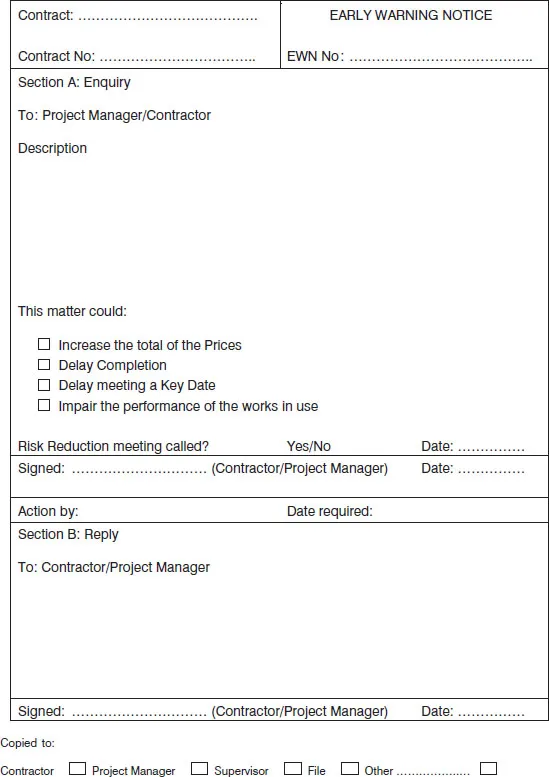
This last point sometimes causes confusion, but if we take as an example the Contractor being instructed by the Project Manager to use a particular type of water pump and the Contractor knows from experience that particular pump would probably not be sufficient to meet the Employer’s requirements once the works are taken over, then the Contractor should give early warning (see Figure 1.1).
The Contractor may also give an early warning by notifying the Project Manager of any other matter which could increase his total cost. One could query whether a matter which could increase the Contractor’s cost, but not affect the Price, should be an early warning matter, or for that matter, whether it should be anything to do with the Project Manager, particularly if Options A or B have been selected so the Contractor is not looking to recover this additional cost through the contract, but the words are “the Contractor may give an early warning” so he is not obliged to do so.
Note, also within Clause 16.1, the Contractor is not required to give an early warning for which a compensation event has previously been notified. So, as an example, if the Project Manager gives an instruction which changes the Works Information, it is a compensation event, for which neither the Project Manager nor the Contractor are required to give early warning.
The early warning procedure obliges people to be “proactive”, dealing with risks as soon as the parties become aware of them, rather than “reactive”, waiting to see what effect they have then trying to deal with them when it is often too late.
Encouraging the early identification of problems by both parties puts the emphasis on joint solution finding rather than blame assignment and contractual entitlement.
It is one of the most important and valuable aspects of the contract and it is perhaps surprising that, whilst few other contracts refer to an early warning process, only the NEC contracts set out in clear detail what the parties are obliged to do, with appropriate sanctions should the parties not comply (see Clauses 11.2(25), 61.5 and 63.5).
Notifying early warnings
Again, if we refer back to the question, “Is there a standard format … for an early warning notice?”, as stated in the beginning to the response, the answer is no, but the contract requires (Clause 13.1) that all instructions, notifications, submissions, etc. are in a form that can be read, copied and recorded, so early warnings should not be a verbal communication such as a telephone conversation.
If the first notification is a telephone conversation, or a comment in a site meeting, which are quite likely, it should be immediately confirmed in writing in the format required by the contract to give it contractual significance.
Figure 1.1 Suggested template for early warning notice
Also, Clause 13.7 requires that notifications which the contract requires must be communicated separately from other communications; therefore, early warnings must not be included within a long letter which covers a numbers of issues or embodied within the minutes of a progress meeting.
There are some key words within the obligation to notify “The Contractor and the Project Manager”. No one else has the authority or obligation to give an early warning. The Project Manager is therefore notifying on behalf of himself, the Employer, the Supervisor, the Employer’s Designers and many possible others whom he represents within the contract.
The Contractor is notifying on behalf of himself, his Subcontractors, his Designers (if appropriate), and many possible others whom he represents under the contract. Early warnings should be notified by the key people named in Contract Data Part 2.
Project Managers are often criticised for seeing early warnings as something the Contractor has to do, but not the Project Manager, and in fact most early warnings are actually issued by the Contractor. However, the Contractor and the Project Manager are obliged to give early warnings each to the other, so it is critical that Project Managers play their part in the process and issue early warning notices where required.
As an example, if the Project Manager becomes aware that he will be late in delivering some design information to the Contractor because of a delay by a designer, he should issue the early warning as soon as he becomes aware that the information will not be delivered to the Contractor, not wait and subsequently blame the Contractor for not giving an early warning stating that he has not received the information!
• “As soon as” means immediately. A number of clauses within the contract deal with the situation in which the Contractor did not give an early warning. Whilst the party who gives the early warning must do so as soon as he becomes aware of the potential risk, the other party should respond as soon as possible and in all cases within the period for reply in Contract Data Part 1.
• “Could” does not mean must, will or shall. Clearly there is an obligation to notify even if it is only felt something may affect the contract, but there is no clear evidence that it will.
Example
On 1 February, the Contractor becomes aware of an issue which could increase the total of the Prices and delay Completion. He should immediately give an early warning to the Project Manager. However, he fails to do so until 22 February, three weeks later.
When the Contractor gives the early warning, the Project Manager notifies a compensation event and instructs the Contractor to submit a quotation, at the same time notifying the Contractor that he did not give an early warning of the matter that an experienced Contractor could have given.
If the Project Manager has given such notification, then the compensation event is assessed as if the Contractor had given early warning, so the Contractor should price his quotation based on the event as at 1 February, rather than 22 February.
If the Project Manager fails to give an early warning, there is no direct remedy within the contract, but the Project Manager would be losing an opportunity to raise an issue with the Contractor that could potentially present a risk to the success of the project, and if necessary to have a risk reduction meeting, so this failure could be detrimental to the Employer.
The Project Manager enters early warning matters in the Risk Register. Early warning of a matter for which a compensation event has previously been notified is not required. If the Project Manager gives an instruction for which a compensation event has already been notified, there is no requirement for either party to give an early warning.
It must be emphasised that early warnings are not the first step towards a compensation event as is often believed. Early warnings feature in a completely separate section of the contract and in fact the early warning provision is intended to prevent a compensation event occurring or at least to lessen its effect. It can also be used to notify a problem which is totally the risk of the notifier. It is also worth mentioning that early warnings are a notice of a future risk, not a past one.
The parties are not required, nor is it of any value, to notify a risk that has already happened.
Remedy for failure to give early warning
Under Clauses 61.5 and 63.5, if the Project Manager decides that the Contractor did not give an early warning of the event which an experienced contractor could have given, he notifies this to the Contractor when he instructs him to submit quotations. If the Project Manager has done so, the event is assessed as if the Contractor had given early warning.
Failure to give an early warning can also be considered as Disallowed Cost under Options C, D and E, Disallowed Cost being the cost which the Project Manager decides was incurred only because the Contractor did not give an early warning which the contract required him to give.
Question 1.2 What is a Risk Register and what is its purpose within the NEC3 Engineering and Construction Contract?
The Risk Register was first included within NEC3 in 2005 where it is defined under Clause 11.2(14) as “a register of the risks which are listed in the Contract Data and the risks which the Project Manager or the Contractor has notified as an early warning matter. It includes a description of the risk and a description of the actions which are to be taken to avoid or reduce the risk”.
It is critical that the parties fully understand that the purpose of a Risk Register is to list all the identified risks and the results of their analysis and evaluation. It can then be used to track, review and monitor risks as they arise to enable the successful completion of the project.
The Risk Register does not allocate risk, as that is done by the contract.
In that sense, the contract does not prescribe the format or layout of the Risk Register, or its intended purpose, other than to list the risks in the contract and those that come to light at a later date and are notified as early warnings following which, if there is a risk reduction meeting, the Project Manager revises the Risk Register to record the outcome of the meeting.
Note that by the definition with Clause 11.2(4), risks which were not originally included in the Contract Data or subsequently notified as early warnings should not be included in the Risk Register.
Contract Data Part 2 allows the Contractor to identify matters which will be included in the Risk Register. The Risk Register does not allocate or change the risks in the contract, it records them and assists the parties in managing them. In that sense it is a valuable addition to the contract which was absent from previous editions but introduced in NEC3.
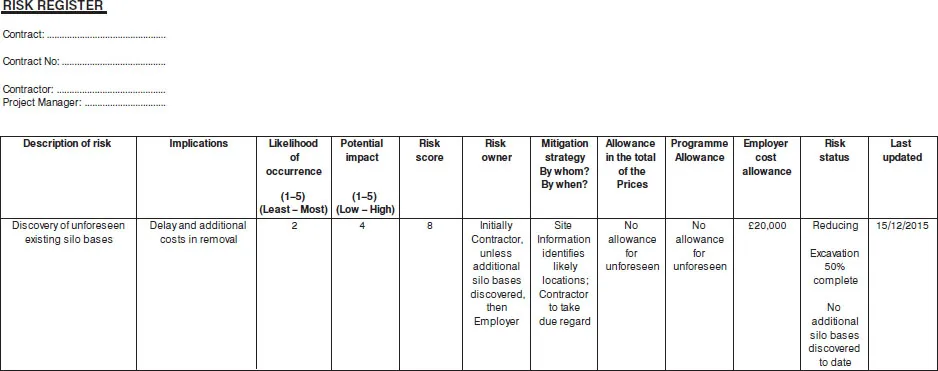
Figure 1.2 Typical Risk Register
A typical Risk Register which would comply with the contract would normally include the basic requirement for a description of the risk and a description of the actions which are to be taken to avoid or reduce the risk (see Figure 1.2).
There is no stated list of components of a Risk Register, but column headings should typically be titled as follows.
1 Description of risk: A clear description of the nature of the risk, if necessary referring to other documents such as site investigations, etc.
2 Implications: What would happen if the risk were to occur?
3 Likelihood of occurrence: This provides an assessment of how likely the risk is to occur. The example shows a forecast on a 1 (least likely) to 5 (most likely) basis, though it may be assessed as percentages, colour coding or simply “Low” (less than 30 per cent likelihood), “Medium” (31–70 per cent likelihood), or ...