- 352 pages
- English
- ePUB (mobile friendly)
- Available on iOS & Android
eBook - ePub
About this book
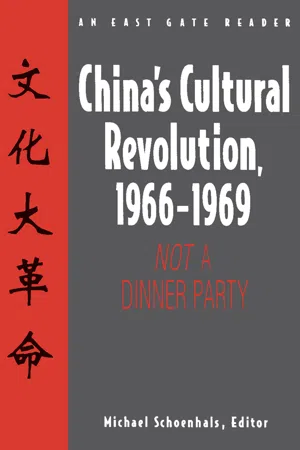
Mao Zedong launched the "Great Proletarian Cultural Revolution" 30 years ago. This documentary history of the event presents a selection of key primary documents dealing with the Cultural Revolution's massive and bloody assault on China's political and social systems.
Part I
Intentions and Means
A. Pronouncements by Members of the CCP Leadership
One searches in vain for an extended, systematic, and credible explanation by Mao Zedong himself of the goals of the Cultural Revolution. There is no master script to be found, no blueprint, no scenario, no game plan. All there is are random, scattered remarks—some spontaneous, others carefully hedged; some just possibly meant to be taken at face value, others almost certainly intended to obscure rather than elucidate. “Let us toast to the unfolding of a nationwide all-round civil war!” is what at least two guests remember hearing Mao propose on his seventy-third birthday, on 26 December 1966.1 Was that what the Chinese Communist Party Chairman had in mind? Or was his intention (as he was quoted as saying in the People’s Daily a week later) to achieve “the greatest ever revolutionary transformation of society, unprecedented in the history of mankind”?2 Were the two goals possibly one and the same? Or one the means, the other the end? We have no firm answers.
The three texts in this section are from the autumn of 1966, a time when the buzz verbs of the Cultural Revolution were “down with,” “drag out,” “smash, burn, fry, and scorch,” and the all-purpose “kill”; and the labels affixed to the movement’s victims such creative dysphemisms as “ox-freaks and snake-monsters” and long and ugly “scientific” (so the Party Center insisted) designations like “the biggest handful of Party-persons in power taking the capitalist road.” Helping Mao to keep the Cultural Revolution on course were his recently promoted deputy and “closest comrade-in-arms,” Lin Biao, and the members of an ad hoc Central Cultural Revolution Group—a dozen or so “ideologues” who met regularly under the chairmanship of Premier Zhou Enlai.3
In the first text Mao talks briefly about what he wished his audience to believe had been two of his motives in launching the Cultural Revolution: wanting to undo the division of the Party Center into a first and second line of command; and wanting to shake up the Party as a whole in an attempt to reinvigorate it. In other words, to “wreak havoc” with the establishment in an attempt to prevent it from going “revisionist.”
The second text is a longer speech by Lin Biao about the whys and wherefores of the Cultural Revolution. It is possibly as close as we shall ever get to an authoritative blueprint for the movement. Mao, we know, had read and approved it prior to delivery, and as CCP historian Wang Nianyi points out, it amounted to the most systematic attempt at explaining the “need” for a Cultural Revolution that any member of the highest leadership had made at that point. “At the time,” Wang notes, writing in 1988, Lin “actually seemed quite reasonable and rather moderate in his tone. … Consequently, many Party members and cadres accepted his arguments.”4
The third text is in many ways a mere footnote to history. Still, God resides in the footnotes (or in the details contained therein, as Einstein is said to have put it) and Zhou Enlai’s letter is important for that one sacred claim contained therein—that the “only criterion of truth” (emphasis added) in the Cultural Revolution was not practice, but “Mao Zedong Thought.” In other words, if Mao Zedong could be quoted as saying that “the situation in the Great Proletarian Cultural Revolution throughout the country is not just good but excellent,” then so be it.5 Anyone arguing the opposite was simply deluded, mistaken, or—worse—lying.
_____________________
1 Chen Boda, cited in Ye Yonglie, Mingren fengyun lu (Famous Men of the Hour) (Guilin: Lijiang chubanshe, 1992), p. 14; and Guan Feng, cited in Ye Yonglie caifang shouji (Ye Yonglie’s Interview Notes) (Shanghai: Shanghai shehui kexueyuan chubanshe, 1993), p. 119.
2 Renmin ribao, 1 January 1967.
3 Zhou, who was himself not a member of the Central Cultural Revolution Group, chaired all of its regular meetings. Wang Li, personal communication.
4 Wang Nianyi, Da dongluan de niandai (Years of Great Turmoil) (Zhengzhou: Henan renmin chubanshe, 1988), pp. 110, 112–13.
5 And he was, of course. Cf. Liberation Army Daily, 9 November 1967.
1
“Just a Few Words”
Source: Translation of “Zai Zhongyang gongzuo huiyi shang de jianghua” (Talk at the Central Work Conference) (October 25, 1966) in Stuart R. Schram, ed., Mao Tse-tung Unrehearsed: Talks and Letters 1956–1971 (Harmondsworth: Penguin Books, 1974), pp. 270–74. Reprinted with permission.
I have just a few words to say about two matters.
For the past seventeen years there is one thing which in my opinion we haven’t done well. Out of concern for state security and in view of the lessons of Stalin in the Soviet Union, we set up a first and second line.1 I have been in the second line, other comrades in the first line. Now we can see that wasn’t so good; as a result our forces were dispersed. When we entered the cities we could not centralize our efforts, and there were quite a few independent kingdoms. Hence the Eleventh Plenum carried out changes. This is one matter. I am in the second line, I do not take charge of day-to-day work. Many things are left to other people so that other people’s prestige is built up, and when I go to see God there won’t be such a big upheaval in the State. Everybody was in agreement with this idea of mine. It seems that there are some things which the comrades in the first line have not managed too well. There are some things I should have kept a grip on which I did not. So I am responsible, we cannot just blame them. Why do I say that I bear some responsibility?
First, it was I who proposed that the Standing Committee be divided into two lines and that a secretariat be set up. Everyone agreed with this.2 Moreover I put too much trust in others. It was at the time of the Twenty-three Articles that my vigilance was aroused.3 I could do nothing in Beijing; I could do nothing at the Center. Last September and October I asked, If revisionism appeared at the Center, what could the localities do?4 I felt that my ideas couldn’t be carried out in Beijing. Why was the criticism of Wu Han initiated not in Beijing but in Shanghai? Because there was nobody to do it in Beijing. Now the problem of Beijing has been solved.
Second, the Great Cultural Revolution wreaked havoc after I approved Nie Yuanzi’s big-character poster in Beijing University and wrote a letter to Qinghua University Middle School, as well as writing a big-character poster of my own.5 It all happened within a very short period, less than five months in June, July, August, September, and October. No wonder the comrades did not understand too much. The time was so short and the events so violent. I myself had not foreseen that as soon as the Beijing University poster was broadcast, the whole country would be thrown into turmoil. Even before the letter to the Red Guards had gone out, Red Guards had mobilized throughout the country, and in one rush they swept you off your feet.6 Since it was I who caused the havoc, it is understandable if you have some bitter words for me. Last time we met I lacked confidence and I said that our decisions would not necessarily be carried out. Indeed all that time quite a few comrades still did not understand things fully, though now after a couple of months we have had some experience, and things are a bit better. This meeting has had two stages. In the first stage the speeches were not quite normal, but during the second stage, after speeches and the exchange of experience by comrades at the Center, things went more smoothly and the ideas were understood a bit better. It has only been five months. Perhaps the movement may last another five months, or even longer.
Our democratic revolution went on for twenty-eight years, from 1921 to 1949. At first nobody knew how to conduct the revolution or how to carry on the struggle; only later did we acquire some experience. Our path gradually emerged in the course of practice. Did we not carry on for twenty-eight years, summarizing our experience as we went along? Have we not been carrying on the socialist revolution for seventeen years, whereas the Cultural Revolution has been going on for only five months? Hence we cannot ask comrades to understand so well now. Many comrades did not read the articles criticizing Wu Han last year and did not pay much attention to them. The article criticizing the film The Life of Wu Xun and studies of the novel Dream of the Red Chamber could not be grasped if taken separately, but only if taken as a whole. For this I am responsible. If you take them separately it is like treating only the head when you have a headache and treating only the feet when they hurt; the problem cannot be solved. During the first several months of this Great Cultural Revolution—in January, February, March, April, and May—articles were written and the Center issued directives, but they did not arouse all that much attention. It was the big-character posters and onslaughts of the Red Guards that drew your attention; you could not avoid it because the revolution was right on top of you. You must quickly summarize your experience and properly carry out political and ideological work. Why are we meeting again after two months? It is to summarize our experience and carry out political and ideological work. You also have a great deal of political and ideological work to do after you go back. The Political Bureau, the provincial committees, the prefectural committees, and county committees must meet for ten days or more and thrash out the problems.7 But they mustn’t think that everything can be cleared up. Some people have said, “We understand the principles, but when we run up against concrete problems we cannot deal with them properly.” At first I could not understand why, if the principles were clear, the concrete problems could not be dealt with. I can see some reasons for this: It may be that political and ideological work has not been done properly. When you went back after our last meeting, some places did not find time to hold proper meetings. In Henan there were ten secretaries. Out of the ten there were seven or eight who were receiving people. The Red Guards rushed in and caused havoc. The students were angry, but they did not realize it and had not prepared themselves to answer questions. They thought that to make a welcoming speech lasting a quarter of an hour or so would do. But the students were thoroughly enraged. The fact that there were a number of questions that they could not immediately answer put the secretaries on the defensive. Yet this defensive attitude can be changed, can be transformed so that they take the initiative. Hence my confidence in this meeting has increased. I don’t know what you think. If when you go back you do things according to the old system, maintaining the status quo, putting yourself in opposition to one group of Red Guards and letting another group hold sway, then I think things cannot change, the situation cannot improve. But I think things can change and things can improve. Of course we shouldn’t expect too much. We can’t be certain that the mass of central, provincial, prefectural, and county cadres should all be so enlightened. There will always be some who fail to understand, and there will be a minority on the opposite side. But I think it will be possible to make the majority understand.
I have talked about two matters. The first concerns history. For seventeen years the two lines have not been united. Others have some responsibility for this; so have I. The second issue is the five months of the Great Cultural Revolution, the fire of which I kindled. It has been going on only five months, not even half a year, a very brief span compared to the twenty-eight years of democratic revolution and the seventeen years of socialist revolutio...
Table of contents
- Cover
- Half Title
- Title Page
- Copyright Page
- Dedication
- Table of Contents
- Acknowledgments
- Introduction
- Map of China
- Part I. Intentions and Means
- Part II. Effects and Consequences
- Part III. After the Event
- Organizational Charts
- Chronology
- Biographical Sketches
- Further Readings
- Index
Trusted by 375,005 students
Access to over 1.5 million titles for a fair monthly price.
Study more efficiently using our study tools.
Frequently asked questions
Yes, you can cancel anytime from the Subscription tab in your account settings on the Perlego website. Your subscription will stay active until the end of your current billing period. Learn how to cancel your subscription
No, books cannot be downloaded as external files, such as PDFs, for use outside of Perlego. However, you can download books within the Perlego app for offline reading on mobile or tablet. Learn how to download books offline
Perlego offers two plans: Essential and Complete
- Essential is ideal for learners and professionals who enjoy exploring a wide range of subjects. Access the Essential Library with 800,000+ trusted titles and best-sellers across business, personal growth, and the humanities. Includes unlimited reading time and Standard Read Aloud voice.
- Complete: Perfect for advanced learners and researchers needing full, unrestricted access. Unlock 1.5M+ books across hundreds of subjects, including academic and specialized titles. The Complete Plan also includes advanced features like Premium Read Aloud and Research Assistant.
We are an online textbook subscription service, where you can get access to an entire online library for less than the price of a single book per month. With over 1.5 million books across 990+ topics, we’ve got you covered! Learn about our mission
Look out for the read-aloud symbol on your next book to see if you can listen to it. The read-aloud tool reads text aloud for you, highlighting the text as it is being read. You can pause it, speed it up and slow it down. Learn more about Read Aloud
Yes! You can use the Perlego app on both iOS and Android devices to read anytime, anywhere — even offline. Perfect for commutes or when you’re on the go.
Please note we cannot support devices running on iOS 13 and Android 7 or earlier. Learn more about using the app
Please note we cannot support devices running on iOS 13 and Android 7 or earlier. Learn more about using the app
Yes, you can access China's Cultural Revolution, 1966-69 by Michael Schoenhals in PDF and/or ePUB format, as well as other popular books in History & Chinese History. We have over 1.5 million books available in our catalogue for you to explore.