![]()
INTRODUCTION
Mark Swenarton, Tom Avermaete and Dirk van den Heuvel
In recent years the architecture of the second half of the twentieth century has become a prime area of interest for architectural historians. Most of their studies adopt the classic format of the monograph, devoted to individual architects (for example, Ernst May, James Stirling), to groups (Archigram, Team 10) or to offices (Candilis-Josic-Woods, Atelier Montrouge, Van den Broek and Bakema),1 while others have tried to theorize the field as part of a revisionary, historiographical critique of the period.2 The list of publications is extensive and proof of a most fruitful practice in mining the (recent) history of modern architecture. At the same time, within political sociology there has emerged an enormous literature on the welfare state, with Gøspa Esping-Andersen’s The Three Worlds of Welfare Capitalism (1990) triggering a plethora of studies examining the post-war welfare state as an international phenomenon from an economic, social and political viewpoint.3
Strangely, however, these twin developments have taken place virtually in complete ignorance of each other. Little attention has been given to the varied ways in which architecture and urban planning interacted with the different regimes of welfare provision.4 The forementioned architectural histories have tended to analyze post-war buildings and neighbourhoods as expressions of individual oeuvres or cultural currents, rather then as exponents of complex welfare state arrangements. Only in Belgium and Sweden has there been an emerging interest in the architectural production of the welfare state per se, but largely from a national perspective.5 Conversely, to the extent that the sociological studies have investigated welfare state intervention in the built environment, they have done so as an abstract matter of decrees, programmes and strategies, without reference to the physical realization of the welfare state in architecture and the built environment.
If the built environment was of little significance to the welfare state, this situation might be understandable. But the planning of the built environment – from new towns (Figure 1.1), to social housing, to schools and universities, hospitals and health centres, to leisure and sports complexes, to arts centres – was one of the key areas in which the welfare state sought to achieve its ambitions of economic redistribution and social welfare. This already vast area of intervention in the everyday environment of the population becomes even greater when we consider that the post-war welfare state also incorporated the reconstruction of national industries and energy production, involving the construction of vast new infrastructures. Given the enormous role that the built environment played in the welfare state, and the role that welfare state ideology and commissions played in the architectural developments of the period, this mutual indifference of the two disciplines appears extraordinary.
This book is a first attempt to connect these two fields with each other from an international perspective and to look at post-war architecture in western Europe in terms of its role within the welfare state. The aim is to investigate the complex kinship between the welfare state and the built environment, looking at the role of plans, neighbourhoods and buildings within welfare programmes, as well as probing the contribution made by planners, urban designers and architects to the implementation, articulation and development of the welfare state in post-war western Europe. What is offered is not a comprehensive account or synoptic overview, but rather an attempt to explore the field through a series of case studies – some thematic, some based on particular architects or projects – written from different points of view by leading architectural historians from Europe and the USA. Likewise, rather than attempting an overview of this vast subject, this introduction aims to elucidate some of the key themes and issues involved: conceptual, methodological and historical.
The book is the outcome of a transnational project extending over a number of years. The first steps were taken by Tom Avermaete and Dirk van den Heuvel of TU Delft when they organized a session on Architecture and the Welfare State at the European Architectural History Network (EAHN) 2010 conference in Guimaraes, Portugal.6 Mark Swenarton was one of the speakers at that session and together the three collaborated on a follow-up at the EAHN conference in Brussels in 2012.7 Meanwhile, Swenarton’s move to the University of Liverpool provided the opportunity for a rather different kind of event, again organized by the three editors – an invited international closed-doors symposium, called the Liverpool Workshop – which took place in September 2012. It is the papers presented there, substantially revised in the light of the debates that took place at the symposium, which are published here for the first time.8
At the Liverpool Workshop intensive discussions took place on a wide range of issues and these were summarized on behalf of the organizers by Adrian Forty as a list of questions and issues for future research; for the benefit of other scholars these are reproduced in the Appendix.9 A specific obstacle identified at the symposium was the lack of an international multilingual bibliography on the subject and so, as a step towards this, a list of items for further reading is also provided.
Why now?
Our project investigating the relationship of architecture and the welfare state has coincided with the period of crisis that seized the economies of the United States and Europe in 2008. While the rationale for the project stems in part from the crisis, the one is not reducible to the other. While the crisis of the neoliberal economic model that had become dominant in the 1990s with the completion of the internal market of the EU gave a particular urgency to our research, the investigations into the post-war discourse of modern architecture created a more sharply defined project than that of the apparently neutral term of ‘the post-war’ so widely adopted: namely that of architecture and the welfare state.10 It also made re-focusing on western Europe a matter of course, while being aware of the possible criticism of maintaining a eurocentric perspective.
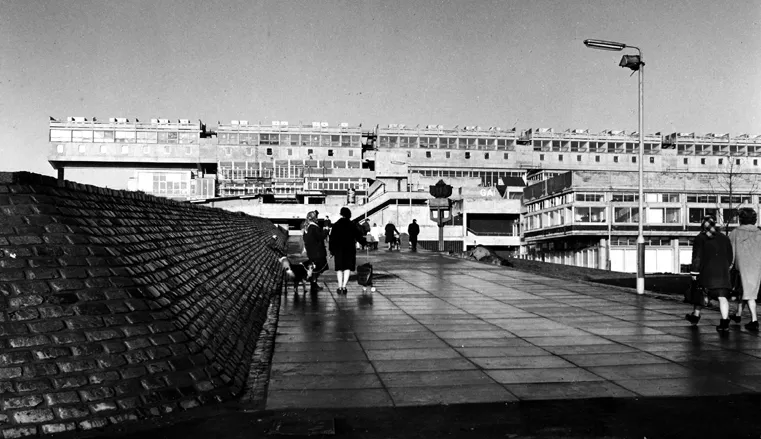
Figure 1.1 Cumbernauld Development Corporation (Hugh Wilson-Dudley Leaker/Geoffrey Copcutt), Cumbernauld New Town, North Lanarkshire, the town centre photographed in 1967 (Architectural Press Archive/RIBA Library Photographs Collection).
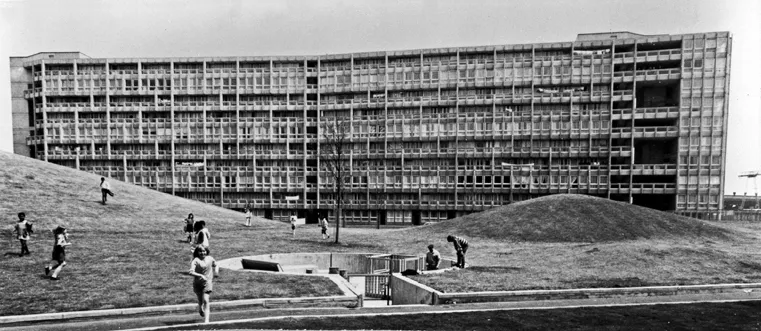
But the economic crisis is not the only reason that the relationship of architecture to the welfare state is relevant today. The built production of the welfare state constitutes a sizable portion of the cities of Europe that we inhabit today; if we are to make the best use of this inheritance we need to understand both its objectives and its historical formation. Moreover, the question of what parts of this inheritance to retain and conserve, and what parts can be demolished and redeveloped, is one that arises regularly in public debate in most European countries, with newspaper articles and exhibitions regularly devoted to the question of the conservation (or otherwise) of post-war buildings.11 The ultimately unsuccessful campaign to save Robin Hood Gardens in London, the only major housing scheme built by Alison and Peter Smithson (Figure 1.2), was one of the most high-profile of these. For many years the Docomomo International conferences have provided an international professional platform for these debates.12 Decisions about retention or demolition need to be informed not just by an understanding of the individual building or buildings, which can be provided by conservation bodies and listing agencies, but by an understanding of the broader context within which they stood. If we are to assess their historical importance, we need to understand that history.
To investigate the shifting role, or roles, of the architect in society and in the process of planning and building constitutes a second motivation for revisiting the architecture of the welfare state. For a number of years the claim of the architect to be the leader of the building team has been under attack.13 Architects, it is said, may be useful at the early stage of a project for gaining planning consents, but after that have little to offer, with contractors taking over their role in the specification of constructional methods and materials and project managers taking over their role in directing the project. This contrasts with the picture of the architect widely held in the heyday of the welfare state. In those times, we are told, the architect was the heroic figure, building the future, the form-giver who devised new forms of homes, of schools, of hospitals, and of entire cities: the person at the forefront of innovation, tasked by government to devise new ways of living for the population and with the authority to drive through his or her (mostly his) vision. Recently, this historical role of the architect has been subjected to reappraisal, notably at OMA’s installation at the 2012 Venice Biennale, Public Works: Architecture by Civil Servants. But was the architect really as powerful as it appeared? The claim is double-edged, because if so then the architect also has to take responsibility for those things that went wrong. Perhaps the architect was only the figurehead, and in reality, others – politicians, managers, planners, the building industry – had more influence. If so, it may be that the post-war golden age of the architect is a myth and then, as now, it was the development process that dictated the outcome. We need to know what the real roles of the various actors were, what the space that they had for decision-making was, and what coalitions were built between the parties involved in the planning processes.
Figure 1.2 Alison and Peter Smithson (Greater London Council), Robin Hood Gardens estate, London, 1965–1972, photographed by Sandra Lousada.
Since the onset of the financial crisis in 2008 it has become apparent that in Europe we have been entering an era in which the large-scale provision of public services by public bodies will be further reduced. To revisit the welfare state era accordingly is not to look back in nostalgia but to learn from the consistent negotiations between capital, labour and the state from which the western European welfare state emerged. The resulting balance of power was not so much a clear-cut model as a precarious hybrid, a balancing act, indeed. Whereas in the past in many countries the state undertook to provide the necessities of life – for example, education, health services, housing – more and more it seems today that these are either left to the market, with the state withdra...