This new book provides a clear and accessible guide on best practice to support teachers when using process drama in establishing creative learning partnerships with their students. It offers a detailed analysis and explores the roles of actor, director and playwright that the teacher must adopt in order to develop the 'thinking on your feet' skills and knowledge necessary to deliver a complete process drama experience.
Addressing the dynamic nature of process drama, it provides a clear and rigorous explanation of the theory of process drama and links it to practice. Drawing on a wide range of detailed examples from the authors' international and cross-cultural practice, it demonstrates how an effective process drama operates in action.
Written to help practitioners and students produce powerful, artistic and educative experiences, chapters cover:
pedagogy and the improvised nature of the art form;
the structural framework and making shifts in the drama;
the role of actor, director, playwright and teacher;
monitoring emotional range;
progression and the importance of reflection;
the spiral of creative exchange and the complexities of co-creativity.
Putting Process Drama into Action will be an essential guide for students undertaking initial teacher training at primary level, in addition to those studying both Drama and English at secondary level. It will also prove to be essential reading for specialist and non-specialist teachers in the primary and secondary sectors who teach, or wish to teach, process drama.
There is a wide range of activities that can be clustered under the umbrella term of drama education. These include the study and performance of plays – both devised and written; technical aspects of theatre; differing cultural and historical styles and genres, acting skills and much more. However, this book is focused on the practice of a particular genre known as process drama: a term used to describe drama conducted mainly in an educational context in which there is no external, watching audience. In process drama the students with the teacher, together, form a theatrical ensemble and create drama to make meaning for themselves. In other words, it is drama for learning.
However, across the world, as governments of the day continue to play football with education, there are frequently changing directives about what constitutes an appropriate school curriculum. Over recent years, many countries have privileged the STEM curriculum of science, technology, engineering and mathematics. As a result, the curriculum status of the humanities and the arts has been lowered and the constituent subjects within them marginalised. Within this marginalised position, drama’s place has been weakened and in some countries it does not have a place in a national curriculum at all.
On the other hand, it is also evident that at the same time as governments have been STEM-focused within curricula many have called on teachers to structure creative, enactive and engaging learning experiences through which the curriculum may be delivered and through which key cross-curricular themes and issues such as social cohesion, intercultural understanding, healthy relationships and environmental education may be addressed. More recently, there has been a growing range of voices internationally calling for STEM to become STEAM by including the arts. This because of the recognition that the creative processes intrinsic to the arts develop skills such as critical and innovative thinking, problem-solving and creativity that enhance engagement with STEM in addition to providing a rounded and richer curriculum provision that better meets the needs of students and the economy.
How does process drama fit into this rather complicated picture?
The nature of process drama provides the means by which students can learn about drama and also through drama about other things because it is both an art form and a pedagogic process. As such, it is recognised by teachers internationally as a compelling, challenging and stimulating learning experience through which students can develop their knowledge, skills and understanding of drama, explore issues from across the curriculum, come to a better understanding of the world around them and practise and hone skills that are transferable to the real world.
In addition, educational institutions worldwide are coming under growing pressure to address and respond, as UNESCO (2009) puts it ‘to the diversity of needs of all children, youth and adults through increasing participation in learning, cultures and communities, and reducing and eliminating exclusion from education’ (p.8). In other words, any improvement in the effectiveness of our educational institutions will only be achieved if they are able to demonstrate their willingness and ability to become increasingly inclusive and educate all the children, young people and adults in their communities, who may be marginalised by reason of gender, ethnicity, religion, poverty, language, disability, geographical isolation or sexual orientation.
Across the world, in the wake of the accelerated movement of various groups of people across national borders, as refugees, ethnic, religious, political or economic migrants, educational planners are being faced with enormous challenges. They are often confronted with the need to absorb a broad range of new populations into educational institutions, which sometimes require quite radical responses, including adjustments and modifications to their curriculum content, approaches to teaching and learning, organisational structures and policy strategies, in order to arrive at a common position that is inclusive of all their constituents.
Even in situations not directly affected by such seismic changes, a heightened awareness is emerging that in order to be truly effective, schools must develop approaches to teaching that respond to individual differences, and foster changes in attitudes which nurture a broadening sense of social justice, as well as the development of diverse and non-discriminatory communities.
By making available and using alternative types of representation that give learners different ways of accessing information, and thus different ways to acquire knowledge, process drama works to make educational environments increasingly inclusive as a pedagogy which not only accommodates diversity but which, indeed, welcomes it. Additionally, process drama uses alternative types of action and expression to accommodate learners in demonstrating and interrogating their knowledge in a variety of different ways. Finally, process drama also uses alternative types of engagement that serve to interest, challenge and motivate learners.
In summary, the use of process drama, as Glass, Meyer and Rose (2013) suggest:
■supports a full range of preferred learning styles by providing flexible options for participants
■helps to increase autonomy in making individual choices
■fosters greater collaboration and communication among participants
■builds group consensus for decision making
■deepens levels of engagement as a common interest in the content of the drama develops into collective concern
■generates critical feedback to peers both formally and informally
■enhances relevance, value and authenticity through personal interpretation and
■provides options for sustaining effort and persistence (p.102).
So, what is this book about?
It is a book about making choices – about the choices that the teacher makes in relation to process drama as she and the students create it, together.
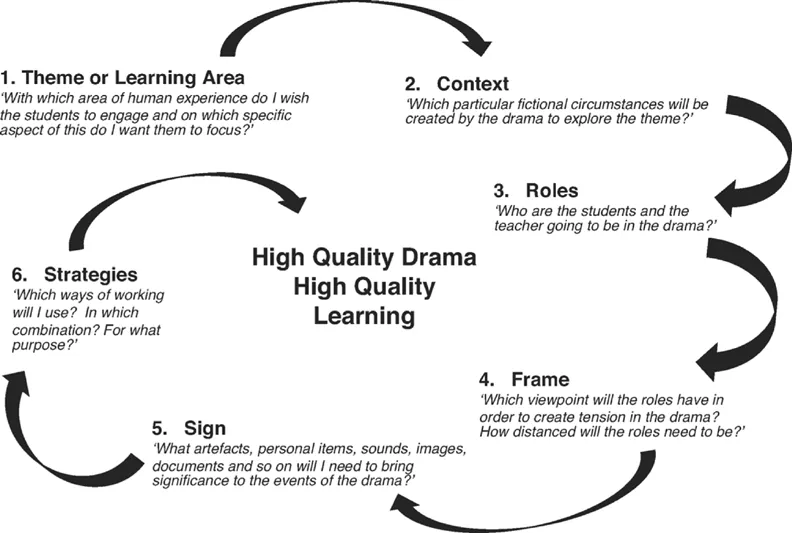
In our first attempt to explain the complexity of process drama to ourselves and others (2001, 2013) we recognised as others have done that process drama, like any other aspect of the curriculum, needs to be carefully planned if the students are going to have the greatest chance of learning from it. We tried to distil the key principles of planning process drama: theme, context, role, frame, sign and strategies, and created a series of key questions for the teacher to enable the choices she needs to make in the planning process (p.11). These can be seen in Figure 1.1.
At that time, we were clear that we were dealing with what we referred to as the ‘pre-action phase’ of the drama; focusing on the planning decisions that the teacher needs to make before the drama begins, even though we did include some extended examples of how a process drama might develop as it is created by the teacher and students together.
In this book, we are turning our attention to the myriad of choices the teacher must make while leading a group of students through the creation of a coherent and successful process drama experience during its ‘action phase’. That is after it has begun and as the narrative and tensions of the drama unfold in time and space through the action, reaction and interaction of the roles as they respond to the events of the emerging plot. The improvised nature of this form of drama together with its essential co-creativity between students and teacher means that she needs the ability to think on her feet as the drama unfolds.
Of course, we recognise that teachers across all subjects need to develop the skill to respond perceptively to what is happening in class. However, in process drama, there are specific considerations to be alert to.
So what are they?
In the theatre, responsibilities for the various elements that contribute to the production of a finished piece of dramatic art are widely distributed among several key people. Generally speaking, the playwright is responsible for the script of the play to be performed; the actors assume the various roles of the characters in the play, while the director guides the actors (supported by a team of technical artists responsible for costumes, sets, props, lighting and sound) to an interpretation of the playwright’s work which will provide a meaningful artistic experience for a watching audience of people who will interpret the event in their own way.
FIGURE 1.1 The principles of planning process drama
As Jonothan Neelands (1998, p.149) points out:
Actors train so that they can control gesture, time and space … Directors learn to weave all of the temporal, spatial and physical actions on the stage into the illusion of another world. Playwrights fill the artistic dimensions of time, space and presence with living and immediate representations of human behaviour and experience.
Process drama uses most of these elements of theatre, yet in many respects it appears even more complex in nature, because of the demands it makes on both the teacher and students. In working with process drama, the teacher, while never losing sight of her primary responsibility to provide a meaningful learning experience for her students, must simultaneously undertake the additional functions of actor, playwright and director because the learning experience she is seeking to facilitate is a drama.
We (2005) have termed this ‘quadripartite thinking’ (p.64) and used it to describe the range of ‘heads’ the teacher needs to wear to initiate and manage the complexities of the unfolding drama.
Moreover, process drama is fundamentally a whole group drama, improvised in nature, in which the students serve as co-creators of the dramatic experience as well as the audience for their own work. This is not to suggest that the students will spend time observing each other, although this might sometimes be the case. The key to understanding the mechanism for this type of drama for learning is the recognition of the human capacity to suspend disbelief and for the moment to accept the circumstances of a fiction as ‘real’ while simultaneously perceiving it for the fiction that it is. At the heart of this paradox, at the point where fiction and reality are in juxtaposition to each other, is the crucible in which both artistic creation and learning are forged. It enables the participant to be able to say, ‘I am making this happen’ and ‘This is happening to me’ as the voice of the artist and the voice of the learner speak in chorus.
So, the teacher cannot lose sight of the fact that as co-creators of the drama experience the students also assume the functions of playwright, actor and director as they interpret, develop, respond and contribute to the dramatic experience as it unfolds through their own quadripartite contributions.
Are there any further considerations?
We have not yet mentioned a fifth dimension – not a separate ‘missing head’ but rather a missing integrated strand rippling through all the others that runs throughout the entire collaborative creative and artistic relationship that exists within the process drama experience. It is that of the self-spectator, which as far as the teacher is concerned, means that she develops a critical awareness of herself as she operates in each of her functions as teacher, actor, playwright and director. Because we recognise that the teacher is likely to be more self-conscious of her responsibilities as teacher than the students are of theirs as learners, we acknowledge that the dimension of self-spectator might operate in a different way in the latter. Nonetheless, we believe that it is important for students as learners to similarly develop a critical awareness of themselves as they, too, operate within their additional functions of actor, playwright and director. This is because such an awareness supports learning about drama, itself, as well as enabling increasingly nuanced dramas to further enhance learning through drama about other things.
In other words, for the teacher as well as the students, the drama is experienced by both the self-interacting self and the self interacting with others. In the social context of the drama the self-interacting self is engaged with the formation and making of meaning, while the self also interacts with others in the collective practice of the art form (Merrell, 1992).
And now?
As with our approach to our earlier book (2013), in which we deconstructed the key elements in order to better appreciate how they worked together in the planning phase of the drama – so too, in this book, we intend to deconstruct the various functions of the teacher not only as teacher but also as actor, playwright and director in order to gain a better sense of how they operate in concert with each other. In addition, we will also examine how these interact with the similar range of functions in the students as they operate within the drama.
Earlier in this chapter we stated clearly that this book is about choices. Firstly, the teacher will make choices in response to the questions that can be seen in Figure 1.1 (p.4). However, once the drama begins to unfold, in the same way that the playwright makes choices about the style of the play, the structure of the plot, the ch...
Table of contents
Cover
Half Title
Title Page
Copyright Page
Dedication
Table of Contents
Preface
1 Process drama: art form and pedagogy
2 The improvised nature of the art form
3 The structural framework and making shifts in the drama
4 The head of the actor: working within the drama
5 The head of the director: the centrality of sign
6 The head of the playwright: developing the narrative, shaping and linking dramatic episodes
7 The head of the teacher: maintaining the learning
8 The imperative of task
9 Monitoring emotional range in drama
10 The spiral of creative exchange
11 Progression and the importance of reflection in process drama
12 Process drama and the complexities of co-creativity
Index
Trusted by 375,005 students
Access to over 1.5 million titles for a fair monthly price.
Study more efficiently using our study tools.
Frequently asked questions
Yes, you can cancel anytime from the Subscription tab in your account settings on the Perlego website. Your subscription will stay active until the end of your current billing period. Learn how to cancel your subscription
No, books cannot be downloaded as external files, such as PDFs, for use outside of Perlego. However, you can download books within the Perlego app for offline reading on mobile or tablet. Learn how to download books offline
Perlego offers two plans: Essential and Complete
Essential is ideal for learners and professionals who enjoy exploring a wide range of subjects. Access the Essential Library with 800,000+ trusted titles and best-sellers across business, personal growth, and the humanities. Includes unlimited reading time and Standard Read Aloud voice.
Complete: Perfect for advanced learners and researchers needing full, unrestricted access. Unlock 1.5M+ books across hundreds of subjects, including academic and specialized titles. The Complete Plan also includes advanced features like Premium Read Aloud and Research Assistant.
Both plans are available with monthly, semester, or annual billing cycles.
We are an online textbook subscription service, where you can get access to an entire online library for less than the price of a single book per month. With over 1.5 million books across 990+ topics, we’ve got you covered! Learn about our mission
Look out for the read-aloud symbol on your next book to see if you can listen to it. The read-aloud tool reads text aloud for you, highlighting the text as it is being read. You can pause it, speed it up and slow it down. Learn more about Read Aloud
Yes! You can use the Perlego app on both iOS and Android devices to read anytime, anywhere — even offline. Perfect for commutes or when you’re on the go. Please note we cannot support devices running on iOS 13 and Android 7 or earlier. Learn more about using the app
Yes, you can access Putting Process Drama into Action by Pamela Bowell,Brian S. Heap in PDF and/or ePUB format, as well as other popular books in Education & Education General. We have over 1.5 million books available in our catalogue for you to explore.