eBook - ePub
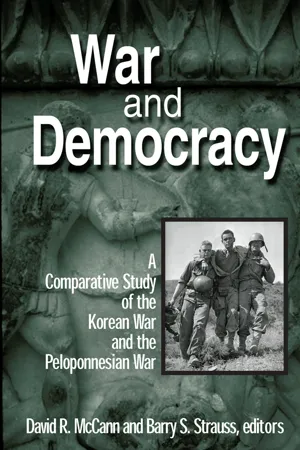
War and Democracy: A Comparative Study of the Korean War and the Peloponnesian War
A Comparative Study of the Korean War and the Peloponnesian War
- 388 pages
- English
- ePUB (mobile friendly)
- Available on iOS & Android
eBook - ePub
War and Democracy: A Comparative Study of the Korean War and the Peloponnesian War
A Comparative Study of the Korean War and the Peloponnesian War
About this book
A comparison of the cultural and political/institutional dimensions of war's impact on Greece during the Peloponnesian War, and the United States and the two Koreas, North and South, during the Korean War. It demonstrates the many underlying similarities between the two wars.
Information
Part I
Democracy: Bellicose, Imperial, or Idealistic?
1
Democratic Warfare, Ancient and Modern
Political thinkers from Machiavelli and Hobbes to George Marshall have written of pragmatic wisdom gleaned from their own Thucydides.1 Yet the time-honored practice of applying the paradigm of his history of the Peloponnesian War to specific contemporary issues is a treacherous one, prone to false assumptions and rife with unfounded analogies. To be frank, I have no idea whether bipolarity or multipolarity is a more stable system of world alliance, or whether Thucydides himself knew the answer—or even anymore whether the historian was an objective realist dutifully outlining the bleak world of interstate relations or a sophisticated moralist whose examples are subjective, deliberately sifted to confirm his own preconceived notions of human behavior and ethics, or whether he was at times neither or both.2
Still, many historians and political scientists have believed that our fifty-year standoff with the Soviet Union is explicable through analogy with the rivalry between Athens and Sparta. In this view, following a successful alliance against a tyrannical would-be enslaver (Persia/Germany), the inevitable differences between Athens/America and Sparta/Soviet Union led the two former allies into armed opposing hegemonies. In these bipolar worlds, the former are democratic, free societies, based on market economies and strong fleets; the latter inward-looking, static cultures, which rely on well-disciplined, if not brutal, infantry regimens.3
In this well-worn model, small Third World states such as Melos/Korea might be seen as either caught in, or manipulated by, the imperial aspirations of morally neutral superpowers. Further similarities between ancient and modern hegemonies extend to the distortion of their own respective domestic societies during decades of growing polarization: Sparta and the USSR are forced to acquire navies and soon doomed to open their societies to compete on the world scene, while Athens and America often betray the spirit of their own constitutions to match the realpolitik of their autocratic adversaries.
But many scholars have countered that the entire analogy is simplistic and upon close analysis fails. The presence of nuclear weapons as final arbiter of conflict makes such ancient and modern parallels simplistic: in antiquity miscalculation, desperation, accident, and misfortune did not lead to instantaneous annihilation of civilization itself. Ancient renegade regimes, with small populations and without allies, did not warrant deference due to the possession of a small nuclear device or two.
The modern Western notions of Christianity and Marxism further distort any facile correspondence and show that intent in America and Russia has been guided by ideologies, religious and otherwise, quite different from their supposed ancient counterparts’ allegiance to either democracy or oligarchy. More paradoxically still, not all would accept the identification of Sparta with the Soviet Union and Athens with America. Sparta’s more egalitarian Peloponnesian League is far closer to the collective security of NATO; the Athenian ironclad confederation surely more akin to a Warsaw Pact that likewise followed the lead of its imperial hegemon. And the more pragmatic critic will simply point out that, unlike the victorious authoritarian Spartans, the Soviet Union lost their cold war against an imperial democracy, proving that 2,500 years of history leave only the thinnest veneer of similarity and tell us nothing about the unchanging nature of the collision between repressive and liberal states.4
Thus I cannot explain how Korea follows or does not follow the Thucydidean paradigm, whether it was a modern Melos that was dragged into a bipolar struggle only to suffer horrendous losses in lives and natural treasure in the backwaters of a larger war, or whether, like the tiny village of Plataea, its slim chance for safety against foreign thuggery lay under the protection of a democratic and benevolent big brother.5
Instead, I wish to learn from the Greeks about the more general question of how democracies conduct themselves in war—and why they often win. There is a considerable body of modern research on the role between democracy and warfare of the last three centuries: in general the evidence suggests that democracies are no less likely to go to war than their autocratic counterparts. In the words of Quincy Wright: “Peace produces democracy rather than that democracy produces peace.” The only encouraging conclusion of the social scientists is that belligerency between like democratic states is infrequent, giving hope to Kantian idealists that should the world become a pandemocratic association of nations, war itself might be rarer. In the end, however, such Utopian theories remain unproven, and our view of warfare in democracies—which most effectively and most quickly voice the will of the citizen majority—apparently depends on how we view the nature of man himself.6
In any case, our ancient evidence is unequivocal: the first and greatest democracy in the West widened, amplified, and intensified the conduct of conflict in a manner unseen before in the history of Greek warfare. In fact, of all forms of ancient government—from monarchy to aristocracy to tyranny to oligarchy and moderate timocracy—for nearly two centuries democracy was the most warlike, revolutionary, and successful of all in its practice of arms.
For purposes of brevity in this ancient investigation, I concentrate on Athens, the first, largest, and best known of the Greek democracies. By “democracy,” I mean rule by the majority of all resident, adult male citizens whose vote in the assembly alone marked the declaration of war. In practical terms, in the Greek world, extreme or radical democracy meant an absence of a property qualification, the empowerment of the poor, the use of the lot, and near full citizen public participation in courts, magistracies, and the assembly regardless of property, wealth, class, or birth (Arist. Pol. 3.1279b-80a; 6.1317a16–b40; b2–b10; cf. Hdt. 3.80.6).7
First however, we must review quite briefly the status of Greek warfare prior to the rise of fifth-century Athenian democracy. That two-century history of hoplite battle in the seventh and sixth centuries B.C. reveals just how radical a departure was the democratic way of war.
Pre-Democratic Warfare Among the Greek City-States
Greek warfare of the city-state emerged somewhere around 700 B.C. as an agrarian enterprise, one made up of farmer-citizens fighting on farmland over disputed farmland (Arist. Pol. 4.1291a31–33; cf. Xen. Oec. 5.12–18; Xen. Oec. 5.4–5; 6.6.7. 9–10; [Arist.] Oec. 12. 1343b2–6; Pl. Rep. 2.374C). Indeed, often farmland itself was assessed in terms of how great a number of hoplite infantry that region might theoretically support (Arist. Pol. 1270a17–32; Plut. Mor. 413F–414A; cf. Dem. 23.199; FGrH 115 225). One-day battles were not designed for aggression or sustained expeditions (Thuc. 1.141.5; Dem. 1.27; Ar. Pax 1183). From an exclusively agricultural point of view hoplite warfare was an extremely frugal enterprise (Dem. 9.48; Polyb. 13.3.2–4), where property and income taxes were not raised from the rural populace to pay for lengthy campaigning. Few, if any, significant wars on land took place. Most smaller disputes were usually between neighboring city-states, whose hoplites killed each other over small tracts of border ground (Thuc. 1.15.2; 5.41.2). Those lands, ironically, were not always valuable in a purely agricultural sense, but were important to farmers as symbols of agricultural prestige, promoting the growing agrarian chauvinism of the community at large, and reflective of individual agrarians’ own endless haggling with neighboring farmers (cf. Hom. Il. 12.421–24).8
Once this system of hoplite warfare arose in the late eighth and seventh centuries B.C., the traditional social and economic expenditures of fighting, so common earlier in the palace economies of the Near East and in Egypt—property taxes and rents, technology, soldiers’ salaries, extensive fatalities, lost agricultural productivity, lengthy training and preparation, sieges, permanent officers and planners, destruction of entire cultures, unity of political and military authorities—were minimal. Indeed, such military cargoes were often nonexistent throughout a vast area of the Greek-speaking world, a break between early Western and Eastern practice that cannot be strongly enough emphasized.9
Instead, simple durable weapons were largely standardized for nearly two centuries throughout the insular Greek city-states. The extensive and unmatched protective cover of such bronze armor, the deliberate exclusion of missile-weaponry, cavalry, skirmishers—all the usual sources of fatal motion and speed on the battlefield—and the accompanying rules that limited fighting in a concrete and moral sense, reduced drastically the number who were killed in any given battle. Like restrictions against land accumulation and political aggrandizement, land warfare of the Greeks between the eighth and fifth centuries strove to ensure the equilibrium of the agrarian patchwork of middling property owners. So unlike their more sophisticated successors, Greek hoplite landowners of the seventh and sixth centuries B.C. were fighters of a day; they may not have been democratic in the later Athenian sense, but their property census was not high, and anywhere from a third to a half of the native-born citizenry enjoyed a remarkable egalitarianism.
More specifically, there was neither a priestly class of unproductive military professionals nor an otherwise unemployed military intelligentsia. The formal study of tactics as either a command or academic enterprise did not even exist before the late fifth century B.C. Agricultural devastation was a trigger to start fighting rather than a means to ruin a community. Plunder and booty were incidental, not essential, to the mobilized army’s existence, at least until the fourth century B.C. Formal hoplite battle left relatively little imprint on the local civilian environment. Since the key was to maintain capital and political authority among a tight-knit group of yeoman, warmaking did not evolve beyond the farmer’s peculiar and blinkered notion of time and space.10
To the modern military mind, very little was left to chance in hoplite battle. Most often it was simply a case of winning the fray with your strong right wing—“horns,” as the agrarian infantrymen called them—before suspect and less reliable allied militias on the left collapsed (Thuc. 5.73; Xen. Hell. 6.4.14)—sometimes, as in the case of the so-called tearless battle (Plut. Ages. 33.3; cf. Xen. Hell. 3.217; 4.3.12), before even meeting the enemy. Most rudimentary tactics that did emerge were simple, rather than complex, variations of head-on assaults in column. Given the absence of reserve troops, specialized units, the surprise attack, the night engagement, and the concealed ambush, there was no desire until the fourth century B.C. for elaborate pre-battle tactical planning or even real battlefield command. An Alexander, Napoleon, Patton, or Rommel might have sent cavalry to punch holes in the enemy phalanx, javelin-throwers and archers to volley at his wings, followed by light infantry feints, encircling columns, and surprise attacks in the rear—all preliminaries to the main assault held in reserve, awaiting the opportune moment of enemy weakness. But to the polis Greeks before the advent of Athenian imperial democracy, these generals would have been a distasteful bunch, tinkerers and manipulators unwilling, at first sight of the enemy mass, to grab the shield and run anonymously with their men to death.
Yet, I do not intend to minimize the brutality of early battle. One need only read the poet Tyrtaeus’ “beating waves of assault,” “the dead man in the dust,” “toe-to-toe and shield against shield,” and the hand “holding the bloody groin” (Tyrt. 10.21–25; 11.31–34; 12.23), or glance at early Corinthian vase-painting to recoil from the mayhem and bloodletting among those in the front ranks. For those few hundreds and occasionally thousands of combatants, battle was an especially horrific experience (cf. Pindar fr. 120.5).
The Athenian Military Renaissance
The rise of radical Athenian democracy in the fifth century altered the entire nature of hoplite fighting and thus the Greek way of war. It mutated agrarian warfare to reflect new democratic ideology and values and new challenges beyond the Greek mainland, and so left in its wake a sophisticated and dynamic military practice that had a great deal to do with the destruction of the Greek city-state itself. True, infantry battle between phalanxes still continued throughout the slow decline of the free city-state well into the middle and later fourth century B.C., as the famous murderous encounters at Coronea (394 B.C., Nemea (394 B.C.), Leuctra (371 B.C.), Mantineia (362 B.C.), and Chaeronea (338 B.C.) attest. Those battles, fought magnificently with hoplite infantry and seemingly oblivious to the military revolutions of the times, were in themselves not much different from phalanx fighting of the seventh century B.C.—even though such collisions were no longer any part of a rigorous agrarianism. And the arrangement of spearmen in columnar formation was commonplace even during the subsequent Macedonian period in Greece, as the engagements between heavy pike-bearing phalangites at several later clashes confirm (e.g., Sellasia [222 B.C.], Cynoscephelae [197 B.C.], Pydna [168 B.C.]).
So technically, the charge of a phalanx, whether armed with the traditional hoplite panoply or, in the third through second centuries B.C., modified tactically and equipped with the Macedonian sarissa (the fourteen to twenty-foot pike) and lighter body armor, remained an option for Greek military commanders well into Roman times; on its chosen ground no formation could withstand its onslaught. The legacy of phalanxes remains with us in the West today, seen in our preference to fight it out quickly, brutally, and at all costs decisively, a mili...
Table of contents
- Cover Page
- Half Title Page
- Title Page
- Copyright Page
- Dedication
- Contents
- Introduction
- Part I. Democracy: Bellicose, Imperial, or Idealistic?
- Part II. Categorizing Wars: Civil or Hegemonic, Decisive or Cyclical?
- Part III. Third Forces, or Shrimps Between Whales
- Part IV. Demagogues? or Domestic Politics in Democracies at War
- Part V. Realism, Militarism, and the Culture of Democracies at War
- Chronology
- Contributors
- Index
Trusted by 375,005 students
Access to over 1.5 million titles for a fair monthly price.
Study more efficiently using our study tools.
Frequently asked questions
Yes, you can cancel anytime from the Subscription tab in your account settings on the Perlego website. Your subscription will stay active until the end of your current billing period. Learn how to cancel your subscription
No, books cannot be downloaded as external files, such as PDFs, for use outside of Perlego. However, you can download books within the Perlego app for offline reading on mobile or tablet. Learn how to download books offline
Perlego offers two plans: Essential and Complete
- Essential is ideal for learners and professionals who enjoy exploring a wide range of subjects. Access the Essential Library with 800,000+ trusted titles and best-sellers across business, personal growth, and the humanities. Includes unlimited reading time and Standard Read Aloud voice.
- Complete: Perfect for advanced learners and researchers needing full, unrestricted access. Unlock 1.5M+ books across hundreds of subjects, including academic and specialized titles. The Complete Plan also includes advanced features like Premium Read Aloud and Research Assistant.
We are an online textbook subscription service, where you can get access to an entire online library for less than the price of a single book per month. With over 1.5 million books across 990+ topics, we’ve got you covered! Learn about our mission
Look out for the read-aloud symbol on your next book to see if you can listen to it. The read-aloud tool reads text aloud for you, highlighting the text as it is being read. You can pause it, speed it up and slow it down. Learn more about Read Aloud
Yes! You can use the Perlego app on both iOS and Android devices to read anytime, anywhere — even offline. Perfect for commutes or when you’re on the go.
Please note we cannot support devices running on iOS 13 and Android 7 or earlier. Learn more about using the app
Please note we cannot support devices running on iOS 13 and Android 7 or earlier. Learn more about using the app
Yes, you can access War and Democracy: A Comparative Study of the Korean War and the Peloponnesian War by David R. McCann,Barry S. Strauss in PDF and/or ePUB format, as well as other popular books in Politics & International Relations & Asian History. We have over 1.5 million books available in our catalogue for you to explore.