History, Literature and Theology in the Book of Chronicles presents a new way of approaching this key biblical text, arguing that the Book employs both multiple viewpoints and the knowledge of the past held by its intended readership to reshape social memory and reinforce the authority of God. The Book of Chronicles communicates to its intended readership a theological worldview built around multiple, partial perspectives which inform and balance each other. This is a worldview which emphasizes the limitations of all human knowledge, even of theologically "proper" knowledge. When Chronicles presents the past as explainable it also affirms that those who inhabited it could not predict the future. And, despite expanding an "explainable" past, the Book deliberately frames some of YHWH's actions - crucial events in Israel's social memory - as unexplainable in human terms. The Book serves to rationalise divinely ordained, prescriptive behaviour through its emphasis on the impossibility of adequate human understanding of a past, present and future governed by YHWH.
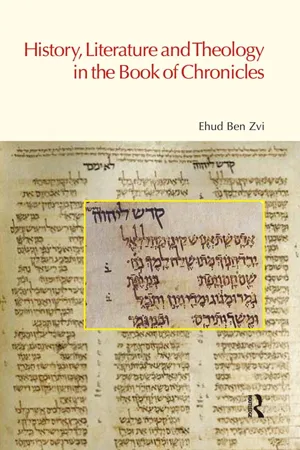
- 316 pages
- English
- ePUB (mobile friendly)
- Available on iOS & Android
eBook - ePub
History, Literature and Theology in the Book of Chronicles
About this book
Information
Part I
INTRODUCTORY ESSAYS
Chapter 1
INTRODUCTION
This is a collection of twelve studies, ten of which were published in the last fifteen years in a variety of journals, Festschriften and other works. Chapters 3 and 10 are published here for the first time, and Chapter 9 was co-authored by Antje Labahan and me. These studies are published together, because their cumulative weight leads, among others, to a new understanding of the Book of Chronicles, its balanced and nuanced theology – for the present purposes, there is no difference between ‘theology’ and ‘ideology’, historiographical approach and of the way in which the book serves to reshape the social memory of its intended and primary rereaderships, in accordance with its own multiple viewpoints and the knowledge of the past held by its community. (Ancient readerships in ancient Israel were rereaderships; the latter term will be used occasionally to stress that the relevant books were not read, but mainly reread, time and again.)
The book is organized around four parts: (a) Introductory Essays, (b) Chronicles and the Rereading and Writing of a Didactic, Socializing History, (c) Chronicles and Theology as Communicated and Recreated through the Rereading of a Historiographical, Literary Writing and (d) Chronicles and Literature: Literary Characterizations that Convey Theological Worldviews and Shape Stories about the Past. The first part includes this chapter as well as one in which several of the positions elaborated in this volume are brought forward and summarized. The second part explores what I would call the historiography of the implied author of the book of Chronicles as constructed by the intended and primary rereaderships of the book. In which ways is the past constructed in this didactic work? In which ways do the readers of the book socialize themselves by reading the book or reading it to others. To be sure, the point of the didactic exercise is not only to construct a past, but to construct a past for the purpose of communicating ‘proper’ theological positions. So the ‘historian’ is also a ‘theologian’. Conversely, the ‘theologian’ is a ‘historian’, since much of this theology is formulated and communicated through the construction of images of the past. As result, the boundaries between the material discussed in Part II and Part III are quite artificial and certainly porous. Essays in Part III focus more, however, on theology as communicated and recreated through the reading and rereading of Chronicles than on questions of historiographical writing. Similarly, Chronicles is a historical narrative. It is a history, but as any history it is also a literary piece, even if subject to particular genre requirements (e.g., to be coherent with the images or social memory/ies agreed upon or at least acceptable within the discourses of the communities within which and for which the relevant historical book was written). Thus the boundaries of the last section are certainly as arbitrary and porous as those of the first two. The main difference is that some often called literary-critical questions are more salient here than in the other sections.
These studies represent my work on Chronicles through a considerable time span. Of course, my mind kept considering matters, and probing new ideas and directions, so there is a sense of progress (hopefully, not of regress) from the earlier to the later contributions. Thus, for instance, ideas first adumbrated in some earlier contributions are fully developed in later ones, and then, at an even later stage, their implications or the larger context in which they play a role become clear. Similarly, some positions taken as accepted knowledge in earlier essays are strongly questioned or rejected in later ones. This said, when taken as a whole, the reader of this volume will note that although each of these studies explores a particular topic or pericope their conclusions or implications on several crucial topics tend to converge time and again. Among these topics, one may mention the call for a thorough re-evaluation of the theology of the Book of Chronicles and the understanding of (hi)story that the book advances. This collection as a whole contributes also to the advancement of better understanding of the self-perception of the (hi)storian that it reflects, the world of knowledge of its readership, and accepted views about borders, among Israel and ‘the other’, or men and women, and their partial permeability. Thus, this collection provides an important window for the examination of the intellectual history and milieu of late Achaemenid Yehud and Jerusalem. It contributes also to a better understanding of the concept of the reception and mode of reading of (hi)storiographical works that existed within that milieu. For instance, Chapter 3 shows that the primary readerships of the book were asked to, and most likely did approach some passages in Chronicles (and other [hi]storiographical works) from perspectives other than collecting information so as to recreate a fully mimetic, on the surface true, image of past events. Moreover, it claims that such passages were marked, so as to help the primary readerships that approached the text within, rather than against its grain to recognize them.
I would like to emphasize from the outset that these studies repeatedly demonstrate that Chronicles communicates to its intended readership a theological worldview built around multiple, partial perspectives informing and balancing each other. Significantly, it is a worldview in which the limitations of even theologically ‘proper’ knowledge are emphasized. For instance, in Chronicles’ past similar deeds may and at times did lead to very different results. Thus, even if most of the past is presented to the readers as explainable, it also affirms that those who inhabited it could not predict the path of future events. Chronicles is therefore, a (historiographical work that informs its readers that historical and theological knowledge does not enable the prediction of future events. Further, although Chronicles tries to expand the ‘explainable’ past, it poignantly construes some of the most crucial events in Israel’s social memory as unexplainable in human terms. Thus, Chronicles communicates to its readers that some of YHWH’s most influential decisions concerning Israel cannot be predicted or explained. It is against this background of human limitation in understanding causes and effects in a past (present and future) governed by YHWH and the uncertainty that it brings, that the emphasis on divinely ordained, prescriptive behaviour should be seen. The intellectual horizon of Chronicles was perhaps not so far from that of the interpretative frame of Job or Qohelet, and of these books as a whole.
The essays have been kept in their original form, except for minor changes. These include very minor bibliographic updates, occasional additional comments in the notes, simple matters of style and the like, and a few notes on matters on which I did substantially change my mind (see Chapter 11). As a result, readers of this volume can still approach each one of these essays separately, as readers of these chapters in their original publication have been able to do. At the same time, the reader of this volume will easily recognize that these essays are interconnected. At times, a simple observation in the body of text or in a note in one is fully discussed in another; at times, the argument of one strongly builds on and develops further or reinforces positions advanced in another. Readers of this volume will be able to discern and follow these connections much more easily than readers of the individual articles, and above all will be able to assess the cumulative argument on the central matters mentioned before that this collection as a whole provides.
Since I have refrained from changing these essays in any substantial way, I will mention here some of my thoughts as I underwent the process of reading and thinking about them again, from a 2005 viewpoint.
The first essay (Chapter 2) originated as my presidential address at the 2002 Annual Meeting of the Canadian Society of Biblical Studies (CSBS). The precise contents were distributed in printed form, as all presidential addresses in the Society, in the yearly Bulletin the society distributes to its members the following year. It was later published in Studies in Religion/Sciences Religeuses, which is the journal of the Canadian Corporation for Studies in Religion. It was my intention at the time to use the presidential address to bring the book of Chronicles to the attention of the members of the CSBS, and above all, to new ways of understanding Chronicles, to invite them to consider a new general viewpoint. The book of Chronicles has been discussed much more among members of the Society since. If I contributed to that process, even if in a minor way, I would be delighted.
In its present form the essay serves well as an introductory chapter to the volume as a whole. It provides a reflection on, and above all a summary outline of some of the views I have adopted through time on the book of Chronicles and the study of the book of Chronicles (see, e.g., Chapters 6, 8 and 9). It also elaborates on some important themes that are not dealt with elsewhere in the volume (see especially the discussion about shaping memory and similarity and dissimilarity in the presentation of a new historiographical work).
A prominent aspect of the talk, and of the essay now, is the call to recognize the balanced, theological approach that Chronicles communicated to its intended and primary rereaderships, once all its messages are taken into account. Chronicles is a work in which the partial messages of individual literary subunits (e.g., regnal accounts or sections thereof) interact, inform and place in proportion those of other subunits in the book and all together communicate the full range of the theological discourse in which both authorship and intended and primary readerships were involved. It follows, therefore, that one must carefully differentiate between the messages conveyed by particular accounts, or portions thereof, and those conveyed by the book as a whole. The former are only strands in the dense tapestry of the latter. To understand the theological positions that are brought forward in Chronicles as a whole, and which the intended and primary rereaderships were supposed to associate with the Chronicler as its implied author, the focus should be on the general tapestry. This issue is a recurrent theme throughout the volume.
Looking back at this essay, my main regret is that I did not include in the original address (or its later published version) any discussion of modes of reading and the related questions concerning genre that emerge from these considerations. Of course, a full discussion of these matters would have been well beyond the scope of the presentation/article, but some reference to them would have been in order.
An analysis of these matters, however, stands at the center of Chapter 3 (published for the first time in this volume). One of its main conclusions is that the intended and primary readerships of the book were asked to, and most likely did approach some passages in Chronicles (and other [hi]storiographical works) from a perspective other than collecting information so as to recreate a fully mimetic, on the surface, true image of past events. In fact, the Chronicler (i.e., the implied author of the book as constructed by the mentioned readerships) does not claim to provide a transparent window into the past, but something akin to a painting of the past with a particular point to make and a didactic purpose, that is, as representations that bring forward a truth or sets of truths, but not necessarily a detailed, mimetic and fully historically reliable picture of events and circumstances of the past.
To be sure, the primary readerships most likely believed that the communicator speaking to them through the text of Chronicles, that is, the Chronicler was relating to them the events as they truly happened. But ‘truly’ here does not point at ‘truth’ in the sense of ‘objective’ truth, or history as ‘it actually happened’. The literati who constituted these communities of readers neither expected nor demanded full and complete mimesis with past events. Nor did their historiographical works claim to provide it. In fact, they contain instances of lack of congruence at the mimetic level that served as literary or rhetorical devices to draw attention to meanings of the text at levels other than the mimetic, from the perspective of the primary readerships. The observations advanced in the chapter bear implications for the study of ancient Israelite historiography and for that of the possible genre differences and overlaps between ‘historical’ and ‘fictional’ narratives. A full study of these implications is, of course, beyond the scope of the chapter and involves more than Chronicles. These observations have also ‘practical’ applications for the study of particular accounts in Chronicles. The latter are illustrated with several examples from the account of Amaziah in 2 Chronicles 25. I hope readers of the chapter are drawn to further studies of both the ‘practical’ and general implications of the matters discussed here.
Chapter 4 (i.e., ‘Shifting the Gaze: Historiographic Constraints in Chronicles and their Implications’) is in part a call for a corrective stance. The study of Chronicles has focused for the most part on how and why Chronicles deviates from its sources. My call is to focus as much on cases of ‘lack’ of deviation, which are at the very least as many in the book. Certainly, Chronicles could not deny, some facts agreed upon within the community/ies within and for which the book was composed. But why these facts, but not others? What characterizes them, and what does it tell us about the world of the intended and primary rereaderships of Chronicles and their construction of the implied author of Chronicles?
This chapter maintains a very important distinction between ‘core facts’ that cannot be challenged and all other facts that existed within the relevant discourses and constructions of the past that existed among the Yehudite literati of the time of Chronicles (cf. my ‘Malleability and its Limits: Sennacherib’s Campaign against Judah as a Case Study’, and Chapter 6 in this volume). Rather than enumerating these core facts – though numerous examples are provided in the chapter – the main point of the essay is to examine how these distinctions between ‘core’ and ‘non-core’ contributes to an understanding of the worlds of knowledge within which Chronicles was composed and first read and reread. Again, I hope this chapter will contribute to the setting of an agenda that should, and I hope will be expanded also in terms of the literature being studied. For instance, one could ask which kinds of core facts are represented across biblical genres in Yehud and which are not, and why? As per methodology, the matter of core facts can be profitably approached within the general, heuristic frame of social memory/ies and its/their roles in society. Certainly, the study of social memories has much to contribute to that of the...
Table of contents
- Cover Page
- Half-Title Page
- Title Page
- Copyright Page
- Dedication
- Table of Contents
- Acknowledgments
- Abbreviations
- Part I Introductory Essays
- Part II Chronicles and the Rereading and Writing of a Didactic, Socializing History
- Part III Chronicles and Theology as Communicated and Recreated Through the Rereading of a Historiographical, Literary Writing
- Part IV Chronicles and Literature: Literary Characterizations that Convey Theological Worldviews and Shape Stories about the Past
- Bibliography
- Index of Biblical Works Cited
- Index of Authors and Individuals Cited
Trusted by 375,005 students
Access to over 1.5 million titles for a fair monthly price.
Study more efficiently using our study tools.
Frequently asked questions
Yes, you can cancel anytime from the Subscription tab in your account settings on the Perlego website. Your subscription will stay active until the end of your current billing period. Learn how to cancel your subscription
No, books cannot be downloaded as external files, such as PDFs, for use outside of Perlego. However, you can download books within the Perlego app for offline reading on mobile or tablet. Learn how to download books offline
Perlego offers two plans: Essential and Complete
- Essential is ideal for learners and professionals who enjoy exploring a wide range of subjects. Access the Essential Library with 800,000+ trusted titles and best-sellers across business, personal growth, and the humanities. Includes unlimited reading time and Standard Read Aloud voice.
- Complete: Perfect for advanced learners and researchers needing full, unrestricted access. Unlock 1.5M+ books across hundreds of subjects, including academic and specialized titles. The Complete Plan also includes advanced features like Premium Read Aloud and Research Assistant.
We are an online textbook subscription service, where you can get access to an entire online library for less than the price of a single book per month. With over 1.5 million books across 990+ topics, we’ve got you covered! Learn about our mission
Look out for the read-aloud symbol on your next book to see if you can listen to it. The read-aloud tool reads text aloud for you, highlighting the text as it is being read. You can pause it, speed it up and slow it down. Learn more about Read Aloud
Yes! You can use the Perlego app on both iOS and Android devices to read anytime, anywhere — even offline. Perfect for commutes or when you’re on the go.
Please note we cannot support devices running on iOS 13 and Android 7 or earlier. Learn more about using the app
Please note we cannot support devices running on iOS 13 and Android 7 or earlier. Learn more about using the app
Yes, you can access History, Literature and Theology in the Book of Chronicles by Ehud Ben Zvi in PDF and/or ePUB format, as well as other popular books in Historia & Historia antigua. We have over 1.5 million books available in our catalogue for you to explore.