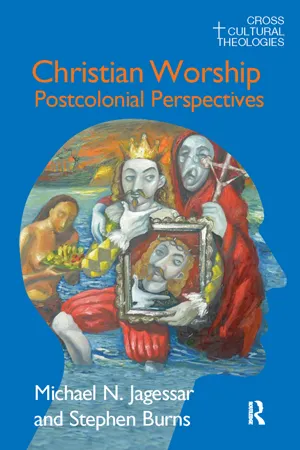
- 160 pages
- English
- ePUB (mobile friendly)
- Available on iOS & Android
eBook - ePub
About this book
Postcolonialism has greatly influenced biblical and theological criticism but has not yet entered the realm of church worship and practice. 'Christian Worship' brings the insights of postcolonial thinking to the rituals of religious life. The book critically analyses liturgical theology through the lens of postcolonialism and explores the challenges of appropriating postcolonial perspectives in Christian worship. Ranging from liturgical texts and song to Scripture, lectionaries, festivals and sacraments, this volume offers a fresh approach to liturgy that will be of interest to students of theology, seminarians and church practitioners.
Information
Part One
Postcolonial Optics
1 On Opting for an Optic
The term “postcolonial” is contested, is put to different uses by different persons, and shelters a range of distinct, though related, convictions, methods and themes. Postcolonial theology has begun to elaborate on this cluster of issues in relation to texts and doctrines, and our own present work is an attempt to expand attention from texts and doctrines to symbols and practices that shape Christian assembly, in what we believe to be a distinctive initiative. By examining the diverse ways in which the term postcolonial is used, we enlarge some understandings more widely held in common: that postcolonial perspectives involve (i) affirmation of the equal dignity of human beings, (ii) exposure of imperial dynamics at play in culture and politics, unreflective everyday practices as well as carefully and intentionally constructed policies, and (iii) celebration of subaltern wisdom, creativity and resistance to dominant supposed “norms.” The liturgical genres that provide counterparts for these foci are perhaps bold proclamation, searching lament and generous praise. And perhaps the convergence of postcolonial and liturgical concerns also beckons, or provokes, an invitation to repentance?
We offer further biographical material in the course of our reflections, but at the outset state that one of us is Black, an Indo-Guyanese person who currently resides in the UK and whose familial commitments also link him to mainland Europe and North America. The other is White, a British person who currently resides in Australia, whose familial commitments link him to sojourners in North America and Asia as well as indigenous Australia. Both have some, though very different, experiences of Diaspora. One’s teaching and published work is closely identified with “Black theology,” being the reviews editor of an international journal that bears that name and having published two books with the phrase “Black theology” in the title line, one of which also bears the descriptor “postcolonial.” The other is closely associated with studies of “liturgy” and “worship,” marked by critical classicist approaches and often of an inter-disciplinary nature. This makes our partnership in this joint exploration of postcolonial perspectives of Christian worship both appropriate and strong, and expands our previous joint writing on the convergence of our concerns, and our joint editing with another colleague, Nicola Slee, of a collection that includes alongside our own contributions a number of others’ postcolonial perspectives on liturgical topics.
Still, we are not without reserve in pursuing this project. Firstly, we cannot possibly provide anything like a comprehensive postcolonial critique of liturgical tradition and practice. We do not attempt to revisit the kind of introduction to liturgical studies that one of us has written but this time more intentionally through postcolonial optics. Rather, we must settle instead for something more piecemeal and modest that nevertheless suggests the challenging implications of this approach for liturgical foci we are unable to unfold here. More than that, however, our reserve – and particularly, perhaps that of Stephen Burns – is about the possibility, let alone appropriateness, of a White person addressing the concerns that emerge in this book. We affirm that “White liberals” (such as Stephen imagines others as well as himself might assume himself to be) – and moreover White persons in general – need to be confronted with postcolonial perspectives. We submit that White persons who attempt to voice postcolonial perspectives are rightly vulnerable to possible charges of paternalism and the oftentimes gross attempt to speak for another, such as one should not and indeed in fact cannot. Still, we tentatively wish to suggest that the risks of a White person attempting to give voice to postcolonial perspectives are at least reduced by our method in which we both jointly own the convictions in this book, as we together embrace a revisionist agenda for Christian worship. Further, we also hold the view that as the progenies of both colonized and colonizer histories, the complex interrelationship forces us together. Whatever the caveats, Caliban and Prospero are inseparable (as is the significant role of Miranda) in this conversation.
Notwithstanding, our shared intent is to suggest ways in which Christian worship, as both enacted and studied, should change in response to postcolonial critique. To put it bluntly, we are committed to change rather than to silence,1 and so we invite readers who may relate to a White liberal dilemma that should rightly be of concern also to “stutter”2 towards speech in the conviction that change is necessary and that silence is not an option for us if it colludes with further practice of imperialism. Resort to silence can be an abrogation of integrity and responsibility.
Even so, we remain aware that as the term “liberation” has, in Rasiah Sugirtharajah’s term, been “highjacked,”3 so there is a clear potential threat that postcolonial convictions and themes will be “co-opted by the Christian mainstream.”4 Sugitharajah complains of the way in which the basic tenets of liberation theology have been absorbed by theologians far from the contexts in which liberation theology emerged, and then “recast as apolitical and personal empowerment.”5 We assert that constant self-critical vigilance is required of White liberals to temper the absorption of postcolonial perspectives simply as an “enrichment” to what are undoubtedly important emancipatory but nevertheless somewhat other agendas, be they feminist, queer or whatever in their trajectory (we name these two in particular because of their prominence alongside postcolonial perspectives in our previously mentioned edited collection). We suggest that a commitment to postcolonial perspectives will involve vigilance about attempting to retain a focus on issues of ethnicity, however helpful it also is to foster the kind of bi-focal, tri-focal, and other alliances that resist the atomization of optics oftentimes regarded as “marginal.” Indeed, alliance may be crucial to effective resistance of dynamics of marginalization which may more easily take place when related though distinct optics remain atomized.6 This is to say at least that White liberal consideration – and celebration – of postcolonial perspectives needs to quite consciously and constantly be checked by reference to a tradition of postcolonial thinking which began and continues to focus on issues of ethnicity, complex and diverse as that vibrant tradition has become.
These reflections raise questions in their turn about how we relate in this work to liturgical tradition, and what might be signalled by talk (employed above) of critical classicism in relation to it. We conclude this book with reflections in this area; in the meantime, however, we note that Stephen Burns especially broadly concurs with Gordon Lathrop, who writes of being: “marked by the willing reception of traditional patterns and archaic symbols, in the belief that these classics bear authority among us … [yet] at the same time … marked by the willing elaboration of a contemporary critique of received tradition.”7 Together, we affirm that our explorations are committed to maintaining a focus on the ambiguities of tradition. And we assert that commitment to tradition implies commitment to “search for lost coins” within it, to echo a feminist image which has been of special importance to Stephen Burns,8 which is essentially a constructive task.
Locating and Interrogating Selves
One of the implications of contextual theology is that it involves autobiography. We affirm Dolores Williams’s sense that
I have come to believe that theologians, in their attempt to talk to and about religious communities, ought to give readers some sense of their autobiographies. This can help an audience discern what leads the theologian to do the kind of theology she does. What has been the character of her faith journey? What lessons has this journey taught? What kind of faith inspires her to continue writing and rewriting, living and reliving theology in a highly secular Black-and-White world paying little or no attention to what theologians are saying?9
Conversation cannot happen in a vacuum. We are embodied and located cultural beings. We need to locate ourselves and key aspects of our stories that will have a bearing on this project. We are mindful that individual identities are multilayered, multivocal and will comprise of a complex list of descriptors. Like Geertz’s “thick descriptions,” there are layers upon layers that we negotiate and appropriate accordingly and conveniently. We are all plural beings whether we realize it or not. And while we may be like all others and some others; we are also like no other. We are each unique.10
Michael Jagessar is a progeny of the history of colonial indentureship or modified slavery of Indians from the subcontinent. He was born as a colonial subject. He grew up in a context where his grandparents, parents and siblings on both sides are still practising Hindus, Christians and Muslims. Religion was certainly the most observable fact of daily life as religious diversity was a given in that very plural community in Guyana. Michael has inherited an interfaith life with all the extras that come with the blessings of multiple religious heritages. It was natural to follow one grandparent and her Hindu rituals of morning pujas (prayers), another to church (Black step-grandfather), and yet another (maternal) to the Mosque or for midday prayers if they were in the rice fields.
While Michael’s entry point into this conversation is that of a Caribbean Christian theologian, his is also a heritage heavily shaped by both Muslim and Hindu influences.11 He breathes and lives a life of perpetual internal dialogue. As one whose life has been shaped in the Caribbean, Michael’s theology, theologizing and hermeneutics reflect Caribbean impulses – especially its rainbow nature embracing a diversity of peoples, religions, cultures and the ongoing dialogue and interaction in this context, albeit in the wider Caribbean Diaspora as he is now located in Birmingham (UK).
“Marginality” may be one of the better descriptors to explain his journey thus far. Here Michael is also keen to refer to the notion of “limbonality” to embrace his multiple worlds and the ability to be located in-between two or three, in all three or beyond all, noting that it is the in-between spaces where he finds the real stuff of theologizing. This is one of the reasons why he finds it difficult to theologize with a view. His proclivity is to do theology from a multiplicity of views in creative and dynamic dialogue and tension. This is important to note as Michael has no interest in defending or articulating fossilized/monolithic theological notions. God-talk (theology) for him, especially in the context of worship and liturgy (our focus) is done through the influence of the rich world of Caribbean diversity, contradictions, ambivalence and the exciting possibilities and gateways this offers. Thus, while Michael writes from a Christian perspective, it is neither “normative” nor is it sympathetic to Euro-centric views.
Michael’s spirituality is shaped by these multiple religious heritages. His transition to Christianity occurred in the context of a Lutheran School in Guyana and it is in this ecclesial tradition that he was called to ministry, attended an ecumenical seminary and was ordained. He later worked in different parts of the Caribbean (Jamaica, Grenada, Curacao) and in other ecclesial traditions (Churches of Christ, Moravian, Methodist, Presbyterian, United Protestant) before he moved to the UK (with the United Reformed Church). In all of these contexts, Michael has been and is presently involved in theological education, practice of ministry, doing theology in the context of social justice engagement, community development, and raising critical questions in these and other areas. Significant has been Michael’s navigating of what he calls “wider and hybrid ecumenism” and in his teaching and writing he has constantly drawn from, challenged and critiqued these treasures and multiple blessings.
Michael contends that ecclesial and religious traditions are yet to find a theology to touch and embrace people like himself – travellers, not cemented long-term boarders.12 The journey allows him to get to places he cannot fully figure out. Most of the time, he is stranded somewhere between origin and destination. He often moves backward, forward, outside and to a third space or in-between spaces simultaneously in his border-crossing journeys, unable to return to the same place. For Michael, two metaphors stand out: that of a dancer savouring transitional moments and a musician striving to discern and handle pauses between the notes, experiencing the Divine in the in-between spaces.13
Michael’s academic journey has been and continues to be a movement between various worldviews and the complicated colonial history of Caribbean indenturedship that has given rise to the complexity of his story. While his “formal” theological formation took place in Guyana, Jamaica, and in the Netherlands, the wider contexts of the Caribbean have played a significant role in the shaping of his theological views. And one significant voice (among the many others) that has been influential is that of Philip Potter.14 Michael’s engagement in Caribbean literature and theology was the result of the urgings of Potter who was his MA mentor in Jamaica. It was no surprise therefore that Michael’s PhD work was on Philip Potter and especially his contribution on the ecumenical scene around the dialogue of cultures.
Michael’s employment of the postcolonial optic is related to this multiple and complex Caribbean heritage. This is not to claim that Michael was aware of such an optic though his thinking was and is constantly evolving. What he contends is that while it is unnamed this habit has been there long before the present theorizing. Michael’s own interest in theology and Caribbean literature through his MA work in 1987 and with specific reference to writers such as C. L. R. James, Wilson Harris, Derek Walcott, Frantz Fanon, Olive Senior, John Agard, and Edouard Glissant (among others) meant that the postcolonial optic was already taking shape in his work and writings. This is especially reflected in his later re-writing of liturgies, employment of Anansi (the Caribbean Patron saint) as conversation partner in theological discourse, his interpreting of texts and his eclectic and interdisciplinary approach to doing theology. After all, as Michael declares, the Caribbean has been the first modern multicultural site or experiment initiated by European colonial powers in its geopolitical, cultural, religious and economic race of empire building and Michael is ideally located to use the influences of this context, in conversa...
Table of contents
- Cover Page
- Half Title Page
- Title Page
- Copyright Page
- Contents
- Foreword
- Preface
- Garibay: The Arrival: In His Image
- Introduction: Context, Conversation, Critique
- Part One Postcolonial Optics
- Part Two The Mixed Media of Liturgy
- Part Three The Word in Liturgical Contexts
- Part Four Time, Space and Persons
- About the Authors
- Notes
- Bibliography
- Index of Names
- Index of Subjects
Trusted by 375,005 students
Access to over 1.5 million titles for a fair monthly price.
Study more efficiently using our study tools.
Frequently asked questions
Yes, you can cancel anytime from the Subscription tab in your account settings on the Perlego website. Your subscription will stay active until the end of your current billing period. Learn how to cancel your subscription
No, books cannot be downloaded as external files, such as PDFs, for use outside of Perlego. However, you can download books within the Perlego app for offline reading on mobile or tablet. Learn how to download books offline
Perlego offers two plans: Essential and Complete
- Essential is ideal for learners and professionals who enjoy exploring a wide range of subjects. Access the Essential Library with 800,000+ trusted titles and best-sellers across business, personal growth, and the humanities. Includes unlimited reading time and Standard Read Aloud voice.
- Complete: Perfect for advanced learners and researchers needing full, unrestricted access. Unlock 1.5M+ books across hundreds of subjects, including academic and specialized titles. The Complete Plan also includes advanced features like Premium Read Aloud and Research Assistant.
We are an online textbook subscription service, where you can get access to an entire online library for less than the price of a single book per month. With over 1.5 million books across 990+ topics, we’ve got you covered! Learn about our mission
Look out for the read-aloud symbol on your next book to see if you can listen to it. The read-aloud tool reads text aloud for you, highlighting the text as it is being read. You can pause it, speed it up and slow it down. Learn more about Read Aloud
Yes! You can use the Perlego app on both iOS and Android devices to read anytime, anywhere — even offline. Perfect for commutes or when you’re on the go.
Please note we cannot support devices running on iOS 13 and Android 7 or earlier. Learn more about using the app
Please note we cannot support devices running on iOS 13 and Android 7 or earlier. Learn more about using the app
Yes, you can access Christian Worship by Michael N. Jagessar,Stephen Burns in PDF and/or ePUB format, as well as other popular books in Teologia e religione & Pratiche e rituali cristiani. We have over 1.5 million books available in our catalogue for you to explore.