First Published in 2015. Written in an accessible way and with colour images, this book looks at the role of Colonial rule in the Government within American History. Starting with the landing of Norseman Leif Eirksson in 1020 in North America, early explorers, Spanish and English colonization, the effect on the native American tribes, the four government structures of France, Spain, England the Netherlands. Then moving onto the developing colonies and the breaking away from Great Britain and the Acts of law that influenced change. Includes a timeline and sections for further reference.
landed in North America was the Norseman Leif Eiriksson. He lived between 980 and 1020 C.E. and founded settlements in present-day Newfoundland. He named the land Vinland after the wild grapes found there. However, he and his men were not the first inhabitants of the New World. North and South America were peopled by numerous tribes and, in some cases, established civilizations of Native Americans. The arrival of Europeans would alter the land and the life that the Native Americans had established. Eiriksson’s expedition was the first of many by Europeans.
The Push to Colonize
The real push to explore lands to the west of Europe was motivated by the desire to find a quick route to the Far East. In 1271, Marco Polo arrived in China with his father on a diplomatic mission. They had traveled by land across Asia. He lived at the court of the Mongol conqueror Kublai Khan for over twenty years. Upon his return to Italy, he wrote a famous book, The Travels of Marco Polo. This book and its description of China’s riches captured the imagination of many future explorers including Christopher Columbus.
Land routes between Europe and China provided merchants with a way to trade for exotic items like spices and silk. However, the trip was difficult and took a long time. Traders who lived in western Europe and wished to trade with China had to travel through neighboring countries that were often hostile. Their only hope of successfully trading with the Far East was by sea. In an attempt to find a sea route to China, the Portuguese first tried to go east. They headed down around the continent of Africa and sailed around the Cape of Good Hope, at Africa’s most southern point. This allowed them to arrive in India and continue their travels. However, this too was a difficult and dangerous trip. The Spanish saw the Portuguese efforts and successes and decided to sponsor their own explorations. They hoped to find an even quicker and easier route to the Far East.
Early Explorers
Date
Explorer
Nationality
Most Known For
Around 1000 C.E.
Leif Eiriksson
Norse
First European to reach North America.
1492–1504
Christopher Columbus
Italian
Four voyages to the Caribbean and West Indies.
1497–1498
Vasco da Gama
Portuguese
First to travel to North America by going around Africa.
1513
Vasco Nuñez de Balboa
Spanish
First European to sight the Pacific Ocean.
1519–1521
Hernán Cortés
Spanish
Conquered the Aztec.
1520–1521
Ferdinand Magellan
Portuguese
First European to circumnavigate the globe.
1532
Francisco Pizarro
Spanish
Conquered the Inca.
1534–1542
Jacques Cartier
French
Traveled the St. Lawrence River.
1539–1541
Hernando de Soto
Spanish
Discovered the Mississippi River.
1577–1580
Sir Francis Drake
English
First Englishman to sail around the world. He also led the English in the defeat of the Spanish Armada [1588).
1608
Samuel de Champlain
French
Founded Quebec.
1673
Jacques Marquette and Louis Joliet
French
Explored the Mississippi River.
1682
René-Robert Cavelier
French
Explored the Mississippi to its mouth at New Orleans and claimed it for France.
An Italian named Christopher Columbus decided to try to find a route to China by sailing west. He tried to get the Portuguese to pay for his trip first. When this failed, he turned to King Ferdinand and Queen Isabella of Spain. In 1492, they agreed to fund his voyage.
Columbus left with his crew and three ships, the Niña, Pinta, and Santa Maria, to find the route to the Far East. However, he had miscalculated the earth’s circumference. When he did find land, he thought that he had found the Indies. Instead, he had reached North America. His error led to his calling the natives he found there Indians.
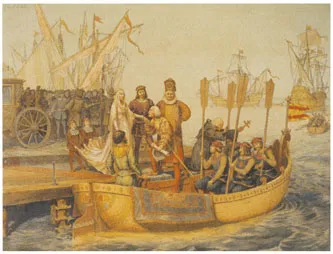
Queen Isabella and King Ferdinand of Spain bid Christopher Columbus farewell as he departs on his first voyage. A priest blesses the men who are preparing to leave on the ships that wait in the background.
From these beginnings, four major European nations began to explore and colonize the New World they had found: Spain, France, the Netherlands, and England. Each was motivated first and foremost by economic reasons. At the same time, each nation had their own methods for settling in the new lands.
Spanish Colonization
The Spanish were the first to set up major settlements in North and South America. The conquistadors (con-KEE-stah-dors), or Spanish soldiers, had three main objectives: gold, glory, and God. They came to the New World to plunder it for its riches. As they began to interact with the native population, many saw evidence of gold or other forms of wealth. In fact, the easy manner with which these items were treated by the natives made the Spanish believe that they were readily available.
The conquests of the Aztec people, by Hernán Cortés, and the Peruvian Inca, by Francisco Pizarro, fed the belief that the New World was rife with riches. The conquistadors desperately desired conquest to gain glory for the Spanish court. This combination of conquest and the gold that was sent back to Spain led to further missions. It also spurred the desire of other European nations to send their own explorers and colonizers to America.
A Flat Earth?
Despite the popular myth, Christopher Columbus was not the first person to believe or prove that the earth was round. The belief that the earth was round was known even in ancient times. Aristotle argued that it was round because of the shadow cast by it on the moon. It was this belief that the earth was spherical that caused Columbus to believe that if he sailed west he could reach the Far East by sea. His mistake was that he thought the earth was much smaller than it is, which led him to believe that he had reached the Indies when he had in fact landed in the Caribbean.
Without realizing it, the Spanish spread death with their arrival because of the diseases they carried. The native people had little or no immunity to common European illnesses. While many of the Spanish had become immune to smallpox, they could still carry the disease and pass it on to the native people. The death toll from this and other diseases was so great that some historians estimate that more than 90 percent of the native population was killed in some areas.
The Spanish treated the native peoples with disdain. They sent missionaries to the Americas, along with the conquistadors, with the goal of converting the natives to Catholicism. In many instances if the natives did not convert, they were treated as heathens, or uncivilized nonbelievers, and some conquistadors believed that this meant they were permitted to hurt or kill the natives. The Catholic Church at that time considered the conversion of the native populations not only a Christian duty but also as the only way to save the souls of the newly discovered peoples. Despite the typical treatment by the conquistadors, many Catholic missionaries became staunch defenders of the native peoples when they saw the way they were being treated.
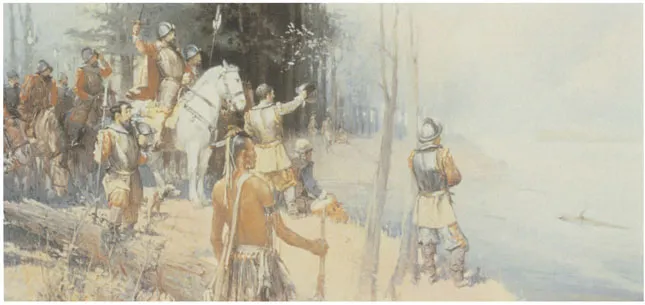
The Spanish explorer Hernando de Soto is credited with being the first European to “discover” the Mississippi Riven During his exploration of North America, De Soto’s treatment of the native people was extremely cruel.
Spanish colonies were set up around a colonial governor with large landholders who had much power. The conquistadors would be given lands and also encomiendas. The encomienda system gave them the ability to tax native people and villages within a particular territory in exchange for protection. The individual workers, in this case the Indians, technically owned their land but also owed the encomendero money or goods in exchange for military protection. By the early 1500s in many areas of the West Indies, almost all of the native people were dead through conquest or more often by ...
Table of contents
Cover
Half Title
Golonial Life
Title Page
Copyright Page
Table of Contents
Chapter One Colonial Rule
Chapter Two English Colonial Government
Chapter Three Native American Tribes
Chapter Four Government Structures
Chapter Five The Developing Colonies
Chapter Six Colonial Unity
Timeline
Glossary
For More Information
Primary Source List
Index
Trusted by 375,005 students
Access to over 1.5 million titles for a fair monthly price.
Study more efficiently using our study tools.
Frequently asked questions
Yes, you can cancel anytime from the Subscription tab in your account settings on the Perlego website. Your subscription will stay active until the end of your current billing period. Learn how to cancel your subscription
No, books cannot be downloaded as external files, such as PDFs, for use outside of Perlego. However, you can download books within the Perlego app for offline reading on mobile or tablet. Learn how to download books offline
Perlego offers two plans: Essential and Complete
Essential is ideal for learners and professionals who enjoy exploring a wide range of subjects. Access the Essential Library with 800,000+ trusted titles and best-sellers across business, personal growth, and the humanities. Includes unlimited reading time and Standard Read Aloud voice.
Complete: Perfect for advanced learners and researchers needing full, unrestricted access. Unlock 1.5M+ books across hundreds of subjects, including academic and specialized titles. The Complete Plan also includes advanced features like Premium Read Aloud and Research Assistant.
Both plans are available with monthly, semester, or annual billing cycles.
We are an online textbook subscription service, where you can get access to an entire online library for less than the price of a single book per month. With over 1.5 million books across 990+ topics, we’ve got you covered! Learn about our mission
Look out for the read-aloud symbol on your next book to see if you can listen to it. The read-aloud tool reads text aloud for you, highlighting the text as it is being read. You can pause it, speed it up and slow it down. Learn more about Read Aloud
Yes! You can use the Perlego app on both iOS and Android devices to read anytime, anywhere — even offline. Perfect for commutes or when you’re on the go. Please note we cannot support devices running on iOS 13 and Android 7 or earlier. Learn more about using the app
Yes, you can access Government by Martin Kelly,Melissa Kelly in PDF and/or ePUB format, as well as other popular books in History & Early American History. We have over 1.5 million books available in our catalogue for you to explore.