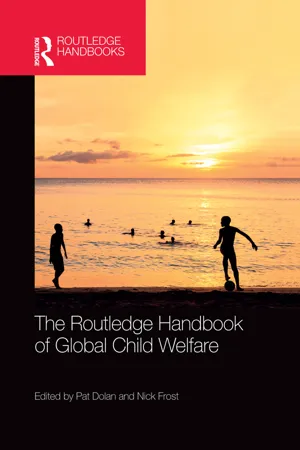
In the context of the increasing global movement of people and a growing evidence base for differing outcomes in child welfare, Routledge Handbook of Global Child Welfare provides a compelling account of child welfare, grounded in the latest theory, policy and practice. Drawing on eminent international expertise, the book offers a coherent and comprehensive overview of the policies, systems and practices that can deliver the best outcomes for children. It considers the challenges faced by children globally, and the difference families, services and professionals can make. This ambitious and far-reaching handbook is essential reading for everyone working to make the world a better and safer place for children.
eBook - ePub
The Routledge Handbook of Global Child Welfare
- 389 pages
- English
- ePUB (mobile friendly)
- Available on iOS & Android
eBook - ePub
The Routledge Handbook of Global Child Welfare
About this book
Information
Part I
Historical and theoretical perspectives
Part 1 provides a contextual introduction to the rest of the volume: it explores the history of childhood (Pollock), the history of child welfare (Frost) and theories of childhood from a multi-disciplinary perspective (Wright). The aim is provide a wider context for the remainder of the collection, which is more applied and immediately practice relevant.
Linda Pollock, in Chapter 1, explores the history of childhood and the family, which underpins the remainder of the volume. Childhood varies both historically and geographically as Pollock expertly explores. Being a child in 15th-century England is profoundly different from being a child in 19th-century New York or in 21st-century Afghanistan. The history of childhood is also entangled with the history of the family and parenting, a complexity which is helpfully addressed by Pollock. She points out that there is no single history of childhood: the chapter explores the variety of experience of childhood both historically and spatially.
Nick Frost attempts to address the complex history of the growth of child welfare systems in Chapter Two. Drawing on British examples, the chapter attempts to situate key developments in child welfare and make connections with major themes and developments in child welfare. The two examples utilised are the foundation of the Thomas Coram Founding hospital in 18th-century London and the policy of child migration – that spanned four centuries. Of course, each nation state has a unique and specific history, all of which cannot be explored in this volume. We hope however that the chapter suggests some universal themes that the reader can relate to their own specific context. The complex relationship, state–family–childhood, is at the heart of all child welfare debates, and the history and nature of this varies considerably across the world.
A third contextual chapter is provided by Hazel Wright, who explores a range of theoretical approaches to childhood. The child can be understood through a number of theoretical lenses – the ‘psychological’ child, the ‘sociological’ child, the ‘developmental’ child and so on. Even within these lenses there are many differing perspectives: with psychology – behaviourist, psychoanalytical and social psychology to name but a few. These theories matter in real life: theories generate professions and steer interventions in childhood. We have focused here on sociological and psychological theories which map most precisely onto child welfare interventions, but the reader should bear in mind that there are range of biological and neurological theories, for example, which are not explored in this volume. Wright provides a wide-ranging and analytical discussion which will help the reader situate the more applied discussions that follow in the clear and well-informed theoretical framework that she provides.
1
Childhood, parents and the family: 1500–1900
Introduction
There is no culture that does not distinguish in some way between a child and an adult, making the study of childhood an essential component for understanding current and past societies. Yet it is only relatively recently that children were considered as important historical subjects. Scholarly interest in the history of childhood perhaps began with Philippe Ariès classic book, Centuries of Childhood, published in 1962, which claimed that the past had no concept of childhood, meaning that children were viewed as adults in miniature rather than as a different kind of person with their own needs. His work encouraged other historians to develop what has become known as the ‘Black Legend’ of childhood in the past: parents in the past were not bonded to their children, grieved lightly if at all at their deaths, disciplined them harshly and forced them into arranged marriages. Family life and domestic relationships became based on affect only from the 18th century on. In turn, this model was challenged by a wave of revisionist scholarship that argued for a great deal of continuity in parent–child relations, especially in the realms of love and affection, rather than any dramatic change from harshness to permissiveness. Past parents, according to this model, loved their children, took the best care they could of them, and did not beat them harshly.1
The historiographical debate over whether or not there was a concept of childhood in the past, whether or not children were severely disciplined in the past and whether or not parents and children had an affectionate relationship now seems unproductive and unimaginative. A large percentage of past populations was young and so parents and others had to devote considerable energy, time and resources to bringing up children, especially because much was expected from a child’s primary caregivers. We have a great deal of evidence to show that parenting was taken seriously, that children were wanted and that a great deal of energy was invested in their care, but there are so many more issues to explore. Recent scholarship on the history of childhood has reinvigorated the field by jettisoning former assumptions, revisiting old paradigms and asking different questions. This new work has moved the field beyond the categorization of the history of parenting in terms of domination or affection, has tackled neglected facets of the history of childhood such as fatherhood, dealing with grown children, sibling relationships or poor families, has sought to uncover the child’s point of view and has begun to examine the non-Western areas of the world, refusing to accept the Western child’s experience as normative.2
It is very difficult to cover the global history of childhood in one chapter because there is no one history of childhood: rather childhood is a social construct with multiple meanings. The concept of a child, parental goals and childhood experience vary across cultures and time and also according to such variables as location, gender, race, religious affiliation and economic status of the individuals concerned. We have a relative abundance of information for the West but much less for the non-Western world, where the study of the history of childhood is just beginning for many regions. A global history of childhood challenges basic Western assumptions about human development and social change, questions the inevitability of the Western view that children should be accorded special treatment, and reveals that children do not always continuously live in a nuclear family but could experience a variety of living arrangements.3
Our modern view of children as innocent and fragile beings who are easily damaged and require special nurture and protection and whose lives should be focused on play and school was not the type of childhood experienced by most children in the past: children who were poor, convicted, enslaved, dual heritage or indigenous were not so protected nor so dependent. Childhood was usually briefer in poor or agrarian societies than it was in wealthy or urban environments. Defining childhood as the modern Western world does today as a stage of economic dependence would also exclude many children in the past. There were some universal features of childhood: infants were dependent on others for their physical care, children needed emotional attachment to thrive, children played; children aged around six to eight years were treated differently from younger children – infants in particular were often treated indulgently – and puberty changes were noticed. There were also some universal elements to being a parent, the first being the expectation that married couples would be parents. All societies seem to have been concerned with teaching children ethical, moral, cultural and social practices, women were typically the primary care takers and gender was an important social construct. Parents had authority over their children but also had duties and responsibilities to them. In essence, parents nurtured, maintained and trained. The implementation of these shared concerns, however, varied.4
A high value was placed on fertility and on children in the past. The great religions of the world – Buddhism, Christianity, Islam and Judaism – all stressed the importance of children. To their parents, children were blessings, precious jewels, treasures and gifts from God. As one might expect, concepts of children did differ culturally. Europeans, for example, tended to think of a child as a blank slate whereas sub-Saharan African society viewed infants as remembering the world they came from. To early modern Europeans, children were tainted with original sin, but in Muslim society, a child was born without sin. To indigenous Brazilians, children were spiritually akin to wild animals or forest demons at birth whereas to Africans a child was born with a soul. Non-Western cultures did not share the European concept of childhood: a child’s development was considered in terms of strength and productivity rather than rationality, making maturation more physical than cognitive.5
Importance of children
The value placed on children and childhood in the past can be seen from the number of rituals surrounding these. Apparently all cultures had celebratory rituals at the birth and naming of a child. In many non-Western cultures, the father cut the umbilical cord, gave birth to the child’s spirit and gave the baby his or her first name – the last was a particularly sacred rite imbued with religious meanings and ancestral significance. The Tokugawa period (1600–1868) in Japan enacted many rituals marking the development of the child, starting with the sash ceremony, which declared the mother’s intention to carry child to term. The birth was followed by ceremonies on the third and seventh days of life, as well as ceremonies marking the child’s first trip out of the house and first visit to the local Buddhist temple.6
Most cultures had developmental rituals. Early modern Europe had a breeching ceremony for boys around the age of seven when boys received adult male dress and accessories: this was an important moment in a boy’s life when he began dressing like and modelling his behaviour on that of adult males, seceding from the world of women. Peter Leigh, who was breeched aged six in 1675, was given not just breeches but also a sword, pistol and holster, a trunk with a key and a new saddle – in other words, everything a gentleman could need. In Latin America a special feast was held every four years in the month of Izali for children between the ages of four to seven, and girls would have their ears pierced. Boys and girls were scarified around the ages of six or seven in Central Africa. Foot binding, a very painful process involving breaking bones in the feet when a girl was aged about five to seven and done to enhance a girl’s marriage prospects, occurred in China from the 10th to the early 20th century. Foot binding, banned in 1912, was a cruel custom but Chinese parents in the past believed they were acting in the best of interests of the child and women could be proud of their tiny feet.7
More extensive rituals accompanied puberty in many societies. In late imperial China, the ritual of capping marked the end of childhood for a young man; its counterpart, the ceremonial pinning of her hair, marked its end for a young woman. In Brazil, both girls and boys had their hair cut short at puberty. Boys were then segregated in special houses and given instructions on skills they would need as men: how to hunt, make war, build a house and withstand all kinds of physical trials. Girls would have their skin cut and treated so that black patterns remained and were given in marriage after their hair grew long and wounds healed. In East Africa circumcision ceremonies meant the end of childhood chores, the beginning of a new freedom of movement and behaviour and a new level of respect from parents and younger children. Female genital cutting, practised in many African countries and several regions in the Middle East and Asia, involved the partial or full removal of a girl’s external genitals. It could have permanently damaging consequences but, as with foot binding, parents who had their daughters cut wanted what was best for them, and the practice was seen as a necessary step to enable a woman to be a fully accepted member of the community. In the past, it was accompanied by coming of age rituals that were valued by girls.8
Parents were indisputably attached to their children. The West usually evaluates affect from the perspective of feeling, but there were other ways to demonstrate love by, for example, acts of caring. Early European explorers were clearly impressed with the care given by Aztecs to children. Love and empathy between parent and child certainly existed in the past. Haj Abu al-Qasim Malik al-Tujjar of Qajar, Iran, was concerned about the distress an impending separation would cause his daughter Tuba Khanum, ‘the light of my eyes’. As was the custom, she had been betrothed as a young girl and was about to be sent to live with her future in-laws. Her father anticipated the emotional pain the parting would cause her and sought to make sure her new family would treat her kindly. He asked if his brother:
could be kind enough to tell Mu’in ‘Tujjar either verbally or in writing to remember that she is only an infant and to try and obliterate her sorrow. Even for adults it is very difficult when ...
Table of contents
- Cover
- Title
- Copyright
- Contents
- Notes on contributors
- Acknowledgements
- Introduction
- PART I Historical and theoretical perspectives
- PART II Parenting, resilience and community support
- PART III Family support
- PART IV Crime and violence against children
- PART V Substitute care
- PART VI Promoting positive practice
- Index
Trusted by 375,005 students
Access to over 1.5 million titles for a fair monthly price.
Study more efficiently using our study tools.
Frequently asked questions
Yes, you can cancel anytime from the Subscription tab in your account settings on the Perlego website. Your subscription will stay active until the end of your current billing period. Learn how to cancel your subscription
No, books cannot be downloaded as external files, such as PDFs, for use outside of Perlego. However, you can download books within the Perlego app for offline reading on mobile or tablet. Learn how to download books offline
We are an online textbook subscription service, where you can get access to an entire online library for less than the price of a single book per month. With over 1.5 million books across 990+ topics, we’ve got you covered! Learn about our mission
Look out for the read-aloud symbol on your next book to see if you can listen to it. The read-aloud tool reads text aloud for you, highlighting the text as it is being read. You can pause it, speed it up and slow it down. Learn more about Read Aloud
Yes! You can use the Perlego app on both iOS and Android devices to read anytime, anywhere — even offline. Perfect for commutes or when you’re on the go.
Please note we cannot support devices running on iOS 13 and Android 7 or earlier. Learn more about using the app
Please note we cannot support devices running on iOS 13 and Android 7 or earlier. Learn more about using the app
Yes, you can access The Routledge Handbook of Global Child Welfare by Pat Dolan, Nick Frost, Pat Dolan,Nick Frost in PDF and/or ePUB format, as well as other popular books in Social Sciences & Social Policy. We have over 1.5 million books available in our catalogue for you to explore.