eBook - ePub
People and Place
The Extraordinary Geographies of Everyday Life
- 296 pages
- English
- ePUB (mobile friendly)
- Available on iOS & Android
eBook - ePub
About this book
An innovative introduction to Human Geography, exploring different ways of studying the relationships between people and place, and putting people at the centre of human geography. The book covers behavioural, humanistic and cultural traditions, showing how these can lead to a nuanced understanding of how we relate to our surroundings on a day-to-day basis. The authors also explore how human geography is currently influenced by 'postmodern' ideas stressing difference and diversity. While taking the importance of these different approaches seriously as ways of thinking about the role of place in peoples' everyday lives, the book also tries to encapsulate what has been so vibrant and exciting about human geography over the last couple of decades. By using examples to which students can relate - such as how they imagine and represent their home, the way they avoid certain spaces, how they move through retail spaces, where they choose to go to university, how they use the Internet, how they represent other nations and so on - the authors show how geography shapes everyday life in a manner that is seemingly mundane yet profoundly important.
Information
one
…Arrivals
This chapter covers:
1.1 Introduction
1.2 Thinking geographically
1.3 Approaches to human geography
1.4 Geographies of people and place?
1.1 Introduction
It has become commonplace for geographers to begin their texts by making reference to the fact that ‘geography matters’. Typically, this is to make a claim that geography can illuminate debates about a range of social, economic and political issues, and to stress that the discipline is one which is relevant, important and up-to-date. This is often shown with reference to matters which are clearly of global importance – environmental pollution, the debt crisis, deforestation, global disease, economic instability, tourism, migration and so on. Yet alongside these matters of international importance, it might equally be shown that geography is concerned with the everyday, the local and (sometimes) the seemingly banal. After all, geography has always been concerned with documenting the things that people do on a day-to-day basis, noting variations across space in the way that people work, rest and play. As such, activities such as eating, shopping, conversing, walking, playing, sleeping and recreation are all inherently geographical, in the sense that they can be understood as practices on which the discipline of geography can offer a distinctive perspective. To show this, we can take a seemingly mundane news story plucked from the relative obscurity of p. 7 of the Guardian of 29 September 1999 (see Figure 1.1). Written by Lucy Ward and Keith Harper, this describes Labour politician John Prescott’s plans to designate new National Parks in the UK. Read the story, and think about how it begins to open up some different geographical dimensions.
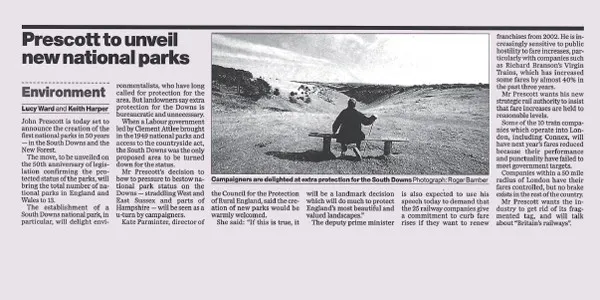
Figure 1.1 New National Parks in the UK,
Source: Guardian (29 September 1999); photograph by Roger Bamber
Perhaps the first thing we might note here is that this story does not concern a matter of pressing global importance (although it might well be of crucial importance for some). Indeed, we might expect that the story would be of little or no concern to anyone outside the UK. Nonetheless, we argue that this brief newspaper article serves to make the point that ‘geography matters’ as it is a story that is replete with geographical dimensions and ideas – many of which we will develop in this book. We begin, then, by drawing out some of the geographical themes that are inherent in this story. On the surface, the story concerns the proposed designation of two new National Parks in southern England, something commented upon firstly, by a representative of the Council for the Protection of Rural England (CPRE), and secondly, by two journalists writing in a British national newspaper. An initial thought might then be, why is this story in any sense a geographical one? Why should the planned designation of two areas of land as National Parks be of geographical concern?
Firstly, and perhaps most obviously, this is a geographical story because it concerns the protection of a landscape that has been created through physical processes. The South Downs, for instance, is a chalk downland that has been shaped and weathered through processes of erosion and deposition, that has been subject to the invasion and succession of various species of flora and fauna, and that has changed according to specific weather and climatic conditions. As such, we can understand the story as one concerning the environmental processes that culminate in the creation of these distinctive physical areas. But while this is one take on the story, it is a partial one in the sense that these landscapes are also peopled landscapes – places that have been created, transformed and used by people in a variety of ways over time. As human geographers we can thus develop different angles on this story, some of which rely on our understanding of the national context in which the article has emerged, and require us as geographers to think about its wider resonances as well as its more explicit content.
We could start, for instance, by saying something about how the apparent need for areas of land to be offered ‘protection’ is associated with particular forms of human habit or behaviour. In the UK, many people like to spend leisure time in areas which are often geographically separated from places associated with other aspects of their lives (such as places of work or education), often exacerbating environmental pressures on areas regarded as being of natural beauty. We might, therefore, begin to think about the ways people organize their use of space and time, making decisions about when and where they will spend their leisure time. From a geographer’s point of view, we might be interested as to why areas like the South Downs or the New Forest are subject to particular pressures from mass recreation, provoking the application of legislative protection to preserve the character of these ‘special’ areas. Here, we can also take a temporal perspective to speculate on why these types of landscape are deemed as being worthy of protection now (rather than 50 or even 150 years ago). Is this because an increasing number of people now perceive these areas as offering better opportunities for recreation and leisure than they did in the past? Or is it because these landscapes have taken on an enhanced value relative to the type of landscapes that have been considered worthy of protection in the past? These are not easy questions to answer (see McEwen and McEwen, 1987; Winter, 1996), but certainly geographers have sought to collect data to examine both viewpoints. For instance, noting changes in the way these areas have been painted and written about might allow us to examine how specific landscapes became highly valued (see Chapters 6 and 7), while interviews and surveys with users of these places might allow us to develop an insight into what people think of these places (Chapter 3). The ways in which people perceive or imagine particular types of place (as places of beauty, leisure, rest or play) become central to our understanding of human geography, helping us to understand why some areas become the focus of particular types of human activity.
A further geographical dimension we can draw from this story is that people seem to become attached to specific places. Places take on a significance far greater than their simply being locations on the Earth’s surface. It is clear from the article that for some people, the South Downs is a very special place. Consequently, another geographical response to this story might be to suggest that these places are meaningful to people, being multidimensional in the range of meanings and significancies they can carry (see Chapter 4). But something else to notice is that the designation of the National Park is not universally regarded as a ‘good thing’. Some groups, such as the landowners mentioned, regard the designation as unnecessary, perhaps fearing that new restrictions would place limits on their own use of space and encourage an increase in the numbers of visitors. In this story, places are therefore something which can be fought over, necessarily bound up with the power relations that exist between different groups (see Chapters 8 and 9). In this case, the South Downs is symbolically important within the wider debates which seek to define places as either public (to be enjoyed by the masses during their recreation) or private (upholding the landowners’ right to manage and use their own land). While walkers and cyclists may want to fight for increased access to the countryside, landowners may assert their right to exclude people from ‘their’ private property.
This raises yet another perspective – that place can be understood in relation to group concerns as well as individual desires and needs. Indeed, examining the proposed South Downs National Park as a site of potential conflict requires us to identify the involvement of a range of interest groups. Specifically, the CPRE is mentioned here as an organization concerned with protecting the countryside. This organization was formed during the late nineteenth century as part of a reaction to expansion of urban sprawl into the British countryside, campaigning for the protection of rural places along with what was imagined as a particularly rural social order. This was, supposedly, a good, natural and harmonious social order based on an appropriate degree of deference to one’s ‘betters’, where one ‘knew one’s place’. We can, perhaps, take this a step further and suggest that organizations like the CPRE have been concerned with the maintenance of boundaries. Boundaries in themselves are important concepts in human geography (and much will be said about them in later chapters). Indeed, the construction of boundaries is central to the concept of a National Park, an area ‘marked off’ as worthy of protection. Here, however, the lines are not simply physical divides such as fences, walls and barbed wire (though these are important). Instead, imagined boundaries come to the fore as central concepts in our understanding of the relationships between people and places. As David Matless (1990) suggests, the CPRE (and agencies like it) do not simply want to protect the countryside, but seek rather to maintain an imagined distinction between the countryside and the town. Similarly, the categories of ‘town’ and ‘countryside’ need to be regarded as products of a particular geographical vision which, in itself, desires order and segregation (see Chapter 6). The fact that this sense of order can be disrupted every time an urban dweller drives out to the countryside to ‘consume’ the rural, or rural dwellers drive into town, watch a film, buy Wellington boots or sell cattle at the market, suggests that it is fundamentally important (and easily disturbed – see Chapter 9).
There are yet other important geographical dimensions spilling out of this brief newspaper article. The demand for National Parks in the UK, although having roots in the nineteenth century, took on particular importance during the Second World War (1939–45) as part of a morale-boosting programme designed to encourage British troops and civilians by providing a vision of what they were fighting for (Evans, 1997). As the press cutting (Figure 1.1) says, legislation for the protection of the countryside was passed by the government soon after the war, in 1949. We might be able to suggest, then, that the UK’s National Parks are tied to an idea of national identity. National Parks, the countryside they claim to protect, and the independence of a ‘proud island race’ that so appeals to some groups in British society, are all bound up with an idea of a national identity that supposedly unifies the very disparate groups of people living within its boundaries (see Chapter 5). Of course, there will always be competing voices whose idea of national identity differs from this very English vision. These groups may well find themselves excluded from Anglo-White versions of what it means to be British, something which may be evidenced when they find themselves in places associated with ‘British values’. Indeed, some geographers have noted that in the British countryside, black and Asian people may be made to feel ‘out of place’ in a space that has become strongly associated with white European people (Kinsman, 1995; see Chapter 7).
The idea that perceptions exist concerning appropriate and inappropriate sorts of people in different places (and, by extension, appropriate and inappropriate sorts of behaviour), leads us further to argue that there is also a moral dimension to human geographies. The implication here is that certain people, and particular activities, can be considered as ‘in place’ or ‘out of place’ in specific areas (Cresswell, 1996). A geographical perspective on this might be to examine how such definitions of Tightness and wrongness come into existence, for instance, by exploring the way that National Parks have been imagined as suitable for certain groups and behaviours (but not others). David Matless’s (1995, 1998) fascinating account of the portrayal (on map covers and in photographs, for example) of outdoor leisure in the early twentieth century points to how particular ways of being and moving in the countryside have come to be considered as particularly healthy, as morally and spiritually uplifting, tied into particular ideas about what it means to be a ‘good citizen’. Alternative behaviours, from dropping litter to becoming a ‘New Age Traveller’, become inappropriate as far as majority opinion is concerned. A question we might pose here is ‘why?’; why is leaving crisp packets and camping in an old bus in the British countryside constructed as ‘wrong’? And why is walking in the open air regarded as morally and spiritually uplifting?
Again, there can be no easy answers, and although we will suggest ways of thinking through these kinds of questions throughout this book, we need to acknowledge that human geographers must confront a whole series of difficult questions as they seek to make sense of the relations between people and place. Indeed, another dimension we want to pull out of the National Parks newspaper cutting is the question of what we might mean by ‘place’ anyway. The designation of new National Parks in the UK might lead us to conceptualize places as things which can be seen as independent, as bounded, and as separate from other places. A National Park, existing inside a line drawn on a map (and indicated as one drives into it by road signs) might give us the impression of a place separate from all others. What we have suggested above already contradicts this; we have shown, for example, how the use and occupation of National Parks is related to wider processes of urbanization and the impacts of town and country planning. But places are also open to influences on a far greater scale than the national. The concept of the national park itself originated outside of the UK, in the USA, where the first parks (e.g. Yosemite and Yellowstone) were set up in the 1860s and 1870s in response to concerns over the loss of wilderness (Pepper, 1996). Places, then, can be thought about as open; that is, as receptive to ideas, people and power relations extending way beyond them (Massey, 1995a). In an era characterized by globalization, we need to be able to think about what happens to individual and distinctive places when there are powerful economic, political and social processes which, some have argued, are involved in the homogenization of place – everywhere might seem to be becoming the same (see Chapter 2). While taking issue with this claim, we recognize the importance of thinking globally, whil...
Table of contents
- Cover
- Half Title
- Title Page
- Copyright Page
- Table of Contents
- List of figures
- List of tables
- Preface: read this!
- Acknowledgements
- Chapter 1. ... Arrivals
- Chapter 2. Everyday places, ordinary lives
- Chapter 3. Knowing place
- Chapter 4. A sense of place
- Chapter 5. Disturbing place
- Chapter 6. Imagining places
- Chapter 7. Representing place
- Chapter 8. Place and power
- Chapter 9. Struggles for place
- Chapter 10. Departures…
- Bibliography
- Index
Trusted by 375,005 students
Access to over 1.5 million titles for a fair monthly price.
Study more efficiently using our study tools.
Frequently asked questions
Yes, you can cancel anytime from the Subscription tab in your account settings on the Perlego website. Your subscription will stay active until the end of your current billing period. Learn how to cancel your subscription
No, books cannot be downloaded as external files, such as PDFs, for use outside of Perlego. However, you can download books within the Perlego app for offline reading on mobile or tablet. Learn how to download books offline
Perlego offers two plans: Essential and Complete
- Essential is ideal for learners and professionals who enjoy exploring a wide range of subjects. Access the Essential Library with 800,000+ trusted titles and best-sellers across business, personal growth, and the humanities. Includes unlimited reading time and Standard Read Aloud voice.
- Complete: Perfect for advanced learners and researchers needing full, unrestricted access. Unlock 1.5M+ books across hundreds of subjects, including academic and specialized titles. The Complete Plan also includes advanced features like Premium Read Aloud and Research Assistant.
We are an online textbook subscription service, where you can get access to an entire online library for less than the price of a single book per month. With over 1.5 million books across 990+ topics, we’ve got you covered! Learn about our mission
Look out for the read-aloud symbol on your next book to see if you can listen to it. The read-aloud tool reads text aloud for you, highlighting the text as it is being read. You can pause it, speed it up and slow it down. Learn more about Read Aloud
Yes! You can use the Perlego app on both iOS and Android devices to read anytime, anywhere — even offline. Perfect for commutes or when you’re on the go.
Please note we cannot support devices running on iOS 13 and Android 7 or earlier. Learn more about using the app
Please note we cannot support devices running on iOS 13 and Android 7 or earlier. Learn more about using the app
Yes, you can access People and Place by Lewis Holloway,Phil Hubbard in PDF and/or ePUB format, as well as other popular books in Scienze sociali & Geografia. We have over 1.5 million books available in our catalogue for you to explore.