- 198 pages
- English
- ePUB (mobile friendly)
- Available on iOS & Android
eBook - ePub
About this book
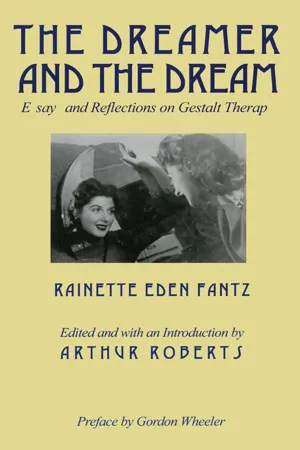
In this collection of papers and lecturers from the late Rainette Fantz, we witness firsthand the exhilarating possibilities inherent in the Gestalt therapy model. Frantz brings her background in theater to bear on her remarkable work as a therapy and teacher-work marked by delightful imagination, striking improvisation, and aesthetic beauty. The insights contained in these chapters illuminate everything from the intricacies of an opening session to the theoretical foundations of Gestalt dreamwork, and Frantz's candid style invites the reader to explore with her the joys and sorrows of a career as a Gestalt therapist.
Information
PART I: ESSAYS
1
METAPHOR AND FANTASY
The concept of awareness is a basic one in the study and application of Gestalt therapy, and over the years we at the Gestalt Institute of Cleveland have evolved many different approaches to the teaching of it. We have worked with “figure-ground,” with the process of widening and narrowing of focus, with differentiation and integration, and above all with the direction of attention. All of these and many others are modes that have proved very useful in the heightening of awareness.
I believe it important to stress that as we move into the realm of metaphor and fantasy we come in touch with an entirely different type of awareness, with a novel approach to authenticity. In effect we dispense in part with the cognitive function and focus instead on the intuitive part of the self.
Let me recapitulate. Awareness may be directed outward toward the external world or inward toward the self. When directed outward there are essentially two places that it may go—toward persons in the environment or objects in that same environment. When directed inward the possibilities both in direction and function are considerably broadened. It may be focused affectively on emotions or sensations or cognitively/intuitively on thoughts, memories, wishes, fantasies and metaphor.
Using the last of these as a point of departure, it's extremely exciting to me to realize that language, particularly metaphor, is not simply a means of communication but rather an “organ of perception,” (Jaynes, 1976, p.51)—a way, in other words, of perceiving the world. I remember with both fondness and astonishment a ride into the country in early spring. The countryside was burgeoning, and my companion and I were surrounded on all sides by lush bushes of yellow, sunlit blooms. My friend suddenly stopped the car and pointing to the yellow dazzlement asked, “What is the name for those?” “Forsythia,” I replied simply. “Oh,” said he, “Forsythia! Now I can think of it.”
In this particular example, yellowness, lushness, luminosity, all the qualities that forsythia encompasses, were not in themselves adequate to allow for discrimination; a name was necessary to tie them together to form a unique “gestalt” which in the future could convey a memory of yellowness, lushness, luminosity. But a label is not a metaphor. It is a means of connoting a meaning that is already specific, derived over time. Metaphor on the other hand is a special way of bestowing meaning on something novel that at one particular moment is as yet strange, unnamed, unrealized and tantalizing. Labels allow us to “think” about something we already know; metaphors permit us to “experience” something formerly unknown in the light of our previous history. In a word—to make contact.
Julian Jaynes in The Origin of Consciousness in the Breakdown of the Bicameral Mind points out that many parts of the human body have been used as metaphors. For example, if one thinks of a “head,” one may use it in a way to signify the very top of something as in the head of an army, the head of a table, the head of a bed or the head of a household. One's visage provides a cogent way of looking at or speaking picturesquely of things such as the face of a clock, of a cliff, of a card, of a crystal. Eyes too are often used to characterize objects in a way which gives or endows them with additional meaning, e.g. the eye of a needle, the eye of a storm, the eye of a flower. The same kind of effect can be produced by utilizing “teeth.” We speak of the teeth of a comb, the teeth of an argument, the teeth of a gale—all of these implying bite and power without the necessity for amplification.
The skin too is an important metaphor. How often have you heard people say, “Stay in touch” with individuals who are “thick skinned,” or “thin-skinned,” or “touchy?” How often have you, yourself, said “Handle him carefully lest you ‘rub’ him the wrong way?” We speak of “feeling” for another person; we speak of “touching” experience. All of these expressions derive from our own sense of touch and that of those who have gone before us to the first syllable of recorded time.
In very early times language and its referents climbed up from the concrete to the abstract on the steps of metaphor. Our commonly used verb form “to be” derives from the Sanskrit word “asmi” which signifies “to breathe.” Interestingly, eons ago there was no word for “existence.” One breathed or one grew or one essentially was not. Every conscious thought can be traced, if we try diligently enough, through metaphor, back to concrete actions in a concrete world (Jaynes, 1976). For example, “my runaway thoughts” is an expression which emanates from the explicit action, “to run.” To be very specific, understanding a thing, any thing—any person—is to arrive at a metaphor for that thing or person by substituting something more familiar. The feeling of familiarity is the feeling of understanding.
I'm reminded of my nephew gingerly holding his sister's new-born son for the first time—clearly uncomfortable, unable to relax. And as the little one squirmed about and screwed up his face, my nephew said, “Oh, what a little monkey you are!” and suddenly smiled and was at ease. Out of strangeness—familiarity.
It was not the naming that was crucial here but the qualities that the name evoked—those qualities of playfulness, wrinkledness, slipperiness, smallness—that brought to the unknown a kind of recognition, without which there could have been no acceptance, no immediate joy.
When we consider metaphor and fantasy, it is crucial to be aware that we possess a complete apperceptive mass from which these metaphors, these fantasies originate. I am reminded of Rilke's notion of living fully before sitting down to write. Our apperceptive mass is what we refer to in Gestalt terms as “background,” our assimilated experience out of which new and surprising “figures” may continually emerge. It is composed of all that we have read in our lifetimes. It can range from history to myths. When I think of history, I thing of the Fall of Troy (the beautiful Helen, the enamored Paris and, of course, the unforgettable Trojan Horse), I think of Ghengis Khan and the Asiatic hoards over-running Europe, of the Spanish Inquisition and the Spanish Conquest, of the discovery of America and its settlement, of the French Revolution replete with Marie Antoinette's, “Let them eat cake!” and the guillotine, of the first and second world wars and the fall of the atom bomb on Hiroshima.
When I reflect on some of the literature I have enjoyed I recollect Crime and Punishment, The Brothers Kharomazov, The Scarlet Letter, Moby Dick, Wuthering Heights, and more lately the spy novels of John Le Carre. These oeuvres color the way I think, the way I see, just as what you may have enjoyed colors your perspective.
If I turn to fairy tales I become very conscious of how often they involve Jungian archetypes—the wicked step mother or witch, the innocent child, the ideal hero, the polarities of good and evil.
And myths—the stories of a hero or heroine beset by temptation, tests of the self, universal struggle. Jason and the Golden Fleece immediately leap to mind. How unforgettable are the fire-breathing bulls, the sowing of the dragon's teeth which immediately sprouted from an armed guard, and the aid received from the sorceress, Medea. How memorable the Iliad, the Homeric counterpart to the Fall of Troy. Interestingly, Jaynes cited the Iliad as an example of great writing which existed before the development of the conscious mind. Nowhere in the poem (in the original Greek) do its characters think, ponder, decide: rather Odysseus, Agamemnon and Achilleus respond in action to the “voices of the Gods.”
Our apperceptive mass may also include the music we've heard. This music may range from the great classics of Bach, Beethoven, and Brahms, through folk songs, blues and jazz, to modem rock and such cult creations as the Rocky Horror Picture Show which my daughter, Lori, saw 26 times, memorizing in the process every one of the songs, replete with the accent and style of the varied singers. One of my former group members had the uncanny ability to hum or sing out in the middle of a session some show tune or symphonic theme which metaphorically represented precisely where another member was emotionally or otherwise. It cut through a lot of crap.
Our metaphors may emerge from the art we have perceived, from the softness of line and color of a Renoir, from the angularity and strangeness of color of a Picasso, the depth and richness of color of a Rembrandt—who has ever seen the Man in the Golden Helmet and could not make it a part of himself?—the freshness of color and piquancy of shape of a Miro. The list is endless.
They may also derive from the architecture we have viewed, from the clean strong lines of modem buildings, the gingerbread forms of the Victorian era, from the Acropolis to a Howard Johnson Motel. They may derive from all things seen in nature: a turbulent stream, a corkscrew willow, the magnificence of the Grand Canyon or the breathtaking sight of a deer, ears up, poised for flight.
In short, our apperceptive mass includes all of those “figures” I've mentioned above, plus all those you may name—and in addition the experiences in our lives of birth, death, pain, joy, power and loss. Out of these do metaphors grow. In essence they emanate from the depths of our learning and the richness or paucity of our culture.
In addition, the use of metaphor is a process of translation from the lengthy and ordinaiy to the cogent and pithy. Not only is it a short-cut to communication but it is a representation of awareness in image form. Metaphor, to look at it in a slightly different but related way, has its roots in Freud's idea of primaiy process. To review, the “primary process” was, or is, if you will, the way in which infants tried to discharge tension by forming images of the object that would remove their tension. For example, a hungry infant might “image” or conjure up a picture of food or of the mother's breast which might be a fount of milk. (I am not referring here to “primaiy process” as Peris et al uses it when they speak of health as primary process in contact, but rather as Peris himself might have used it when he was more immediately influenced by psychoanalysis.) This “image” of the infant is not, as I think of it, pure fantasy as it might be in the adult, but more precisely an actual “experiencing” which, unfortunately for the infant, does not lead to satisfaction.
Since the primary process alone cannot actually reduce tension (one cannot eat a mental image), the secondary process begins to develop, and the ego—the second system of the personality—begins to form. It is essential in development, certainly. But unfortunately we as a species get so carried away by the secondary process that we lose touch with our images; we get lost in the world of words, of ever rational thought. Perhaps it is time to return—at least for moments—to the primary process, to the time before labeling began, to allow our images to give us direction.
We meet someone whose long blond hair evokes images of Rapunzel, the princess in the tower, the need to rescue. These images which contain qualities that make for metaphor may afford an opening to feelings about the person in the here and now. It becomes possible to move with these feelings guided by our metaphor.
In somewhat the same way we can move with our fantasies; we can urge our clients into directed awareness, directed fantasy (a way to catch awareness at unawares). There are many ways in which to do this, but I will mention two of the most simple, and perhaps most familiar. The first one is to suggest to a client or a group, “Go into a cave and tell me what you find there.” In actuality this statement is preceded by some minimally mesmerizing sentences such as, “You are walking along a twisting wooded path with the sun shining slant-wise through the gold leaves of the aspens. A slight breeze is blowing so that the fragile leaves shiver making a silvery, whispering sound. The wild flowers along the way brighten the pathway with flashes of iridescent, luminous color. Suddenly you come to a clearing and see looming before you the dark entrance to a cave. Go into that cave, and tell me what you see.”
When this directed fantasy trip is attempted in a group—training or therapeutic—many of the students come up with spontaneous and variegated responses. I've encountered gold filled streams, cold pools of dark water, mud, wolves, bears, bats, Formica speckled rock and occasionally, nothing. If I know my group, it's intriguing to discover how often the fantasies which individuals dream up are apt metaphors for parts of themselves.
Similarly, when I work with individuals, the directed fantasy can be amazingly effective in furthering the therapeutic process. I vividly recall engaging with an extremely attractive woman, always nice to a fault but with a facade that was utterly impenetrable. Upon being asked to go into the ubiquitous cave, she approached it in fantasy, and then drew back in alarm, saying she couldn't possible enter it, that it frightened her. After dealing partially with her fear, I asked her to describe the cave to me. She did so with some reluctance. It was seen by her as a dark, towering side of a mountain, smooth surfaced like granite and quite impenetrable. I asked her whether it had any opening, since caves usually do, and she replied that it did but the opening was blocked by a huge boulder which she could not budge. Asked to see if she could find some sort of tool to help her get some leverage, she finally discovered an iron crowbar with which she began to pry aside the boulder—about one inch. At which point she looked at me and said, “I am like that cave; I've made myself smooth and unapproachable—even to myself. Not only do I not want others to have access to me, but I'm afraid to look inside myself.” So for the moment we stopped. I respected her reluctance; but in further sessions we did enter her cave to discover much of richness there.
The second directed fantasy we frequently use is the one in which we ask a client or a group “to dig a hole and bring out and describe what is buried there.” The preamble to this can be very similar to the one which precedes the request to go into a cave. By the same token, the responses to the suggestion—both from the group or the individual client—vary in much the same way as did those to the first experiment. Even the resistances bear a certain similitude. What might you find if you dug a hole? How might you resist digging it?
Once again I am reminded of an individual client of mine who would sit with me week after week on my same gold love seat and parsimoniously proffer pieces of her existence, rarely without extreme investment of energy from me. Needless to say, though I was quite interested in who and what she was, I was also exceedingly frustrated. It's significant to the playing out of her fantasy that in appearance she was very handsome and tall, with straight red hair pulled tightly back, richly though very simply dressed, and in manner, taciturn, stem, almost hard.
When I asked her to dig a hole, she looked at me as if I might have one in my head, eventually started, with huge reluctance, to wander through the rocky field I'd invented for her, and stopped almost immediately because she had nothing with which to dig. With some additional coaxing she at last found a sturdy stick with which she could begin to scratch the surface of the ground. Actually she dug and dug, stopping intermittently to pronounce the experience silly and to complain that it was useless since she would never find anything. I urged her on. Suddenly an expression of utter surprise appeared on her face, and she sat bolt upright in her seat. I asked what had happened, and she replied, “But I have something!” I asked her to bring it up and show it to me, and with much reticence she leaned towards me as if to hand me a rather heavy object. I did not take it but suggested instead that she look at it herself and tell me about it. It turned out to be a book, very dusty, covered with dirt having been buried so long a time. But when she brushed the dirt away, she said, “Oh—it's so lovely; it's covered with the softest of blue leather, the pages are edged with gilt as though they must have much of importance written on them, and the huge volume is bound with golden clasps as if there's much of richness inside.” As of course there was. She had made her own metaphor.
I could give you many more examples, even delve into the realm of the undirected fantasy, but I'd like to close simply with a quote from Highet.
We are all cave-men. The cave we inhabit is our own mind, and consciousness is like a tiny torch, flickering and flaring, which can at best show us only a few outlines of the cave-wall that stands nearest, or reflect a dangerous underground river flowing noiselessly at our feet, so that we start back in horror before we are engulfed; as we explore, we come often on shapes of beauty, glittering stalagtites, jewel encrusted pillars, delicate and trusting animals… (Highet, 1954, p.36)
And so we do, if we allow ourselves our fantasies, our metaphors, our dreams.
2
THE GESTALT APPROACH TO DREAMS
The Gestalt theory of dreams derives organically from the body of Gestalt principles and methodology and is perhaps most representative of the differences which exist between the existential modes of therapy and the more traditional procedures. Two concepts which are central to the understanding of Gestalt formulations are the idea of n...
Table of contents
- Cover
- Half Title
- Titles From GICPress
- Title Page
- Copyright Page
- Dedication
- Acknowledgments
- Table of Contents
- Magic and Methodology
- Editor's Note
- Theatre & Therapy
- Part I: Essays
- Part II: Reflections
- References
- About the Author
Trusted by 375,005 students
Access to over 1.5 million titles for a fair monthly price.
Study more efficiently using our study tools.
Frequently asked questions
Yes, you can cancel anytime from the Subscription tab in your account settings on the Perlego website. Your subscription will stay active until the end of your current billing period. Learn how to cancel your subscription
No, books cannot be downloaded as external files, such as PDFs, for use outside of Perlego. However, you can download books within the Perlego app for offline reading on mobile or tablet. Learn how to download books offline
Perlego offers two plans: Essential and Complete
- Essential is ideal for learners and professionals who enjoy exploring a wide range of subjects. Access the Essential Library with 800,000+ trusted titles and best-sellers across business, personal growth, and the humanities. Includes unlimited reading time and Standard Read Aloud voice.
- Complete: Perfect for advanced learners and researchers needing full, unrestricted access. Unlock 1.5M+ books across hundreds of subjects, including academic and specialized titles. The Complete Plan also includes advanced features like Premium Read Aloud and Research Assistant.
We are an online textbook subscription service, where you can get access to an entire online library for less than the price of a single book per month. With over 1.5 million books across 990+ topics, we’ve got you covered! Learn about our mission
Look out for the read-aloud symbol on your next book to see if you can listen to it. The read-aloud tool reads text aloud for you, highlighting the text as it is being read. You can pause it, speed it up and slow it down. Learn more about Read Aloud
Yes! You can use the Perlego app on both iOS and Android devices to read anytime, anywhere — even offline. Perfect for commutes or when you’re on the go.
Please note we cannot support devices running on iOS 13 and Android 7 or earlier. Learn more about using the app
Please note we cannot support devices running on iOS 13 and Android 7 or earlier. Learn more about using the app
Yes, you can access The Dreamer and the Dream by Rainette E Fantz in PDF and/or ePUB format, as well as other popular books in Psychology & Applied Psychology. We have over 1.5 million books available in our catalogue for you to explore.