- 232 pages
- English
- ePUB (mobile friendly)
- Available on iOS & Android
eBook - ePub
About this book
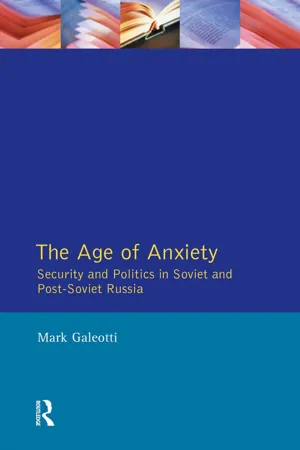
The geography of Russia -- vast, unwieldy, exposed -- and her tragic history of foreign invasion have created an overriding sense of military vulnerability amongst her leaders that, after the horrors of the Second World War, amounted almost to paranoia. This important study of the years since Brezhnev shows how this obsession with national security have been at the core of Russian thinking right through the reforms of the Gorbachev era and the eventual collapse of the USSR, and continues to dominate the turbulent politics of post-Soviet Russia today.
Information
PART ONE
THE CHALLENGES OF RUSSIAN SECURITY
1 RUSSIA’S SECURITY DILEMMAS
I cannot forecast to you the action of Russia. It is a riddle wrapped in a mystery inside an enigma; but perhaps there is a key. That key is Russian national interest.Winston Churchill, 1939
‘National security’ is a complex and intangible concept. It means a lot more than just the security of a nation’s borders – military security. It necessarily incorporates safeguarding a country’s vital economic interests – economic security. Yet already, the question arises of where to draw the line? To the imperial leaders of Britain and France, attempts by China to keep out cheap Indian opium represented a threat to their economic interests and thus reason enough to send in the gunboats and fight the 1839–42 and 1856–68 Opium Wars, to keep China addicted. Beyond that, there is internal security, the maintenance of the status quo and thus, by extension, the rule of the dominant class, system or group. Hence, security is an intrinsically political issue, in which the general and the private, like the policeman, the secret agent and the diplomat all play their role:
Nowadays it is impossible to ensure security merely by improving one’s sword and shield.Chief of the General Staff Akhromeev, 1987
Russia’s concept of its security – what it entails, from whom it needs to be guaranteed and how this best is done – has been and still is dominated by three challenges: its geography, its history and its empire. Together, they go some way towards explaining those characteristics the USSR shared and Russia shares with other nations, and those features which are much more distinctively Russian. After all, one can draw all sorts of comparisons. The USA is another frontier state – both were born from expansion across largely virgin territory – and like Russia has a strong tradition of patriotism and a sense of historical mission. To understand the differences between the two one must look at the extraordinary problems the Russian state has had to face, and the strategies she has adopted across the years and centuries.
THE CHALLENGE OF GEOGRAPHY
Geography is probably the single most important factor in determining a nation’s concept of war.Chris Donnelly, Red Banner (Coulsdon: Jane’s, 1988)
Even a cursory glance at a map reveals the problems facing Russia. For a start, consider the size of this nation, whether the Tsarist empire, USSR or post-Soviet Russia. The USSR was the largest nation in the world, spanning eleven time zones – almost half the circumference of the globe – and larger than the USA and China put together. With that size came great strategic vulnerability and difficulties of rule. How could the USSR secure a border 67,000 km in length? How do you centrally control such a huge nation, over twenty-two million square kilometres in size for the USSR, seventeen million square kilometres for Russia?
The answer, in short, is that you do not. Even modern communications technology failed to tighten the centre’s grip on the country to the extent it desired. The USSR was just too huge and varied a nation for centralisation to be anything more than a crude instrument. It spanned the baking Islamic republics of Central Asia and the ice-locked northern ports of Archangel and Murmansk, the advanced and disaffected Baltic states (incorporated by conquest in the Second World War) and the traditional Rus heartlands; as the sun set on Kamchatka, it was rising over Moscow, 6,700 km to the West. As the archives are opened, it becomes clear just how far even the excesses of Stalinism could not impose unitary control over this nation. Instead, the state has always had to rely upon two basic strategies: delegation and deterrence. Delegation in the sense that local élites and administrators had to be relied upon for much day-to-day governance of the country, deterrence in maintaining a suitable apparatus to monitor their execution of the orders of the centre and exact a terrible penalty when transgressors are uncovered. Thus, the tsars had to put their faith in the aristocrats and provincial governors, and while elaborately codified laws could be and were drawn up, their application out in the localities was often haphazard. Instead, the tsars relied upon their spiritual and mystical role as monarchs by divine right to bind the country together, while creating a variety of political police forces, from Ivan the Terrible’s black-cloaked Oprichniki to the cavalier-investigators of the Third Section, whose symbol was a handkerchief ‘to wipe away the tears of Russia’. In the Soviet era, it was the local Party committees which increasingly came to dominate politics, especially in the Brezhnev era of the 1960s and 1970s, while the KGB provided the deterrent arm of the state.
Not only is Russia large, it has been isolated from the cradles of civilisation. It has been bypassed by the great world trade routes and the importance, wealth and cultural influences they brought. Within its bounds it is distinguished by poor soils and an inclement climate: less than a third of the USSR’s area could be farmed, and of that only about a third was decent arable land. The result is that the farming season is short and poor harvests regular. No wonder Russians refer to life as bor’ba, ‘struggle’. One result is to ensure that, for all its natural resources, Russia has been poor. The industrial revolutions of Europe were sparked by improving productivity in the farms, producing surpluses to support growing urban populations, trade and investment. Yet while agrarian productivity in Britain grew by anything from four to six times between the fifteenth and nineteenth centuries, in the same period, Russia’s stayed the same.
Economic backwardness meant military vulnerability. Most of Russia’s borders were not ‘natural’ in that they were not marked by seas, lakes, rivers, swamps, mountains or similarly convenient obstacles. Instead, the borders were open to any invader. From the east came the Huns, Avars and Khazars, the Mongols in the thirteenth century and the Chinese in the eighteenth. From the West came Teutonic Knights in the thirteenth century, Lithuanians in the fourteenth, Poles and Swedes in the seventeenth, Napoleon in the nineteenth, the Kaiser and then Hitler in the twentieth. They were also to prove all too permeable the other way, open to serfs fleeing their masters or stubborn Cossack raider-traders, eager to find new sources of wealth far from tsarist tax-collectors. In the twentieth century, barbed wire, helicopters and radios helped close the border to much incidental traffic, but Soviet military planners were to have to face the headache of devising a strategy which could cope with their nightmare scenario: war at once in Europe and in Asia. What is more, they were being asked to cope without having to rely on ‘defence in depth’, retreating across Russia’s vast plains until the enemy’s supply lines become over-extended – as had happened to Nazis and Napoleon alike. In both those cases the wars had eventually been won, but at terrible cost in terms of deaths and devastation.
THE CHALLENGE OF HISTORY
One feature of the history of Old Russia was the continual beatings she suffered for falling behind, for her backwardness. She was beaten by the Mongol khans, she was beaten by the Turkish beys, she was beaten by the Swedish feudal lords, she was beaten by the Polish and Lithuanian gentry, she was beaten by the British and French capitalists, she was beaten by the Japanese barons. All beat her for her backwardness: for military backwardness, for cultural backwardness, for political backwardness, for industrial backwardness, for agrarian backwardness.Stalin, 1931
The result is that Russian history has been dominated by the theme of invasion. Indeed, the very notion of ‘Russia’ is usually taken to have begun with invasion, with the Varangian (Viking) traders and adventurers who took over much of European Russia and established themselves as overlords over the scattered slav tribes of the region by the end of the tenth century. Then, in the winter of 1236–37, the first Mongol outriders appeared, harbingers of four years of fast, merciless conquest and ushering in an era which still casts its shadow over Russia. The capital, Kiev, was burnt to the ground, and while news of the death of their Great Khan stopped the Mongols from carrying on into Western Europe, most of Russia was left at the mercy of the Mongol Empire, the Golden Horde.
The Mongols wanted tribute and manpower and thus set up puppet states to exact these for them and keep the country quiet on pain of retribution. When, for example, the citizens of Tver rose against their occupiers in 1327, the city was sacked, its prince forced to flee into exile and its great rival, Moscow, granted control over its lands. Thus, even the Mongols found themselves relying on delegation and deterrence. Russian princes held their thrones for so long as they were willing quislings, and so the ruthless, the able and the opportunistic prospered for more than two centuries in which Russia was effectively cut off from the rest of Europe. Eventually the Mongols, already in decline, were to be expelled and Russia united, but it was to be by the Muscovites, arguably the greatest quislings of them all. Nevertheless, the period of the ‘Mongol Yoke’ was to leave a lasting impression on Russian culture. To be vulnerable was to be prey, and defeat meant not a mannered peace treaty and the loss of some lands or dues, but the total subjugation of the nation to an alien power. It was to be a lesson reinforced time and time again, and a lesson alien to nations such as the USA and Great Britain fortunate not to have suffered invasion for centuries.
THE CHALLENGE OF EMPIRE
A third key issue is the relationship between external security and internal order, arguably at the heart of the events of the 1980s and early 1990s. The relationship between the two have been graphically shown in Russia’s history. How to guarantee security given Russia’s backwardness and vulnerable position? From poverty and insecurity came a common pattern of Russian history. Its rulers felt threatened from outside, by richer, more advanced neighbours along Russia’s long, indefensible borders. At the same time, this was a large, hungry and unruly country. How could one ever reform it without chaos and turmoil? Thus was born a great conservatism driven by the feeling, better the devil you know, better not take chances with change, since that could sweep everything away. Russia’s history is one of a single cycle dictated by this dilemma. An external danger finally convinces Russia’s rulers that the dangers in reform are outweighed by the dangers in not reforming. Yet change is never an easy or a comfortable venture, and resistance soon ensures that any changes are but superficial, as timidly brutal conservatism reasserts itself, with nothing done to tackle the underlying causes of Russia’s problems. Thus it was with the tsars, thus with the kommissars.
It took defeat in the Crimea in 1853–56, where modern British rifles outranged old Russian cannon and where, lacking steamships, Russia’s Black Sea Fleet was fit for nothing except being scuttled to block Sevastopol harbour, to prove that economic backwardness meant technological and thus military weakness. This led to Alexander IPs Emancipation of the serfs in 1861. The peasants were given their freedom, the right to own land, but this bid to reform the very basis of society was critically undermined from the start. The class of bureaucrat-aristocrats who ran the country would not stand for the destruction of their wealth and power, and kept the best land, while forcing the peasants to pay exorbitant prices for the rest. When ‘Tsar-Liberator’ Alexander II was assassinated, the pendulum swung back to conservatism and repression until defeat at the hands of the Japanese in 1904–05 once again brought reform on to the agenda. After a brief flirtation with constitutional monarchy and social reform, conservatism again triumphed, until the First World War brought hunger, outrage and ultimately revolution. Of course, the converse is also true. Even if it eventually ‘lost’ the Cold War, success in the Civil War of 1918–21 consolidated the Bolshevik regime’s hold on power, while it was victory in the Great Patriotic War of 1941–45 which gave Stalin and the Party a legitimacy it had never previously enjoyed.
This is especially important in the light of the fact that the USSR and Russia’s old and new were and are all multiethnic land empires, patchworks of nationalities and communities. Even in areas populated predominantly by ethnic Russians, the size of the country and the difficulties of ruling and tying it together all contributed to localism; in non-Russian regions such as Tatarstan and the North Caucasus this merely reinforces the tensions inherent in imperial rule. The USSR was the most striking, with over a hundred different ‘nationalities’ within this notionally federal state, from the 145 million Russians (50.8 per cent of the total) through the seventeen million Uzbeks (5.8 per cent) down to the 1,100 Yukaghir (0.00038 per cent). The USSR was divided into fifteen ‘Soviet Socialist Republics’ and a variety of Autonomous Regions, yet for all its notionally federal nature, Russia was the senior republic and the leadership predominantly Russian, or at least slav.
The ethnic topography of Russia reflects the way it grew and the very lack of clear boundaries discussed earlier. From the slavic heartlands of the Rus, its rulers pushed westwards towards Europe through conquest, slowly rolled over the indigenous peoples and khanates of the south and expanded largely unchecked into Siberia in the search for gold and ‘black gold’ – animal furs. In the eighteenth century, Russia even laid claim to Alaska until it sold the territory to the United States for less than $8 million.
From a security point of view, this creates three main problems.
Table 1: Soviet Nationalities
| Ethnic group | Nationality | Population | % of whole | Own region |
| Slav | Russian | 145,155,000 | 50.8 | Russian Republic |
| Ukrainian | 44,186,000 | 15.5 | Ukraine | |
| Belorussian | 10,036,000 | 3.5 | Belorussia | |
| Central Asian | Uzbek | 16,698,000 | 5.8 | Uzbekistan |
| Kazakh | 8,136,000 | 2.8 | Kazakhstan | |
| Tajik | 4,215,000 | 1.5 | Tajikistan | |
| Turkman | 2,729,000 | 1.0 | Turkestan | |
| Kirghiz | 2,529,000 | 0.9 | Kirghizia | |
| Caucasian | Azeri | 6,770,000 | 2.4 | Azerbaijan |
| Armenian | 4,623,000 | 1.6 | Armenia | |
| Georgian | 3,981,000 | 1.4 | Georgia | |
| Balt | Lithuanian | 3,067,000 | 1.1 | Lithuania |
| Lett | 1,459,000 | 0.5 | Latvia | |
| Estonian | 1,027,000 | 0.4 | Estonia | |
| Oth... |
Table of contents
- Cover
- Half Title
- Title Page
- Copyright Page
- Table of Contents
- Preface
- List of Maps and Tables
- Part One The Challenges of Russian Security
- Part Two ‘New Thinking’ and Gorbachev’s USSR
- Part Three The Failure of Reform
- Part Four The New Russia
- Chronology
- Glossary
- Guide to Further Reading
- Index
Trusted by 375,005 students
Access to over 1.5 million titles for a fair monthly price.
Study more efficiently using our study tools.
Frequently asked questions
Yes, you can cancel anytime from the Subscription tab in your account settings on the Perlego website. Your subscription will stay active until the end of your current billing period. Learn how to cancel your subscription
No, books cannot be downloaded as external files, such as PDFs, for use outside of Perlego. However, you can download books within the Perlego app for offline reading on mobile or tablet. Learn how to download books offline
Perlego offers two plans: Essential and Complete
- Essential is ideal for learners and professionals who enjoy exploring a wide range of subjects. Access the Essential Library with 800,000+ trusted titles and best-sellers across business, personal growth, and the humanities. Includes unlimited reading time and Standard Read Aloud voice.
- Complete: Perfect for advanced learners and researchers needing full, unrestricted access. Unlock 1.5M+ books across hundreds of subjects, including academic and specialized titles. The Complete Plan also includes advanced features like Premium Read Aloud and Research Assistant.
We are an online textbook subscription service, where you can get access to an entire online library for less than the price of a single book per month. With over 1.5 million books across 990+ topics, we’ve got you covered! Learn about our mission
Look out for the read-aloud symbol on your next book to see if you can listen to it. The read-aloud tool reads text aloud for you, highlighting the text as it is being read. You can pause it, speed it up and slow it down. Learn more about Read Aloud
Yes! You can use the Perlego app on both iOS and Android devices to read anytime, anywhere — even offline. Perfect for commutes or when you’re on the go.
Please note we cannot support devices running on iOS 13 and Android 7 or earlier. Learn more about using the app
Please note we cannot support devices running on iOS 13 and Android 7 or earlier. Learn more about using the app
Yes, you can access The Age of Anxiety by Mark Galeotti in PDF and/or ePUB format, as well as other popular books in Politics & International Relations & European History. We have over 1.5 million books available in our catalogue for you to explore.