- 240 pages
- English
- ePUB (mobile friendly)
- Available on iOS & Android
eBook - ePub
About this book
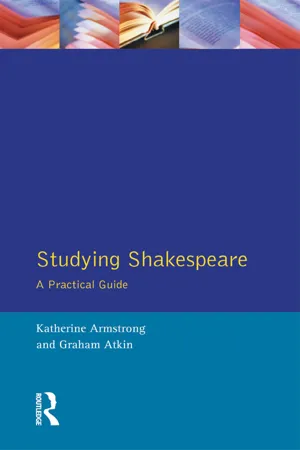
This book is a concise single volume guide to studying Shakespeare, covering practical as well as theoretical issues. The text deals with the major topics on a chapter-by-chapter basis, starting with why we study Shakespeare, through Shakespeare and multimedia, to a final chapter on Shakespeare and Theory. Current trends and recent developments in Shakespearean studies are also discussed, with an emphasis on the contextualisation of Shakespeare, historical appropriations of his work and the debate concerning his place in the literary canon. Extensive reference is made to a variety of developing media, e.g. film, audio cassette, video, CD-Rom and global digital networks, bringing the study of Shakespeare into the twentieth century.
Information
PART I
Basic skills for the Shakespeare student
CHAPTER 1
Why study Shakespeare?
Introduction
To ask why we study Shakespeare is a conventional enough way to open an introductory guide of this kind, but it is a provocative question none the less. A cynical answer might be that we study Shakespeare because we have to: he is compulsory for the majority of students at school in Britain and the United States, and anyone who pursues literature in English at a higher education level will probably find, on graduating, that they have been watching, reading, talking and writing about Shakespeare more or less annually for eight years or longer.
Yet if this explains, it certainly does not justify why we study Shakespeare, and over recent years many commentators have argued that Shakespeare’s pre-eminence in the canon of English literature (the body of classic authors commonly studied at school and college) has more to do with tradition, issues of national identity and ideological coercion than it has to do with his intrinsic literary merit.
It is the chief purpose of this chapter, and indeed this book, to argue that Shakespeare richly deserves his unrivalled place in the curriculum, since to us the most compelling answer to the question, ‘Why study Shakespeare?’ is that we benefit immeasurably from doing so. Pleasure is one such benefit – the majority of students like studying Shakespeare and are enriched by the experience – and instruction another – through studying Shakespeare we learn about society, the ways individuals behave, language, and so on, and also develop our skills of critical analysis and expression.
But before exploring in greater depth these reasons we ought to consider the argument, frequently proposed in recent years, that we study Shakespeare merely because students have always done so, at least since the birth of English as an academic discipline. No book on Shakespeare published today can afford to ignore the fierce, if sporadic, debate about his canonical status which academics, critics and directors have been conducting since the 1980s. Numerous critical books and articles have dealt with the issues arising from this controversy, and it received a wider airing in the 1994 Shakespeare season (‘Bard on the Box’) on television. Though the canon of English literature has been much discussed and attacked in recent years, Shakespeare’s place in it has provoked particularly intense discussion amongst those responsible for the teaching of English in schools and universities in Britain and, to a lesser extent, North America. The first part of this section will try to explain why so much energy has been expended on this issue.
The Shakespeare debate
The issue boils down to politics: for every traditionalist who insists that all fourteen-year-olds should study at least one Shakespeare play, there are scores of educationalists and critics who argue that the teaching of Shakespeare has more to do with ideology than literature. To these commentators, Shakespeare has been foisted on us by a reactionary educational and political establishment determined to safeguard its values and traditions.
This may sound extreme, yet it is undoubtedly true that politicians and other public figures have at times used Shakespeare for dubious ends, and professional teachers of English have naturally resented their doing so. To take one example, John Redwood, formerly Minister for Wales, used Shakespeare’s history plays to defend Anglo-Welsh unity following the pit closures in South Wales, on the obscure grounds that ‘Glyndwr in Henry IV [Part 1] bridged the two cultures by speaking both Welsh and English’.1 More notoriously, Nigel Lawson, formerly Chancellor of the Exchequer, quoted from Troilus and Cressida in his autobiography, using Ulysses’ disquisition on the need for social hierarchies to defend the economic policy of the Thatcher government.2 And the tendency to use Shakespeare rhetorically has not been confined to politicians: the Prince of Wales, for instance, has repeatedly promoted Shakespeare as a key element in the shaping of British national identity.3
These are instances of overt ideological appropriation, and are ultimately, perhaps, of limited significance, but some have argued that Shakespeare’s very place in the curriculum is a question of politics. As the American critic John Bender observes, for certain left-wing British academics:
the stress on Shakespeare goes beyond any question of residual aesthetic admiration to become a contest with established ideology (and especially with Thatcherism) over the significance of a playwright at once deeply embedded in the British system of education and central to an outworn and delusionary nationalism.4
It is easy to take for granted the terms of a debate which has been continuing for some years, and it is as well to remind ourselves of the reasons for the deadlock between the political left and right over Shakespeare. In brief, those who defend Shakespeare’s unique status in the literary canon are driven by the conviction that studying Shakespeare is vital to the moral and spiritual development of the student, and they subscribe implicitly to the view that a universal knowledge of his work will be conducive to social cohesiveness and a common pride in Britain’s national heritage. Their opponents, however, feel that this agenda is politically indefensible and misguided, if not indeed disingenuous, in its underlying claim that Shakespeare’s appeal is universal, transcendent and ahistorical. In a pluralistic, multicultural society it can seem inappropriate to insist that all students study the work of a long-dead, white male playwright, even if room is made for other writers who speak more obviously to the concerns of our times.
Most famously, Jonathan Dollimore and Alan Sinfield prefaced their influential volume Political Shakespeare, first published in 1985, with a trenchant discussion of the institutional uses to which Shakespeare has been put in the last four hundred years, concluding that the plays can only be understood in relation to the sociopolitical contexts of their production. According to Dollimore and Sinfield, who describe themselves as cultural materialist critics, we should be seeking not to uncover an intrinsic meaning in Shakespeare, but to understand the conditions which have determined his interpretation by successive generations. They conclude their preface with the following declaration:
cultural materialism does not pretend to neutrality. It knows that no cultural practice is ever without political significance – not the production of King Lear at the Globe, or at the Barbican, or as a text in a school, popular or learned edition, or in literary criticism, or in the present volume. Cultural materialism does not, like much established literary criticism, attempt to mystify its perspective as the natural, obvious or right interpretation of an allegedly given textual fact. On the contrary, it registers its commitment to the transformation of a social order which exploits people on grounds of race, gender and class.5
To the dismay of one traditional critic, M. C. Bradbrook, who asked if Shakespeare himself had been completely lost sight of in Political Shakespeare, another materialist critic, Graham Holderness, pointed out that there is no immanent, inviolable Shakespeare, only a series of readings of him.
In the eyes of many left-wing participants in the controversy, Shakespeare has been particularly susceptible to co-option by the forces of reaction. As Holderness puts it, he ‘functions in contemporary culture as an ideological framework for containing consensus and for sustaining myths of unity, integration and harmony in the cultural superstructures of a divided and fractured society’.6 This argument is a tendentious one, and we can only determine its validity by exploring in specific terms how such ideological functions might be carried out.
An obvious starting-point might be to scrutinize the ways in which examination papers implicitly encourage students to think and write about Shakespeare. Alan Sinfield has written eloquently on the uses and abuses of Shakespeare by GCSE and A-level examination boards, arguing that the overwhelming majority of exam questions require the candidate to respond to Shakespeare in a spirit of humanistic celebration: ‘Almost invariably it is assumed that the plays reveal universal “human” values and qualities and that they are self-contained and coherent entities; and the activity of criticism in producing these assumptions is effaced.’7 Through a multitude of examples Sinfield demonstrates that the teaching of Shakespeare in post-war British schools has been subtly coercive. His argument may seem initially unpalatable to those readers, myself included, who were trained to think of Shakespeare as ‘not of an age but for all time’,8 and innocent of any bias, least of all political. Yet it was confirmed for me only recently by the candid responses of a class of mature women students to whom I was explaining the cultural materialist critique of Shakespeare’s place in the literary canon. A number of the students admitted that they had never liked Shakespeare at school and had deeply resented his attitude to women; they also said that they had never articulated these feelings on the assumption that any attempt to criticize ‘the Bard’ would be penalized.
Once such responses are voiced and discussed, the class becomes theorized in the sense that the Shakespeare text is being approached not as an autonomous, historically transcendent artefact, but as a product of cultural forces, past and present. Cultural materialists and feminists are not necessarily opposed to studying Shakespeare per se, but they wish to question the ways in which he is typically taught and studied. As well as critiquing his patriarchal bias, they have, for example, pointed to his patriotic representations of the Plantaganet, Tudor and Stuart kings in the history plays, and argued that his popularity continues to rest, in part, on his appeal to English nationalism. Plays about Agincourt and Bosworth Field still have emotional power in a country increasingly devoted to its past. We hanker after ‘Tudorbethan’ homes for our families; county councils continue to use the red and white roses to symbolize Lancashire and Yorkshire; and Henry V was being used for nationalistic purposes as recently as 1975, according to those who have suggested that its performance by the Royal Shakespeare Company at the time of the first oil crisis was suspiciously opportunistic.9 And Shakespeare did more than appear to paint a flattering portrait of Tudor and Stuart power; many of his plays evoke a lost world of folklore and festivals, and have contributed greatly to the sentimental idea of a ‘Merrie England’ which is supposed to have existed prior to industrialization.
Whereas traditional critics try to divorce literature and education from ideology, the materialists regard them as inextricably intertwined. For the traditional critic Shakespeare is vital as a means of testing the ability of students to respond sensitively and intelligently to literature. Cultural materialists would object first, that other authors could serve the same purpose, and second, that what constitutes a sensitive and intelligent response to literature is not a given; rather, it is defined in particular ways by particular cultures and historical periods.
Of course, to say that some of Shakespeare’s advocates admire him for elitist, or politically questionable, reasons, or for no good reason at all, is not necessarily to imply that he should be removed from the syllabus or relegated to a lower league in the literary tables. He may still be worth studying, even if we recognize that he has sometimes been studied for the wrong reasons. Having said this, I would agree that unacknowledged factors have been far too influential in creating an institutional culture of ‘Bardolatry’. For some, Shakespeare is almost a cultural icon, a figurehead of Britain’s national identity. Shakespeare remains compulsory in the Key Stage 3 ‘SATs’ examination, and each summer for the past several years the broadsheet newspapers have run articles discussing the advantages and limitations of studying Shakespeare for all secondary school pupils irrespective of their ability. For some his difficulty for the modern reader is perversely what makes his study seem essential for fourteen-year-olds.
The ‘Shakespeare Debate’ looks set to continue, given that Shakespeare retains much of his former importance in the syllabus, even as educators, critics and students become increasingly sophisticated in their understanding of how his mythological status has been created and maintained. Given the nature of degree study, students are increasingly likely to participate in the Shakespeare debate themselves: many will find themselves taking a course in Shakespearean drama alongside theory courses which question the basis of the traditional literary canon. Shakespeare remains one of the ‘Top Ten’ authors studied in the English departments of colleges and universities in Britain even as the number of books which query the value of ‘Dead White European Male’ authors proliferate and as applications from finalists to undertake postgraduate research on early modern literature slow to the barest trickle.
And, of course, new critical approaches to the study of Shakespeare such as feminism and cultural materialism reflect a wider cultural shift; there is less interest in other canonical authors amongst students now than there was fifteen or even five years ago. In 1992 the Guardian reported the findings of the Consortium for Col...
Table of contents
- Cover
- Half Title
- Title Page
- Copyright Page
- Dedication
- Table of Contents
- A note on texts
- Preface
- Part I Basic skills for the Shakespeare student
- Part II Studying Shakespeare in depth
- Conclusion
- Appendix
- Index
Trusted by 375,005 students
Access to over 1.5 million titles for a fair monthly price.
Study more efficiently using our study tools.
Frequently asked questions
Yes, you can cancel anytime from the Subscription tab in your account settings on the Perlego website. Your subscription will stay active until the end of your current billing period. Learn how to cancel your subscription
No, books cannot be downloaded as external files, such as PDFs, for use outside of Perlego. However, you can download books within the Perlego app for offline reading on mobile or tablet. Learn how to download books offline
Perlego offers two plans: Essential and Complete
- Essential is ideal for learners and professionals who enjoy exploring a wide range of subjects. Access the Essential Library with 800,000+ trusted titles and best-sellers across business, personal growth, and the humanities. Includes unlimited reading time and Standard Read Aloud voice.
- Complete: Perfect for advanced learners and researchers needing full, unrestricted access. Unlock 1.5M+ books across hundreds of subjects, including academic and specialized titles. The Complete Plan also includes advanced features like Premium Read Aloud and Research Assistant.
We are an online textbook subscription service, where you can get access to an entire online library for less than the price of a single book per month. With over 1.5 million books across 990+ topics, we’ve got you covered! Learn about our mission
Look out for the read-aloud symbol on your next book to see if you can listen to it. The read-aloud tool reads text aloud for you, highlighting the text as it is being read. You can pause it, speed it up and slow it down. Learn more about Read Aloud
Yes! You can use the Perlego app on both iOS and Android devices to read anytime, anywhere — even offline. Perfect for commutes or when you’re on the go.
Please note we cannot support devices running on iOS 13 and Android 7 or earlier. Learn more about using the app
Please note we cannot support devices running on iOS 13 and Android 7 or earlier. Learn more about using the app
Yes, you can access Studying Shakespeare by Katherine Armstrong,Graham Atkin in PDF and/or ePUB format, as well as other popular books in Literature & Shakespeare Drama. We have over 1.5 million books available in our catalogue for you to explore.