eBook - ePub
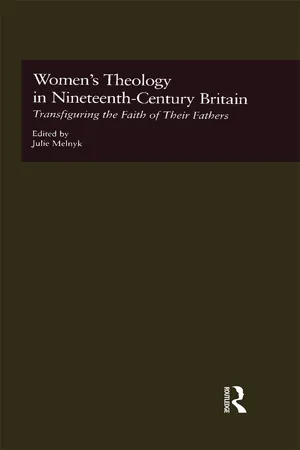
Women's Theology in Nineteenth-Century Britain
Transfiguring the Faith of Their Fathers
- 264 pages
- English
- ePUB (mobile friendly)
- Available on iOS & Android
eBook - ePub
About this book
First published in 1998. This collection of original essays identifies and analyzes 19th-century women's theological thought in all its diversity, demonstrating the ways that women revised, subverted, or rejected elements of masculine theology in creating theologies of their own. While women's religion has been widely studied, this is the only collection of essays that examines 19th-century women's theology as such
A substantial introduction clarifies the relationships between religion and theology and discusses the barriers to women's participation in theological discourse as well as the ways women overcame or avoided these barriers. The essays analyze theological ideas in a variety of genres. The first group of essays discusses women's nonfiction prose, including women's devotional writings on the Apocalypse; devotional prose by Christina Rossetti and its similarities to the work of Hildegard von Bingen; periodical prose by Anna Jameson and Julia Wedgwood; and the letters of Harriet and Jemima Newman, sisters of John Henry Newman. Other essays examine the novel, presenting analysis of the theologies of novelists Emma Jane Worboise, Charlotte M. Yonge, and Mary Arnold Ward. Further essays discuss the theological ideas of two purity reformers, Josephine Butler and Ellice Hopkins, while the final essays move beyond Victorian Christianity to examine spiritualist and Buddhist theology by women
This collection will be important to students and scholars interested in Victorian culture and ideas-literary critics, historians, and theologians-and particularly to those in women's studies and religious studies.
Information
Women’s Theology and Nonfiction Prose
Envisioning Equality, Asserting Authority:
Women’s Devotional Writings on the Apocalypse, 1845-1900
Robert M. Kachur University of Massachusetts, Lowell
I am lost in the profound wisdom of God in [the book of Revelation's] constitution, that to some it should be an open page, and to others a sealed book. -- The Orb of Light; or, The Apocalyptic Vision, by a Lady (1860)
To some an open page, to others a sealed book. With that characterization of the biblical Apocalypse, the anonymous "Lady" author of The Orb of Light reveals the key to the last book of the Bible's enduring appeal: the paradox of its being both open and sealed at once. Although "Apocalypse" means "unveiling," the book re-veils even as it reveals. It promises a glimpse into the transcendentally true; but because it seeks to represent spiritual realities for which there is no adequate language, it uses arcane symbols that need to be decoded. No wonder, then, that the Apocalypse1 has been capturing the religious and literary imaginations for centuries: because it wrestles with the unutterable, it abounds in allegory and symbolism whose hermeneutical instability has allowed writers to use the authoritative Word for their own purposes. Reviewing the history of Apocalyptic interpretation during a series of lectures in 1913, University of London professor R.H. Charles lamented the book's subversive potential: the moment people began rejecting the literal sense of the Apocalypse, "the meaning assigned to the text became wholly arbitrary, and each man found in it what each man wished to find" (12).
This is not to say, of course, that the Apocalypse has always been used in similar ways, or even that levels of public interest in it have remained constant. Britons seemed to have been particularly engrossed by the Apocalypse during certain periods; the mid-to-late Victorian era is one of these. As Mary Wilson Carpenter and George P. Landow have documented, "interest in prophetic exposition reached an unprecedented peak of popularity" around 1860 (303). Between 1845 and 1900, British writers published hundreds of commentaries, devotional guides, tracts, sermons and lecture on the Apocalypse -- a flurry of writing about Last Things not seen in Britain since the apocalyptic rise and fall of the Commonwealth two centuries before.2
Even more interesting, a significant number of the Victorians writing about the Apocalypse were women. Although women were officially prohibited from offering original biblical exegesis within the Anglican church and most Dissenting congregations during the nineteenth century,3 they published at least two kinds of prose intended to illuminate the Apocalypse: adaptations of Apocalyptic exegesis done by men, simplified for laypeople and children, and the ecclesiastically sanctioned form of "devotional meditations" on the Apocalypse.4 In defining "devotional meditations" I follow theological historian Margaret R. Miles in referring to "manuals of instruction in the practice of Christianity" which "do not often argue theological issues; the advice they give is usually concerned with changing their readers' behavior" (2). Thus, women's texts of the Apocalypse were by definition supposed to be unremarkable echoes of men's texts -- translations of what the last book of the Bible means, or suggestions of how those already established meanings should affect one's domestic affairs and private worship.
No less than thirty such pieces of women's non-fiction prose on the Apocalypse written during the second half of the nineteenth century have been preserved in the British Library alone. These texts reinforce what a variety of contemporary sources (from articles in the London Times to the private correspondence of the young George Eliot) suggest: that women writing biblically-centered texts during the mid- to late-Victorian era were indeed drawn to the Apocalypse in significant numbers.5 In some cases, this fascination with the Apocalypse among female Christian writers is mentioned in these texts themselves. In her opening "Advertisement" to The Sevenfold Book (1853), Catherine Gauntlett refers to the surprising number of women engaged with the Apocalypse:
Since the commencement of this little work, some others on the same subjects have been published; but the author nevertheless ventures to send it out, with the hope that, by the blessing of God, it may not wholly miss its design. The successive, and almost simultaneous, issue of volumes on the Apocalypse, may be regarded as a providential direction to a more general, systematic, and diligent study of the book itself. (iii)
In addition to testifying to the increased number of women writing "little works" on the Apocalypse such as her own, Gauntlett -- whose text is a simplified adaptation of clergymen's exegesis -- provides a record of the perceived characteristics of women's religious writing as a whole: "These hints on the Revelation were begun with the design of aiding young enquirers in the study of this divine book; and of making it plain to a class of readers, who have not time for lengthy volumes, or works of research and controversy" (iii). According to Gauntlett, women's religious writing does not put forth an argument: it "hints" at possibilities. It is written for "a class of readers" which include the young and those inexperienced at Bible reading. It includes neither "research" nor "controversy."
In this essay, I challenge these widely held assumptions about Victorian women's religious texts in order to make a more specific argument about the function of women's devotional texts on the Apocalypse. I seek to demonstrate that female devotional authors -- unlike Gauntlett and other women who attempted to write faithful adaptations of men's exegesis -- were attracted to the Apocalypse precisely because it allowed them to begin to articulate arguments with controversial implications. Within their devotional prose, in other words, these women do, indeed, try their hand at original biblical exegesis. Furthermore, their interpretations of the Apocalypse make explicit what is implicit in their very choice to become exegetes: that Christian women should be repositioned as authoritative readers, writers, and speakers within the church and within society at large.
Before examining how exactly these writers use the Apocalypse to critique gender ideology, the larger question of why these women were drawn to the Apocalypse at all must be addressed. As feminist biblical scholars such as Tina Pippin and Adela Yarbro Collins have pointed out, the Apocalypse is in some ways an especially misogynist biblical text. In its narrative, the two vilified female figures, Jezebel of Revelation 2 and the Whore of Babylon of Revelation 17-18, are killed; the Whore is, additionally, stripped, burned and eaten. Even the book's two "good" female figures, the Woman Clothed with the Sun of Revelation 12 and the Bride of Revelation 21, are marginalized by ultimately being excluded from the narrative in important ways.6 While some feminist biblical scholars, such as Elisabeth Schussler Fiorenza, take issue with Pippin's contention that the Apocalypse is too inherently misogynist to be recuperated for women, all agree that it at least seems to reinforce unacceptable gender assumptions -- not the least of which is the representation of women as either saints or whores, a dichotomy which met with widespread acceptance during the mid- to late-Victorian era. Why then women's attraction to the Apocalypse as a resource for making critiques of gender ideology during the latter half of the nineteenth century?
In this essay I will attempt to show that it is the Apocalypse's fantastic, controversial allegory and its utopic vision of the New Earth that enabled women to make critiques of gender ideology -- and to cloak those critiques within a veil of orthodox respectability which would allow them to be published and read.
Although all books of the Bible have been subject to multiple interpretations, the Apocalypse's bizarre, dreamlike quality has generated an especially large number of conflicting interpretations and the greatest amount of controversy since its inclusion in the canon.7 Even the voluminous Catholic Encyclopedia laments that "[it] would be alike wearisome and useless to enumerate even the more prominent applications made of the Apocalypse" (598). Thus for women writers who were prohibited from doing straight biblical exegesis, the Apocalypse's open-ended quality made it easier, rather than more difficult, to interpret than other books of the Bible. Because there had not typically been "one" overarching interpretation of the Apocalypse accepted as orthodox within the Christian community, women who would otherwise not be allowed to publish biblical exegesis would be allowed -- indeed, required -- to make explicit exegetical choices when writing about the last book of the Bible. Unlike New Testament books not dominated by controversial allegory, in other words, the Apocalypse is so radically open-ended that to write about it is to interpret it.
Women writing devotional texts on the Apocalypse between 1845 and 1900 were, in fact, exegetes who developed their own hermeneutic -- one interpreting religious allegory in terms of the female reader-exegete's immediate circumstances and response. Using this exegetical approach, women used Apocalyptic allegory to envision new possibilities for themselves. Despite devotional texts' marginalization as "feminine" and "practical" within the larger body of "serious" exegesis on the Apocalypse, their generic conventions more easily allowed women to position female experience as a source of authority, as well as to articulate desires for equality within the Christian community. In addition to the freeplay of meaning afforded by its allegory, the Apocalypse provided women writers with a provocative glimpse of the utopic afterlife that loomed so large in Victorian imaginations, but is rarely and usually only fleetingly described in the Bible. The New Jerusalem's close identification with the Bride of Revelation has led to its construction in various eras as a distinctly "feminine" place (Pippin 35). Furthermore, its emphasis on the redeemed's unification as one body under God provided a way for women (much as it had done for Socialists of both sexes)8 to justify their vision of an egalitarian community. Ultimately, this essay seeks to show that this group of devotional writers, producing texts over a span of fifty years, represents a significant movement anticipating twentieth-century attempts to construct a biblical feminism. The pages that follow examine the writings of women speaking through the Apocalypse to articulate an authoritative, yet "orthodox," Christian female voice.
It is important to emphasize here that the progressive devotional writers discussed in this essay were not revolutionaries. Although their entry into original biblical exegesis is in itself a critique of contemporary gender ideology, they do not typically announce it as such. Nor do they often call special attention to the feminist implications of their exegesis. Instead, these writers clearly seek to remain "orthodox" Christians; rather than breaking with Christian orthodoxy, they try to inscribe their feminist impulses into it.
This complicity with established church systems distinguishes these writers in an important way from the more radical "Apocalyptic" feminists of the early nineteenth century, whose Socialist activities Barbara Taylor details in Eve and the New Jerusalem. Those who did interpret Socialism within the framework of Christian eschatology -- "Mother Ann" Lee, Mary Evans, Luckie Buchan, Sarah Flaxmer and Joanna Southcott, to name the most prominent -- were anything but orthodox. Their radical, heretical belief that Christ was ushering in a new egalitarian world order through female messiahs fashioned after the Apocalypse's Bride and Woman Clothed with the Sun obviously placed an insurmountable gulf between them and established Christian churches. Like bright burning flames, these highly visible feminist messiahs made an intense impression on small groups of people outside established churches for a short period of time.9
By contrast, the Apocalyptic writers being examined in this study were like smouldering coals emitting more heat than light: they sought to change the way their Christian readers felt about women, slowly, without making their feminist impulses too overtly visible. Although these writers do not directly condemn the heresies of the earlier Apocalyptic feminists, the fact that the only women in recent history who had attempted to use the Apocalypse to make feminist claims were infidels and heretics surely discouraged them from explicitly calling attention to the controversial implications of their claims. The devotional writers examined here, in fact, uniformly avoided all labels that were considered incompatible with Christianity within the established churches, even when the label might have been somewhat accurate. A number of these writers for example, envision not merely egalitarian, but socialist-sounding utopic societies, yet roundly condemn Socialism as an infidelity-breeding evil. This inconsistency makes sense if we consider that their project was to construct a biblical feminist theology that would not be associated with fringe radical movement (Socialism, female messianism and the like) but mainline Christianity itself - a theology that could not be dismissed by the majority of Christians as heterodox and peripheral. To do this, they had to do away with labels that, in Mikhail Bakhtin's words, had become "already enveloped in an obscuring mist...of alien value judgments and accents" (276). Indeed, although attempts to envision a Christian feminism date back at least to Hildegard of Bingen and other medieval writers,10 these Victorian writers are distinctive precisely because they articulate such sentiments while remaining "ordinary" Christian women writing from respectable positions within mainline churches. The attention roused by visionary abbesses like Julian of Norwich or messiahs like Joanna Southcott would defeat their larger purpose. In order to make universal claims for Christian women, their personas, their callings, and their abilities must appear unremarkable...
Table of contents
- Cover
- Half Title
- Series Title
- Title
- Copyright
- Dedication
- Contents
- Acknowledgments
- Introduction
- Women's Theology and Nonfiction Prose
- Women's Theology and the Novel
- Reformers Write
- Beyond Victorian Christianity
- Contributors
- Index
Trusted by 375,005 students
Access to over 1.5 million titles for a fair monthly price.
Study more efficiently using our study tools.
Frequently asked questions
Yes, you can cancel anytime from the Subscription tab in your account settings on the Perlego website. Your subscription will stay active until the end of your current billing period. Learn how to cancel your subscription
No, books cannot be downloaded as external files, such as PDFs, for use outside of Perlego. However, you can download books within the Perlego app for offline reading on mobile or tablet. Learn how to download books offline
Perlego offers two plans: Essential and Complete
- Essential is ideal for learners and professionals who enjoy exploring a wide range of subjects. Access the Essential Library with 800,000+ trusted titles and best-sellers across business, personal growth, and the humanities. Includes unlimited reading time and Standard Read Aloud voice.
- Complete: Perfect for advanced learners and researchers needing full, unrestricted access. Unlock 1.5M+ books across hundreds of subjects, including academic and specialized titles. The Complete Plan also includes advanced features like Premium Read Aloud and Research Assistant.
We are an online textbook subscription service, where you can get access to an entire online library for less than the price of a single book per month. With over 1.5 million books across 990+ topics, we’ve got you covered! Learn about our mission
Look out for the read-aloud symbol on your next book to see if you can listen to it. The read-aloud tool reads text aloud for you, highlighting the text as it is being read. You can pause it, speed it up and slow it down. Learn more about Read Aloud
Yes! You can use the Perlego app on both iOS and Android devices to read anytime, anywhere — even offline. Perfect for commutes or when you’re on the go.
Please note we cannot support devices running on iOS 13 and Android 7 or earlier. Learn more about using the app
Please note we cannot support devices running on iOS 13 and Android 7 or earlier. Learn more about using the app
Yes, you can access Women's Theology in Nineteenth-Century Britain by Julie Melnyk in PDF and/or ePUB format, as well as other popular books in Literature & 19th Century History. We have over 1.5 million books available in our catalogue for you to explore.